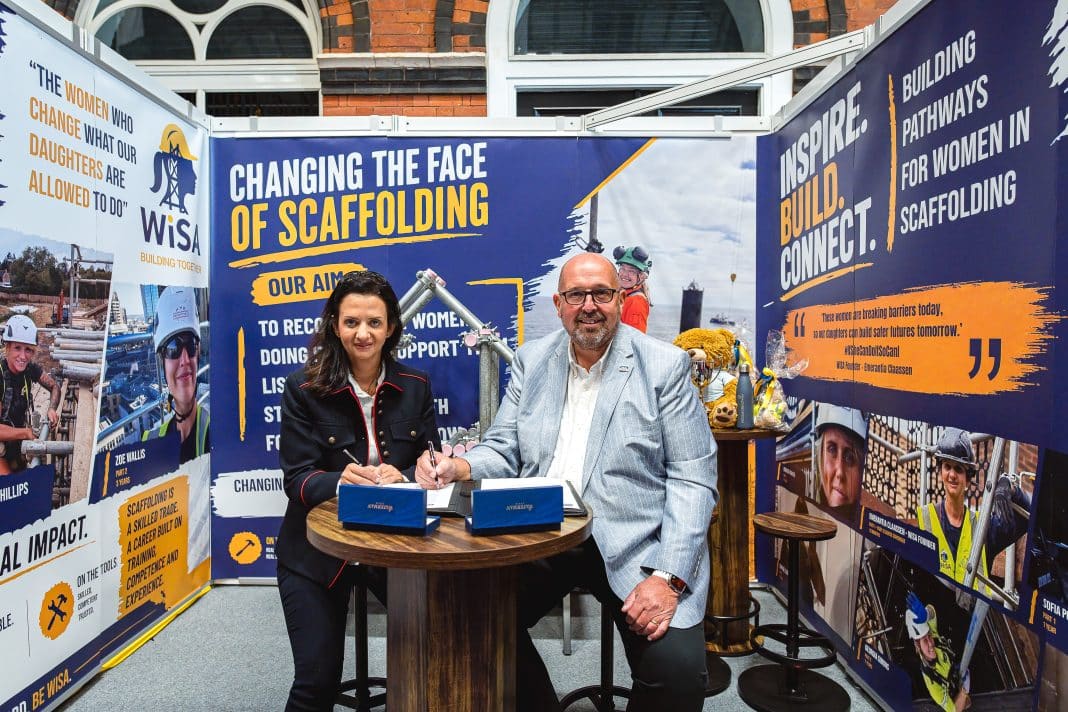
The National Access & Scaffolding Confederation (NASC) and Women in Scaffolding Association (WiSA) have signed a Memorandum of Understanding setting out plans to work together on workforce development and increasing the number of women entering and progressing through the scaffolding sector.
The agreement was signed at ScaffEx26 in Manchester by NASC Group CEO Clive Dickin and WiSA founder and director Emerantia Claassen.
Under the MOU, the two organisations will work together on recruitment, retention, career progression, mentoring and professional development.
They also plan to share industry knowledge and take part in joint events, forums and other industry activities.
Clive Dickin said the industry needed to draw talent from a wider pool as it deals with skills shortages.
“The scaffolding and access industry needs skilled people across every part of the sector, and addressing those skills shortages means making sure we are attracting talent from the widest possible pool,” he said.
“We need more initiatives that encourage women to see scaffolding as a genuine, rewarding career, whether that is on the tools, in design and engineering, health and safety, training, management or leadership.”
Dickin said working with WiSA would give NASC a route to turn those aims into practical activity.
WiSA, which is still in the early stages of its development, will focus on workforce engagement, mentoring, outreach and industry representation as part of the partnership.
Emerantia Claassen said: “WiSA is still at a very early stage in its journey, and the opportunity to work alongside NASC means a great deal to us.
“We are extremely happy with the objectives and the spirit of the MOU and what it represents for women in our industry.
“By working collaboratively, we can create more opportunities for women to enter scaffolding, build their careers and see a long-term future for themselves within the sector.”
NASC will contribute its technical and training knowledge, competence frameworks and links with contractors, training providers and other industry organisations.
The two organisations will initially meet every quarter to develop the programme and review progress. The MOU itself will be formally reviewed every two years.