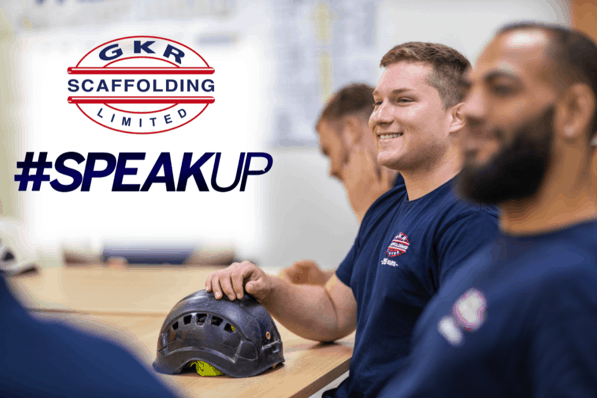
At an industry event this month marking the company’s 25 years in business, GKR Scaffolding made a call to some of construction’s largest contractors to join their movement to change the blame culture that is stifling progress in our industry.
Citing research from Harvard Professor, Amy Edmondson and also Google’s Project Aristotle which investigated team performance in high-risk and innovative industries, GKR highlighted why psychological safety builds high-performance teams.
GKR defines psychological safety as creating an environment of trust where everyone feels comfortable discussing mistakes, asking for help and sharing ideas without fear of reprisals.
Edmondson’s and Google’s research proves that high performing teams record-making more mistakes, creating a learning cycle for continuous improvement. Although this has obvious implications for improving safety, there are also benefits to productivity and innovation due to the openly sharing ideas.
The non-operational by-product of this is an improvement in mental wellbeing due to staff feeling included and not working in a culture of fear, but it also aids diversity. Diverse workforces need psychological safety to create genuine inclusion.
The business will be launching their #SpeakUp campaign internally in November based on their research into what makes people work safer, to a high technical quality and supports general wellbeing, whilst still driving people to work to extremely high standards.
Workshops will run through the GKR Academy for all employees responsible for managing others both on-site and in offices. These workshops will simulate situations to highlight the benefits of building psychological safety into modern management styles as well as covering the tools and techniques to drive this.
It is also integrated within staff communications sessions, appraisals and objectives, as well as promoted via the Share-Learn-Improve reporting process used by staff to highlight near misses and observations of good practice.
Helen Gawor, Business Strategy Director, said:
“We are addressing many challenges within our industry – a need for diversity, being slower to innovate, low productivity and poor mental health. We have historically focussed on these challenges through individual initiatives, but all these initiatives can only succeed if we improve psychological safety.
Our blame culture is the elephant in the room. We want everyone to feel confident about speaking up. This could be to share great ideas and highlighting good practice as well as questioning work that may be wrong or reporting something that is unsafe.”
Peter Cullen, Health & Safety Director, said:
“Principal contractors have the huge task of bringing different businesses with different capabilities and different ways of working together as one team. Because of our legacy blame culture, we stifle learning and create a hero culture based on self-preservation. All because people fear the consequences of mistakes so don’t speak up.
We hypothesise that psychologically safe supply chains will improve project performance, but it needs to be embraced by the principal contractor. We all need to change how we manage our people, communicate with each other and the KPIs used to measure success. Reporting RIDDORS, for example, actively discourages reporting due to the potential consequences faced. This discourages reporting for learning.”
The initiative has been welcomed by industry representatives and GKR will be sharing their learning and resources with contractors to build momentum in removing the blame culture from construction.
GKR believe that #SpeakUp initiatives take behavioural safety to a whole new level, driving culture change to improve productivity, safety, an ability to innovate and the mental wellbeing of our whole industry. Ultimately building the high-performance environment construction needs to create for the future.