The Scaffolding Association Australia (SAA) has launched the first version of its Australian Best Practice Guidelines for Scaffolding, providing the industry with a single reference intended to support safer and more consistent working practices across the country.
The 140-page document has been developed for scaffold contractors, principal contractors, clients, designers, engineers, supervisors, safety professionals, regulators and scaffold users.
It covers the full lifecycle of a scaffold, from initial planning and risk assessment through to design, erection, inspection, use, alteration and dismantling.
SAA said the guidance had been produced to complement Australia’s workplace health and safety legislation, applicable codes of practice, Australian Standards and manufacturers’ instructions, rather than replace them.
The association also makes clear that the document is an industry resource and not a prescriptive legal standard. Users remain responsible for complying with the legislation and regulatory requirements that apply in their own state or territory.
That distinction is significant because Australia’s model Work Health and Safety laws must be adopted by individual jurisdictions before becoming legally binding, and requirements can vary across the country.
The guidelines therefore direct users to check local legislation while using the AS/NZS 1576 series as a benchmark for the design, manufacture and safe use of scaffolding.
Clearer responsibilities across the scaffold lifecycle
Among the central themes is the allocation of responsibilities between the different parties involved in scaffolding work.
The document examines the duties of asset owners, clients, scaffold contractors, designers and users, including the need to communicate site hazards, verify the capacity of supporting structures and manage completed scaffolds during use.
It also addresses situations where several businesses hold overlapping safety duties on the same project.
SAA general manager Erryn O’Brien said the guidance was intended to provide a practical industry reference and improve consistency between those responsible for procuring, designing, building and managing scaffolds.
“The Guidelines have been developed to provide practical, industry-led guidance that complements existing legislation, Australian Standards and manufacturer information,” she said.
“They are intended to support greater consistency across the industry and provide a practical reference for scaffold contractors, principal contractors, engineers, clients, regulators and other stakeholders involved in scaffolding.”
The publication devotes separate sections to compliance and risk management, training and certification, site management, safe erection and dismantling, scaffold components, design documentation and the management of completed structures.
All scaffolding work should be treated as high risk
It also sets out the three Australian High Risk Work Licence categories covering basic, intermediate and advanced scaffolding.
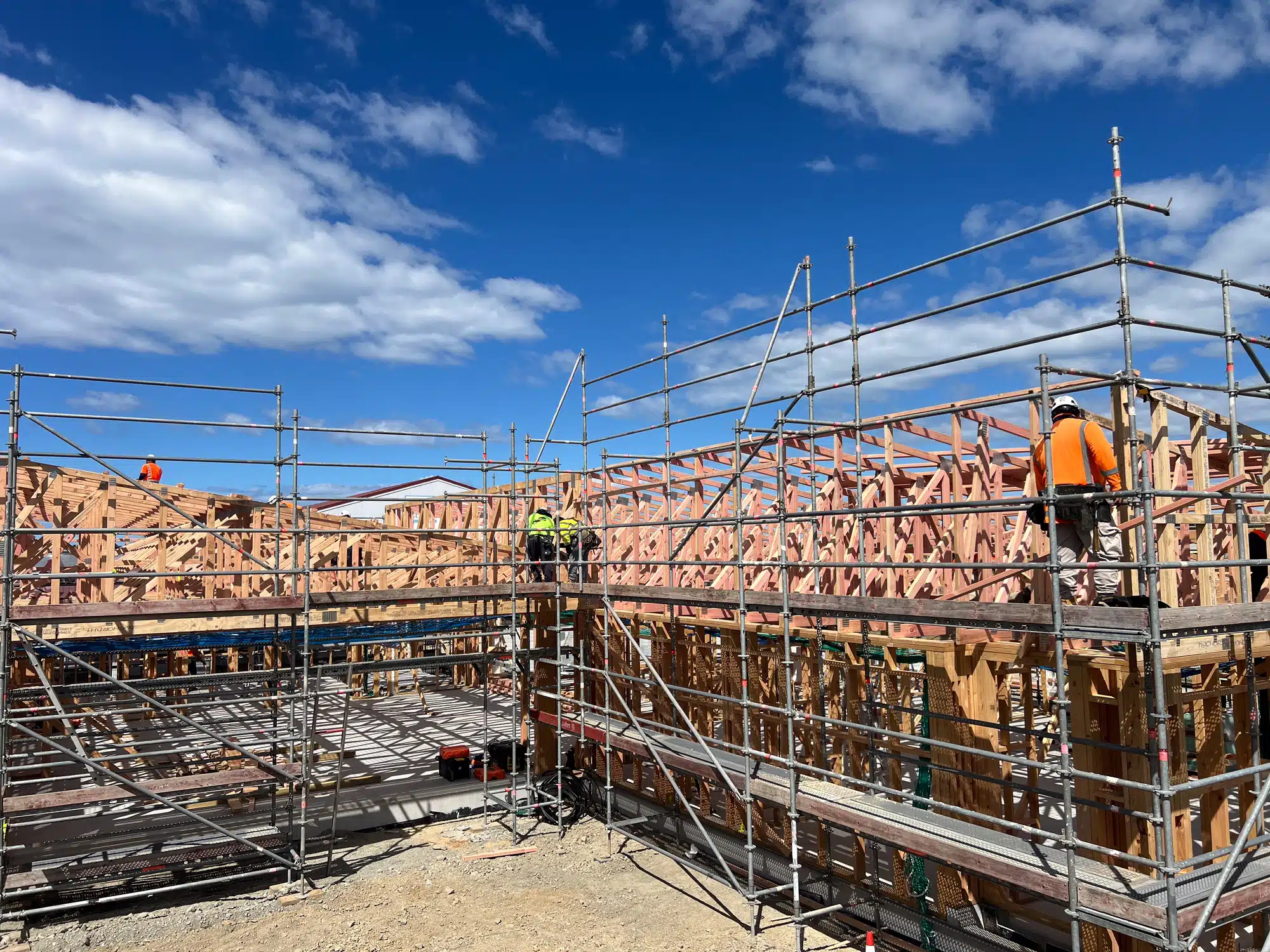
Under Australian legislation, an appropriate licence is required where a person or object could fall four metres or more. However, SAA states in the document that it regards all scaffolding work as high risk, regardless of height, and believes scaffolds should be erected by suitably experienced licensed scaffolders.
The safe erection section describes three recognised approaches: advanced guardrail systems, the progressive or “dummy lift” method, and the tunnelling method.
These are ranked according to the hierarchy of controls, with advanced guardrails identified as an engineering control and the other two methods treated as administrative controls, with fall-arrest equipment required in some circumstances.
Detailed guidance is also provided on bracing, ties, foundations, platform duty ratings, access, containment sheeting and the additional loading created by wind, rain and materials placed on a scaffold.
The design section explains when a scaffold may require engineering input, including structures that fall outside manufacturers’ instructions or the parameters of the relevant Australian Standards.
The guidelines are being made freely available, which SAA said reflected its aim of raising standards beyond its membership.
They will also form the basis of a wider technical framework. Further editions are planned, alongside a series of Technical Guidance Notes being developed by the association’s Technical and Engineering Committee.
O’Brien described the publication as the starting point for a body of guidance that would continue to develop as industry practices and technical requirements evolve.