
Blencowe Makes History with Temporary Roof Scaffold

ADVERTISEMENT

Blencowe Scaffolding ‘leads the way’ after installing the first ever Layher Keder XL roof system on a UK construction project.

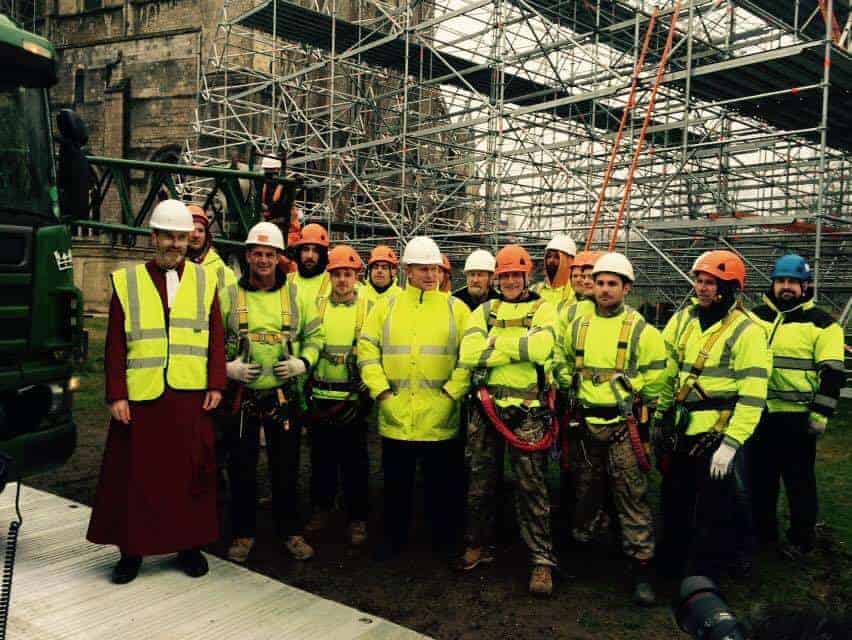
Months of precision planing and a highly skilled team of scaffolders from Blencowe Scaffolding Ltd made history yesterday after successfully installing a 27 tonne temporary roof to the world famous Winchester Cathedral.

Hundreds of spectators from around Winchester witnessed the 300 tonne crane, which is one of the biggest mobile cranes in Britain lift seven prebuilt sections of the Layher Keder XL roof system into place. The ambitious structure will stay in place providing weather protection for the next two years.

blen 101

The temporary roof is believed to be the biggest single scaffolding structure ever to be put on a British Cathedral.

The 11th Century Winchester Cathedral is currently undergoing a £20.5m restoration works program with £4m being spent on major roof repairs. The temporary roof will allow 40 roofers to remove the existing lead, which is broken and leaking. The lead will then be melted down off-site and recast to last another 150 years.

Speaking to ScaffMag Alan Blencowe, of Blencowe Scaffolding said;

“It was a tremendous project to be involved with and it’s been great working closely with Winchester Cathedral’s project management team and Layher UK. We’d like to say a huge thank you to all our scaffolders that were involved in the project and for helping to make it such a success.”

“We hope to undertake more projects of this magnitude in the near future and pleased to announce that we now have a separate division within Blencowe Scaffolding Ltd for Layher scaffolding projects.”

Site Construction Manager Ian Bartlett said;

“As far as we know, this is the first time that this has taken place on a Cathedral in this country. Apart from the complexities of building the framework in the first place, the logistics of working in a relatively tight space at that end of the building to achieve the lift mean that everything has to be planned to the minutest degree.”


Daniel Norton
Daniel NortonFounder & Editorhttps://www.scaffmag.com
Daniel Norton is the founder and editor of Scaffmag and Editor-in-Chief of Scaffold & Access Magazine. A former scaffolder, he founded Scaffmag in 2008 and now leads its news and editorial coverage of the global scaffolding and access industry, including safety, regulation, business, innovation and major industry events.

Most popular ↑

Government announces paternity pay for self-employed dads

Self-employed fathers and partners are to receive two weeks of support under government plans, with payments currently worth up to £194 a week.

Two taken to hospital after Streatham scaffolding collapse

Two people were rescued before firefighters arrived after scaffolding collapsed on Streatham High Road on 25 October. Both were taken to hospital.

Luton plans £11m scaffolding framework

Luton Council is preparing an estimated £11.04m scaffolding framework and will hold a supplier briefing next week ahead of a planned December tender.

Budget 2026: what it means for scaffolding firms

Fuel duty relief, higher minimum wages and apprenticeship measures feature in Budget 2026, as NASC warns investment promises must translate into construction work.

Forty CVs, and one of them is talking to ChatGPT.

Brian Webb examines how hidden instructions in CVs and other documents can influence AI responses, and what scaffold businesses should watch for.

Latest news

Hong Kong plans safety overhaul after Wang Fuk Court fire report

Hong Kong has announced changes to building-renovation oversight following the release of the Wang Fuk Court fire inquiry report, which contains 120 recommendations.
- Advertisement -
More from

Self-employment reforms could shift proof burden onto contractors

Proposed worker-status changes could put the burden of proving genuine self-employment on contractors. A new assessment puts the economy-wide annual net direct cost at £167.8m.

Scaffolding firms face tighter harassment duties from 30 October

Stronger harassment duties and new union-access rules take effect across Great Britain on 30 October, with implications for firms working on client-controlled sites.

Budget 2026: what it means for scaffolding firms

Fuel duty relief, higher minimum wages and apprenticeship measures feature in Budget 2026, as NASC warns investment promises must translate into construction work.

Alimak targets £6m savings as construction profits fall

Alimak sets out SEK80m (about £6m) annual savings target as construction profits fall, while reporting positive UK parts and service demand.
Latest articles