Harsco Infrastructure has provided Self-Climbing Formwork (SCF) which is now helping ensure quick and safe access during the construction of a 320m tall pylon for the world’s longest cable-stayed bridge.
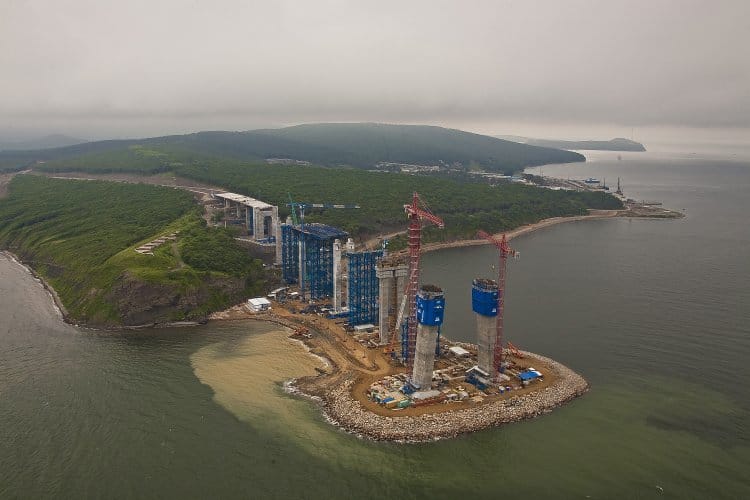
The Harsco solution provides a fully enclosed temporary working environment which protects against extreme weather conditions during construction of the pylon and its 70m tall approach piers, which together form part of the record-breaking Russky Island Bridge at Vladivostok in Russia.
Optimised planning
During the technical planning phase Harsco’s SCF team used their expertise to accelerate the construction schedule and ensure maximum safety, particularly for the two climbing units used on the pylon. This eliminated the need for any time-consuming conversion work and resulted in a formwork and platform solution that is perfectly adapted to the tapering and inclined geometry of the pylon itself.
At the base, this calls for a ground plan of 7.8 x 13 m with a 2 m wall thickness, tapering to 7.1 x 7 m with a 0.7 m wall thickness at the top. The in-depth planning means that only a single work platform has to be removed from the SCF assembly, which is being done during a pre-scheduled break in construction work. All other adjustments and climbing can be carried out safely and without holding up the site work unnecessarily
Seven work levels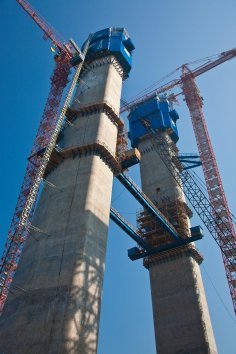
The SCF unit provides seven work levels with a total height of 19 m, with the top two used for upstream steelfixing. As both the external – and unusually also the internal – working platforms are all full-scale, steelfixing can proceed immediately after concrete pouring, thus saving time and increasing safety. On the next two levels, work is carried out on the formwork and the concrete surface can be heated from here if necessary. To accelerate work flow, the formwork level also has separate projecting materials platforms served by a crane.
The three trailing platforms round off the rigid, steel-frame climbing pier production unit. These platforms allow the concrete to be protected from the weather for two complete cycles after pouring, and again, heated if necessary. The result is that the concrete can be protected from the weather for almost three whole weeks after pouring, with any patching work carried out in a heated environment – a huge advantage during extreme winter conditions.
72 climbing cycles
To accommodate the tight construction schedule the system was specifically designed to allow adjustments to the self-climbing formwork, and the 72 climbing cycles of 4.5 m, to be performed quickly. Rigid separation between the steelfixing levels and the shuttering and climbing operations means that once the steelfixing is completed, the formwork can be retracted and cleaned before the climbing shoes are fitted and the climbing rails raised and tied for the next pouring cycle. This allows the SCF platforms to be raised immediately after completion of the steelfixing and the formwork to be moved into its new position ready for the next pour. Once pouring is complete, the steelfixing for the next cycle can begin.
Protection from the elements
To protect men and materials from the severe climate, the self-climbing formwork is fully enclosed, complete with a modular, movable roof. The enclosure ensures risk-free operations, even at extreme heights where the wind forces can be exceptional. It also allows the work chamber to be heated so that the concrete can set or be patched, even with external temperatures of 35O below (Celsius).
The SCF bracket: High load-bearing capacity, a single tying point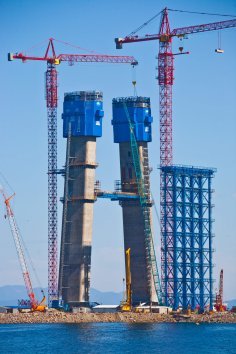
The exceptionally high load-bearing capacity of Harsco’s SCF brackets (150 kN vertically and 100 kN horizontally) is crucial to this project. The pylon’s special geometry and continuous tapering mean that only six of the 22 brackets employed actually climb vertically, with the others climbing at transverse and often changing angles of up to 5% from the vertical. Despite its high load-bearing capacity each SCF bracket requires just a single tie, with installation of the tie cones being a simple task. The cones only need to be positioned at the correct horizontal intervals, and unlike pairs of cones, they do not need to be set at a precisely measured angle. There is therefore no need for elaborate realignment of the bracket to accommodate changes of angle or inaccuracies when setting-up the formwork.
Perfect package
Harsco is providing a formwork foreman and a number of technicians to support the project and ensure that the meticulously planned work processes are followed on site. Along with Harsco’s SCF formwork and various other ancillary services it is providing, this is helping the construction process progress swiftly and safely.
Record-breaker
With its 1,100m central span the 3,100m Russky Island Bridge will ultimately be the world’s longest and tallest cable-stayed bridge. Traversing the Eastern Bosphorus, it will link the far east port of Vladivostok with Russky Island, which belongs to the city. The Russian building contractor, SK MOST, is aiming for a record-breaking construction period of just 43 months so that the bridge’s four-lane road is open in time for the Asia-Pacific Economic Cooperation summit at the end of 2012.
Russky Island Bridge – Data
Bridge deck width (steel structure): 21 m
Headroom under bridge: 70 m
Bridge length: 1,885.53 m
Total bridge length: 3,100 m
Largest span: 1,104 m
Height of bridge pylons: 320.9 m
Budget: €360 million