Researchers have demonstrated an autonomous drone system capable of placing bricks and applying adhesive in mid-air, in a development that could shape future approaches to construction work at height.
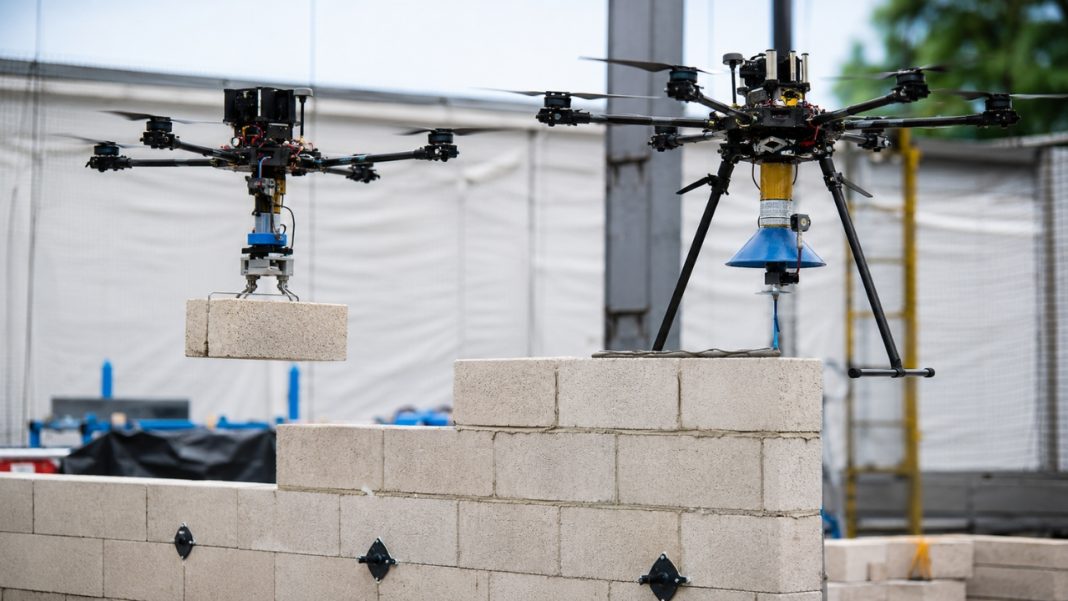
The system uses two unmanned aerial vehicles working together. One drone carries and positions bricks, while a second drone applies bonding material between them.
The research, titled Autonomous Reactive Masonry Construction using Collaborative Heterogeneous Aerial Robots with Experimental Demonstration, was published by Marios-Nektarios Stamatopoulos, Elias Small, Shridhar Velhal, Avijit Banerjee and George Nikolakopoulos.
According to the paper, the system is designed to show how aerial robots could carry out coordinated masonry tasks without direct human control during the construction sequence.
The researchers said the work is, to the best of their knowledge, the first experimental demonstration of fully autonomous aerial masonry construction using different types of drones, with separate aircraft assigned to brick placement and adhesive application.
The brick-carrying drone was fitted with a ball-joint mechanism to improve placement control. It used onboard vision, ArUco markers and pose estimation to align the bricks during the build.
The second drone was fitted with a servo-controlled valve and extruder nozzle to apply adhesive material between the bricks.
The drones were coordinated through a reactive mission planning system, allowing the aircraft to manage task dependencies, respond to feedback and work as part of a single construction process.
The development adds to growing research interest in construction robotics, particularly in areas where drones could move beyond inspection, surveying and progress monitoring into physical site tasks.
However, the technology is not yet ready for use on live construction sites. The demonstration was carried out in a controlled research setting, and several major barriers remain before autonomous aerial masonry could be used commercially.
These include payload limits, battery life, wind conditions, flight stability, site safety, regulation, adhesive performance and the structural requirements of permanent masonry.
For the scaffolding and access sector, the research is unlikely to alter short-term demand for scaffold-based access or skilled masonry work.
Its more immediate relevance is in showing how autonomous systems may eventually support difficult or hazardous tasks at height, particularly in controlled environments where conventional access is complex or costly.
The paper suggests aerial robots could become part of a wider mix of construction technologies, working alongside traditional access methods rather than replacing them outright.
For now, the system remains a research milestone rather than a practical site solution. But it underlines the direction of travel as construction robotics becomes more capable, more specialised and more closely linked to work at height.