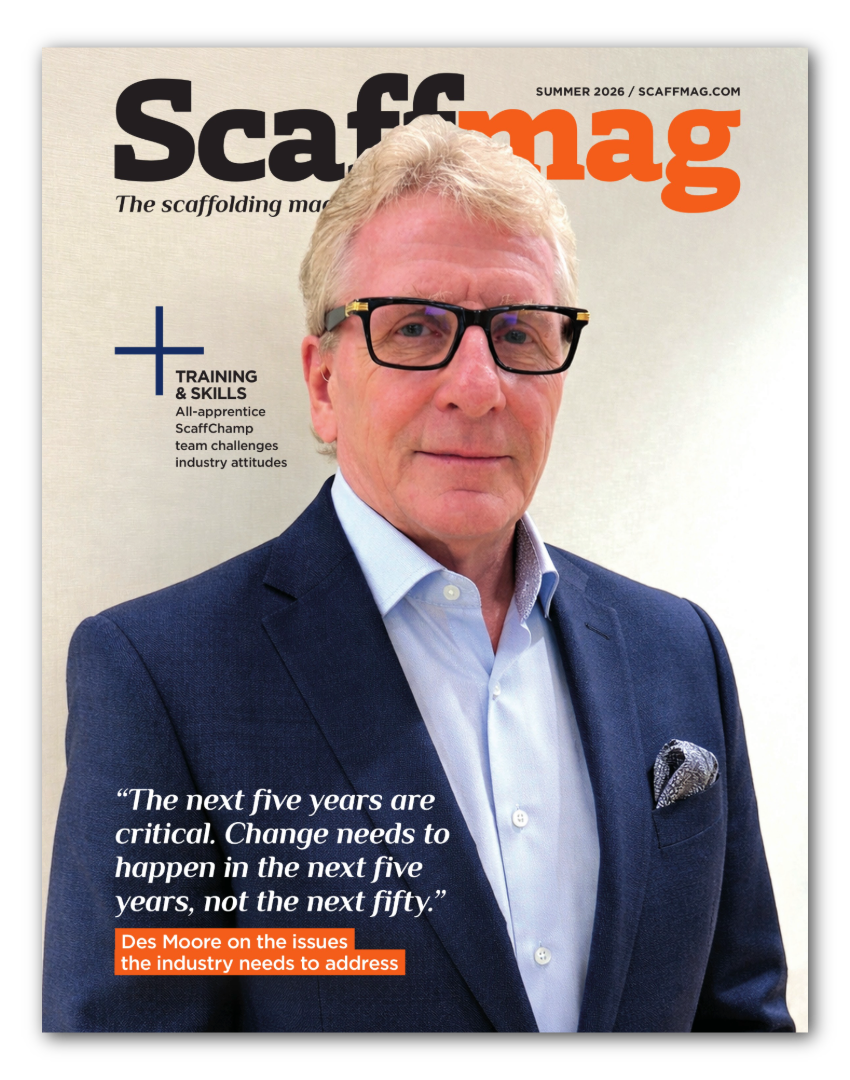

As Des Moore approaches his 70th birthday, he is not interested in nostalgia. After more than 50 years in scaffolding, from the tools to senior management and board-level roles, he is still focused on what comes next. The industry has improved in many ways, he says, but there is still work to do on safety, professionalism, training, leadership and commercial discipline.
Moore started out as a scaffolder in the 1970s, moved through contracts and branch management, led TRAD through a long period of growth, and later served in senior industry roles including as NASC President. Today, through his consultancy firm, MOR1X, he remains active across the sector, advising businesses and working with firms including MR Scaffolding Services, Baton and ULMA
He remains positive about the future. He is also blunt about what scaffolding still gets wrong.
Safety has improved, but standards are still uneven
Health and safety has seen the biggest change of his career. “There has been a significant and necessary improvement in health and safety,” he says. “Scaffolding can be dangerous if safe practices are not adopted.”
Standards on site, though, are still uneven. Thousands of contractors operate across the UK, and the gap between the best-run firms and the rest is too wide. Larger businesses can afford dedicated health and safety support. Smaller firms often cannot. Basic standards still aren’t being applied consistently.
“I walk past sites where there are scaffolders wearing harnesses that are not attached, or who don’t even have a lanyard on the harness. It’s just for show,” Moore says. “That is literally an accident waiting to happen.”
Part of the problem, he argues, is poor communication. Scaffolders get handed long, generic RAMS documents that do little to explain the actual risks of the job in front of them. He wants more direct briefings, led by line managers, with a one-page summary of the main risks on site.
He is also critical of weak near-miss reporting and a lingering macho culture in parts of the industry.
“These are learning moments,” he says. “But there is still not enough guidance on what a near miss looks like and why it matters. We have to move away from that macho image and create a culture where people feel safe.”
The industry still has a perception problem
If safety is a live issue, recruitment sits behind almost every conversation about scaffolding’s future.
Too few young people see the trade as a serious career, Moore says, and that is one of the industry’s biggest long-term problems.
“That’s what happened to me,” he says. “I fell into scaffolding after leaving school with no qualifications. The industry has been incredibly good to me. It gave me opportunities I could not have imagined at the time. But too many young people still don’t see scaffolding as something to aim for.”
The sector has not done enough to present itself as professional, skilled and ambitious. That matters when businesses are trying to attract the next generation, not just of scaffolders but of supervisors, managers, estimators and commercial staff.
There are signs of progress. Some firms are bringing people through in a more structured way. At MR Scaffolding Services, where Moore works with the business on training and development, trainee estimator and surveyor programmes are giving young people a route into the sector beyond the yard gate. Trainees spend time in the yard, in transport and on site before moving into office-based roles. That kind of grounding gives people a proper understanding of how a scaffolding business actually works.
He points to leaders like Rob West at Benchmark Scaffolding and Luis McCarthy at JMAC Group as examples of people raising standards and building a stronger culture in their businesses.
If scaffolding wants better people, it has to look and behave like a profession that values them. That means stronger recruitment, better training, visible career paths and a more serious approach to management.

Four problems keep coming up
The same themes keep surfacing in his work with contractors. Project delays, the wider economy, cash management and pricing.
On delays, Gateway 2 and 3 approvals continue to disrupt larger projects. Firms are left pricing jobs without a clear idea of when work will actually begin, and that uncertainty spills into labour planning, resource allocation and cashflow.
The wider economic picture is no easier. Housebuilding remains under pressure. Confidence and investment are affected. None of that is new to experienced contractors, but it still creates difficult trading conditions for firms trying to plan ahead.
Cash management is the point Moore returns to most often. During his time leading TRAD, cash was never treated as a back-office issue. It was central to how the business was run.
“I could be in a meeting with Mohed Altrad about something completely unrelated and within 15 minutes he would ask me about the cash position,” he says. “He understood how important that was.”
Then there is pricing. Parts of the market continue to quote work too cheaply, often without a real understanding of what makes a job profitable or unprofitable. It damages margins, distorts value and weakens the reputation of the sector.
Better management matters more than most people admit
Many of these problems come back to management.
Too many businesses still lack the basic control systems needed to understand what is happening on jobs. Where money is being made. Where it is being lost. That applies to pricing, labour, transport, materials and planning. It is also why Moore has become a strong supporter of digital tools that help firms get a better grip on operations.
“As someone who is now involved with Baton, I do see the value of technology very clearly,” he says. “What surprises me is how many leaders still do not know which jobs have made money, which have lost money, and why.”
Technology, he argues, should not be seen as a nice extra. It should be used to make better decisions. If a client says a site needs six scaffolders, a well-run business should be able to test that assumption, plan properly, and decide whether four would do the job just as well. That is productivity in practice, a commercial discipline as much as a technical one.
Training has to go beyond the basics
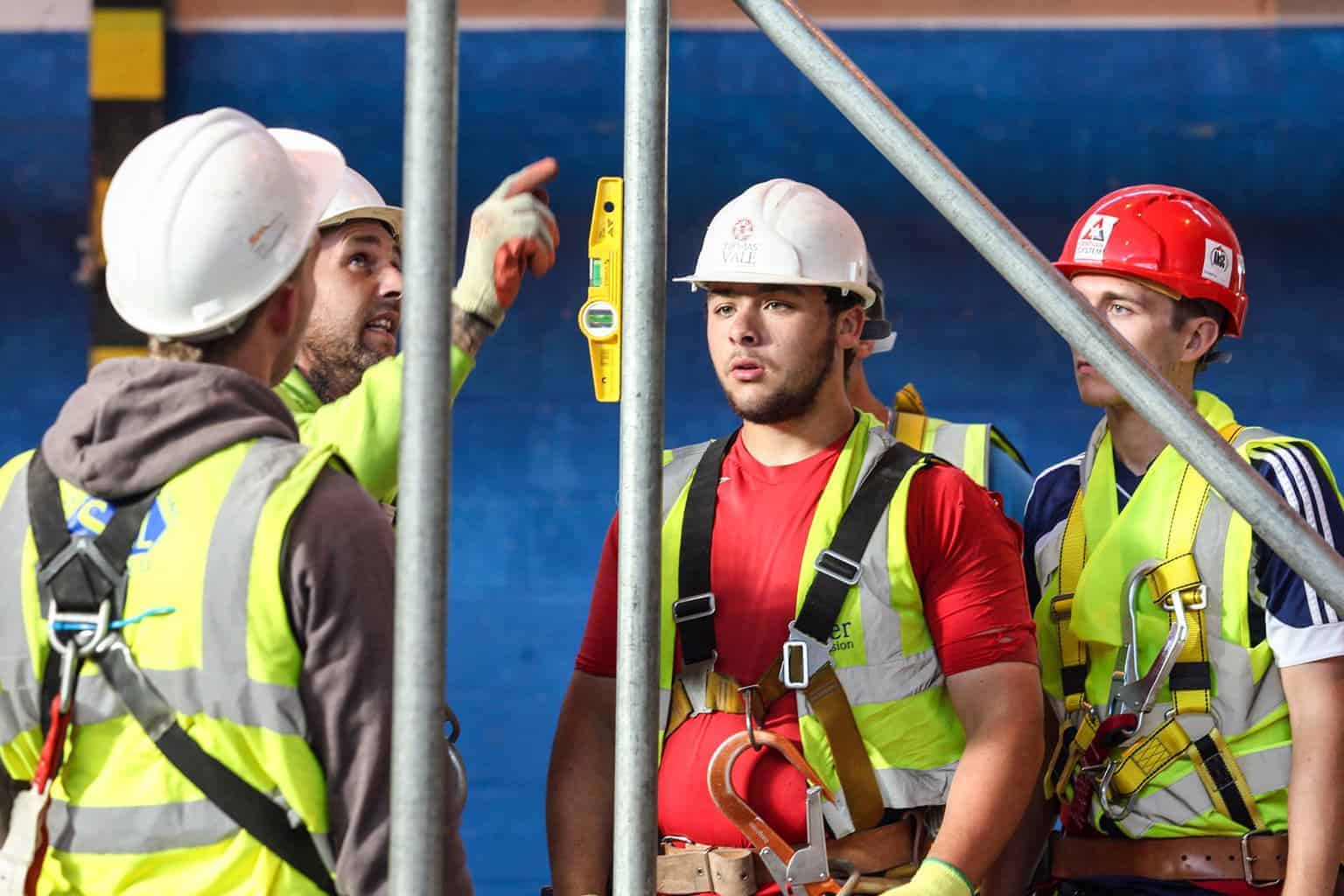
Asked what successful scaffolding businesses will need to do over the next three to five years, Moore comes back first to training. Not just basic site training. Not just apprenticeships. Training across the whole business.
Management training, in particular, is still badly neglected. Business performance often depends more on the quality of managers than on anything else.
“I cannot over-emphasise the importance of training all your staff,” he says. “Managers direct how well, or not, the business performs.”
He still values hands-on leadership and has little patience for managers who run teams from behind a screen. Face-to-face communication matters. Managers need to be visible. They need to understand what is happening in the business at ground level. Emails and WhatsApp groups are no substitute for being present.
He is equally firm on productivity. The industry has tolerated low productivity for too long. Better systems can help measure it, but the bigger shift is cultural. Businesses need to care about it, track it, and manage around it.
Moore also expects system scaffolding to play a bigger role in the years ahead. The initial investment can be high, he accepts, but the long-term return is there for firms that use it properly and understand the commercial case. That thinking sits behind his current work with ULMA as it builds the presence of the BRIO metric system in the UK market.
“The next five years are critical. Change needs to happen in the next five years, not the next fifty.“
The issue, for him, is not just product but support. Manufacturers need to do more than supply equipment and deliver technical training. They also need to help contractors understand how to get better business results from the systems they buy. Some suppliers still fall short on that.
The next five years matter
For all the problems he identifies, Moore is not pessimistic. Scaffolding is full of good businesses, hard-working people, and leaders who care about improving standards. But the sector cannot afford to drift.
It needs to take safety more seriously at every level. It needs to present itself better to new entrants. It needs stronger managers, better pricing, tighter commercial control and more willingness to adopt the tools that improve performance.
Above all, it needs to move now.
“The next five years are critical,” he says. “Change needs to happen in the next five years, not the next fifty.”
After half a century in scaffolding, Moore is still looking ahead. The industry already knows much of what it needs to do. The real question is whether enough businesses are willing to do it.