
Two directors are on trial after a scaffolder was crushed to death in a “long-predicted” church collapse.
A court heard that Jeff Plevey, 56, from Cardiff, died when the derelict Citadel Church in the city, collapsed as he dismantled the scaffolding surrounding it in July 2017.
Stewart Swain director of Swain Scaffolding Ltd and Keith Young director of Young Contractors, the demolition firm working on the church are accused of gross negligence manslaughter.
Both directors deny the charges at the trial being held at Swansea Civic Centre.
Lead prosecutor Andrew Langdon QC told a jury that at about 14:45 on 18 July, 2017, railway workers on the nearby Splott Bridge heard a “loud crack” and “a bang, like a small explosion”.
They then heard men at the church building site shouting “run”, and telling someone to “jump” before scaffolding around the church collapsed.
The railway workers hurried across to find those who had escaped looking “distressed” and repeatedly saying “Jeff is inside”.
Scaffolder, Jeff Plevey was eventually discovered among the rubble and wreckage. He had been crushed to death, the court was told.
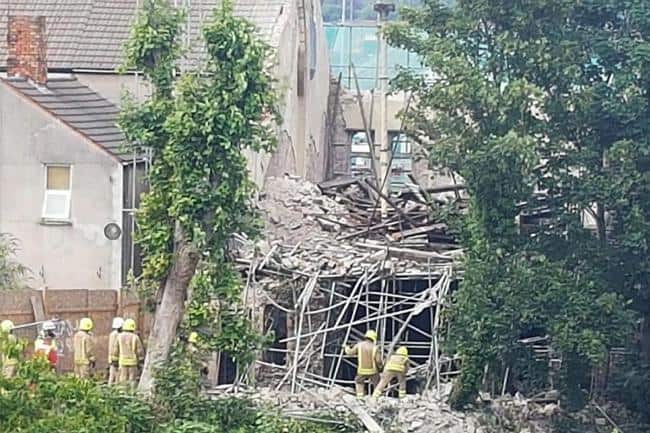
The prosecutor said the case was about the collapse of the church wall. “Could it have been predicted? If so, why were three men working on scaffolding that abutted it?” he added.
Mark Gulley, from Penarth, director of Amos Projects Limited, who had owned the Citadel since 2006, and Richard Lyons, from Bristol, a partner of Optima Scaffold Design Solutions Ltd are also on trial for health and safety offences.
Mr Gulley had intended to refurbish the church and repurpose it into flats, but then later decided to demolish the church and sell the site to developers.
The trial was told a report commissioned by Network Rail into the building found the church to be in a “poor” state and the rear wall “in danger of imminent collapse”.
The report was sent to Mr Gulley in 2016 and shared with demolition contractors, but not with the scaffolding contractor and defendant Mr Swain. Despite the report’s warning and the “obvious” danger posed by the rear wall, the prosecution said contractors failed to carry out sufficient works to stabilise it.
Scaffolding erected around the building was then tied to the wall, making any collapse liable to take the scaffolding with it.
According to a news report, Mr Plevey and two other scaffolders had been told to dismantle the scaffolding in preparation for the wall demolition when the collapse happened.
Mr Langdon said: “It was the long-predicted collapse of that unstable wall. Unsupported and dangerous as it had been throughout, it had become even more dangerous since the demolition of the church had begun.”
The prosecution claimed no-one had taken responsibility for the project as a whole, describing the management of the site as “dysfunctional”. The court was also told that had building regulations been followed “this fatality could not have occurred”.
Two other men, Phil Thomas, from Cardiff, who was Mr Young’s health and safety advisor from South Wales Safety Consultancy Ltd, and Richard Dean, of Abertillery, from NJP Consultant Engineers Ltd, have already pleaded guilty to health and safety offences.
The prosecution was brought following a joint investigation by South Wales Police and the Health and Safety Executive.
The trial before Mrs Justice Jefford is expected to take up to 10 weeks.