
BrandSafway helped protect space shuttle Endeavour during one of the more unusual construction projects in recent years, as contractors built a 200ft-high museum gallery around the spacecraft while it was already standing upright inside.
The Samuel Oschin Air and Space Center in Los Angeles opened to the public on 13 November, bringing visitors face-to-face with Endeavour in its full launch configuration. But getting the spacecraft into position, and building a museum around it, presented an extraordinary challenge for the construction teams involved.
The California Science Center identifies BrandSafway as the project’s scaffolding and shuttle-protection contractor, working alongside architect ZGF, engineer Arup and main contractor MATT Construction.
For BrandSafway, the job meant creating specialist access and protection around an irreplaceable spacecraft while structural steelwork and roof construction continued overhead. With Endeavour’s delicate surfaces exposed throughout the build, there was almost no margin for error.
Inches to spare
According to Engineering News-Record (ENR), BrandSafway produced prefabricated curved scaffolding around the shuttle’s external fuel tank, shaped so the huge structure could pass through without making contact. Separate circular scaffolds were also erected around the two solid rocket boosters.
The clearances involved were remarkably tight. A NASA account from April 2024 reveals that the external tank passed between the scaffold-clad boosters with less than an inch of space on either side. Crews used straps and come-alongs to gain a little extra room as the tank was carefully lowered into position, although NASA does not identify which contractor carried out that manoeuvre.
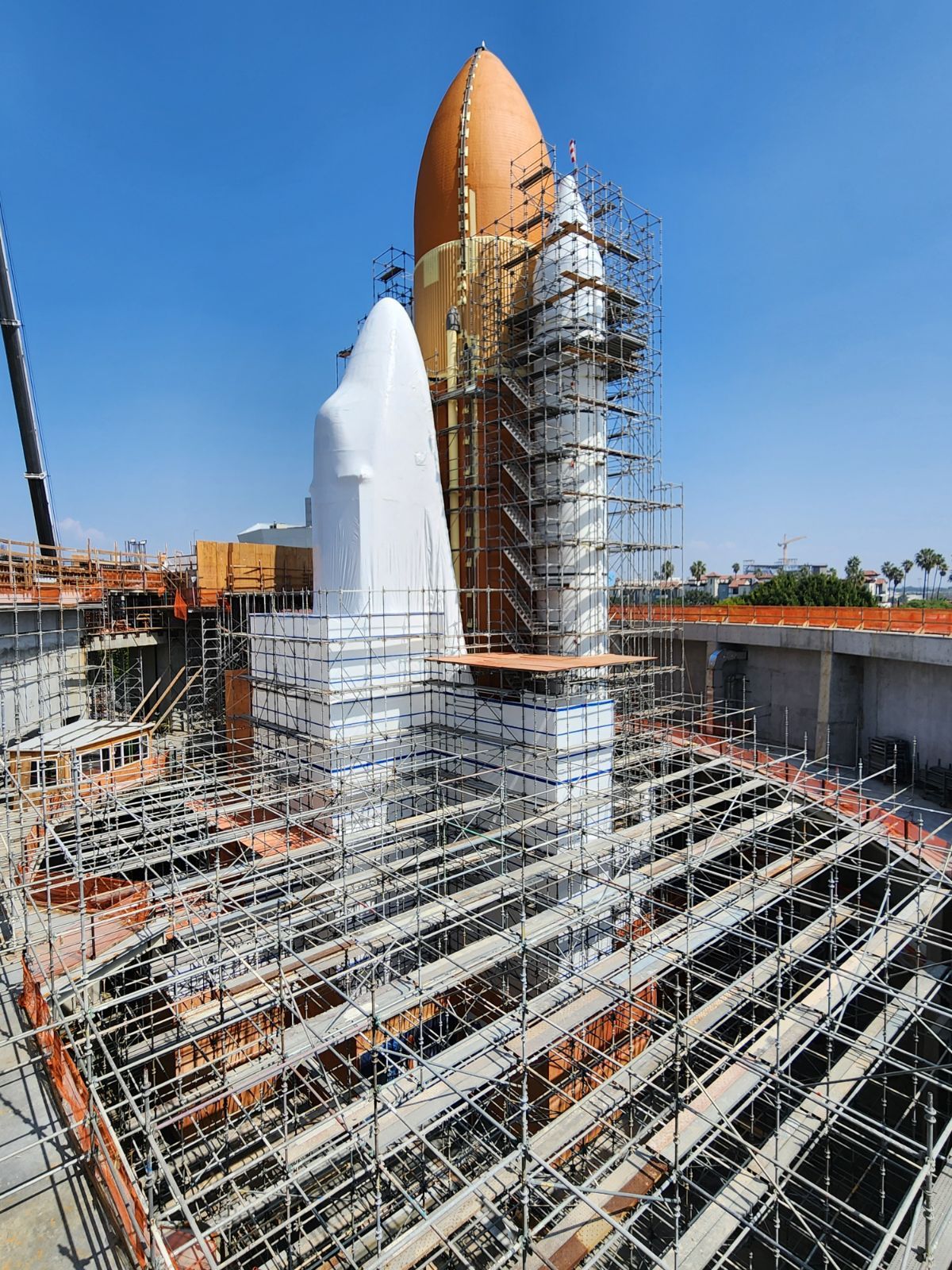
BrandSafway’s protective structures also had to accommodate the museum construction itself. ENR reports that the scaffold had to avoid overloading its base while staying clear of temporary shoring supporting the steel frame above. Vinyl sheeting with internal mesh, plywood and ballistic protection formed barriers against falling objects.
Around the boosters, padded fabricated components and straps helped steady sections of scaffold while protecting the spacecraft beneath.
Even the tools carried by workers required special precautions. Endeavour’s thermal-protection tiles are exceptionally fragile, so crews working above the orbiter used tethered tools and secured containers for bolts and other small items. A single dropped object could have caused serious damage to the spacecraft.
Building the museum around Endeavour
The shuttle was placed inside the site long before the building surrounding it was finished, creating an unusual construction sequence that required close coordination between contractors.
MATT Construction identifies several major challenges, including positioning the shuttle stack inside the partly completed structure, installing its temporary protection and erecting the roof’s steel diagrid above it while temporary bracing remained in place.
The stacking operation began in July 2023, with the booster bases installed first, followed by the remaining components of the launch stack. As Endeavour took shape in its upright position, construction of the museum continued around it.
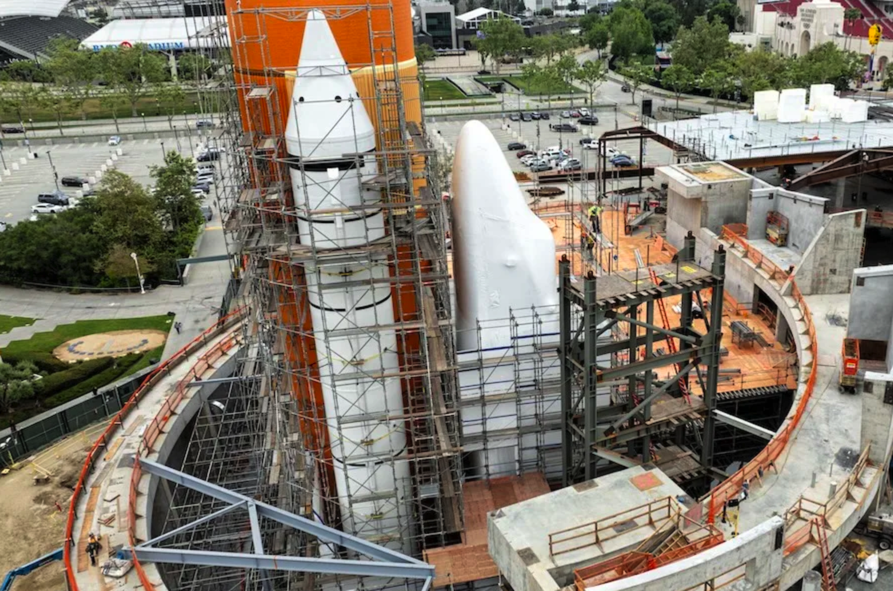
That meant contractors were effectively working around a priceless exhibit throughout much of the remaining build. Once the permanent steelwork became self-supporting, crews faced another delicate operation: removing the temporary shoring without disturbing the structure above or the spacecraft below.
ZGF announced completion of the main building in April 2026, clearing the way for exhibit installation ahead of the November opening. The 200,000 sq ft expansion includes a shuttle gallery rising around 200ft, allowing visitors to view Endeavour from several levels.
BrandSafway had already identified the project as an SAIA awards finalist earlier this year.
The completed museum brings an extraordinary piece of space history to the public. For the scaffolding industry, the construction behind it tells an equally fascinating story of specialist access engineering, careful planning and the remarkable precision required when working around something that simply cannot be replaced.