

Guest design article: What is Effective Length ?

ADVERTISEMENT


Image5

Guest Technical Article By IDH, The Independent Design House

IDH was incorporated in July 2011 and established to provide specialist Scaffold DesignFormwork Design & general Temporary Works Design consultancy serving Sub-Contractors, Main Contractors and Client developers.

What is Effective Length?

Effective length is a critical concept in Structural Design for all structural members such as Steel UC and UB sections, reinforced concrete columns and scaffold tubes.  Its technical definition is ‘the length of a component which is effectively restrained’.

When designing structural members they can be subject to a number of forces such as Shear, Tension, Compression, Torsion and combinations of these to name but a few.  Generally speaking, when we look at structural members, be it beams or struts, the Compressive force element is predominant in determining the structural capacity and the failure mechanism.

Example 1:
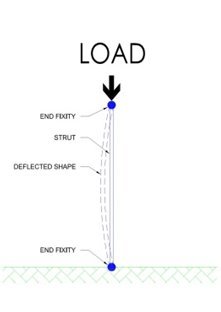
Image1

In this example, if the ends of the strut are held in place in all directions then the effective length Le is equal to the length of strut.

Example 2:
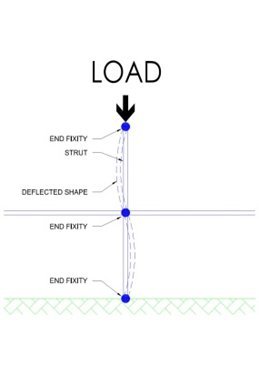
Image2

Now if we introduce a support in the middle and prevent it from moving in all directions, the Le becomes half the strut length.  This is critical, if we started for example with a scaffold tube of 2m it would have a strut capacity of 29.1 kN (TG20:08 Table 20).  By reducing the effective length to 1.0m the strut capacity increases to 58.6 kN.

Example 3:
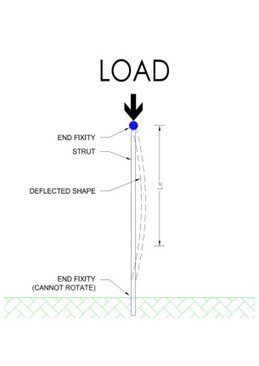
Image3

If we now fix one end of the tube in to concrete say so that it cannot pivot or rotate, although the length of the tube is still 2m, it now has an Le of 1.4m.  So our 2m tube in the last example can carry 45.3 kN – much more than a tube of the same length restrained as the first example.

In scaffolds, the same principles apply.  If we have a 2m lift ledger braced pair of standards, with each end of each pair prevented from moving left and right, the effective length would be 2.0m.  However we seldom have this scenario in scaffolds – we have every other pair of standards ledger braced, we have ties on varying lifts and we typically only sway brace the outside face.  Meaning, on closer review, we have lots of different standards with lots of different end fixity conditions resulting in lots of different effective lengths throughout the scaffold arrangement.  This results in different standards having different load capacities and the global capacity of the scaffold limited to the single standard with the worst leg load / effective length ratio.

For more explanation on this and other technical scaffold design subjects visit the IDH blog: http://www.idh-design.co.uk/blog/

Author: Tim Burt
ADVERTISEMENT

Popular Categories

Latest posts

Brogan wins Manchester student accommodation access package

Brogan Group has secured the powered access package for a student accommodation building in Manchester. The access specialist will provide several passenger and goods hoists...

‘Not every scaffolder is ok’: Alan Osborn backs mental health campaign at ScaffChamp

Alan Osborn is set to shave his head at ScaffChamp 2026 as part of a campaign to raise £5,000 for men’s mental health and...

Baton opens early adopter programme for scaffolding contractors

Baton has opened applications for its Early Adopter Programme, giving scaffolding contractors early access to a software platform designed specifically for construction subcontractors. The company...

SCA joins Coriant in move to widen access and industrial services capability

Coriant has announced the acquisition of specialist contractor SCA, in a move that further expands the group’s capabilities in access, temporary containment and industrial...

Robot named Douglas begins work on Tilbury Douglas site

Tilbury Douglas has begun using a humanoid robot to carry out administrative and data-collection tasks on a live construction site. The contractor says the...

HAKI reports sharp UK sales drop as construction starts stall

The Swedish-listed scaffolding and access safety group said UK revenues fell to SEK 52 million (£4.2 million) in the three months to 31 March,...

CISRS appoints Kathryn Bowe after delay to quality committee reforms

CISRS has appointed Kathryn Bowe as full-time Chair of its Quality Assurance Committee, months after the organisation was forced to restart recruitment for the...

NASC throws support behind first International Scaffolding and Access Day

NASC has thrown its support behind the first International Scaffolding and Access Day, as the UK industry prepares to join a new annual campaign...

Women completing construction apprenticeships triple since 2018, says CITB

The number of women completing construction apprenticeships has more than tripled since 2018, according to new figures from the Construction Industry Training Board (CITB). CITB...

Pilosio brings UK scaffolding safety model into Italian conference spotlight

Pilosio is set to use its presence at GIC Piacenza, a major construction trade event in northern Italy, this week to push a broader...

Latest news

Spring Issue #29 | Past issues >>

Latest topics

Most popular ⚡︎

Robot named Douglas begins work on Tilbury Douglas site

Tilbury Douglas has begun using a humanoid robot to...

SCA joins Coriant in move to widen access and industrial services capability

Coriant has announced the acquisition of specialist contractor SCA,...

Scaffolder died nine months after building site fall, inquest told

A four-day inquest has opened into the death of...

CISRS appoints Kathryn Bowe after delay to quality committee reforms

CISRS has appointed Kathryn Bowe as full-time Chair of...

Women completing construction apprenticeships triple since 2018, says CITB

The number of women completing construction apprenticeships has more...

Related articles

ADVERTISEMENTS