A Queensland coroner has called for mandatory additional controls on freestanding tower scaffolds used in public places after finding that a widely used height-to-base “rule of thumb” was not enough to protect against strong winds.
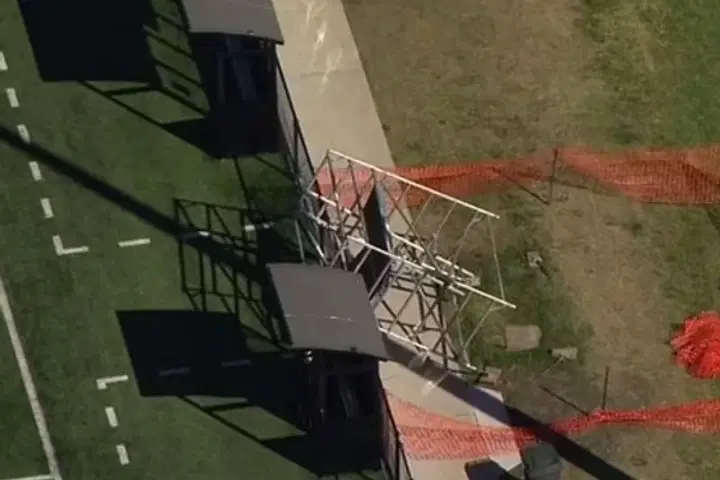
Coroner Megan Fairweather made the recommendations following an inquest into the death of Andrew Stephen Jones, 37, who was struck by a tower scaffold while watching his son play football at Mitchelton Football Club in Brisbane on 25 July 2021.
The findings, delivered on 30 September, identify a broader industry issue around the way wind risk is assessed for low-level freestanding tower scaffolds and recommend changes to Queensland’s Scaffolding Code of Practice.
Scaffold was within accepted height-to-base guidance
The aluminium tower had been installed in April 2021 to provide a filming platform for Premier League matches. It stood in an open, publicly accessible area between two football pitches and was expected to remain in place for several months.
The structure measured about 3.1m overall, with the working platform just over 2.1m above ground. Its minimum base dimension was 1.28m and its height-to-base ratio was around 1.6:1.
The inquest heard that this was comfortably within the widely accepted industry guidance that a tower with a base greater than 1.2m could be considered stable where the working height did not exceed three times the minimum base dimension.
However, the coroner found that relying on that ratio alone did not provide an adequate assessment of wind risk.
Senior structural engineer Aaron Poole estimated that the tower’s critical wind range for toppling was between 47km/h and 54km/h. Evidence before the inquest placed likely gusts at the site on the day of the incident between 41km/h and 68km/h.
The current Australian guideline AS/NZS 4576:2020 advises that freestanding tower scaffolds should not be operated or left unattended where wind speeds may exceed 40km/h. Queensland’s Scaffolding Code, however, refers to “strong winds” without defining the term or giving installers a simple method for assessing when extra controls are required.
Simple controls could have prevented collapse
Mr Poole told the inquest that readily available measures including outriggers, tie-downs, tube-and-clip restraints and additional dead loads could substantially increase stability. His evidence was that appropriate controls could withstand wind loads above 70km/h and would very likely have prevented the incident.
The coroner said these measures were practical, accessible and affordable, and would remove the need for installers of lower tower scaffolds to carry out complex engineering calculations.
The findings also highlight a regulatory gap for lower towers. Because the scaffold’s working platform was below four metres, its erection did not require a High Risk Work Licence for scaffolding and routine inspections were not required under the relevant regulations. There was also no requirement for a formal handover certificate.
Fairweather found there had been no formal plan for ongoing monitoring or safety risk management after installation. She said the circumstances raised issues “much broader than the actions of any individual” and found that the accepted industry rule of thumb, when used in isolation, did not adequately assess strong-wind risk.
Four changes recommended
The coroner recommended that Queensland’s Office of Industrial Relations amend the Scaffolding Code of Practice to define “strong winds” and require freestanding tower scaffolds erected in public places to use additional controls appropriate to the circumstances.
She also recommended a comprehensive education campaign for manufacturers, suppliers, installers and hire companies, followed by a compliance campaign to ensure the changes are understood in practice.
A fourth recommendation calls for manufacturers and distributors to provide clearer instructions, guidance and warnings covering design choice, environmental conditions, location, public access, duration of use and suitable control measures.
The Coroners Court records the case as requiring a Queensland Government response. Under the state’s process for coronial recommendations, the government aims to publish its response within six months.
Previous prosecution
Mobile Scaffolds Queensland Pty Ltd, which supplied and installed the tower, was fined A$400,000 in August 2024 after being convicted of failing to comply with its health and safety duty. The company was in liquidation and the case was heard in its absence.
The coronial findings note that installer Christopher Sweedman was separately charged, but that charge was dismissed in November 2024 after the Work Health and Safety Prosecutor offered no evidence.
Fairweather found Mr Sweedman had acted in good faith within the limits of his training, experience and accepted industry practice. She also accepted expert evidence that he could not reasonably have been expected to understand and apply the engineering calculations contained in the relevant Australian standards.
Workplace Health and Safety Queensland issued a safety alert following the 2021 incident, warning that tower scaffolds must account for environmental loads, site location, prolonged installation and the safety of people nearby.
The Queensland Scaffolding Code of Practice 2021 currently requires environmental factors to be considered and calls for alternative height-to-base ratios or extra support where a tower is likely to be exposed to strong winds.