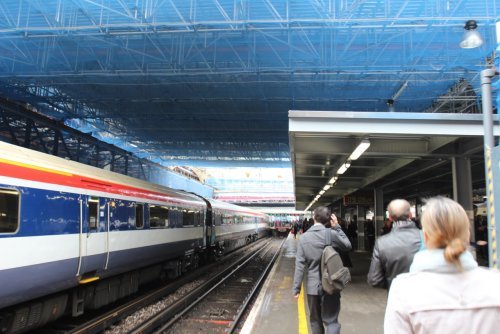
Leading scaffolding contractor, XERVON Palmers, are in the final stages of a 14-month contract worth £20 million to deconstruct the train shed roof at the historic, busy London Bridge Railway Station – opening up the station to the sky for the first time in over 100 years.
[dropcap]C[/dropcap]rucially, the XERVON Palmers contract has been completed without the use of major cranes and with all railway operations continuing as normal, 24-hours a day – with the station still capable of serving its 100,000+ passengers per day, and no disruption to station operations, or traffic surrounding the venue – with XERVON Palmers running a separate day and a night shift of operatives and managers.
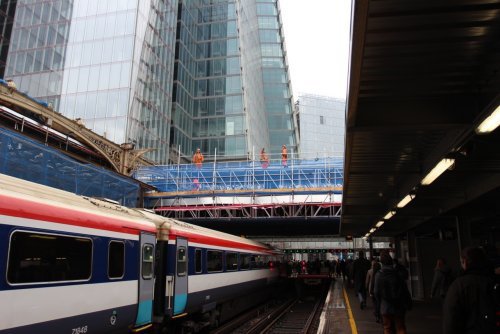
The huge project – which included creating a structurally-supportive 18,000 square metre protection deck running the full 70m across the station with some 10,000 aluminium special access panels and 350 tonnes of temporary steel and a secondary mobile access system – is part of a £600 million, five year long (running to 2018) refurbishment programme aiming to successfully redevelop one of London’s most historic and busy stations, in partnership with main contractor Costain and Network Rail.
In addition to the design and construction of the mobile protection deck (rolled into place using modern ‘cassette’ techniques), the sequenced, safe removal of the dilapidated, historic, crescent-shaped train shed roof and the creation of a mobile access walkway in the side roofs to remove the roof cladding (with a bespoke access in the central barrel of the site with integral support beams), XERVON Palmers operatives also managed waste and recycling. More than 1,200 tons of steel has been removed (all by hand) and asbestos has been removed from site along with rare heritage material, in the form of pre-1880, Georgian wrought iron and polished re-enforced glass, which has also been recycled.
The vast London Bridge project adds to XERVON Palmers extensive transport scaffolding and access CV, with recent jobs including St. Pancras, Paddington, Waterloo, Waverley and King’s Cross in addition to works on the iconic Forth and Tay bridges. And with further historic railway station scaffolding, access and other specialist works planned and tendered for during 2013 into 2014, XERVON Palmers continue to provide services for this key market sector.
“This has been an exciting and challenging task,” said Ian McFarlane, Director for Business & Project Development at XERVON Palmers. “We have been very happy to take it on and have succeeded in developing an excellent solution – developing sophisticated and innovative access and scaffolding solutions.
“The creation of the protection deck has allowed work above to continue whilst the station operates as normally as possible at ground level: Thanks to XERVON Palmers design and execution, commuters would know nothing of the comprehensive work plan which allowed the roof to be deconstructed into manageable sizes and weights. The deconstruction sequence ensured that each piece removed was compliant with the detailed loadings allowed. Each piece was manually removed from site via loading paths created within the protection deck. Planning and coordinating the works, managing the logistics and transport to remove and safely dispose of the waste has been a significant success for XERVON Palmers. We used all of our experiences from the past to develop this excellent, expert solution.”
David Crabtree, who headed the XERVON Palmers team throughout the London Bridge project, said: “We’re coming to the end of a huge 14-month scaffolding and access job. And the XERVON Palmers design provided has delivered a safe, cost effective, viable and on-budget and on-schedule solution for the whole project – allowing railway and passenger movements to continue as normal.
“The protection deck was a major design solution, created to fit in with Network Rail’s extensive health and safety regulations for the safety and protection of the general public, railway operatives and the operating railway. We needed to create a safe working environment for everyone. As such, before construction began, we carried out extensive drop testing in the design process on a test rig – to prove to Network Rail and Costain the integrity of our protection deck design. And it has proved to be an extremely safe and successful set-up – as well as simultaneously providing lateral restraint for the two external walls of the station structure, with a 70m tied and braced system, putting loads back into the protection deck with a bracing plane throughout the works. It’s been a big, rewarding and successful job for XERVON Palmers, showcasing the depth of talent in the company and our ability to take on complicated jobs like this, on sites of historical importance and at busy operational centers, with the minimum of disruption.”
And Donald Morrison, CEO of XERVON Palmers added: “This contract is a good example of the company’s expertise in the provision of high end design lead protection decks. This solution has allowed us to carry out the significant deconstruction works safely whilst maintaining 100% passenger throughput at the railway station.”
The XERVON Palmers London Bridge Station project is expected to finish at the end of May, on time and on budget.