
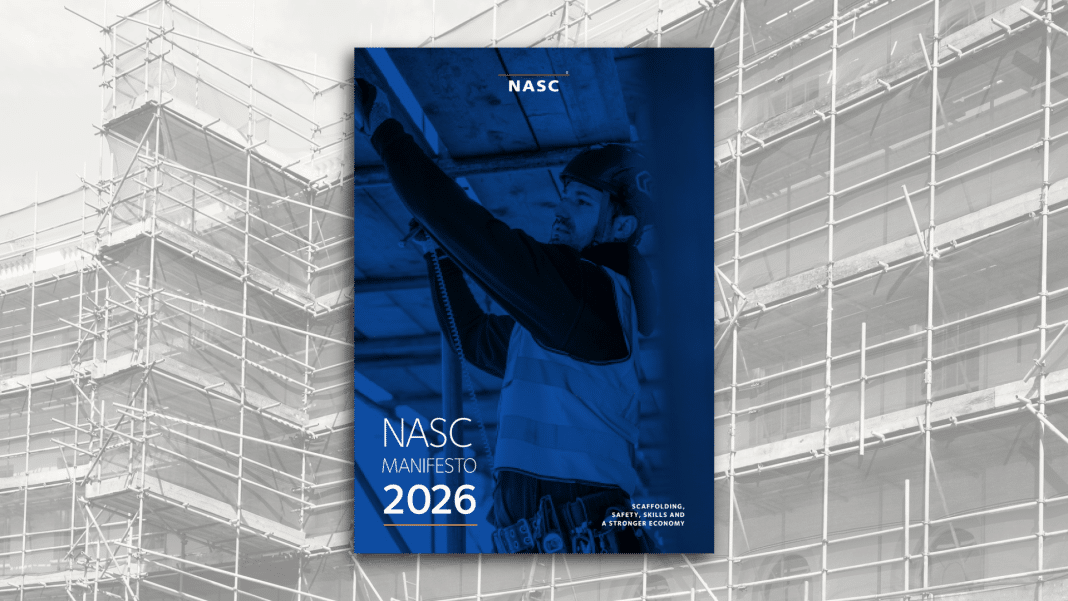
The NASC has called for increased funding for the Health and Safety Executive, a nationwide network of scaffolding training providers and stronger payment protections for contractors in its updated 2026 manifesto.
Launched today, the document sets out eight actions across six policy areas covering supply chains, employment law, skills, training, safety and the environment.
The updated manifesto builds on the NASC’s existing policy platform, with the trade body saying it will now be reviewed regularly to reflect changes in government policy, legislation and the issues facing members.
“This latest manifesto marks a change in approach for NASC. Rather than remaining a static document, it will now be reviewed and updated regularly to reflect changes in government policy, legislation and the challenges facing members,” said Clive Dickin, NASC and CISRS Group CEO.
Responsibility for maintaining the manifesto will sit with the NASC’s ESG and Public Affairs Committee.
Safety and HSE funding
Among the main demands is greater investment in the HSE, which the NASC says has been underfunded in recent years.
The organisation also wants a public-facing campaign showing what safe and compliant scaffolding looks like, alongside stronger reporting, inspection and enforcement against poor practice.
The manifesto says the scaffolding and access sector has made major gains on safety over the past 50 years, citing the NASC’s 2026 Safety Report, which recorded one RIDDOR-reportable incident for every 250,000 hours worked in 2025.
Training capacity and workforce shortages
Skills and training form a large part of the manifesto.
The NASC wants the Department for Education to help establish a nationwide network of dedicated training providers, backed by adequate funding and closer involvement from regional and devolved skills bodies.
It also supports full-time scaffolding courses for 16 to 18-year-olds, improved careers education and more work experience to give young people a clearer route into the industry.
The manifesto says domestic training should remain a priority, but firms should retain targeted access to skilled overseas workers where shortages cannot be filled locally.
Payment and supply-chain reform
The manifesto also calls for stronger protections for contractors and subcontractors working on major infrastructure projects, particularly where government programmes change or major contractors collapse.
Prompt payment remains another focus. The NASC has welcomed proposals to ban retentions through the Commercial Payments Bill and measures aimed at tackling late payment, while warning that any new rules will need monitoring for unintended consequences.
On employment law, the NASC says businesses need proportionate regulation that preserves flexibility and avoids adding unnecessary administrative costs, particularly for smaller firms.
Building safety and transport
The manifesto confirms the NASC’s position that scaffolding and access are temporary works and fall outside the scope of the Building Safety Act.
It also calls for continued support for the Building Safety Regulator and more work on permanent features, such as structural tying points, that could make future scaffold erection safer and more efficient over the life of a building.
Transport is another policy area. The NASC wants the government to review how drivers’ hours rules apply to scaffolding businesses, arguing that many scaffold vehicles work locally rather than on long-distance haulage.
It is also proposing a scrappage scheme to help companies replace older fleets.
The manifesto says NASC members contribute almost £3bn in added value to the UK economy while providing access and temporary structures across construction, infrastructure, energy, manufacturing and transport.
“Scaffolding is a highly skilled industry that plays a vital role in keeping the UK building, maintaining and improving its infrastructure,” said NASC President Sarah Klieve. “This manifesto gives us a clear platform to champion our members and make the case for the policies that will help responsible businesses invest, grow and continue raising standards.”
The NASC says collaboration between industry, government and the education sector, including CISRS training centres, will be needed to deliver the proposals and improve safety, skills and productivity across the sector.