A serious scaffolding incident can unfold in seconds, but the consequences for the people and businesses involved can continue for years.
That is the focus of the opening episode of the new season of The Brace Yourself Podcast, which sees hosts Simon Boyes and Ben Beaumont, ScaffPlan’s founder and managing director, joined by scaffolding safety specialist and expert witness Keaton Owen.
Owen, founder of Scaffold Safety, has more than 20 years’ experience across scaffolding, safety and training. His career has taken him from working on the tools and supervising scaffolding crews to senior safety roles, training, inspections and expert evidence in serious workplace prosecutions, including cases that have reached the higher courts. His work sits within the Australian safety and legal system, so the terminology and processes discussed should not be assumed to transfer directly to the UK or other jurisdictions.
The episode concentrates on what happens after an accident has occurred, rather than why it happened. Using the example of a worker falling from a scaffold, the discussion begins with the immediate emergency response before moving through scene preservation, investigation, documentation, expert evidence and, in some cases, the eventual court process.
The first few hours
Owen explains that following a serious incident, emergency services take priority. Depending on the circumstances, ambulance crews, fire and rescue services and police may all attend, and once the injured person has been cared for, attention turns to securing the area and understanding what happened.
One of the challenges is balancing the need to make the site safe with the requirement to preserve evidence. Isolating the risk may mean blocking off a bay or a stair, Owen explains, but beyond that the scene stays as it is.
“Leave things where they are,” he says. “If a board’s fallen, leave it where it is. Don’t try and cover up that the board’s fallen out, or where the handrail’s missing, because they need a thorough timeline of photos and measurements specific to the causation.”
The case for rehearsal is stronger than most listeners will expect. Owen says around 70% of rescue-related injuries come from first responders who are not trained for the situation, a figure he pairs with what he has seen on site.
“I’ve seen people grabbing pieces of tube off the ground, don’t even have a hammer, trying to take scaffold apart to get to injured people,” he says. “That can cause more damage than it’s actually fixing.”
Companies, he argues, need to understand their emergency procedures before they are ever required, through first-day training, mock rescues and scenario planning, particularly where scaffolders may need to help gain access to an injured person or remove sections of a structure during a rescue.
The paperwork question
Once the immediate emergency has passed, the investigation begins.
According to Owen, investigators may want to examine everything from risk assessments and safe working procedures to inspection records, worker inductions, training records and scaffolding licences, with design and engineering information forming part of the evidence where it is relevant to the structure involved.
Investigators look well beyond what paperwork existed. They want to know whether hazards had been identified, what controls were supposed to be in place and whether those controls were actually being followed when the incident happened. Emails, messages and other communications can become relevant where investigators are trying to establish who knew about a particular risk and when they knew it.
Responsibility can extend beyond the scaffolder
A serious incident involving scaffolding does not automatically mean responsibility sits with one contractor. Under the Australian framework, Owen explains, several parties can hold overlapping duties of care at once, and prosecutions regularly involve more than one of them. “Most of these prosecutions that I deal with, there’s a scaffold contractor getting prosecuted and there’s a builder at the same time,” he says.
Where responsibility lands turns on two questions that follow every duty holder into court. “One of them will be what you reasonably ought to know. For who you are in your position, what should you have known? For a builder it’s completely different, sometimes, to an engineer or a scaffolder,” Owen says. The second is how obvious and foreseeable the risk was.
The stakes have risen too. Owen notes that the major Australian states have passed industrial manslaughter laws, with fines for the most serious reckless or negligent breaches running from hundreds of thousands into the millions of dollars, alongside potential jail time. Courts can also order companies to publicly declare an incident.
What an expert witness actually does
The episode also opens up a part of the process few in the industry ever see: Owen’s own role. Engaged to give technical guidance to the court, he prepares detailed reports on causation and industry practice, and before a case is heard, the opposing experts meet.
“The two experts come together and they talk about what they agree and what they don’t agree on, and they create what they call a conclave report,” he says. “The judge has got both your reports and then your conclave report, so he’s really clear on what both your opinions are.”
Cases can continue for years
One of the more sobering stretches of the conversation concerns time. Owen says cases typically take at least two years to move from incident to court, with three or four not unusual, and significant involvement from lawyers, barristers and technical specialists along the way.
“I’m working on some at the moment that probably won’t go to court till next year, and they happened in 2022,” he says. “That’s five years.”
For scaffolding businesses, the practical lesson is to make sure safety systems work before an accident ever tests them. Asked what every scaffold business should have in place, Owen starts in the same spot.
“Read your guides. Read your standards, read your codes, grab hold of your regulator guides, read it all, and align what you do to that,” he says. “And then verify everything you do. Most people’s compliance doesn’t get questioned until there’s actually been an incident.”
Scaffmag joins Brace Yourself
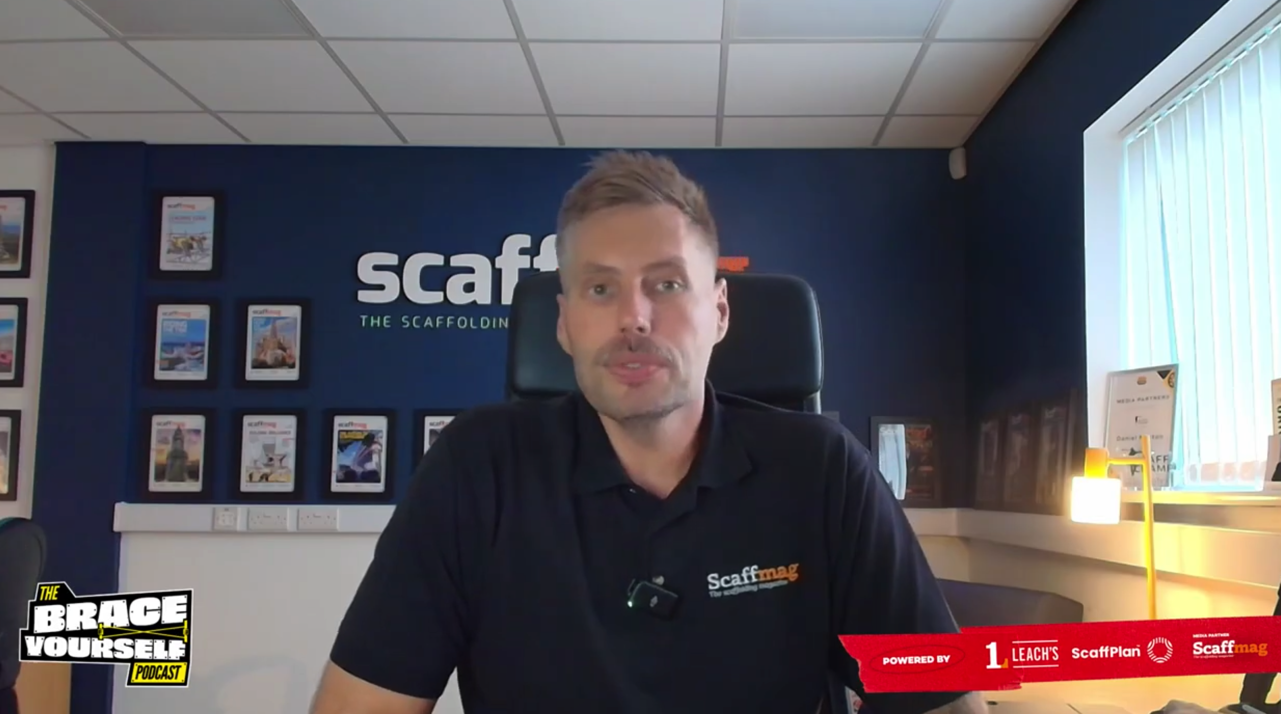
The episode also marks the beginning of Scaffmag’s partnership with The Brace Yourself Podcast, with Scaffmag becoming the show’s Official Media Partner. Each episode will now include a dedicated Scaffmag industry news update covering some of the biggest stories from across the scaffolding and access sector.
The first Scaffmag News Desk segment appears in this episode, covering the latest NASC manifesto, the creation of ALTRAD Hire and Sales, Australia’s campaign for scaffolding to be recognised as a skilled trade, KEWAZO’s UK expansion and the forthcoming Scaffolding Excellence Awards.
The full episode of The Brace Yourself Podcast is available now – Link