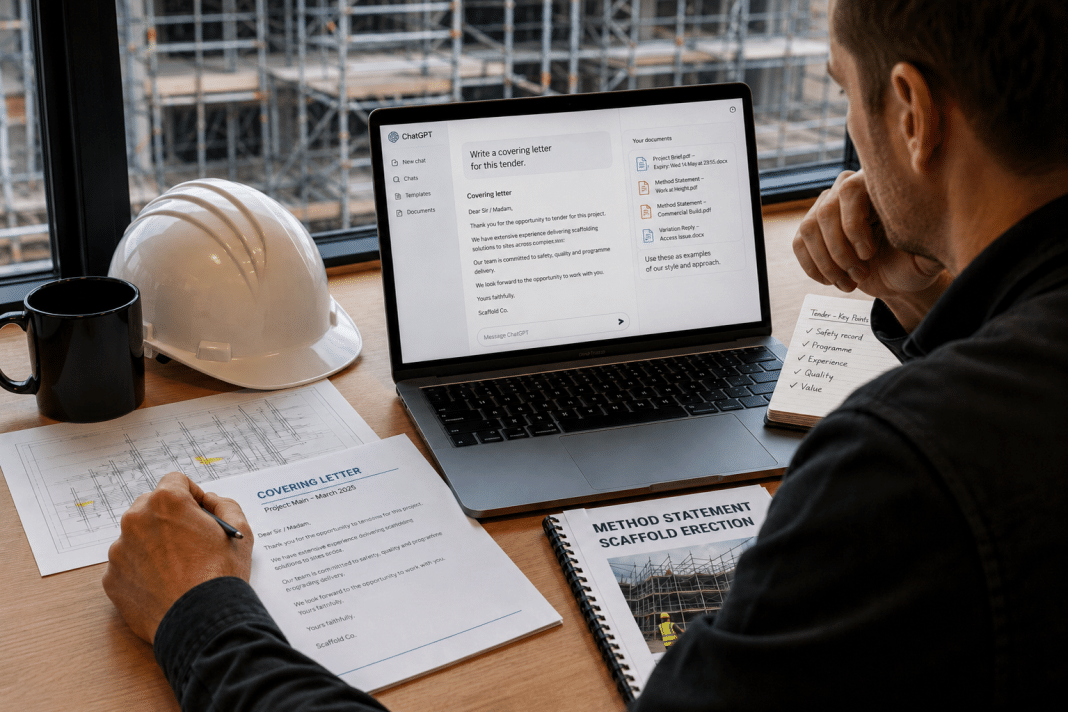
You’re tendering for one of the biggest jobs you’ve surveyed this year, and now it all comes down to a strong covering letter. You asked ChatGPT to write it. What came back was correct, polite, and could have been sent by any scaffold company in the country.
So you wrote better instructions, called a “prompt”. “Confident but not pushy.” “Mention our safety record.” “Keep it under a page.” The second letter was longer than the first and still nothing stands out. You don’t feel unique.
The reason has nothing to do with how you worded the prompt.
Most people carry on in this direction, writing longer and longer instructions and getting little improvement for the effort. ChatGPT works by matching patterns. So does Claude, and so does every tool like them. AIs are strong at building on something that already exists and weak at creating something from an abstract description.
“Confident but not pushy” may mean something different to you than it does to me, and ChatGPT has no way of knowing what specifically you intended. However, the last covering letter that you wrote yourself has meaning. It sits there in your words, with your rhythm and your way of handling price.
Instead of telling ChatGPT what you want, show it.
Paste in the covering letter you sent for the job you won in March. Then ask for a new letter, for this client, for this scope, written like that one. The output changes completely. The original version sounds like the internet (which is what ChatGPT was trained on) and the new one sounds like your scaffold company, because your voice lives in those documents and nowhere else.
Think about what happens if you leave ChatGPT alone. Every scaffold company bidding against you has the same ChatGPT open this month, and left to itself, it writes everyone similar letters. The client opening five tenders reads five versions of one voice.
Pasting in an example works well beyond covering letters. Show the AI two of your own method statements and the third arrives matching them. Show it the reply you send when a client asks for a variation, and you stop writing that reply from scratch every month.
Keep your best covering letters, method statements and variation replies in one place and reuse them, because the more of your own work you give ChatGPT, the closer the answer lands.
Before you start pasting, you need to be aware of two things, and they matter more than anything else in this article.
ChatGPT copies faithfully, which includes the habits you would rather not repeat. If your old letter buries the price on the second page, so will the new one. Read what comes back before it goes out.
And think about what the document contains before you paste it. A covering letter is one thing. A full rate build-up is another, and where those details go depends on which account your people signed in with. A later column deals with that properly.
Try this next time you use ChatGPT. Find the last thing you sent that you were pleased with. One document. Paste it in before you ask for anything at all.
You have spent years communicating with your clients. Every covering letter, every method statement, every reply is already yours. Nobody else has a copy. Start there.