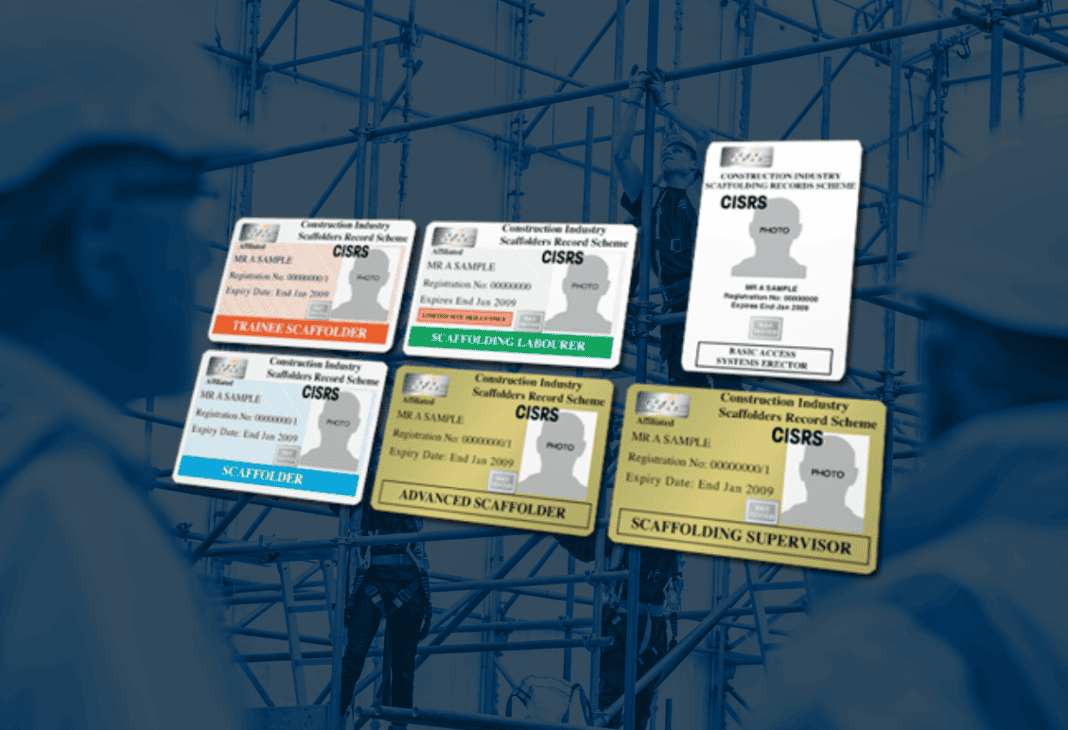
CISRS has announced plans to leave the Construction Skills Certification Scheme (CSCS), with new and renewed scaffolding cards set to be issued without the CSCS logo from June 2027.
The scheme will become the Competence in Scaffolding Record Scheme on 1 January 2027, retaining its CISRS initials. Its departure from CSCS is planned for 1 June 2027.
CISRS says the decision will allow it to support scaffolders working across construction, utilities, marine, aviation and petrochemical industries without introducing separate cards for different sectors.
It says existing cards will remain valid until their expiry dates, with qualifications, training programmes and assessment routes unchanged.
Why CISRS is leaving
The decision centres on the scope of the CSCS licensing arrangements.
According to CISRS, a requirement introduced in March 2024 restricts cards issued under the licence to construction use. It says maintaining that arrangement would mean duplicate cards for scaffolders working across construction and other industries, adding costs for workers and employers.
Clive Dickin, CISRS CEO, said: “The same scaffolders undertake the same activities using the same qualifications and competence standards regardless of whether they are operating on a construction project, inside an aircraft hangar or on an offshore installation.
“The sector certification scheme recognised by scaffolding employers and their clients needs to adjust and reflect this reality.”
CISRS says its governance has historically focused on construction, despite the scheme’s use across a much wider range of workplaces.
According to figures supplied with the announcement, the scheme has about 120,000 cardholders worldwide.
A recent consultation of NASC members found that an average of around 35% of their work took place in non-construction settings, rising to as much as 80% for some firms, CISRS said.
What happens to existing cards?
CISRS says cardholders will be able to continue using their existing cards for the remainder of their validity, and that all current qualifications will remain valid.
From June 2027, new and renewed cards will have a revised design without the CSCS logo. The scheme also plans to issue cards increasingly online.
Existing training and further education providers will be able to continue delivering the scheme, with no competence routes withdrawn.
Dickin said: “All CISRS qualifications, training programmes, assessment routes and card verification systems will remain operational with a commitment to become OFQUAL registered within three years.”
CISRS says employers will continue to use a single card as evidence of scaffolding competence across the sectors in which their workforce operates.
Construction site acceptance

CISRS has stated that existing cards will remain valid at the same sites as before.
Acceptance of future cards without the CSCS logo will be an important part of the transition. Build UK’s published training standard currently supports the Construction Leadership Council recommendation that the industry specify card schemes carrying the CSCS logo, with no equivalents accepted.
The announcement does not set out how that requirement will be addressed for the new cards.
The National Federation of Builders has backed the move, saying consistent recognition of scaffolding competence across industries would help avoid duplication.
Richard Beresford, its chief executive, said: “Making sure that the same skills are recognised in the same way across all sectors of the built environment is necessary to avoid costly duplication and potential confusion.”
He added: “CISRS has built its credibility over time and it is recognised by everyone in the sector as the reliable standard of training, assessment and certification in scaffolding and access.”