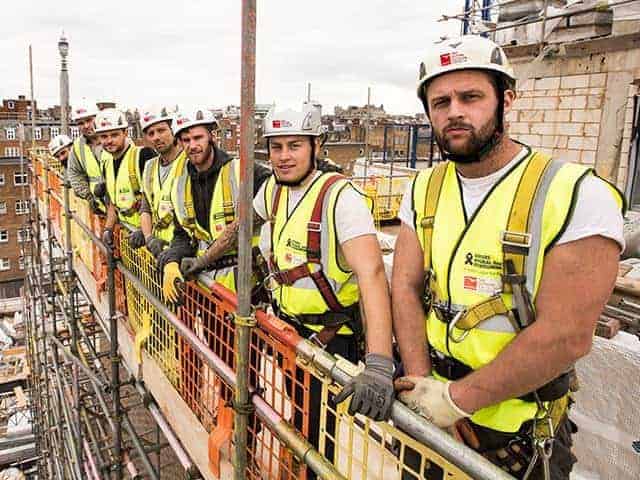
Unite says 19 directly employed scaffolders and 31 joiners in the North East have received dismissal notices amid a dispute over proposed changes to pay and bonuses. Taylor Wimpey says discussions are continuing.
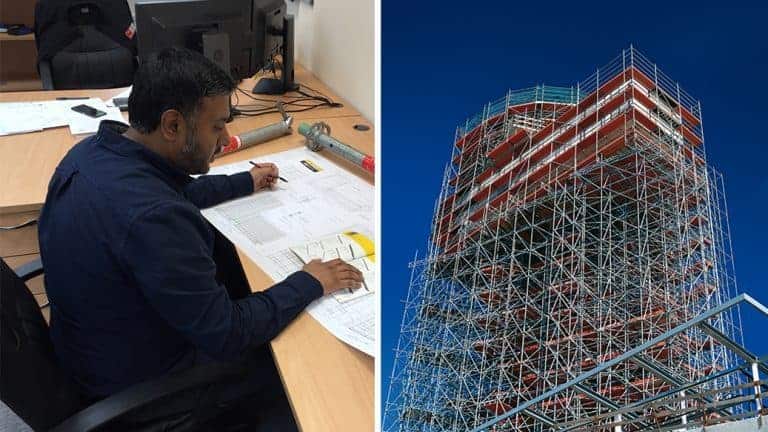
Ascent Access Scaffolding MD Nathan Huband is calling for more first aid training after using CPR to help save colleague Raj Soni at the firm’s Netherton yard.
Unite says 19 directly employed scaffolders and 31 joiners in the North East have received dismissal notices amid a dispute over proposed changes to pay and bonuses. Taylor Wimpey says discussions are continuing.
Ascent Access Scaffolding MD Nathan Huband is calling for more first aid training after using CPR to help save colleague Raj Soni at the firm’s Netherton yard.
Unite says 19 directly employed scaffolders and 31 joiners in the North East have received dismissal notices amid a dispute over proposed changes to pay and bonuses. Taylor Wimpey says discussions are continuing.
Ascent Access Scaffolding MD Nathan Huband is calling for more first aid training after using CPR to help save colleague Raj Soni at the firm’s Netherton yard.
Unite says 19 directly employed scaffolders and 31 joiners in the North East have received dismissal notices amid a dispute over proposed changes to pay and bonuses. Taylor Wimpey says discussions are continuing.
Ascent Access Scaffolding MD Nathan Huband is calling for more first aid training after using CPR to help save colleague Raj Soni at the firm’s Netherton yard.
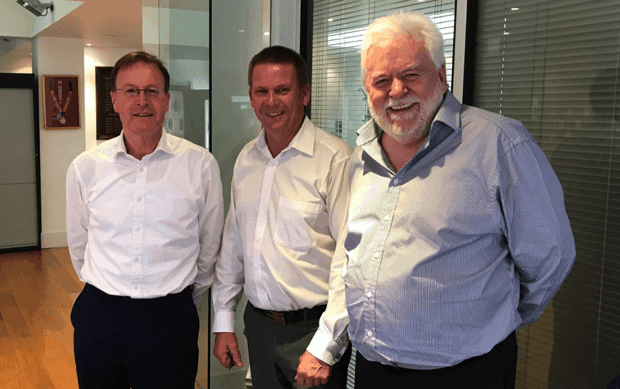
Graham Burke CEO of Scaffolding, Access & Rigging New Zealand (SARNZ) met representatives of NASC at their London office on the 17th of May.
The NASC have reported that the meeting proved to be the perfect opportunity to discuss a number of key issues involving the industry. According to a recent statement, Mr Burke was particularly keen to learn more from an established trade body in the work at height sector.
NASC MD Robin James (left) meeting with Graham Burke of SARNZ & NASC’s Ken Johnson (right)
Mr Burke had previously run a scaffolding business and latterly President of SARNZ, and made a tremendous contribution to the development of Australian and New Zealand scaffolding standards. With more than 100 members the New Zealand trade body is already making great strides. However administration and support is limited and Mr Burke is having to wear a number of hats as he tries to grow the organisation.
The meeting was arranged to coincide with a family visit, offering the chance for this influential role model to further develop working relationships.
NASC Managing Director Robin James said: “The confederation is delighted to develop a relationship with SARNZ. We had an excellent meeting with Graham and discussed many areas of common interest and concern.Unsurprisingly some these are identical to those which the NASC itself faces here in the UK construction industry. We look forward to supporting the continued emergence of SARNZ and seeing the benefits of this relationship for many years to come.”
Mr Burke has been extremely influential on other important initiatives including the development of good practice guidelines for scaffolding in New Zealand, industry training standards and lobbying on skilled scaffolder shortages.
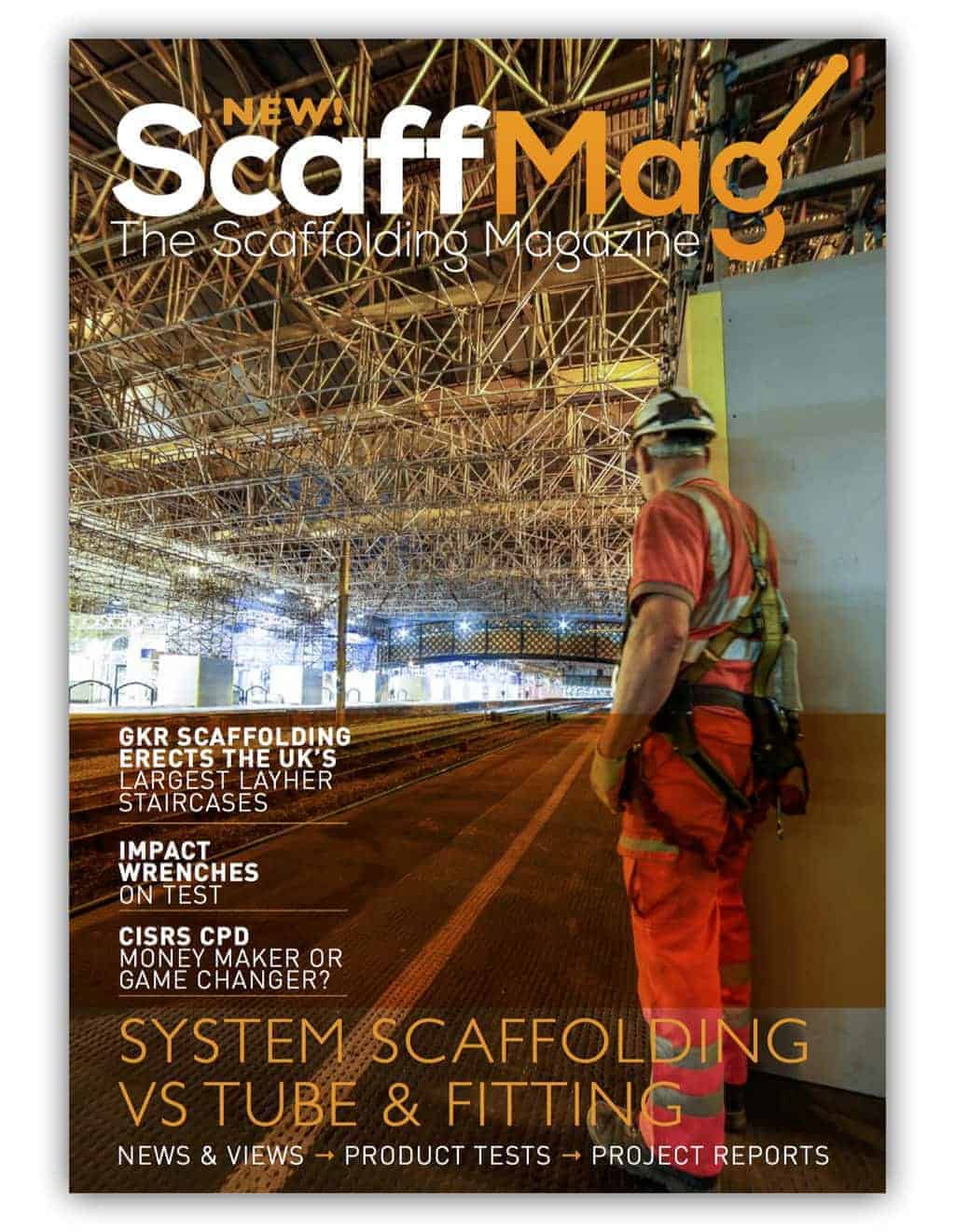
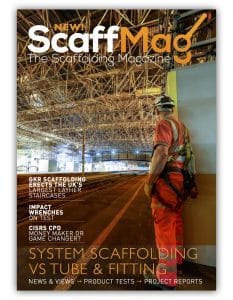
ScaffMag announce plans to produce a Digital Magazine.
We are pleased to announce our plans to publish a FREE quarterly digital magazine like no other.
For over seven years ScaffMag has been continually reporting on our great industry. Through this dedication – and of course your loyal readership and social media following, ScaffMag has grown in popularity to become the industry’s leading source for latest scaffolding news, current affairs and jobs while profiling the best practices and industry standards.
An example of our front cover
Launching in the Summer our valued loyal readers will be able to immerse themselves in a exciting digital scaff-fest. Featuring glorious double paged in-depth exclusive articles and project reports, interviews, regular views and opinion columns from industry leaders, scaffolders spotlight.. the list goes on and on.
Encompassing modern technology the magazine will be available to download and read on all mobile, tablet and desktop devices.
Daniel Norton Founder and Editor of ScaffMag said:
“I am really excited and thrilled to announce our new media offering to our readers. Ever since I founded ScaffMag back in 2009 it was always called ScaffMag ‘the scaffolding magazine’ with the website acting as the magazine. Now we have the opportunity to do both. This is the natural next step in our company’s history, to produce a modern and edgy digital publication that can be consumed on the move”.
If you have some news or if you would like to be featured in the first issue of ScaffMag please drop us an email to [email protected]
Contractors Pyeroy have admitted health and safety failings over the death of a man trapped between a cherry picker and scaffolding at Devonport Dockyard in 2013.
Keith Stevens
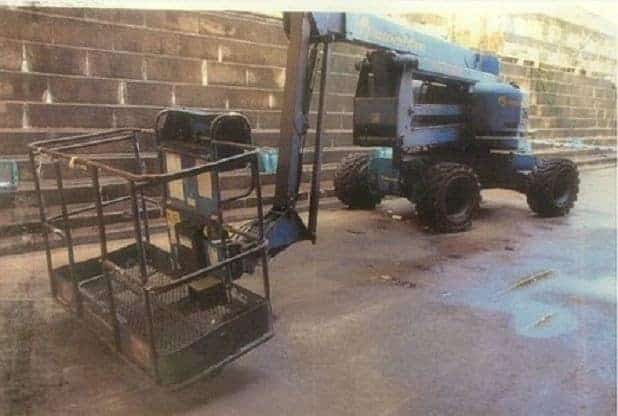
57-year-old scaffolder Keith Stevens was caught between a large scaffolding tube and the bar of the cherry picker he was working on over a submarine in Eight Dock. The Gateshead based company admitted before city magistrates to failing to ensure work at height was planned, supervised and carried out safely. The charge specified failings included planning for emergencies and rescue.
They could face a hefty fine when sentence is passed at Plymouth Crown Court on May 25th. An inquest into the death heard Mr Stevens had suffered from a ‘cardiac event’ due to cardiomegaly. The jury however, could not decide in February 2015, whether his death was caused by his heart problem following the crush or the other way around.
As a consequence jury members found the cause of the accident was ‘unclear’. It seems colleagues tried to move the arm of the cherry picker with Mr Stevens bent over the controls – but were unable to do so. As a result, there was a 24-minute delay before Mr Stevens, from Newton Abbot, could be lowered to the ground.
The cherry picker involved in the accident
A solicitor for Mr Stevens’ family revealed there was no-one on the ground at the time competent enough to operate the cherry picker. The family’s lawyer Lara Spencer said: Mr Stevens could have been lowered in just one or two minutes and the company was guilty of a ‘gross failure’. “There is nothing to suggest he couldn’t have been resuscitated. The company had needed an emergency rescue plan.”
HSE inspectors had not been able to find any fault with the cherry picker, the inquest heard. Coroner Ian Arrow recorded an open verdict stating: “This is a rare case. The only verdict is an open verdict”.
Generation believes the Future is Futuro. Over the next 6 months over 300 scaffolders have signed up to find out why at a series of nationwide demonstrations.
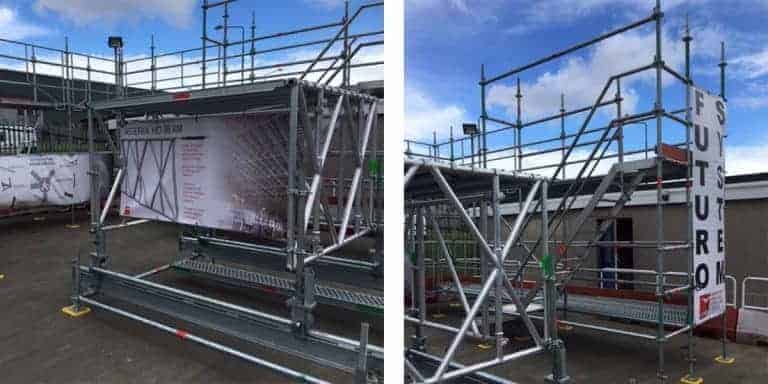
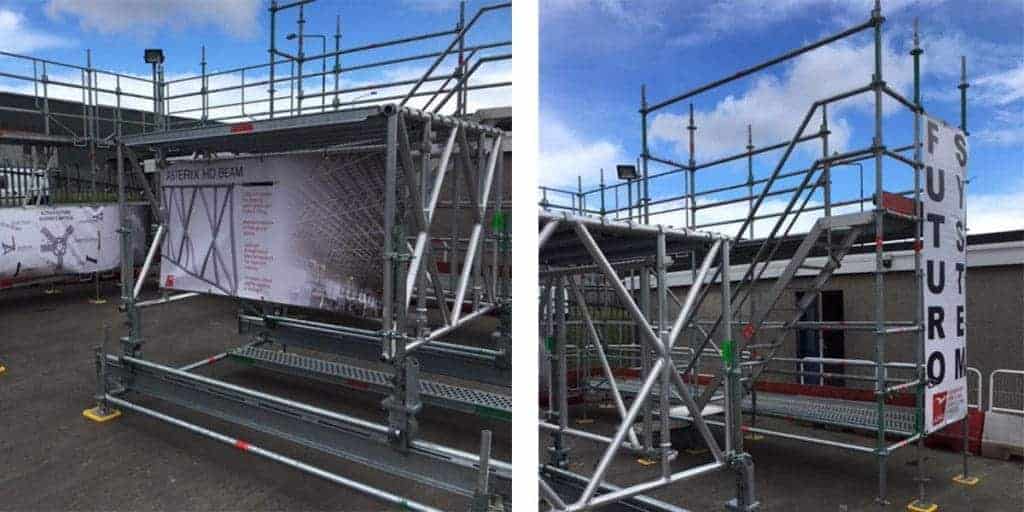
In April, it was the turn of the Edinburgh branch to show scaffolders how Futuro can transform their business and profits. Over 30 scaffolders, braved bad weather, to attend either a morning or afternoon session.Working on a Futuro scaffold, attendees saw how the innovative tension-optimised socket plate makes Futuro one the best ring systems on the market. Stress-engineered for maximum strength and weight savings, it has eight formed openings that can all be used simultaneously to house ledgers and/or diagonals set at virtually any angle. Whilst not ideal for an open-air demonstration, the hail and freezing conditions perfectly demonstrated howthe connections flat shape reduces wear and prevent ice, mortar, grit and dirt accumulation. The shape also allows the standards and socket plates to interlock to reduce the storage volume by over 5% and make it roll resistant to allow safer stacking and transportation. Attendees were impressed with the strength of the structure relative to the number of components required to achieve this. The use of steel boards as part of the integral structure means better integrity with fewer ledgers and components. The attendees saw that Futuro was 50% quicker to erect than Lok systems and 300% faster than tube fittings and boards. Gary Watson, area director for Scotland and the North East remarked on the day: “The feedback we have had has been very positive. Attendees were so impressed by Futuro we have already had enquires. The very next day we received an order for an 8-month hire. It is great to know that the demonstration was useful and underlines our commitment to our customers to provide them with the best value equipment in the market.”Combined with Generation’s design engineer team and commitment to value, Futuro provides scaffolders with quality at the best price.If you want to find out more, Generation’s demo days are FREE to attend across the country. Talk to your local branch, or check out our website for updates to see for yourself.
Wood Group has been awarded a contract to support Shell in the decommissioning of their Brent Bravo platform in the North Sea.
Effective immediately, Wood Group will prepare the platform for removal via single lift methodology. This includes conductor removal, structural strengthening and installation of under deck lift points, in addition to the modifications required to enable the platform to operate on minimum manning mode.
Dave Stewart, CEO for Wood Group’s Asset Life Cycle Solutions business in the Eastern region, said: “We have over four decades of experience supporting Shell’s Brent field and this new contract clearly demonstrates our client’s trust in our consistent delivery of innovative and efficient technical services that have been designed for offshore decommissioning challenges.“We will leverage our learnings from the delivery of the Brent Delta decommissioning scope. Our commitment is to continuing to work in partnership with Shell to ensure the safe, cost efficient and timely execution of the contract.”
Wood Group is a multinational energy services company headquartered in Aberdeen, Scotland.
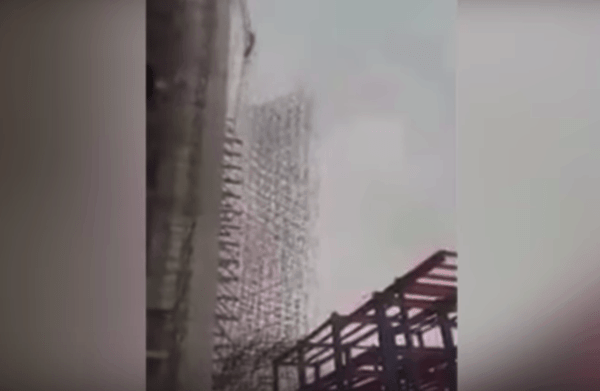
This unbelievable video captured by a bystander, shows the actual moment strong winds brought down a huge 35-storey scaffolding structure.
The video captured earlier this month shows tubes and boards falling away from the building as winds of 72kmp were reported across Tehran, the capital of Iran.
The footage looks to show the entire scaffolding start to move in an upward motion before collapsing to the ground below.
Storms were predicted across the region in the days leading up to the collapse of the huge scaffold. Those working on construction sites across the region were warned of the dangers posed by the extreme weather.
PERI Ltd, the UK’s largest manufacturer of scaffolding and formwork, has provided a unique scaffolding system to help the installation of waterproofing lining at a complex escalator shaft at the new Farringdon Station for the Crossrail project. Crossrail is building 42km of tunnels, 10 new stations and improving 30 more. The finished railway will be named the Elizabeth line when it opens in central London in 2018.
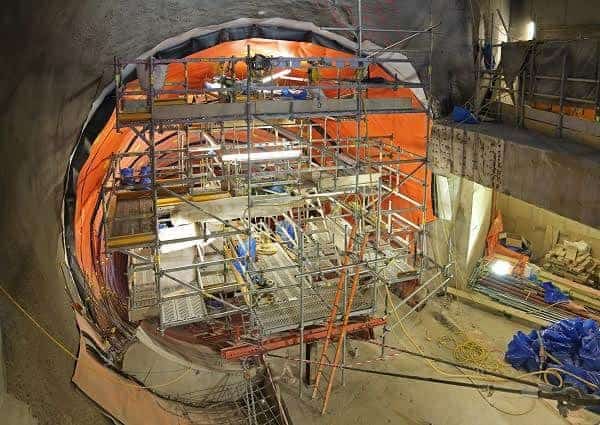
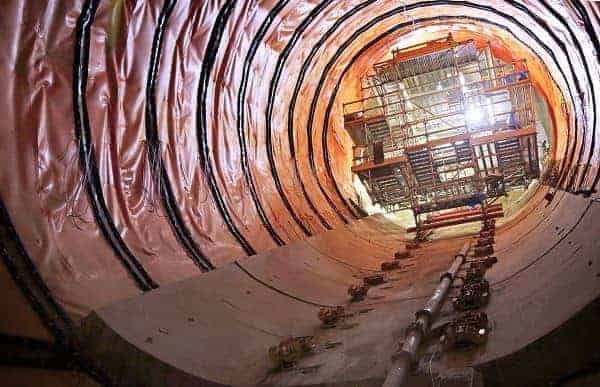
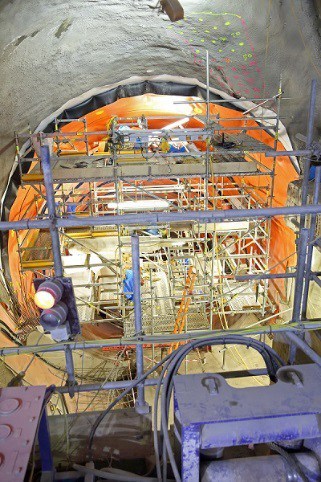
After providing an intricate scaffolding system to the tunnel works on the same project, PERI utilised a combination of its Rail Climbing System (RCS), PERI UP scaffolding and heavy duty rollers to provide contractor Bam Ferrovial Kier JV (BFK) with a safe and reliable climbing system for the complicated escalator shaft. The shaft’s 30° incline meant that PERI’s technical design team had to tailor its previous solution used on the horizontal tunnels, while also taking into consideration the various access points and climbing stability.
PERI utilised a tailored mobile scaffold system on heavy duty rollers to complete the task of waterproof lining the tunnel walls. The system was able to move along the tunnel and as this method was successful, PERI and BFK took the decision to use the same system for the escalator shaft providing the safest and most beneficial solution.
The main challenge for PERI’s design team was the 30° incline. To climb up a standard vertical shaft, PERI’s RCS can be used thanks to its ‘climbing shoes’. The RCS shoe, which is normally fixed to the core walls, allows the rail to be guided up the shaft. However, on this occasion, the RCS shoe required some additional support as the weight from the scaffold, and subsequent friction, would have potentially been too heavy. PERI’s technical team decided to deploy the same heavy duty rollers (as used in the tunnel) for the escalator shaft, meaning the scaffold was securely supported and able to move freely.
The heavy duty rollers can withstand more than 250KN of weight, meaning that, when positioned next to the standard RCS shoe, the system would work efficiently and safely. Additionally, the system was pulled up the shaft using an electronic winch, provided by the contractor, which lifted from the RCS system (rather than from the scaffold).
Another significant engineering challenge for PERI was the positioning of the platform levels used to access the surface of the tunnel. As the contractor required access to specific points, PERI had to design the scaffolding to have staggered platforms. For a standard horizontal design, the platforms can be positioned at two metre intervals, however for the 30° angle, the platforms needed to be staggered as the heights on the different angles continuously changed. After extensive research and development of the 3D designs, PERI’s team were able to plan and implement a cost-effective and optimised scaffolding solution that allowed three access stations at different heights along the 7.5m long scaffold.
Tony Austin, Regional Technical Manager, South at PERI Ltd, commented: “The escalator shaft was a really rewarding project to work on thanks to the originality of the design. The Farringdon project provided our first ever rolling tunnel scaffold designs, and utilising this to an inclined application was another first for us. The end result was ideally suited for the complexity of the project, as the waterproofing could be quickly and safely installed prior to the secondary tunnel lining.”
Nathan Bond, Engineer at BFK, added: “We were happy to once again work with PERI Ltd in the construction of the station. Given the unusual design and incline, we were delighted with the system proposed. The solution was ideal for our needs and the up-front planning, technical expertise and support from the PERI team meant that we were always in safe hands when erecting the system.”
To ensure a smooth process, PERI’s dedicated scaffolding site demonstrator regularly visited the site to help with the assembly of the equipment, providing technical advice throughout the duration of the project. PERI’s equipment was delivered to the site in late March and was on-site for just four weeks. For more information.
A search is still underway tonight after a man was reported missing from a North Sea rig.
The 49-year-old man who, according to unconfirmed reports on social media is a scaffolder from the Aberdeen area. The man was reported missing at around 9:20pm yesterday from the Noble Lloyd Noble installation, located in the Mariner Field approximately 90 miles (150km) east of Shetland.
North Sea Rig Noble Lloyd Noble
Police Scotland can confirm that inquiries are continuing to trace a 49-year-old man who has been reported missing from the Noble Lloyd Noble installation.
Searches involving the Coastguard have been carried out but have now been scaled back but the man has not been traced.
Rescue vessels are continuing to search and a team of officers led by Detective Inspector Norman Stevenson has flown offshore to carry out inquiries and assist the installation.
Detective Inspector Norman Stevenson said: “An extensive search has been carried out which has involved a search and rescue helicopter as well as standby vessels and a platform supply vessel.
“The next of kin of the man have been informed of the ongoing inquiries and further information will be made available to the public when we have it. There are no apparent suspicious circumstances.”
TRAD’s people and many of their clients – including Walter Lilly – supported Workers’ Memorial Day, held on Friday, 28th April 2017.
For this poignant memorial event, a minute’s silence was held at 11am, honoring those who have lost their lives or been injured whilst at work, a devastation which has touched so many people’s lives on a deeply personal level without much thought given from the outside world.
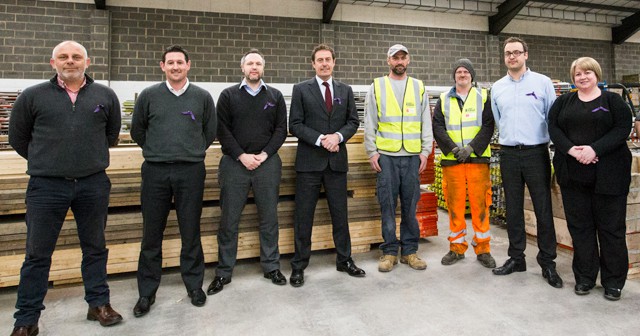
To mark this event, TRAD office staff wore purple ribbons and TRAD’s site people wore PPE displaying the purple ribbon and Workers’ Memorial Day logo.
TRAD Group intend to continue their full support by holding memorials for years to come, reminding us of the importance of supporting Workers’ Memorial Day. Like our clients, we will also strive to improve safety for all, to produce the safest environment for our people, our clients’ people and the general public, to save lives and minimise workplace injuries for future generations:
We all deserve to return home from work; SAFE AND SOUND
Generation launch new design and support services. The move is combined with investment and development of the Futuro system. The new design and engineering team provide scaffolding sub-contractors who want to adopt a ring system or have a complex structural project with access to:
A highly skilled estimation, design and engineering team
State-of-the-art design software
Project support and financial assistance
The Generation design and engineering team are co-located with Altrad DESSA, to create a shared centre of excellence. Scaffolders, in-house designers and independent consultants can now tap into these skills to support the adoption of new products, such as Futuro, and on structurally challenging projects.
The design and engineering service now work with Generation customers to support and deliver:
On-site surveys
Hand sketches
Working CAD drawing production
Stress and structural analysis
Estimation
Material shipping and health and safety advice
Equipment solutions based on scaffold and access requirements
The service is in response to our customers increased adoption of system in response to contractor demands, financial and labour pressures. In response, Generation has increased its investment and development of Futuro and the free customer services it provides.
Futuro is a versatile Ring system, which is fully compatible with other Imperial ring systems at a fraction of the price. The provision of full design and engineering support means that Generation’s account customers and their design teams have complete support to support the adoption of Futuro and any complex project.
Futuro supports a broad range of applications, in particular, construction projects for industrial and civil engineering; where adaptable heavy-duty scaffolding systems are especially important. The vast structures and complexity of these projects make the depth of experience and design support a vital part of the specification process.
Generation believes the future of system scaffold is Futuro. Our customers can now tap into the product benefits and the free services provided to grow the projects they work on and their business.
Talk to us how we can support you within the estimation, specification, design and delivery stages.
www.generationuk.co.uk

 The heavy duty rollers can withstand more than 250KN of weight, meaning that, when positioned next to the standard RCS shoe, the system would work efficiently and safely. Additionally, the system was pulled up the shaft using an electronic winch, provided by the contractor, which lifted from the RCS system (rather than from the scaffold).
Another significant engineering challenge for PERI was the positioning of the platform levels used to access the surface of the tunnel. As the contractor required access to specific points, PERI had to design the scaffolding to have staggered platforms. For a standard horizontal design, the platforms can be positioned at two metre intervals, however for the 30° angle, the platforms needed to be staggered as the heights on the different angles continuously changed. After extensive research and development of the 3D designs, PERI’s team were able to plan and implement a cost-effective and optimised scaffolding solution that allowed three access stations at different heights along the 7.5m long scaffold.
The heavy duty rollers can withstand more than 250KN of weight, meaning that, when positioned next to the standard RCS shoe, the system would work efficiently and safely. Additionally, the system was pulled up the shaft using an electronic winch, provided by the contractor, which lifted from the RCS system (rather than from the scaffold).
Another significant engineering challenge for PERI was the positioning of the platform levels used to access the surface of the tunnel. As the contractor required access to specific points, PERI had to design the scaffolding to have staggered platforms. For a standard horizontal design, the platforms can be positioned at two metre intervals, however for the 30° angle, the platforms needed to be staggered as the heights on the different angles continuously changed. After extensive research and development of the 3D designs, PERI’s team were able to plan and implement a cost-effective and optimised scaffolding solution that allowed three access stations at different heights along the 7.5m long scaffold.
 Tony Austin, Regional Technical Manager, South at PERI Ltd, commented: “The escalator shaft was a really rewarding project to work on thanks to the originality of the design. The Farringdon project provided our first ever rolling tunnel scaffold designs, and utilising this to an inclined application was another first for us. The end result was ideally suited for the complexity of the project, as the waterproofing could be quickly and safely installed prior to the secondary tunnel lining.”
Nathan Bond, Engineer at BFK, added: “We were happy to once again work with PERI Ltd in the construction of the station. Given the unusual design and incline, we were delighted with the system proposed. The solution was ideal for our needs and the up-front planning, technical expertise and support from the PERI team meant that we were always in safe hands when erecting the system.”
To ensure a smooth process, PERI’s dedicated scaffolding site demonstrator regularly visited the site to help with the assembly of the equipment, providing technical advice throughout the duration of the project. PERI’s equipment was delivered to the site in late March and was on-site for just four weeks. For more information.
Tony Austin, Regional Technical Manager, South at PERI Ltd, commented: “The escalator shaft was a really rewarding project to work on thanks to the originality of the design. The Farringdon project provided our first ever rolling tunnel scaffold designs, and utilising this to an inclined application was another first for us. The end result was ideally suited for the complexity of the project, as the waterproofing could be quickly and safely installed prior to the secondary tunnel lining.”
Nathan Bond, Engineer at BFK, added: “We were happy to once again work with PERI Ltd in the construction of the station. Given the unusual design and incline, we were delighted with the system proposed. The solution was ideal for our needs and the up-front planning, technical expertise and support from the PERI team meant that we were always in safe hands when erecting the system.”
To ensure a smooth process, PERI’s dedicated scaffolding site demonstrator regularly visited the site to help with the assembly of the equipment, providing technical advice throughout the duration of the project. PERI’s equipment was delivered to the site in late March and was on-site for just four weeks. For more information.