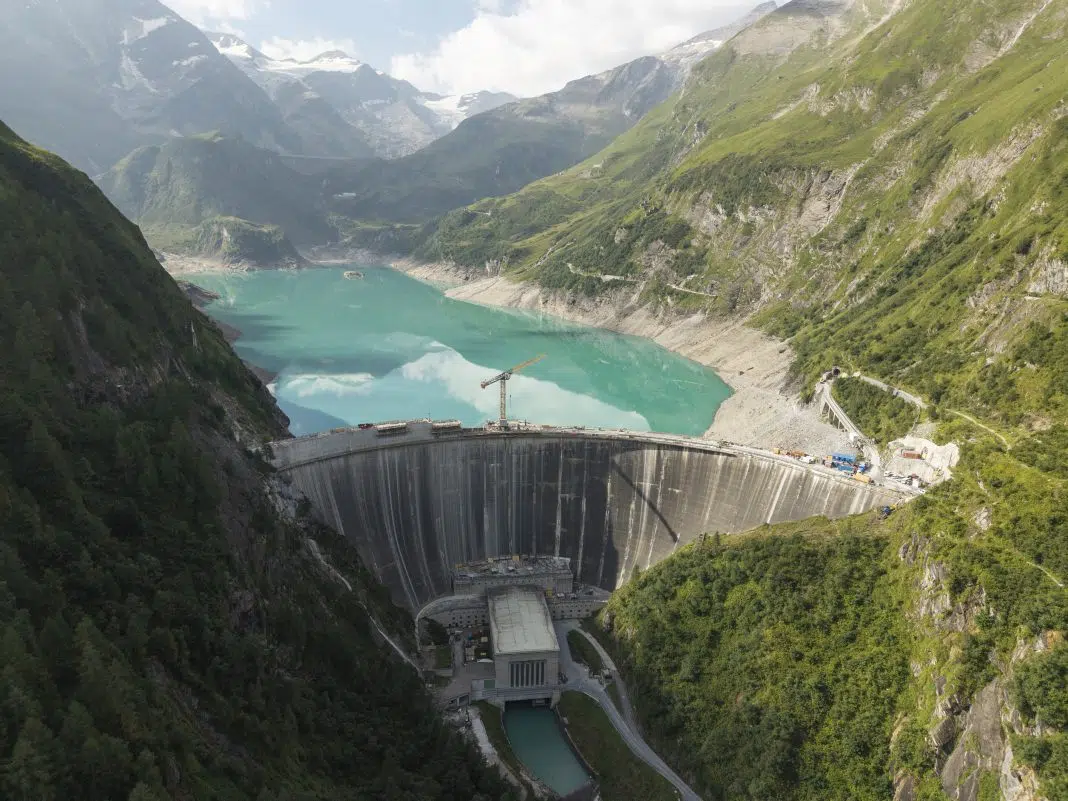
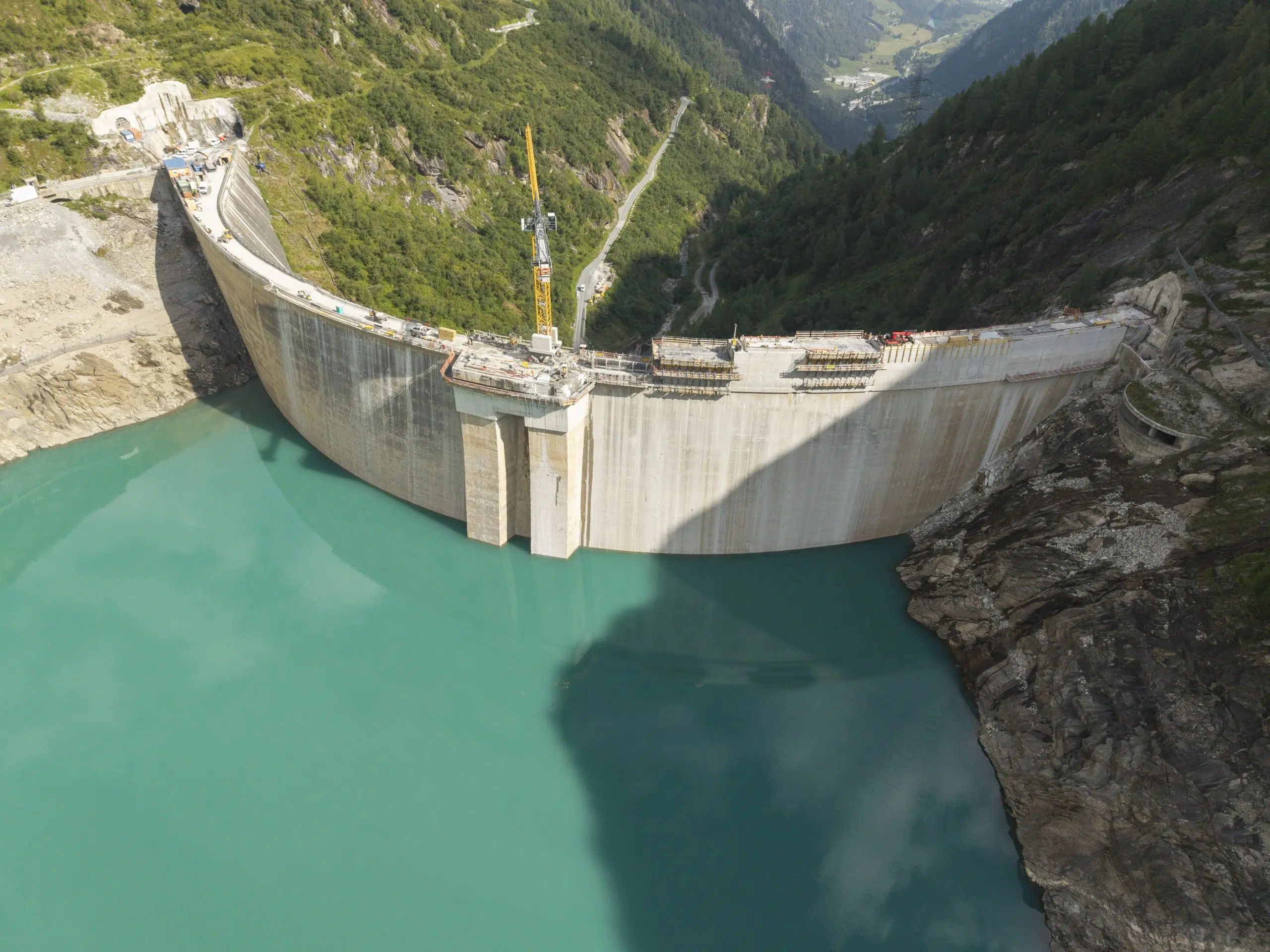
Specialist formwork company Doka is playing a crucial role in one of Europe’s most challenging renewable energy projects, helping to raise a dam 1,700 metres up in the Austrian Alps under some of the continent’s harshest construction conditions.
The Austrian firm has been tasked with providing the technical solutions needed to raise the Wasserfallboden Dam near Kaprun by nine metres – work that must be carried out in sub-zero temperatures, winds exceeding 100 kilometres per hour, and with extraordinary logistical constraints.
The project forms part of the €500 million Limberg III pumped-storage power plant, which, when complete in 2027, will add 480 megawatts of flexible capacity to Austria’s electricity grid and provide vital energy storage for Europe’s renewable transition.
“This project highlights how Doka solutions contribute to the global energy transition,” says Harald Zulehner, Managing Director of Doka Austria. “Here in Austria’s high-alpine environment, our technology and teams enable safe, efficient and reliable execution – even under the toughest conditions.”
Precision engineering at altitude
Doka, which employs 9,000 people worldwide and operates in over 58 countries, has deployed several of its most advanced systems for the Limberg project. The company’s involvement extends from the dam raise itself to the underground cavern housing the new power plant machinery.
For the dam construction, Doka has supplied its D22 dam formwork system, which ensures safe load transfer during concrete pours – critical when working on a structure that will eventually reach nearly 129 metres in height. The Top 50 large-area formwork system enables precise shaping of the curved dam blocks, essential for an arch dam where millimetre-level accuracy is required.
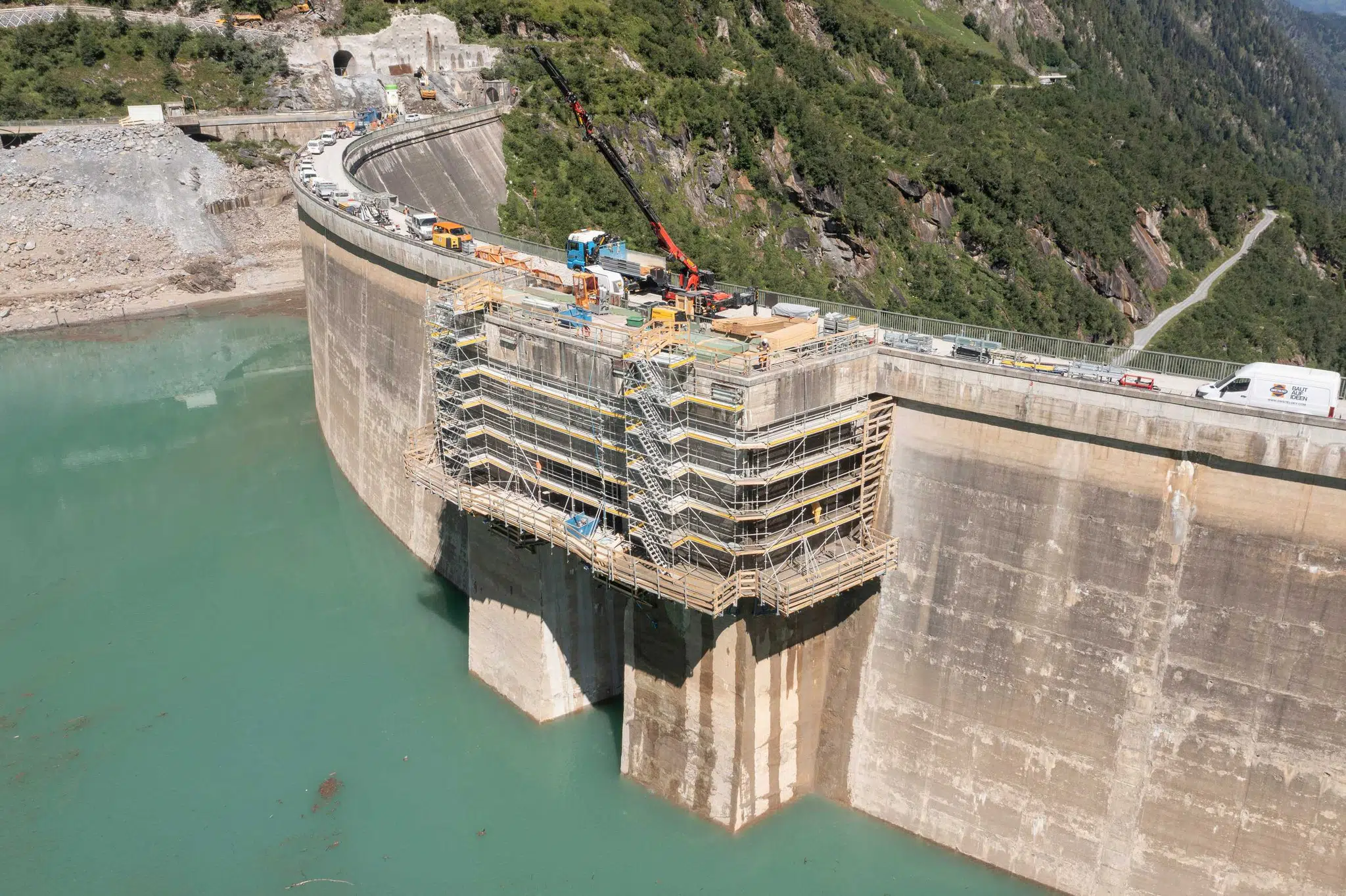
Safety has been paramount given the extreme working environment. More than 700 running metres of Doka’s folding platform K have been installed to provide reliable and safe working conditions for construction crews operating at height in challenging weather. At the control centre, 22 tonnes of Ringlock modular scaffolding serve as stair towers and flexible working platforms for installation and assembly work.
Transforming construction timelines
Perhaps most significantly, Doka’s approach has dramatically accelerated what would traditionally be a slow and painstaking process. Through advanced 3D planning, pre-assembly of components before they reach the site, and optimised logistics tailored to the high-alpine location, the company has helped reduce concreting cycles to just three days for approximately 260 cubic metres.
This represents a considerable achievement. At 1,700 metres above sea level, every aspect of construction becomes more complex. Materials must be transported up winding mountain roads, equipment must function reliably in freezing conditions, and work schedules must adapt to rapidly changing weather patterns.
The scale of Doka’s involvement reflects the technical complexity of the project. VERBUND, Austria’s leading electricity company and the project’s client, specifically sought out the firm’s expertise in dam construction for this flagship energy infrastructure project.
Supporting Europe’s energy transition
The Wasserfallboden Dam raise will increase the reservoir’s storage capacity by 12.7 million cubic metres, bringing the total to nearly 94 million cubic metres. This expansion will provide approximately 30 gigawatt-hours of additional storage – enough to power around 6,000 homes for a year.
Pumped-storage power plants like Limberg III work by pumping water uphill to reservoirs during periods of excess renewable generation, then releasing it through turbines when demand peaks. They are crucial for stabilising electricity grids as countries transition away from fossil fuels.
The Kaprun power plant group, often dubbed the “battery of the Alps”, already includes two pumped-storage facilities dating from the 1950s and 2011. The new Limberg III facility, commissioned on 12 September, operates independently but draws from the same high-alpine reservoirs.
Doka’s work on the project demonstrates how specialist construction technology firms are becoming essential partners in the renewable energy transition. Without the ability to build safely and efficiently in extreme environments, major infrastructure projects like Limberg III would face significant delays or prove economically unviable.
A showcase for advanced construction
The project, being built by Austrian construction firm Swietelsky AG with overall management by PSKW ARGE Limberg III – a partnership between PORR and Marti Tunnel AG – represents one of Austria’s most significant energy infrastructure investments.
For Doka, founded over 150 years ago as part of the Umdasch Group, the Limberg project showcases the company’s evolution from a traditional formwork supplier to a provider of integrated construction solutions. The firm’s involvement spans the entire construction process, from initial 3D planning through to on-site technical support.
As European nations work to meet climate targets and reduce dependence on imported fossil fuels, projects like Limberg III are becoming increasingly valuable. The raised dam will be completed in 2027, with Doka’s systems in use throughout 2025 and 2026, helping to secure Austria’s position at the forefront of renewable energy storage technology.
The success of the project could provide a template for similar high-altitude renewable energy infrastructure across the Alps and other mountain ranges, where pumped storage offers one of the most effective solutions for balancing intermittent wind and solar generation.