
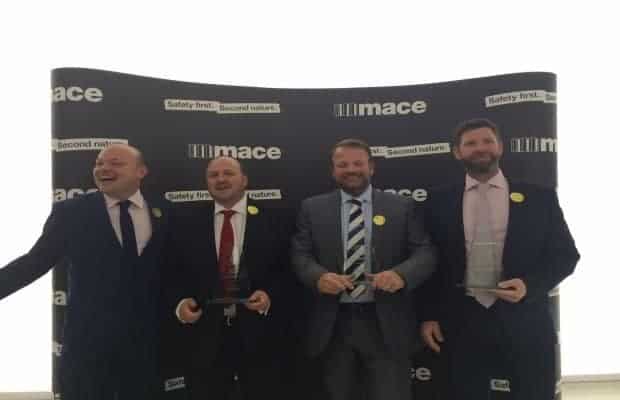
GKR Scaffolding Wins Big At Mace’s Safety Awards Ceremony

ADVERTISEMENT

gkr scaffolding

London based scaffolding firm GKR Scaffolding Ltd has been awarded three accolades for outstanding contributions to health and safety.

On Wednesday, 15 October, GKR Scaffolding Limited attended Mace’s inaugural ‘Safety first. Second nature.’ awards at 30 Euston Square, London.

The awards had been introduced this year to celebrate the outstanding contributions made to health and safety by those across Mace, their clients and supply chain. They recognise the great strides being made from a health and safety perspective at Mace and are an opportunity to thank those for their achievements. It will also service to set a benchmark in best practice for the future.
The GKR team are relentlessly committed to delivering innovative scaffolding solutions safely and improving the safety culture across the scaffold industry.

The firm said they were proud to have been recognised by Mace for their safety culture and for winning the following categories at this year’s awards ceremony:

  • Innovation and Design award for Elimin-8
  • Supply Chain Awards – Most improved
  • Supply Chain Award – Individual: Lee Rowswell

Overall, the GKR team was honoured as a Mace supplier that has demonstrated improved health and safety performance over the past year, along with an increased commitment and drive to communicate the safety message across Mace’s supply chain partners.
Mace’s Group Board sponsor for health and safety, Jason Millett said:

“It was wonderful to see everyone come together to celebrate the achievements that we, along with our clients and supply chain partners, have made in health and safety. There have been some outstanding contributions to Mace’s ‘Safety first. Second nature.’ programme, and, in recognising these, we have been able to say thank you and show our appreciation for all of the hard work and commitment. A truly memorable evening.”

SM Newsdesk
SM Newsdeskhttps://www.scaffmag.com
The staff at ScaffMag.com the leading scaffolding site for a digital generation.

Most popular ↑

Saudi firm breaks 27-year-old scaffolding world record

Saudi scaffolding firm Manar Al Omran has set a new Guinness World Record after building a 67.40m free-standing scaffold in Dammam.

CSCS challenges CISRS case for leaving card scheme

CSCS has challenged the reasons for CISRS’s planned departure, while CISRS tells ScaffMag its legal advice and concerns over duplicate cards underpin the decision.

Scaffold Innovations: GapClamp™

  Since the Work at Height Regulations 2005 came into...

SG4:10 We Think The Answer Is Fast Guard™

If Carlsberg made advance guardrails.....  could this be the...

Scaffold collapses at Sydney site weeks after two workers seriously injured

The scaffold came down at a development on Wattle...

Latest news

CISRS says CSCS notice was served to negotiate “from a stronger position”

NASC president Sarah Klieve says CISRS served CSCS notice to negotiate from a stronger position, as Build UK says the card rules don’t block other sectors.
- Advertisement -
More from

Right-to-work rules extend liability through construction supply chains

Contractors face new responsibilities for labour supplied through subcontracting chains as expanded right-to-work rules come into force.

Housing permission slump raises questions over future scaffolding workload

Planning permissions for new homes in England have fallen to their lowest quarterly level since 2012, raising questions over the volume of residential work likely to reach scaffolding contractors further down the construction pipeline.

Builder fined £120,000 after fatal fall through unsafe floor

W G Carter has been fined £120,000 after carpenter Richard “Felix” Roper suffered fatal injuries in a fall during building work, with HSE pointing to safer access and work sequencing.

Queensland coroner calls for mandatory tower scaffold controls after fatal collapse

A Queensland coroner has called for mandatory additional controls on freestanding tower scaffolds in public places after finding that the industry’s accepted height-to-base rule of thumb was not enough to protect against strong winds.
Latest articles