In the light of the current European conflict, an Immingham based supplier of scaffolding materials has cancelled all orders placed for delivery to Russia.Scaffolding Supplies Ltd has made the decision faced with its latest order due to go to Sakhalin Island. They’ve also called on a complete boycott of sales to both engineering and scaffolding companies across Russia.
Contractors across the construction sector had recently been warned to act immediately to avoid a disruption in the supply chain because of the invasion of Ukraine.
With the inevitable price rises taking hold of deliveries and materials, experts across the whole construction industry had warned some projects could come to a standstill.
Scaffmag has learned the Russian invasion could drive up inflation in the cost of products utilised on construction sites here at home. This also follows on from the fact oil prices have reached a 14-year high.
“tube is set to be in short supply with prices rising to £ 1.50/ft in the next few weeks – it’s going to affect everyone.”
A spokesperson from Scaffolding Supplies Ltd told us: “You will find the material prices are on the rise again with boards alone going up £ 2.00 each. The way things are developing it won’t be long before we see £20 per board.“What’s more, tube is set to be in short supply with prices rising to £ 1.50/ft in the next few weeks – it’s going to affect everyone.“Given what President Putin has done we feel it important to stand shoulder to shoulder with Ukraine at this critical time.“Let’s be honest, all sectors of life here in the UK will see more price rises as the conflict continues. But we feel it’s right to take a stand and are quite prepared to see any downturns through. Freedom and the people of Ukraine are at the front of our minds.”
Only yesterday President Biden reminded the world America will do all it can to punish Russia for the conflict, but freedom sometimes comes at a price.
Brian Berry, chief executive of the Federation of Master Builders (FMB), said Russia’s invasion of Ukraine was creating “dire economic and humanitarian consequences throughout the world.“As a result of Russia’s actions, supply chain disruption and the reallocation of certain types of materials will intensify the situation, with oil, steel, aluminium, timber and copper all set to be some of the worst affected. At a time when costs are surging, it puts builders in the unenviable position of having to raise costs for a customer base that are tightening their belts.”
In terms of the UK, it seems the Immingham company could be the first to take such action putting people before profit.
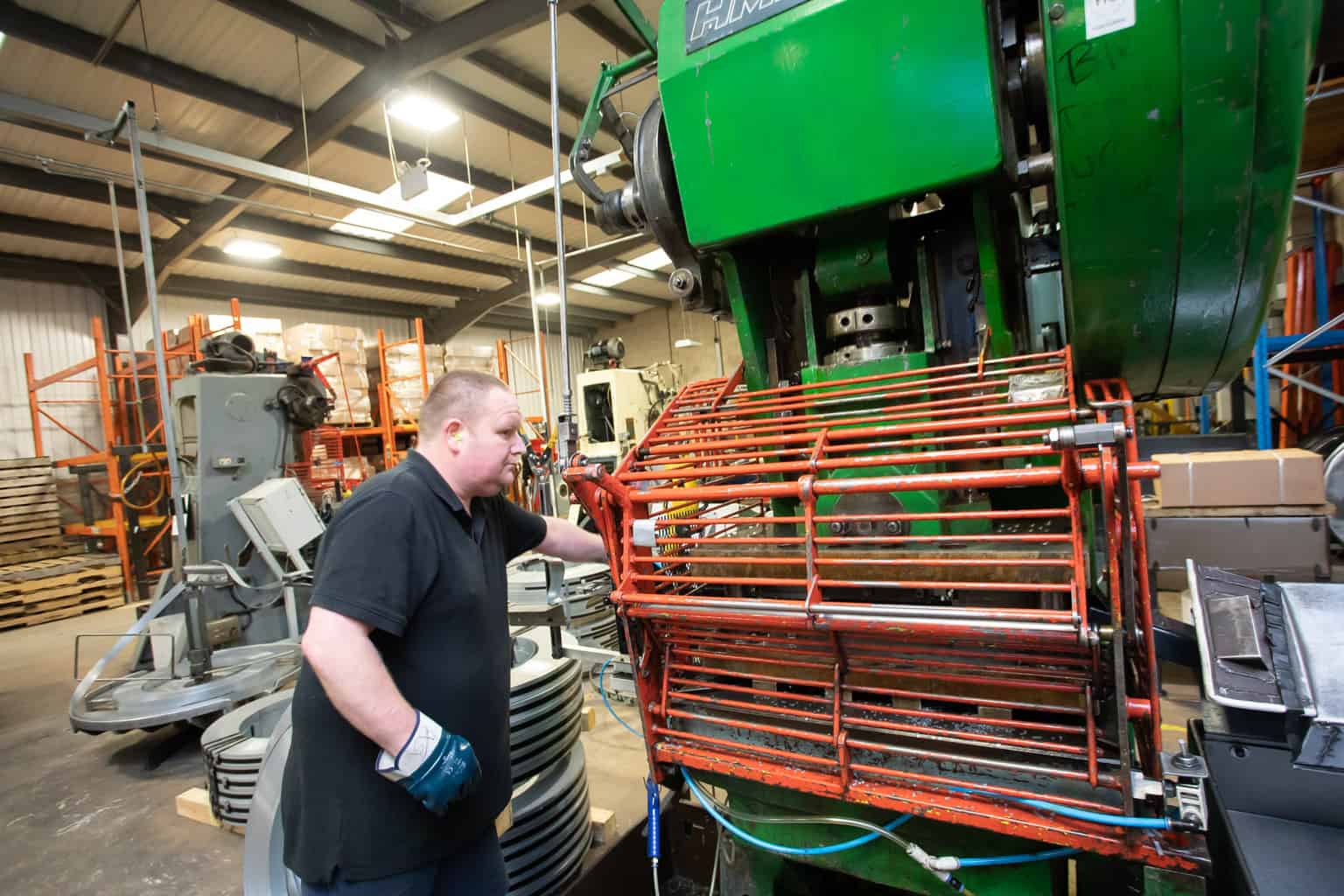
The UK’s leading manufacturer of scaffold board end bands has posted an impressive 12% increase in volumes, thanks to a timely investment in new equipment and a switch to a 4-day working week.Chilwell Products, which is now under third-generation family ownership, has invested nearly £100,000 into equipping eleven of its power presses with the latest servo feed technology from Bruderer UK.
The company which is based in Stanton by Dale were originally looking to continue using air feeds but were convinced by experts from the high-speed press specialist to trial its MF-2P servo feeders and the results have been astonishing.
Volumes have gone from 15.6million to 17.5million over the last twelve months and, better still, the firm has managed to achieve this in just four days, making Friday a permanent day off as a thank you (whilst all staff still maintain full pay).
“We always thought that using servo feeds would mean the material would slip when oily, but these initial concerns were quickly blown away once we put the equipment through a supported trial,” explained Laura Clarke, Managing Director of Chilwell Products and the granddaughter of founder Derrick Telford.
“Through experience, we found set up times were far quicker and they run the material significantly more efficiently than our incumbent air feeds; fewer jams, less downtime, less material rejected and wasted. All making for a much more efficient production.”Image: Rob Finney Photography
She continued: “With this in mind, we began to roll-out the feeders across every press in our factory and are now up to eleven, with a twelfth on order.“Working 39 hours per week and overtime during multiple points throughout the year is now a thing of the past. We always worried that we’d have to move to a larger premises and buy additional presses, but we’ve even eliminated one of the lines as it proved to be surplus! Thanks to Bruderer UK, the outlook and future for the company really has been totally transformed.”
Laura, who took over the reins from her mother and now Company Secretary and Director Lorraine Clarke in 2019, is a firm believer in work/rest balance and ensuring Chilwell Products looks after the heart of its operation – its people.
Boosted by the new technology and changes on the shopfloor, the 30-year-old business leader has written into employee contracts that they’ll never have to work on Fridays or weekends again.
It’s also worth noting that annual salaries are remaining the same, despite staff working five hours less every week.
“We’ve made the changes and have still achieved a 45% increase in capacity, helping us increase turnover and giving us the chance to go after new opportunities,” continued Laura.
“Everyone at Bruderer has been brilliant. From the start, they understood our issues and our concerns and quickly came up with a solution that eased our fears and, instead, opened our eyes to up the opportunity.“The eleven servo feeds are all high quality and installed in a timeframe that suited our business, with the added bonus of having full support of an account manager on hand if we had any small issues in the early days.”Image: Rob Finney Photography
Adrian Haller, Managing Director of Bruderer UK, added: “We’re very used to our technology and equipment having a really positive impact on the shopfloor, but it is even better to hear we have helped introduce a new culture that has transformed Chilwell Products.”
He concluded: “This is definitely a story we are going to tell people when they visit us at MACH 2022 in April – it really underlines what a difference you can make to production and capacity if you explore different processes. Better still we’ll guide you through the entire process.”
Today (8 March) is International Women’s Day – and Victoria Boyle is doing her bit for gender equality after taking on the responsibility for running Legion Scaffolding’s Mercedes-Benz trucks.Legion Scaffolding was established by Daniel Boyle in 2012 and provides commercial and construction scaffolding services, including complex engineering structures, to clients throughout Greater London, Essex and north Kent.
Victoria joined her brother in the Brentwood-based business five years ago and worked initially as his Personal Assistant before stepping up to become Company Secretary. Then, after a vacancy arose for a new Transport Manager, Victoria jumped at the opportunity to add another role to her CV.
“I told Daniel I really wanted to have a go at managing the fleet and he agreed to back me,” she recalled. “Although times are changing, it’s not a job in which you’ll find many women. But I’ve always worked in male-dominated environments – I’ve sold cars and was also a shift manager at DPD, for example – and it suits my character. I knew I could make a go of it.”
And so it’s proved. Victoria participated in an intensive two-week training course at Essex Driver Training in Battlesbridge last summer, at the end of which she passed an examination to secure her Transport Manager’s Certificate of Professional Competence (CPC) qualification from the Chartered Institute of Logistics and Transport (CILT).
Her commitment and determination to succeed strikes a chord with today’s global celebration of the social, economic, cultural and political achievements of women. “I love being a Transport Manager,” enthused Victoria.
“It has its frustrations like any job, particularly because it feels as though the rules and regulations around compliance are constantly changing. But we have a great team of drivers and our Mercedes-Benz trucks are fantastic.”
These are exciting times for Legion Scaffolding, which has remained busy throughout the pandemic. The company recently relocated to a new yard on the opposite side of Brentwood that has double the space of its former home and provides the perfect platform from which to achieve its growth ambitions.
Meanwhile, Legion Scaffolding has just taken delivery from local Dealer Motus Truck & Van, of three new Mercedes-Benz Actros 18-tonners. They represent something of a milestone in being the operator’s first brand new trucks – it has previously acquired used vehicles, including the Euro V Axor rigids that have now been stood down to make way for their successors.
The subject of a Mercedes-Benz Finance contract hire agreement, the new arrivals are Actros 1824 variants with ClassicSpace S-cabs and 320mm engine tunnels. This combination, together with the enhanced visibility provided by their standard-fit MirrorCam technology, merits an impressive four-star Direct Vision rating from Transport for London.
The Actros are powered by 7.7-litre in-line six-cylinder engines that produce 175 kW (238 hp) and are fitted with bespoke platform bodies by Piggott Coachbuilders, of Bishop’s Stortford.
Motus Truck & Van Sales Executive Steve Jenkins worked closely with his customer to ensure the new trucks are perfectly specified to meet its requirements, so each is fitted with an additional centre seat, as well as an optionally upgraded radio and an air gun on a wander lead for blowing dust out of the cab, and protective grilles over the headlights.
Reflecting the operator’s commitment to safety, the trucks are additionally equipped with Brigade safety cameras that were installed by Advanced Alarms, an established supplier to the Dealer.
They are also the first vehicles to wear Legion Scaffolding’s smart new livery – two are in black but the other is silver, with highlights in the same purple shade as the company applies to its scaffolding tube. They have lined-up alongside its remaining pre-owned truck, a 4×2 Actros tractor unit first registered in 2015, which works with a pair of flat-bed trailers.
“Our Mercedes-Benz trucks have always been cost-effective to run and exceptionally reliable,” confirmed Victoria. “That’s crucial, not least because we do a lot of work for a client that undertakes emergency repairs to local authority housing stock, so when they call we have to be able to respond quickly.“Image is also important in this business, and my brother likes everything to look smart and professional,” she added.
“Mercedes-Benz is a premium brand and our new trucks have already been very well received by customers. We believe the three-pointed star reflects the quality of our own service.”
The theme for International Women’s Day 2022 is #BreakTheBias. Whether deliberate or unconscious, say those behind the campaign, bias makes it difficult for women to move ahead. Knowing that bias exists isn’t enough, they contend. Action is needed to level the playing field.
Mercedes-Benz Trucks UK Head of Marketing Katie Purcell commented: “We’re delighted to be recognising International Women’s Day 2022. Although there are more women working in our industry every year, there is still a long way to go before we achieve true parity.“So it’s always great to be able to celebrate the achievements of women like Victoria, who are ‘breaking the bias’ by smashing stereotypes and proving that Mercedes-Benz trucks are for everyone, irrespective of their gender.”
Tim Balcon the CEO of the CITB, has written to construction employers to invite them to take part in a pilot, which will not only offer a job opportunity to an ex-offender but help employers fill their skills gap.
Tim said: “I am very pleased to be working with a group of like-minded people from various organisations in the north west and north Wales.“We have come together in an attempt to address the skills issue and assist individuals who are looking for an opportunity for a fresh start. “We hope this pilot will act as a role model for partnerships between employers, CITB, training providers and other prisons nationally going forward.”
J Murphy & Sons Ltd, Her Majesty’s Prison and Probation Service, (HMPPS) employment specialists, New Futures Network, HMP Berwyn, the CITB-funded Onsite Experience Hub managed by Procure Plus and CITB are looking for a group of willing construction companies who can come together and offer opportunities to prisoners who will be released in the coming months.
Employers are being asked to offer real job opportunities for prison leavers, using the hub to fill their vacancies. The required basic construction skills training will be completed while still at HMP Berwyn, and augmented with a site-based work placement.
The employer will sponsor/mentor one of the applicants while they are undertaking their training. Induction with the firms will take place in custody in preparation for release when they will complete a mandatory work experience placement or direct employment.
Interested employers have been invited to attend a ‘Fresh Start’ awareness event on 5th April to see the prison facilities and hear success stories from one of the partners in the initiative, J Murphy & Sons Ltd.
J Murphy & Sons Limited has already formed a successful partnership with HMP Berwyn and engaged with prison leavers for a long period of time.
John Murphy, CEO, said: “I am pleased to chair the Berwyn Employment Advisory Board, and with the tangible progress we are already making at HMP Berwyn. Thank you to the CITB and other partners for their support. “I would like to encourage all regional employers to consider ex-offenders as a valuable employment stream and a potential driver of their economic growth. Our programme shifts the focus onto upskilling offenders while they are still in the prison system, ensuring they are ready to move straight into stable work when released. Interested employers should attend our event on 5 April to find out more.”
There has already been a good response and following the employers event in April there will be a “Meet the employer” session in May for prisoners due for release who would like to take part in the scheme.
Employers will have the opportunity to meet the candidates, to explore their skills set and identify available experience or employment opportunities. Prior to their release, the prisoners will complete a company induction to ensure they are ready to start work once released.
This is a pilot for HMP Berwyn with plans to roll out the model to other prisons in the near future.
With the number of new construction schemes started across Birmingham City Centre almost doubling in 2021, the HSE are sending inspectors out to sites to ensure firms are complying with health and safety regulations.
As the city prepares to host the 2022 Commonwealth Games in just 140 days’ time, the HSE has noted increased development across the city potentially raising risks for both workers and the public.
Sarah Hill, one of the HSE inspectors leading the campaign, commented: “With a high volume of construction sites in the busy city centre, there is inevitably more potential for incidents which can result in life-changing injuries or worse and working environments which can pose respiratory risks and are hazardous to workers’ health and well-being. This week, HSE colleagues and I will be visiting sites across the city to check that employers are managing risk and keeping workers and the public safe. The fatal injury rate in the construction sector is around four times the all-industry rate, while over 3,500 builders die each year from cancers related to their work, so this is reminder to employers that there is no room for complacency or non-compliance.”
During a visit, inspectors look to see how companies keep their workers, and anyone affected by the work they do, healthy and safe. In the event that an employer is breaking the law, an inspector may deploy a range of measures such as issuing an improvement notice which allows a minimum of 21 days for the issue to put right or, in the case of the most serious breaches, prosecution.
Sarah Hill added: “The majority of work-related illness, injuries and fatalities are wholly avoidable if those responsible for the welfare of their workers follow health and safety guidance and regulation. Construction is a high risk industry, but those that work in it are as entitled as everyone else to go home safe and well at the end of the day.”
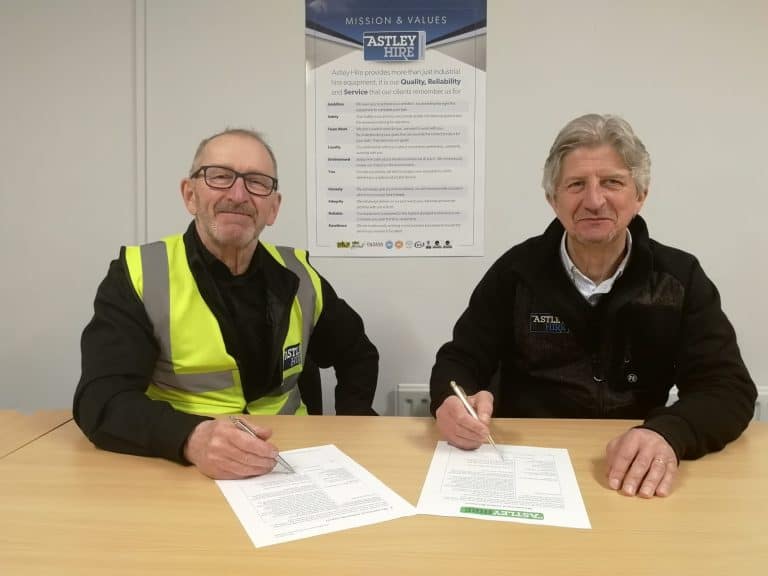
Astley Hire is one of the first industrial equipment hire companies to achieve carbon-neutral status for December 2020 – November 2021 under PAS 2060 framework.
In 2021 Astley Hire embarked on a 12-month long project to address how they could further minimise the environmental impact of the business.
The company has held the ISO 14001 environmental standard for many years but was inspired to make the big push for carbon neutrality by the UK’s target to become carbon neutral by 2050.
Astley Hire engaged with consultancy service Charis Ventures Ltd to assist with the project. By working together to form and implement a comprehensive carbon scheme, Astley Hire and Charis Ventures were able to reduce a potential carbon footprint of 142.08 tons down to a residual value of 48.24 tons, which has been offset via the government approved Carbon Footprint scheme.
Astley Hire’s General Manager, Martin Doran, said: “We have always been aware of the impact of our business activities on the outside world. I am pleased to have reached this significant milestone of zero-carbon neutrality and be one of the first hire companies in the UK to have achieved this status. Our customers who prioritise their green credentials can benefit greatly from knowing they are hiring equipment from a carbon-neutral provider.”
Being carbon-neutral is the first milestone in a long term effort to reduce the business’ carbon output and the requirement for carbon offset.
Astley Hire’s aim for 2022 is to reduce carbon offset by a further 10%, with similar targets for future years.
Over 2022 and beyond, Astley Hire will examine business processes and seek ways to improve key areas such as their vehicle fleet efficiency, fuel for hire equipment, employee commuting, and the digitalisation of processes.
Company Directors Stephen and Michael Dorricott added: “This is probably one of the biggest milestones we have reached as a business in our 56 years of existence. We, as directors, have always been passionate about reducing the environmental impact of the business we own.We are aware that this is only one step in our journey and there is still work to do.”
The next stage of Astley Hire’s carbon-neutral journey is to get the PAS 2060 result certified by an external body, with a long term strategy to target every aspect of the business as technology advances and greener solutions become available.
A North Yorkshire scaffolding company is playing a key role in a major project being undertaken at a famous Yorkshire country house.
Having already successfully completed projects at Knaresborough Castle and Allerton Castle, Thorpe Arch-based Elite Scaffolding is now playing a significant role in a major roof renovation project underway at Ripley Castle, near Harrogate.
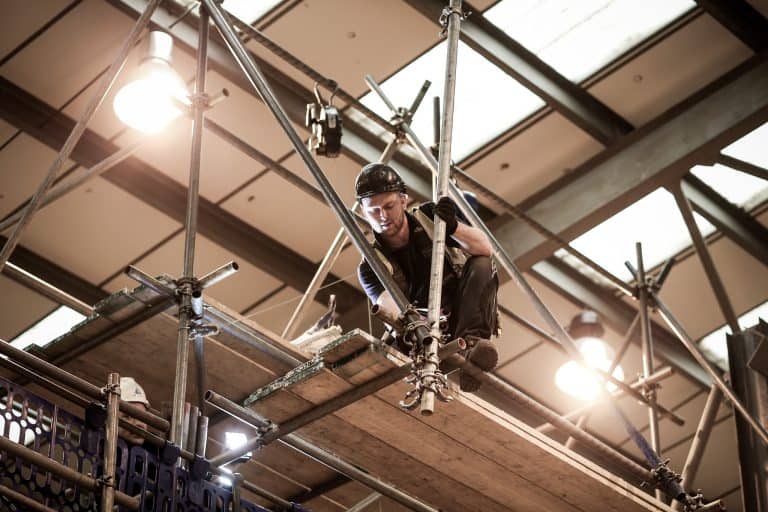
For its part, the Elite team spent four weeks scaffolding the exterior of the 14thCentury, Grade I Listed building, home to the 6th Baronet Ingilby and his family, allowing specialist roofing contractors to carry out their work.
And whilst Ripley Castle is a private house, it and its grounds are open to the public. It is also a popular wedding venue. Last October, the Castle was one of 142 sites across England to receive a slice of the Government’s £35m Culture Recovery Fund.
Spencer Cassidy, Elite Scaffolding’s Managing Director, said: “This is the third Yorkshire castle that we have scaffolded, and in terms of scale it is certainly the most significant.“Before starting, we worked closely with Ripley Castle owner, Sir Thomas Ingilby, and main contractor, HACS, to ensure our work would not visually impact on two weddings it was hosting.“The Elite team worked seven days a week for four weeks, fixing thousands of scaffold tubes and hundreds of planks in place, enabling the roofers to work safely and securely. And once the work on the roof is completed, we will be ready to dismantle our work quickly and efficiently.”
He added: “We have been keeping a very close eye on the weather, and despite enduring three significant storms which have brought gale force winds, torrential rain and snow, I’m pleased to say haven’t given us any problems.“This is a significant project to be involved with and one that boosts our credentials of scaffolding historic and listed buildings. We pride ourselves on the quality of our work and our aim is to raise the standard of scaffolding in Yorkshire. We believe our latest project at Ripley Castle is proof of this.”
Four contractors have been given suspended prison sentences after a scaffolder was crushed to death when a church collapsed ahead of its demolition.
Jeff Plevey, 56, from Cardiff, was killed when the derelict Citadel Church in the city, collapsed as he dismantled the scaffolding surrounding it in July 2017. Contractors had been employed to demolish the church, which was adjacent to a railway line, after the building was sold to a developer.
The incident happened on the afternoon of July 18 when railway workers on the nearby Splott Bridge heard a “loud crack” and “a bang, like a small explosion”. They heard men shouting “run” before the scaffolding around the church collapsed with another “huge bang”.
The workers hurried across to find those who had escaped looking “distressed” and repeatedly saying: “Jeff is inside.” Keith Young, 74, was the contractor in charge of the demolition, while Stewart Swain, 54, was the director of the company hired to erect the scaffolding.
Both stood trial at Cardiff Crown Court accused of gross negligence manslaughter in relation to Mr Plevey’s death but were acquitted by a jury.
They were convicted of lesser health and safety offences.
Young, from Llandough, was director of Young Contractors and was found to have acted in contravention of health and safety regulations.
Swain, from Whitchurch in Cardiff, and his company Swain Scaffolding Limited, were found to be an employer in breach of their duty to an employee.
The owner of the Citadel, Mark Gulley, from Penarth, and Richard Lyons, from Bristol, were also on trial but were acquitted of all charges against them.
Mr Gulley’s company Amos Projects Limited, and Mr Lyons’ Optima Scaffold Design Solutions Ltd, also received not guilty verdicts.
Two other men, Phillip Thomas, from Cardiff, who was Young’s health and safety adviser from South Wales Safety Consultancy Ltd, and Richard Dean, of Abertillery, from NJP Consultant Engineers Ltd, had pleaded guilty to health and safety offences before the trial.
An investigation by the Health and Safety Executive and South Wales Police disclosed a catalogue of failings throughout the course of the demolition works.
Those convicted failed to properly acknowledge and manage the risk presented by the unstable rear wall of the church. The church on Splott Road was built in 1892 and was mainly used by the Salvation Army until it became vacant about 20 years ago and fell into disrepair.
Network Rail had commissioned a survey into the building’s condition due to its closeness to Splott Bridge, which was undergoing works as part of the electrification of the railway between Cardiff and London.
The report found the church to be in a “poor” state and the rear wall “in danger of imminent collapse”.
Although the report was shared with Mr Gulley in 2016, who in turn shared it with the contractors he hired to carry out the demolition project, when scaffolding was erected it was tethered to the unsecure rear wall, the court heard.
Andrew Langdon QC, prosecuting, said: “It was in a dilapidated condition.“Structural engineers describe the structure of the rear wall near to the railway line as in an imminent danger of collapse.“Given the challenge of the work and the danger presented by that wall the prosecution say there was insufficient co-ordination and oversight.”
Kate Brunner QC, representing Young, said: “We are dealing with the very tragic death of Mr Plevey and the profound effect it has had upon his family and friends.“Through me, Mr Young expresses his deep remorse and regret.”
Peter Rouch QC, representing Swain, and Swain Scaffolding Ltd, said: “Mr Plevey had been an old friend of Mr Swain and they had played football and golf together.“They both worked in the scaffolding industry and were good friends and what happened to Mr Plevey hit him hard.”
He said that Swain cared for his disabled wife and custody would have a “catastrophic effect” upon his family.
Young was sentenced to 45 weeks in prison suspended for 18 months and ordered to pay costs of £66,000, while Swain was sentenced to 39 weeks in prison suspended for 15 months, and his company was fined £120,000 and ordered to pay costs of £17,500.
NJP Consultant Engineers Ltd were fined £93,3000 and ordered to pay costs of £13,582.63 and its director Richard Dean sentenced to 35 weeks in prison suspended for 15 months and ordered to pay costs of £20,000.
South Wales Safety Consultancy Ltd was fined £97,000, and its director Phillip Thomas was given 36 weeks imprisonment suspended for 15 months and ordered to pay costs of £20,000.
Strongs Partnership Limited also pleaded guilty to health and safety offences before the trial and were ordered to pay a fine of £33,500 and costs of £17,500.
Judge Her Honour Mrs Justice Jefford said: “All the defendants in this case bear some responsibility for the sad and unnecessary death of Jeffrey Plevey.“He was described by witnesses at trial as an excellent scaffolder, one of the best, and he was obviously popular with his workmates.“He died just doing his job, the job he enjoyed and excelled in.“He was also a family man and his family miss him deeply.“One of the saddest features of this case is that three of the companies involved previously all had unblemished records in health and safety.“If any one of these companies and individuals had raised a red flag, or even a concern about the performance of the others, Mr Plevey’s death could have been avoided.“The familiarity and informality with which these parties operated led to neglect.“What happened on this site exemplifies what can happen and the tragedies that occur if that sort of approach is taken to health and safety on construction sites.“It is to be hoped that lessons will be learned not only by these defendants, but by the industry generally.”
Catrin Attwell, of the Crown Prosecution Service, said: “Mr Plevey’s untimely death was tragic and our thoughts remain with his family who have shown tremendous strength, dignity and patience throughout the course of the investigation and prosecution.”
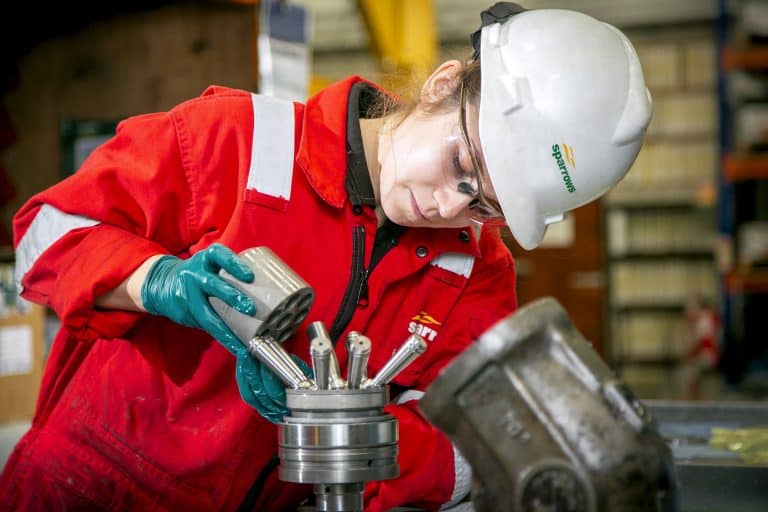
Altrad has agreed to acquire Sparrows Group, a specialist provider of engineering, inspection, operations, and maintenance services in the Offshore Energy, Renewables and Industrials sectors.
According to an announcement today, the transaction is expected to close in Q2 or Q3 2022, subject to customary regulatory approvals.
It marks another milestone in Altrad’s development, proudly investing in businesses that share its excitement, vision, and values to offer enhanced value to its clients.
Around 2,000 talented employees will join the Altrad family, where their diverse skills, experiences, and knowledge will be highly valued and they will be encouraged to develop fulfilling careers.
This latest transaction will enhance Altrad’s and Sparrows’ portfolio of services, provide and fuel organic growth through mutual cross-selling as well as expand Altrad’s presence in the high-growth renewables service market through Alpha. The transaction will allow Sparrows to benefit from Altrad’s management approach and global presence, whilst retaining the existing and well-respected management team.
Mohed Altrad, Founder and President of Altrad, commented: “Sparrows is well-respected across all the global locations it operates and is a trusted service provider and supplier to numerous sectors and strategic clients. Sparrows’ over 2,000 skilled and knowledgeable people will be a valuable addition to our group and we are looking forward to welcoming them to the Altrad family”.
Stewart Mitchell, CEO of Sparrows, added: “This is a hugely exciting time for Sparrows, and we are looking forward to joining Altrad. We are excited about Altrad’s strategic vision and ambition, and this transaction will deliver many advantages for our clients and employees as we continue on our diversification and growth trajectory. The shared values between Altrad and Sparrows, especially a commitment to quality and safety, allows us to sustainably support each other’s ambitious growth aspirations”.
Altrad was advised by BNP Paribas and Squire Patton Boggs. Evercore served as financial advisor, and Freshfields served as legal counsel to Sparrows.
Scaffold training providers Safety & Access have introduced a new commercial course suitable for Directors of scaffolding businesses, Quantity Surveyors, Contract Managers and Estimators.
The two-day course will enable candidates to gain a thorough knowledge and insight of scaffold sub contact terminology, high-risk areas and commercial awareness to avoid contractual loss.
The learning will be effective from the first enquiry to final preparation of a quotation and review and return of the Subcontract document.
Entry requirements for the new course require delegates to have a sound understanding, knowledge and experience of the scaffolding industry and its terminology.
Industry expert, Paul Crabtree
Safety & Access said: “We will be teaming up with Paul Crabtree, whom has been working within all areas of the scaffolding industry for over 50 years. Paul now concentrates on commercial and contractual matters and is widely considered to be a leader in this field.”
For more information and to book on one of the forthcoming courses at their Nottingham training facility please email [email protected] or call 0115 979 4523.




 The subject of a Mercedes-Benz Finance contract hire agreement, the new arrivals are Actros 1824 variants with ClassicSpace S-cabs and 320mm engine tunnels. This combination, together with the enhanced visibility provided by their standard-fit MirrorCam technology, merits an impressive four-star Direct Vision rating from Transport for London.
The Actros are powered by 7.7-litre in-line six-cylinder engines that produce 175 kW (238 hp) and are fitted with bespoke platform bodies by Piggott Coachbuilders, of Bishop’s Stortford.
Motus Truck & Van Sales Executive Steve Jenkins worked closely with his customer to ensure the new trucks are perfectly specified to meet its requirements, so each is fitted with an additional centre seat, as well as an optionally upgraded radio and an air gun on a wander lead for blowing dust out of the cab, and protective grilles over the headlights.
Reflecting the operator’s commitment to safety, the trucks are additionally equipped with Brigade safety cameras that were installed by Advanced Alarms, an established supplier to the Dealer.
The subject of a Mercedes-Benz Finance contract hire agreement, the new arrivals are Actros 1824 variants with ClassicSpace S-cabs and 320mm engine tunnels. This combination, together with the enhanced visibility provided by their standard-fit MirrorCam technology, merits an impressive four-star Direct Vision rating from Transport for London.
The Actros are powered by 7.7-litre in-line six-cylinder engines that produce 175 kW (238 hp) and are fitted with bespoke platform bodies by Piggott Coachbuilders, of Bishop’s Stortford.
Motus Truck & Van Sales Executive Steve Jenkins worked closely with his customer to ensure the new trucks are perfectly specified to meet its requirements, so each is fitted with an additional centre seat, as well as an optionally upgraded radio and an air gun on a wander lead for blowing dust out of the cab, and protective grilles over the headlights.
Reflecting the operator’s commitment to safety, the trucks are additionally equipped with Brigade safety cameras that were installed by Advanced Alarms, an established supplier to the Dealer.
 They are also the first vehicles to wear Legion Scaffolding’s smart new livery – two are in black but the other is silver, with highlights in the same purple shade as the company applies to its scaffolding tube. They have lined-up alongside its remaining pre-owned truck, a 4×2 Actros tractor unit first registered in 2015, which works with a pair of flat-bed trailers.
“Our Mercedes-Benz trucks have always been cost-effective to run and exceptionally reliable,” confirmed Victoria. “That’s crucial, not least because we do a lot of work for a client that undertakes emergency repairs to local authority housing stock, so when they call we have to be able to respond quickly.
“Image is also important in this business, and my brother likes everything to look smart and professional,” she added.
“Mercedes-Benz is a premium brand and our new trucks have already been very well received by customers. We believe the three-pointed star reflects the quality of our own service.”
They are also the first vehicles to wear Legion Scaffolding’s smart new livery – two are in black but the other is silver, with highlights in the same purple shade as the company applies to its scaffolding tube. They have lined-up alongside its remaining pre-owned truck, a 4×2 Actros tractor unit first registered in 2015, which works with a pair of flat-bed trailers.
“Our Mercedes-Benz trucks have always been cost-effective to run and exceptionally reliable,” confirmed Victoria. “That’s crucial, not least because we do a lot of work for a client that undertakes emergency repairs to local authority housing stock, so when they call we have to be able to respond quickly.
“Image is also important in this business, and my brother likes everything to look smart and professional,” she added.
“Mercedes-Benz is a premium brand and our new trucks have already been very well received by customers. We believe the three-pointed star reflects the quality of our own service.”
 The theme for International Women’s Day 2022 is #BreakTheBias. Whether deliberate or unconscious, say those behind the campaign, bias makes it difficult for women to move ahead. Knowing that bias exists isn’t enough, they contend. Action is needed to level the playing field.
Mercedes-Benz Trucks UK Head of Marketing Katie Purcell commented: “We’re delighted to be recognising International Women’s Day 2022. Although there are more women working in our industry every year, there is still a long way to go before we achieve true parity.
“So it’s always great to be able to celebrate the achievements of women like Victoria, who are ‘breaking the bias’ by smashing stereotypes and proving that Mercedes-Benz trucks are for everyone, irrespective of their gender.”
The theme for International Women’s Day 2022 is #BreakTheBias. Whether deliberate or unconscious, say those behind the campaign, bias makes it difficult for women to move ahead. Knowing that bias exists isn’t enough, they contend. Action is needed to level the playing field.
Mercedes-Benz Trucks UK Head of Marketing Katie Purcell commented: “We’re delighted to be recognising International Women’s Day 2022. Although there are more women working in our industry every year, there is still a long way to go before we achieve true parity.
“So it’s always great to be able to celebrate the achievements of women like Victoria, who are ‘breaking the bias’ by smashing stereotypes and proving that Mercedes-Benz trucks are for everyone, irrespective of their gender.”  The subject of a Mercedes-Benz Finance contract hire agreement, the new arrivals are Actros 1824 variants with ClassicSpace S-cabs and 320mm engine tunnels. This combination, together with the enhanced visibility provided by their standard-fit MirrorCam technology, merits an impressive four-star Direct Vision rating from Transport for London.
The Actros are powered by 7.7-litre in-line six-cylinder engines that produce 175 kW (238 hp) and are fitted with bespoke platform bodies by Piggott Coachbuilders, of Bishop’s Stortford.
Motus Truck & Van Sales Executive Steve Jenkins worked closely with his customer to ensure the new trucks are perfectly specified to meet its requirements, so each is fitted with an additional centre seat, as well as an optionally upgraded radio and an air gun on a wander lead for blowing dust out of the cab, and protective grilles over the headlights.
Reflecting the operator’s commitment to safety, the trucks are additionally equipped with Brigade safety cameras that were installed by Advanced Alarms, an established supplier to the Dealer.
The subject of a Mercedes-Benz Finance contract hire agreement, the new arrivals are Actros 1824 variants with ClassicSpace S-cabs and 320mm engine tunnels. This combination, together with the enhanced visibility provided by their standard-fit MirrorCam technology, merits an impressive four-star Direct Vision rating from Transport for London.
The Actros are powered by 7.7-litre in-line six-cylinder engines that produce 175 kW (238 hp) and are fitted with bespoke platform bodies by Piggott Coachbuilders, of Bishop’s Stortford.
Motus Truck & Van Sales Executive Steve Jenkins worked closely with his customer to ensure the new trucks are perfectly specified to meet its requirements, so each is fitted with an additional centre seat, as well as an optionally upgraded radio and an air gun on a wander lead for blowing dust out of the cab, and protective grilles over the headlights.
Reflecting the operator’s commitment to safety, the trucks are additionally equipped with Brigade safety cameras that were installed by Advanced Alarms, an established supplier to the Dealer.
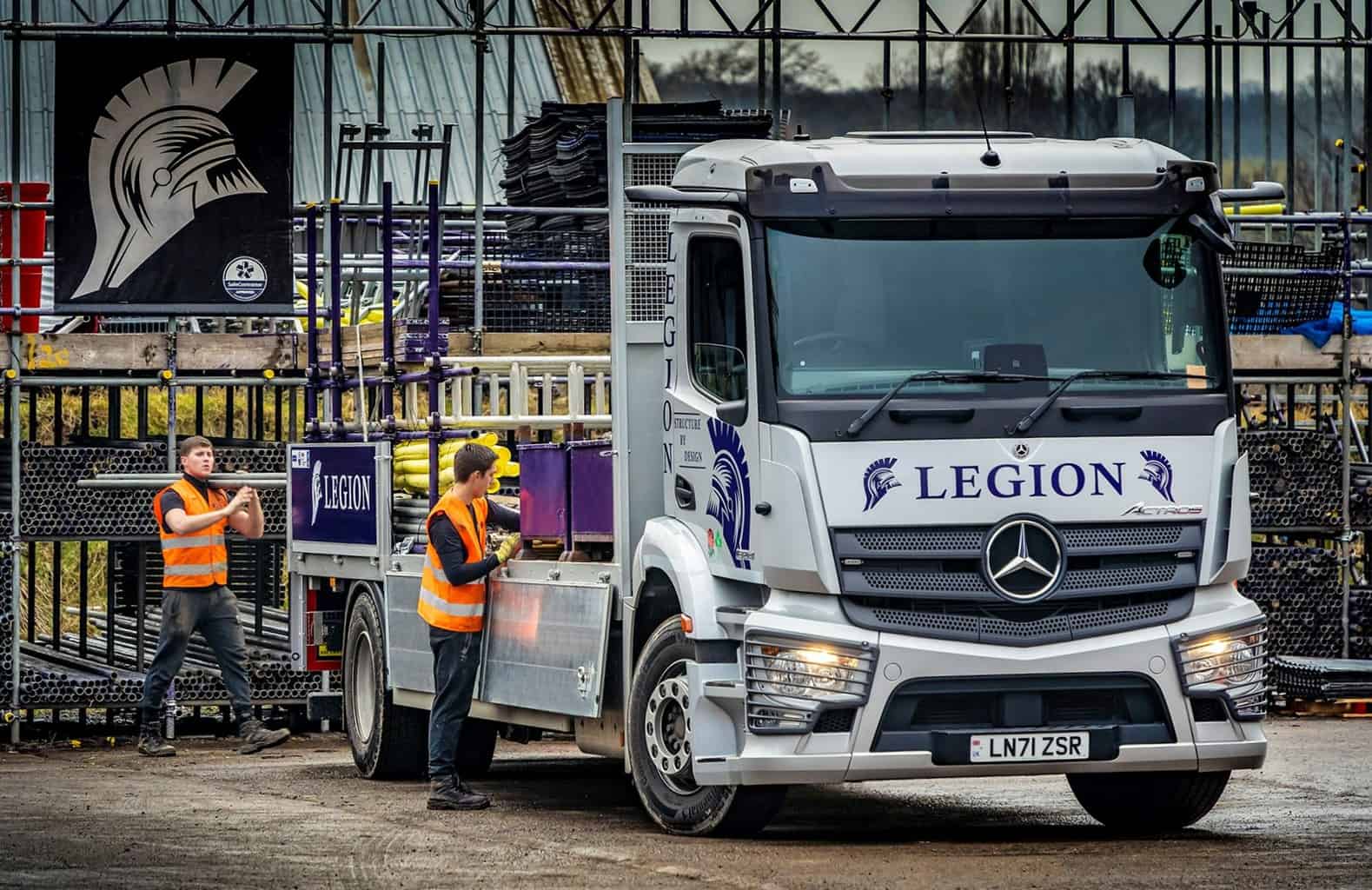 They are also the first vehicles to wear Legion Scaffolding’s smart new livery – two are in black but the other is silver, with highlights in the same purple shade as the company applies to its scaffolding tube. They have lined-up alongside its remaining pre-owned truck, a 4×2 Actros tractor unit first registered in 2015, which works with a pair of flat-bed trailers.
“Our Mercedes-Benz trucks have always been cost-effective to run and exceptionally reliable,” confirmed Victoria. “That’s crucial, not least because we do a lot of work for a client that undertakes emergency repairs to local authority housing stock, so when they call we have to be able to respond quickly.
“Image is also important in this business, and my brother likes everything to look smart and professional,” she added.
“Mercedes-Benz is a premium brand and our new trucks have already been very well received by customers. We believe the three-pointed star reflects the quality of our own service.”
They are also the first vehicles to wear Legion Scaffolding’s smart new livery – two are in black but the other is silver, with highlights in the same purple shade as the company applies to its scaffolding tube. They have lined-up alongside its remaining pre-owned truck, a 4×2 Actros tractor unit first registered in 2015, which works with a pair of flat-bed trailers.
“Our Mercedes-Benz trucks have always been cost-effective to run and exceptionally reliable,” confirmed Victoria. “That’s crucial, not least because we do a lot of work for a client that undertakes emergency repairs to local authority housing stock, so when they call we have to be able to respond quickly.
“Image is also important in this business, and my brother likes everything to look smart and professional,” she added.
“Mercedes-Benz is a premium brand and our new trucks have already been very well received by customers. We believe the three-pointed star reflects the quality of our own service.”
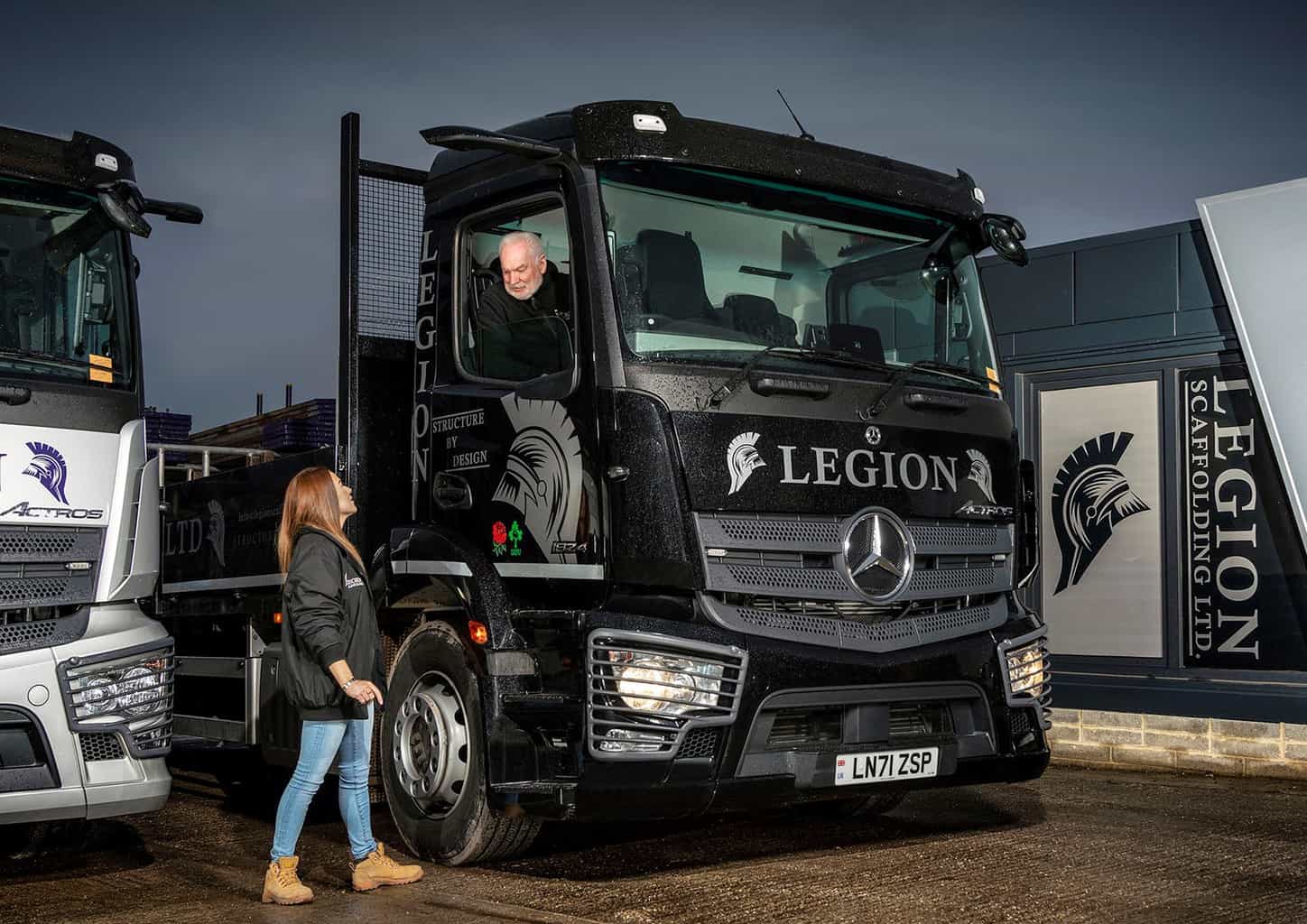 The theme for International Women’s Day 2022 is #BreakTheBias. Whether deliberate or unconscious, say those behind the campaign, bias makes it difficult for women to move ahead. Knowing that bias exists isn’t enough, they contend. Action is needed to level the playing field.
Mercedes-Benz Trucks UK Head of Marketing Katie Purcell commented: “We’re delighted to be recognising International Women’s Day 2022. Although there are more women working in our industry every year, there is still a long way to go before we achieve true parity.
“So it’s always great to be able to celebrate the achievements of women like Victoria, who are ‘breaking the bias’ by smashing stereotypes and proving that Mercedes-Benz trucks are for everyone, irrespective of their gender.”
The theme for International Women’s Day 2022 is #BreakTheBias. Whether deliberate or unconscious, say those behind the campaign, bias makes it difficult for women to move ahead. Knowing that bias exists isn’t enough, they contend. Action is needed to level the playing field.
Mercedes-Benz Trucks UK Head of Marketing Katie Purcell commented: “We’re delighted to be recognising International Women’s Day 2022. Although there are more women working in our industry every year, there is still a long way to go before we achieve true parity.
“So it’s always great to be able to celebrate the achievements of women like Victoria, who are ‘breaking the bias’ by smashing stereotypes and proving that Mercedes-Benz trucks are for everyone, irrespective of their gender.”