TG20:21 Users Download Over 10,000 Compliance Sheets
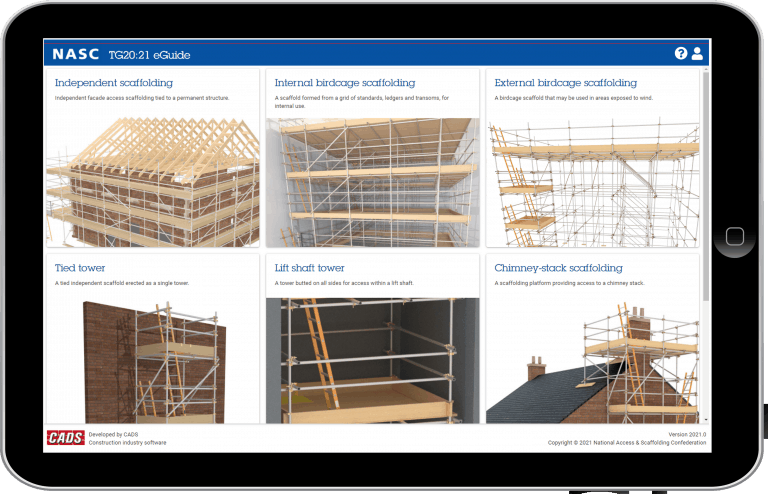
The National Access and Scaffolding Confederation (NASC) has revealed that more than 10,000 TG20:21 compliance sheets have been produced since the new software went live seven weeks ago.
The UK scaffolding trade body shared the TG20:21 download data on its website yesterday showing that 10,109 compliance sheets were generated by users since its launch on Monday 12 April. Furthermore, the NASC revealed that independent scaffolds were the most popular in the period with users creating and downloading 5,501 sheets (54.4% of the total), followed by free-standing tower scaffolds (1,230 or 12.2%) and external birdcage scaffolds (1,171 or 11.6%) – a new addition to the TG20 software. The updated and expanded software allows users of the TG20:21 eGuide to produce compliance sheets for a wide range of scaffolding structures, without the need for bespoke design. The NASC says the data shows that between 200 and 300 compliance sheets have been produced daily since its launch. Commenting on the data Robin James, NASC Managing Director, said: “We are delighted that users have taken to TG20:21 so quickly and are using the new software to produce hundreds of compliance sheets every day. It’s great to see there’s such a diverse spread of scaffold types being generated and that the new features are being utilised by TG20:21 users.”The Sky’s The Charity Limit for The Tall Building Challenge

Construction workers are a generous lot, so it comes as no surprise to see another charity raising challenge slowly building up to help benefit families across the industry.
Hoping to a-spire to a sky-scraping success story, the Tall Building Challenge is exciting, dynamic and invigorating all in one go. It takes determination, no little physical effort and a taste for adventure.
The event involves Brogan Group Volunteers in the UK and Ireland walking or running a set distance each week for eight consecutive weeks, with the distance based on a multiple calculation on the height of eight Tall buildings Brogan Group have provided Access to.
Sounds straightforward enough – until it emerges the team will be set a new Tall Building Charity Challenge of an increasing height each week. In short, if the building is 95m high, they are converting this into a target of 9.5km. And just to ensure everything is accurately recorded a Strava Group has been created, the free activity tracking app, for participants to record results and create the competitiveness needed to see which teams come out on top, On-site or office, depot or country.
“We are thrilled to be launching this in support of the Lighthouse Club.“Will Allen, Marketing Manager, Brogan Group explained: “We are looking to raise £5000 for the Lighthouse Club Charity starting next Monday 7th June with the ‘Tall Building Charity Challenge’ “We are thrilled to be launching this in support of the Lighthouse Club. “This Charity provides emotional, physical, and financial wellbeing support to construction workers and their families. “They receive no public funding and rely on the generosity of those within the industry to help continue their vital work. “We work with organisations like the Lighthouse Club on training up our own Mental health ‘First Aiders’ that support our wider staff at Brogan Group.” Why the lighthouse group? Because the Brogan Group is a Company supporter of The Lighthouse Construction Industry Charity, the only charity providing such vital help to construction workers and their families. The event is also a health and wellbeing initiative for Brogan employees, encouraging increased physical activity as we come out of the lockdown. Taken further, the group have trained up a number of their employees as Mental Health ‘First-aiders’, looking to continue support in this area with the assistance of groups including the Lighthouse Club. Hitting the heights has never been so much fun with the result, so many families will gain priceless help from the money raised. Walk Tall Brogan! – https://www.justgiving.com/fundraising/tallbuildingchallenge
Scaffold Designers IDH Continue Rapid UK Expansion

Independent Design House (IDH), continues its expansion by announcing its newest office opening in Chorley, Lancashire.
With a turnover of over £1.6million and bases in the UK and Poland, the engineering design consultancy already employs 36 people. Joining the company to head up its northern operations, experienced technical manager Anthony Kenmare has been appointed director of the Chorley premises. IDH provides both temporary and permanent works design with full 2D draughting and 3D modeling services along with all BIM requirements. Clients include industry-leading firms such as ISG and Laing O’Rourke Construction Ltd.
HAKI launches refreshed brand identity
HAKI, one of the world’s leading suppliers of system scaffolding, has unveiled their brand refresh, reflective of their revised brand strategy focused on innovation, continuous improvement and an expanded digital offering.
HAKI continues to lead in safe access solutions by adapting and evolving; “We invest in product development to meet customers’ increasingly advanced requirements for innovative solutions, security and cost-efficiency. For a couple of years now, the focus has shifted from technology and production to customer relationships and tailor-made solutions, where the company’s digital tools play a crucial role”, says Thomas Schüller, CEO of HAKI. As part of the company’s expansion journey and goal of offering the best system for safe work at temporary workplaces, HAKI has made several strategic acquisitions. Span Access Solutions was acquired in December 2019 and Vertemax in March 2021. HAKI has thus acquired specialist knowledge and complemented the company’s portfolio with products that meet future requirements for work safety in complex environments. “We have an acquisition strategy with a focus on broadening our offering as well as alternatives to existing solutions. It is a constant process that gives us the opportunity to continuously take on even larger customers and projects. At the same time, we have a strong focus on integrating the new acquisitions so that we become one HAKI”, continues Thomas Schüller, CEO of HAKI. Teamed with these acquisitions, the re-brand is the next step in the execution of the strategy to become customer-focused market leaders, the company said. “By clarifying our position, setting focus areas and boosting energy internally, we are providing tools for our co-workers that will help us become even better partners to our customers. But this is just the first step; there will be more coming from HAKI in the coming months” concludes Sara Bertram, Marketing Director of HAKI.Investigation underway after scaffolder dies in work accident

A joint Police and Health & Safety investigation is underway after a scaffolder is believed to have fallen to his death while working on a job on the Wirral in Merseyside.
The scaffolder and family man, Robert Duffy, 45 from Walton died after an incident at work on Thursday 20th May. According to police reports, he was rushed to hospital following an incident while working at a house in Wallasey. He sadly died in hospital on Sunday 23rd May. Merseyside Police is working with the Health and Safety Executive (HSE) to establish the circumstances surrounding the incident. However, his death is not being treated as suspicious. Local media have suggested the scaffolder had ‘fallen to his death’ while working on the job. Mr Duffy’s family paid tribute to the dad that was a “gentle giant” and who had a “heart of gold.” “Robert was a gentle giant, he had a heart of gold and he’d go out of his way to help others. He enjoyed watching his beloved Liverpool FC. He’ll be missed by so many, life will never be the same again our jigsaw will always be missing a piece. A much-loved husband, father, son, brother and friend has been taken from us far too soon. The house feels so quiet and empty without you here with us.”Scaffolding health risk: Scaffolders 3x more likely to smoke, according to PHE

Experts call on HR teams and encourage scaffolders in the sector to look at stopping smoking ahead of World No Tobacco Day 2021 on 31 May.
Recently released data from Public Health England (PHE) reveals that nearly one in four employees in routine manual and service occupations in England smoke tobacco – over three times more than those in office-based roles.
The data comes after a report from a former government health advisor found reversing trends in smoking cessation in the UK after lockdown. Recent figures predict there will be 600,000 more smokers than originally envisaged next year.
Smoking prevalence in manual roles means these employees are 50% more likely to smoke when compared to the average in England. The data insights, collated by Vape Club ahead of World No Tobacco Day 2021, highlight the need for targeted support to encourage smoking cessation as we move out of lockdown.
While high rates of smoking present health concerns for those in manual labour roles, the number of smokers in routine manual and service occupations has dropped by approximately a third in the last decade.
The government has set a target of reducing the number of smokers to 5% of adults in England by 2030. To achieve this, encouraging smoking cessation for those in manual labour positions will be key.
What smoking cessation measures can be put in place?
In a 2020 study, Quitting Smoking for Mental Health, ex-smokers were asked what their companies could have done to help them quit smoking.
- Smoking ban on-premises – 30% of ex-smokers say that a ban on smoking on workplace premises would have been the greatest support on their quitting journey. Whether government-enforced nationwide or specific to workplaces, the effects are likely to be the same.
- Funding programmes for smoking cessation tools – 32% say that greater support in funding for smoking cessation tools (such as nicotine replacement therapy and vaping) would have further encouraged smoking cessation.
- Encourage nicotine replacement therapy in the workplace – 39% of ex-smokers say that allowing vaping in the workplace, or at least in a designated space, would have helped them to quit smoking. This was echoed by over a third of current smokers (34%), who believe they would be better equipped to quit if this was their workplace’s policy.
Dan Marchant, director at Vape Club and founding member of the UK Vaping Industry Association, says: “It’s clear that employers can be really effective agents of change when it comes to encouraging smoking cessation. With the right tools, an employer that’s proactive in promoting smoking cessation can make a huge difference to someone’s overall wellbeing, both mentally and physically – as well as reducing the ongoing strain that both smoking and smoking cessation services place on the NHS.
“We’ve certainly seen evidence that encouraging employees to quit smoking not only cuts down on the number of sick days caused by the physical impact that smoking has, but it also improves the individual’s mental wellbeing. It’s a no-brainer that companies should encourage more smoking cessation measures – not only will it keep employees at their desks, but it will keep them at their desks and in good overall health!
“Many employers are still playing catch-up with the NHS and Public Health England in acknowledging vaping to be one of the most effective smoking cessation tools, and a device that can improve employee wellbeing. We would hope that businesses will see this and encourage vaping and other smoking cessation measures accordingly.”
Bethany Smith, HR advisor at boiler suppliers and installers Heatable, says: “Supporting employees in adopting a healthy lifestyle shows that you care about their health and wellbeing, which itself improves morale and overall productivity. Beyond that, a healthier lifestyle has a range of inherent benefits, for example, there is plenty of evidence to support regular exercise improving mood and mental health.
HR teams could help encourage smoking cessation by adopting a smoke-free policy in the workplace, this means smoking on-site, the parking area and doorways is prohibited. This simple step is very impactful and by making smoking that little bit more inconvenient, it can be a constant reminder to break the habit.
A healthy workforce is less likely to be ill and take sick days, so in the long term it can save a company a considerable amount of time and money in lost workdays. The less obvious but equally rewarding benefit is that a healthy workforce is less likely to feel fatigued at work and so are more creative and productive in general.”
Lou Campbell, co-founder and programmes director at Mindfulness in the Workplace, added: “In the UK, the burden of wellbeing has fallen onto the shoulders of employers in recent years. This is something that is rarely acknowledged by businesses or the government. Moderate to severe ill health (including mental health), low energy, and/or dysfunctional behaviours are all likely to reduce productivity, motivation and engagement in employees.
“Providing targeted and intelligent wellbeing services to employees is absolutely a remedy to this problem and medium to large businesses are certainly offering at least some wellbeing services to their employees. A two-pronged approach works best. Confidential one-to-one sessions will benefit those who are in crisis or experiencing moderate to severe health issues. Awareness sessions can be delivered to the wider group of employees, focusing on how to maintain positive mental health, work-life balance, healthy habits and whole-person health.”
UKSSH and IBN Scaffold Access barge into York

IBN Scaffold Access Ltd and UK System Scaffold Hire have worked together to install a temporary roof over the main hall on York’s Guildhall – one of the City’s most historic buildings.
The Haki roof was literally shipped to the site on floating pontoons which were loaded at the Queen Staith and towed along the River Ouse to be unloaded at the Guildhall by main contractor VINCI’s site tower crane. The unusual access route resulted from a collaboration between the Canal and River Trust and VINCI to use the River to make site deliveries, helping to limit the disruption to residents and tourists. The Guildhall, a collection of Grade I, II* and II listed buildings – built around the 15th-century hall and riverside meeting room – is currently undergoing a £20 million renovation that will bring the Guildhall’s historic business role into the 21st century, creating quality office space with the potential to create an estimated 250 jobs in high value sectors. The temporary roof will provide protection while the Guildhall roof is being fully refurbished. Brent Davis, Operations Director at IBN Scaffold Access Ltd, said that the Haki temporary roof was the obvious choice for the project: “We know from experience that the HAKITEC 750 Roof System ticks all the boxes – it is lightweight, safe, fast and easy to erect, providing maximum protection against the elements with a very effective weatherproof seal.” “An equally important consideration, given the fact that we had to “float” materials to site, was the fact that the Haki roof system has many fewer components compared to other systems. The precise nature of the access details was also one of the many reasons that we chose to work with UKSSH – we knew that they would respect delivery schedules, delivering quality components precisely as and when we needed them.”Scaffolding Board Prices Set To Rise Further

A global timber shortage is wreaking havoc within the UK scaffolding industry pushing scaffolding board prices sky-high with no end in sight.
Warnings of timber shortages including scaffolding boards are continuing to being issued from leading businesses and organisations from across the UK construction and housebuilding industry. Due to worldwide demand timber organisations and the CLC are expressing stark concerns about low stocks of European softwood, which is the raw material used to produce UK scaffolding boards. Faltering availability and rapidly rising material prices are presenting serious challenges for the sector. And this comes at a time of high levels of sustained growth in construction after the turbulent times caused by the pandemic.Global Timber Demand
Experts say demand for timber from the three biggest global markets of China, America and Russia has contributed to a situation that may take months to stabilise and years to fully recover. The USA is fueling the worldwide demand by purchasing record volumes of timber and paying record prices to build timber-framed houses, meanwhile, China is also buying the round log from Europe and other regions for additional supply. This plus a huge growth in the DIY market across Europe have contributed to the demand for timber sending prices sky-rocketing. To put it simply, global demand is outstripping production.Rising Scaffolding Board Prices
According to sources in the UK, scaffolding contractors are now paying on average between £12 – £16 per 13ft board. The average price last year was around 50% cheaper. Scaffmag understands more increases in scaffolding board prices from suppliers are expected in June and July. One UK scaffolding board supplier said, “The market is difficult to predict but indications are at the end of Q3 the prices will Plato out.” “But we don’t think we will ever see boards priced at £7 – £9 again,” they said. Read more about raising materials pricesEnigma set for End to End Charity Motorbike Ride

Enigma employees and partners are undertaking the ultimate endurance challenge weekend of Saturday 26th June 2021.
The fundraising team will ride motorbikes a distance of 984 miles from Lands End, Cornwall to John O’Groats, Scotland. To raise awareness and funds for Combat Stress, the UK’s leading charity for veterans’ mental health, who for over a century have been helping former servicemen and women deal with issues like post-traumatic stress disorder (PTSD), anxiety and depression. Today they provide specialist treatment and support for veterans from every service and conflict, focusing on those with complex mental health issues related to their military service.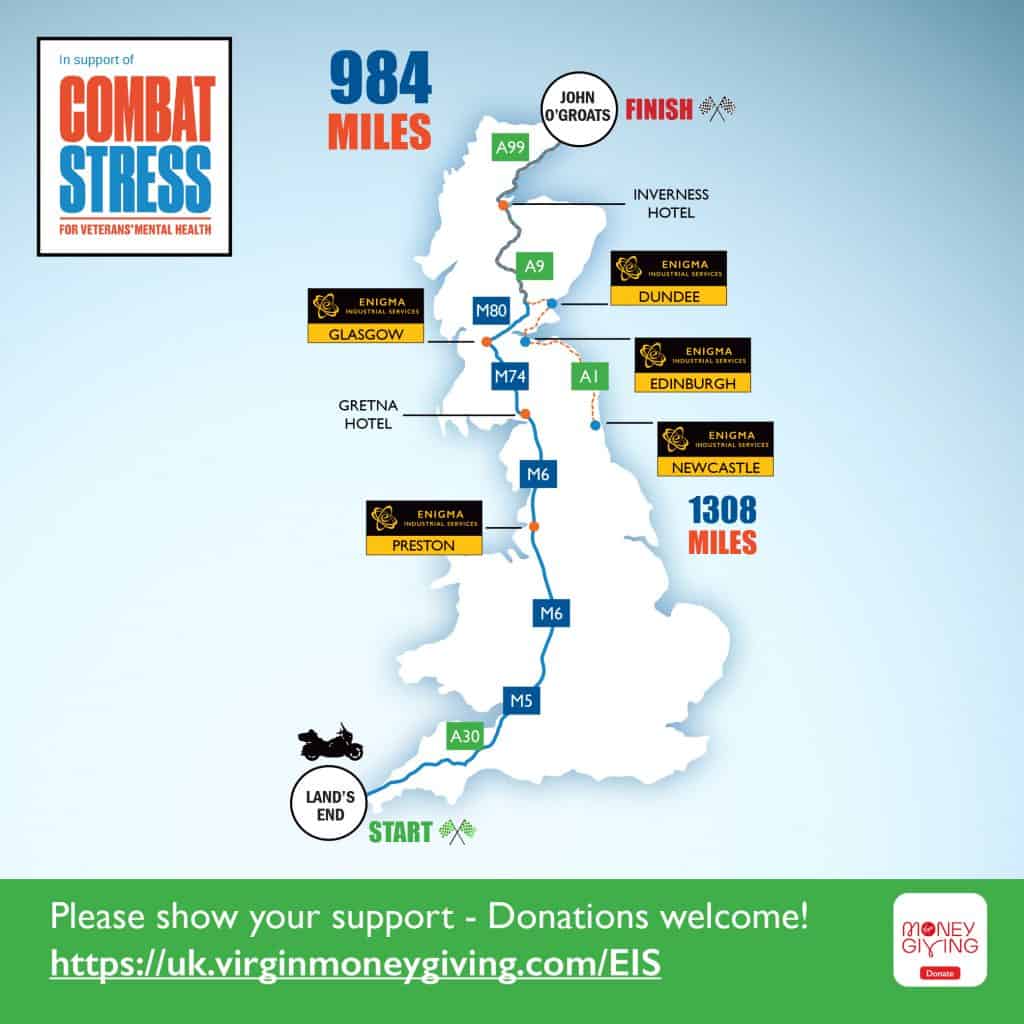 Throughout the United Kingdom, suicide rates continue to rise and supporting people suffering from mental health is a significant national social issue, everyone can help to prevent further deaths by providing support.
Event organiser Roy Rogers, Enigma QSHE & Energy Director, a former soldier himself in the British Army, completing several operational tour’s would like to raise awareness and funds to help fellow veterans struggling with mental health.
Throughout the United Kingdom, suicide rates continue to rise and supporting people suffering from mental health is a significant national social issue, everyone can help to prevent further deaths by providing support.
Event organiser Roy Rogers, Enigma QSHE & Energy Director, a former soldier himself in the British Army, completing several operational tour’s would like to raise awareness and funds to help fellow veterans struggling with mental health.