
ASTERIX HD Beam now available across all TRAD UK sites

The heavy-duty ASTERIX HD beam is ideal for all applications from large-span temporary roofing to stadium lighting rigs.
TRAD UK, the new brand for the combined TRAD Hire & Sales and TRAD Safety Systems companies, is delighted to announce that the proprietary ASTERIX HD beam is now available for sale and hire from each of its six depots across the UK. At 133cm deep, this high load capacity aluminium alloy beam comes in a range of lengths from 0.55m to 4.0m. With a permissible bending moment of 102.2kNm, and a maximum point load of 47.57kN for all load conditions, along with all chords and posts being manufactured in traditional scaffold tube diameter, the beam is arguably the strongest, scaffold fitting-friendly beam available on the UK market today. The beam also offers consistent nodal spacing, ensuring that lacing and bracing elements are consistent when multiple beams are joined together. Beams are simply joined by utilising a simple 8-hole spigot and quick-release pins. In addition, the ends of the beam are closed, allowing it to be load-bearing along the full length. Importantly for scaffolding contractors, the ASTERIX HD beam is fully compatible with the ALTRIX system and, with ridge pitches of 12°, 18° and 36°, it can be used to form large span temporary roof structures, which previously would have been extremely difficult to achieve. It can also be used within many different types of scaffold structures using standard rather than expensive specialist scaffold fittings. And, like the ALTRIX system’s own beam, the ASTERIX HD beam can be used to form large, fully decked areas using either traditional tube, boards and fittings or systems such as TRAD’s PLETTAC METRIX system. However, with the higher load capabilities of the beam, greater distances between supporting structures can be realised, or higher load classes attained.
 Since its launch, the ASTERIX HD beam has been used in a wide variety of construction and refurbishment projects, including the Derby Market Hall Transformation Project, where the beams were used both in the temporary roof structure and the internal support scaffolding.
“The ASTERIX HD beam is an extremely useful product for a range of construction and scaffolding projects,” comments Alan Slater, Head of Technical and Product Support at TRAD UK.
“From large-span bridging sections to temporary buildings, and architectural dig protection structures, these beams are designed to integrate seamlessly with our ALTRIX system and provide straightforward solutions with other standard scaffolding systems.
This makes life as easy as possible for those involved, especially from a manual-handling point of view when compared to alternatives, making it ideal for large or complex construction projects.”
Contractors can buy or hire the ASTERIX HD beam from any of our depots around the UK.
Since its launch, the ASTERIX HD beam has been used in a wide variety of construction and refurbishment projects, including the Derby Market Hall Transformation Project, where the beams were used both in the temporary roof structure and the internal support scaffolding.
“The ASTERIX HD beam is an extremely useful product for a range of construction and scaffolding projects,” comments Alan Slater, Head of Technical and Product Support at TRAD UK.
“From large-span bridging sections to temporary buildings, and architectural dig protection structures, these beams are designed to integrate seamlessly with our ALTRIX system and provide straightforward solutions with other standard scaffolding systems.
This makes life as easy as possible for those involved, especially from a manual-handling point of view when compared to alternatives, making it ideal for large or complex construction projects.”
Contractors can buy or hire the ASTERIX HD beam from any of our depots around the UK. AT-PAC Signs Strategic Global Partnership Deal with Doka

American system scaffolding manufactures AT-PAC have entered into a strategic partnership with Austrian based formwork firm Doka.
The new deal will allow Doka to offer AT-PAC’s Ringlock Scaffold System and Hi-Vis® Scaffold Management Technology under its portfolio of products, globally.
Doka – a world leader in developing, manufacturing and distributing formwork solutions will now offer scaffolding solutions.
AT-PAC said the partnership marks a major milestone in its 25-year history and demonstrates the internationally recognised quality of its products and ability to service major customers on a global scale.
Jeff Davis – CEO of AT-PAC said: “With Doka we have a strong partner in the construction industry. This strategic partnership means that Doka’s customers can benefit above all from the fact that they get everything from a single source”.
Doka CEO Harald Ziebula added: “With this strategic partnership we offer much more than just scaffolding. We are now offering – as we have been doing in the formwork sector for decades – well thought-out scaffolding solutions and services to our customers.”
CITB agrees sale of National Construction College Midlands

The CITB has agreed to sell its Midlands National Construction College (NCC) to Walsall College on 30 November.
The sale includes the land, buildings and business based at King’s Norton in Birmingham. 17 CITB staff members are also being transferred over as employees of Walsall College. An experienced construction skills provider, Walsall College will look to further develop a comprehensive offer for apprentices and work-based leaners that takes them from basic to advanced skills training in sector specialisms including scaffolding and roofing. The sale of the college by CITB is part of its Vision 2020 programme. Reforms include handing over direct training to alternative providers who can offer a service at least as good as that which is currently in place. This allows CITB to focus on delivering improved skills outcomes for all construction employers across Great Britain. Braden Connolly, CITB Director of Products and Services, said: “Walsall College is an excellent Further Education provider with a strong track record and links to employers all over the region. This landmark agreement will secure a bright future for high-quality construction training provision for the industry in the Midlands, with commitments to maintain and develop existing training and with no redundancies from the sale. “It also marks the first of our four National Construction College facilities across the country to be sold to an alternative training provider, as part of our programme to reform CITB to better serve the sector for the future.” Jatinder Sharma, Walsall College’s Principal and Chief Executive, said: “This acquisition takes the college in a new direction for which we are ideally situated. It utilises our expertise in key areas, while enabling us to increase the level and breadth of our provision. “Construction and infrastructure are priority areas for economic recovery in the West Midlands. The emphasis really must be on how we widen our support for local employers and their workforces; ensuring they access the right skills to accelerate the pace of these new builds and redevelopments. “We look forward to getting started.” The National Construction Colleges remain open for business and are taking bookings both now and into 2021.Scaffmag Issue 11 Launches

The latest issue of the Scaffmag magazine has just been published online.
Welcome to the latest issue of Scaffmag magazine which is jam-packed with interesting stories from across the industry. Since our last issue back in August, our sector and the wider construction industry seems to now be on the right path for a hopeful recovery. However, just as the country was getting used to some kind of normality, little did we realise another lockdown would be placed upon us all.
But while economic uncertainty still hangs in the balance, fortunately for us the government continues to support construction as a key industry along with those businesses that supply it, ultimately giving us the green light to continue to operate and ‘keep calm and carry on’, as long as we stick to the guidelines.
And encouragingly, as I write this, the very welcome news of a breakthrough in the race to find a Covid vaccine has shown the world there really is light at the end of the tunnel.
In This Issue
In this issue we have looked to have a special focus on careers, equality and inclusion within the scaffolding industry and as our sector begins to bounce back, we are asking ourselves, could we actually bounce back better?
On page 25, Des Moore discusses ways of encouraging new people to join the industry by providing them with a career, not just a job. In his article Des believes, as an industry, we need to widen our horizons if we are to find the workforce we need to fulfil our project opportunities.
Meanwhile on page 40, our man Richard Trenchard speaks with women in construction and within the scaffolding sector on how we can inspire and encourage other women to join the industry. “I would have to say although it has improved over the 15-plus years that I have worked in the industry, it still has a long way to go,” says Scaffolding Surveying Manager, Tanya Hamilton.
Elsewhere, on page 44, Helen Gowor explains how valuing different skills to encourage diversity not only benefits businesses but helps increase profitability.
And finally, with the nights drawing in and the colder weather on the way, thoughts across the scaffolding sector are turning to winter and what it means for on-site working. On page 50, our friends at Leach’s share their top tips to protect scaffolders this winter.
Happy reading, and stay safe!
Daniel Norton – Editor
TechniSpan suspended platform launches in the Nordics

An innovative suspended platform has been introduced to the Nordic market by temporary access solutions provider HAKI.
The flexible TechniSpan system, which was originally developed by HAKI’s recent acquisition Span Access Solutions, improves the efficiency and safety of underdeck, bridge, and jetty works in the important offshore, energy, and infrastructure industries.
With fewer contact points than traditional scaffolding, the unique traversing system can be easily and quickly erected, lifted, and lowered to cover large working areas, leading to an overall reduction in project time schedule and labour costs for Nordic customers. Technispan system also contributes itself well to complex environments by overcoming challenging difficulties in permanent structures, where conventional solutions often fall short due to limited flexibility.
The suspended platform system can, with great benefits, be integrated with the HAKI Universal scaffolding system to offer new solutions and methods for accessing project requirements in dynamic situations. By combining both HAKI and Span Access’s products and support services, customers can expect a complete service from design to supply, including expert technical advice throughout the project.
Commenting on the entry to Nordic market, HAKI CTO and Span Access MD, Ross Turner said: “By introducing this new innovative access and safe workplace solution to the Nordic region, HAKI and Span Access, will transform the market.
“All the experience and expertise we have established with TechniSpan in the UK market will enable us to deliver highly successful projects in the Nordics, in scenarios where traditional scaffolding would fall-short.”
TechniSpan and the Span Access brand have already proven their capabilities in the UK market, being commissioned for high-profile projects on Scotland’s iconic Forth Road and Rail Bridges and numerous offshore oil and gas projects.
TechniSpan in action on the Forth Bridge

During routine inspections of the Forth Road Bridge in 2015, a crack in the pivot of one of the truss end links was discovered. The changeout of the affected steelwork initially took 18 months to complete; largely slowed down by the traditional scaffolding having to be continually modified to react to the changing work scope and with the scaffolders impeded with a lack of suitable steelwork for their connections into the structure.
Subsequently in 2017, Transport Scotland decided to change the remaining seven end links as a precaution. Due to the disappointing results using conventional access methods, Span Access was contracted to design, engineer, and install a bespoke access system for the later works.
A completely unique hybrid solution using the TechniSpan suspended access platform was specified, which was easily capable of spanning the 10m between structural pick-ups while retaining the strength required to support a five-lift scaffold in its entirety. This in turn was mated with a compatible HAKI Stair Tower, constructed from the platform deck level; giving the contractors five working lifts to access all areas of the scaffold.
Several scenario drawings and checks were completed by the in-house design team, prior to installation, to allow the platform to be opened-up and allow the lifting in of steelwork from river level. A host of hop-ups and variations on the five-lift scaffold were also all designed and checked in advance to give the project the flexibility it needed to succeed.
Additional engineering support throughout the project allowed the client to react to unforeseen circumstances and the swift removal of the system allowed normal bridge operations to resume earlier than planned.
Together, Span Access and the TechniSpan system, helped achieve an 80% reduction in installation time over traditional scaffolding. This led to successful delivery of the project, along with the additional pre-mobilisation engineering works which allowed for most modifications to be completed without works being halted.
Learn more at https://bit.ly/2Ks6mcr
Recruitment drive re-launched for new construction assessors

A project to recruit and train 100 quality assessors for the construction industry in Scotland – which was put on hold due to the Covid-19 pandemic – has been re-launched.
The two-year project, driven by CITB and ESP, in partnership with 24 Scottish colleges, government agencies and private training providers, was originally unveiled back in early March this year.
The re-launch of the recruitment campaign is more good news for the construction industry – which has like many other industries – struggled during the lockdown.
Recruitment of the new assessors will enable more efficient delivery of onsite assessments for apprenticeships in Scotland and help the promising economic recovery that is being made in the construction industry as it emerges from months of inaction.
Recent initiatives such as the UK Government’s Kickstart programme – where employers can offer youngsters aged 16-24 who are claiming Universal Credit a six-month work placement – as well as Skills Development Scotland’s enhancement to their ‘Adopt an Apprentice’ scheme, which has seen the funding grant raised to £5,000, have been welcomed positively by building firms across the country.
During this time colleges across Scotland have been offering more full-time one year construction courses, to enhance the pipeline of work ready MA’s for employers.
The College Assessors role offers a secure and rewarding opportunity with a competitive salary, generous holiday entitlement and benefits package. They are responsible for carrying out a wide range of assessment and verification duties and ensuring apprentices have the skills and knowledge to pass their course outcomes. Additionally they play a key role in ensuring qualifications are delivered to a high standard through compliance with both internal and external awarding body policies, procedures, processes and standards.
The project forms a major part of the CITB’s new strategic road map launched in September (2020), which will focus on a smaller number of priorities to help modernise construction and increase productivity, collaborating with industry, governments and Further Education (FE).
Assessors will be recruited across a range of curriculum areas, including Carpentry & Joinery, Brickwork, Painting and Decorating, Roof Slate and Tiling, Wall and Floor Tiling, Stone Masonry, Wood Machining and Plastering.
Colleges and training providers will continue to recruit individually, while the assessor vacancies will be promoted via a national campaign. The campaign will primarily target individuals working in the construction sector, who may be seeking a full-time or part-time career change with the opportunity to help support and deliver the industry’s future workforce.
As part of the project, West College Scotland (WCS) has been selected to deliver bespoke training to new assessors, which will complement essential qualifications being undertaken through employers such as the L&D9DI and L&D11 – SQA qualifications for assessors and verifiers. WCS are also developing an e-portfolio which will be available free to all training providers as part of this project. Finally, Forth Valley College have also been involved providing Communications, PR and Marketing support for the re-launch.
Jim Brown, Director of ESP, said: “It has been a challenging few months for every industry across Scotland, but we’re excited to be relaunching this campaign at this time. Ensuring we have the Construction Assessors in place across Scotland will support young people into the construction sector and hence underpin the economic resurgence of the Construction industry and secure its future. It will also provide real opportunities for those with experience in the sector who are seeking a new career.
“Becoming an assessor can be a secure and rewarding career choice and the opportunity to shape the next generation of talent. It is a key role in the success of the construction sector, helping new entrants to gain their qualifications and become highly skilled in their trade.
“We originally began the recruitment campaign during Scottish Apprenticeship Week 2020 as it seemed like the perfect time to launch the project. The importance and value of Modern Apprenticeships are recognised throughout the country, and they wouldn’t be achievable without the help and support of the Assessor role.
“This is a fantastic opportunity for experienced industry professionals to use their skills and knowledge in a new capacity and we would encourage them to find out more about this fantastic job opportunity.”
Ian Hughes, CITB Partnerships Director Scotland, said: “Our evidence-based approach to funding will help the construction industry deliver tailored training and assessment to fulfil Scotland’s skills needs.
“The Scottish Assessors project is a great example of how our work in partnership with training delivery organisations ensures that employers have the right people, with the right skills, in the right place. With an average annual growth rate of 1.4% forecast across 2021-2025 for Scotland, our Construction Skills Network (CSN) report highlights the importance of investing in skills.”
Gordon Nelson, Scotland Director at the Federation of Master Builders (FMB) is quick to point many small building firms are finding themselves very busy right now as homeowners use the lockdown restrictions as an opportunity to build extensions or make renovations and refurbishments to their properties. This could lead to them hiring more apprentices.
He said: “Many of our Master Builder members take great pride in recruiting and training construction apprentices.
“Our members have high standards, which is why it is important that the new assessors have sufficient skills and knowledge to ensure apprenticeship qualifications are delivered to high standards too.
“Prior to impact of Covid-19, some members also expressed an interest in becoming assessors themselves. To ensure Scotland’s construction industry has a bright future, we will need a healthy pipeline of skilled and qualified apprentices to become the Master Builders of tomorrow.”
Mark Stevenson, Apprentice Manager for Taylor Wimpey West Scotland, said: “Future-proofing our industry and attracting the right talent who are ready to learn the skills that we need to deliver high quality new homes for our customers is a real focal point for our business. Having access to a CTB appointed work-place assessor will ensure a consistent approach, which will benefit apprentices and companies by improving the overall quality of learning and individual achievement. This can only be good for our industry, especially in these unprecedented times.”
NASC AGM: TG20:21 Price Revealed
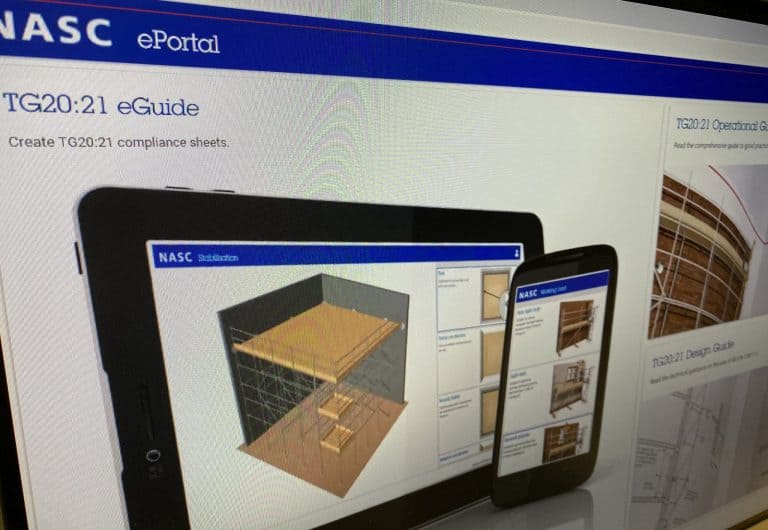
The NASC has just unveiled the cost of its eagerly-anticipated eGuide scaffolding design software, TG20:21.
The new product, which updates and expands on TG20:13, the NASC’s innovative, user-friendly and widely-adopted software, will be available from March 2021 on an annual subscription basis.
Details were revealed by NASC President Lynn way at the NASC’s annual general meeting earlier today that was held online. TG20:21 will cost NASC members £75 per eGuide subscription per year and non-members £300 per eGuide subscription per year.
Users will be able to access TG20:21 – and the associated and updated Operational and Design guides – via a link from the NASC website using a unique serial number and login credentials rather than via a file download or CD.
To ensure the transition for existing users from TG20:13 to TG20:21 is as fair as possible, there will be a short period of free use of the new software.
TG20:21 features a number of changes from the existing TG20:13 software to make the process of producing a compliant scaffolding design even simpler and additions to make the software even more useful.
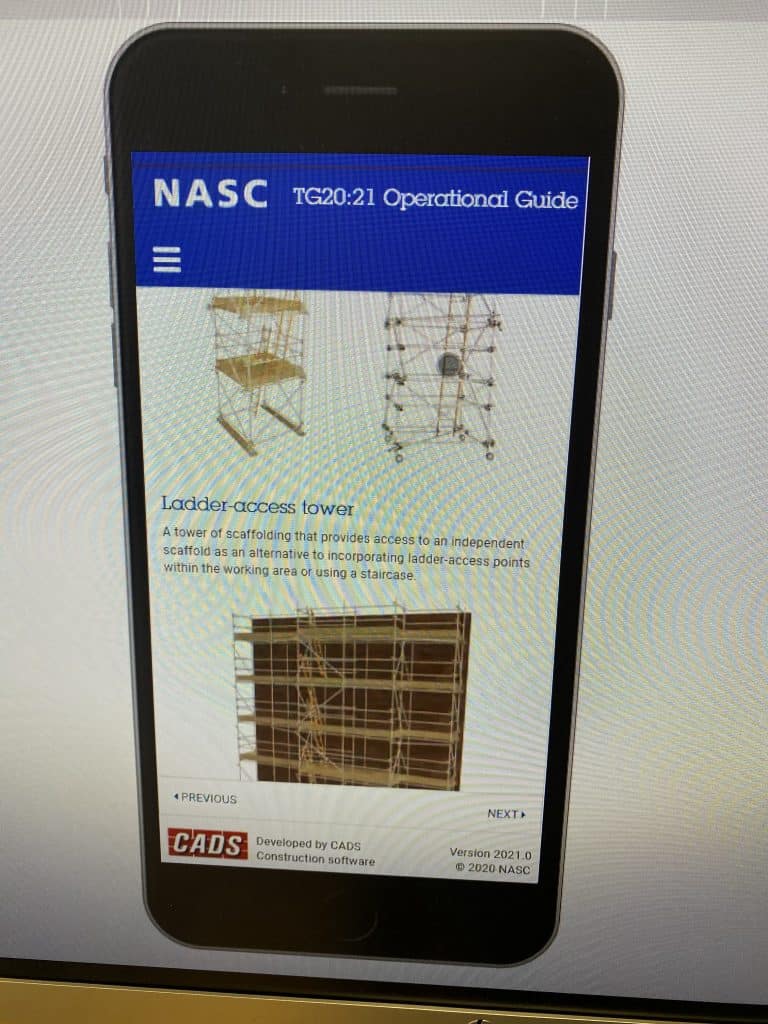
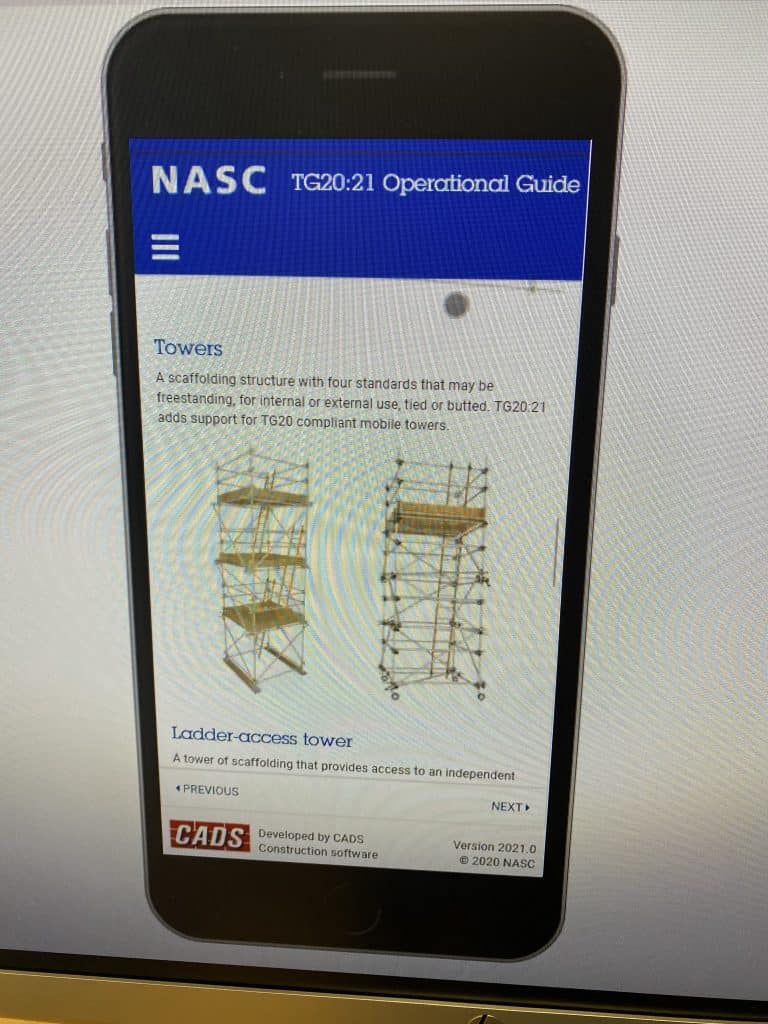

These additions include exterior birdcages, tube and fitting mobile towers, tube and fitting loading bays without beams and tied independent scaffolds with three inside boards.
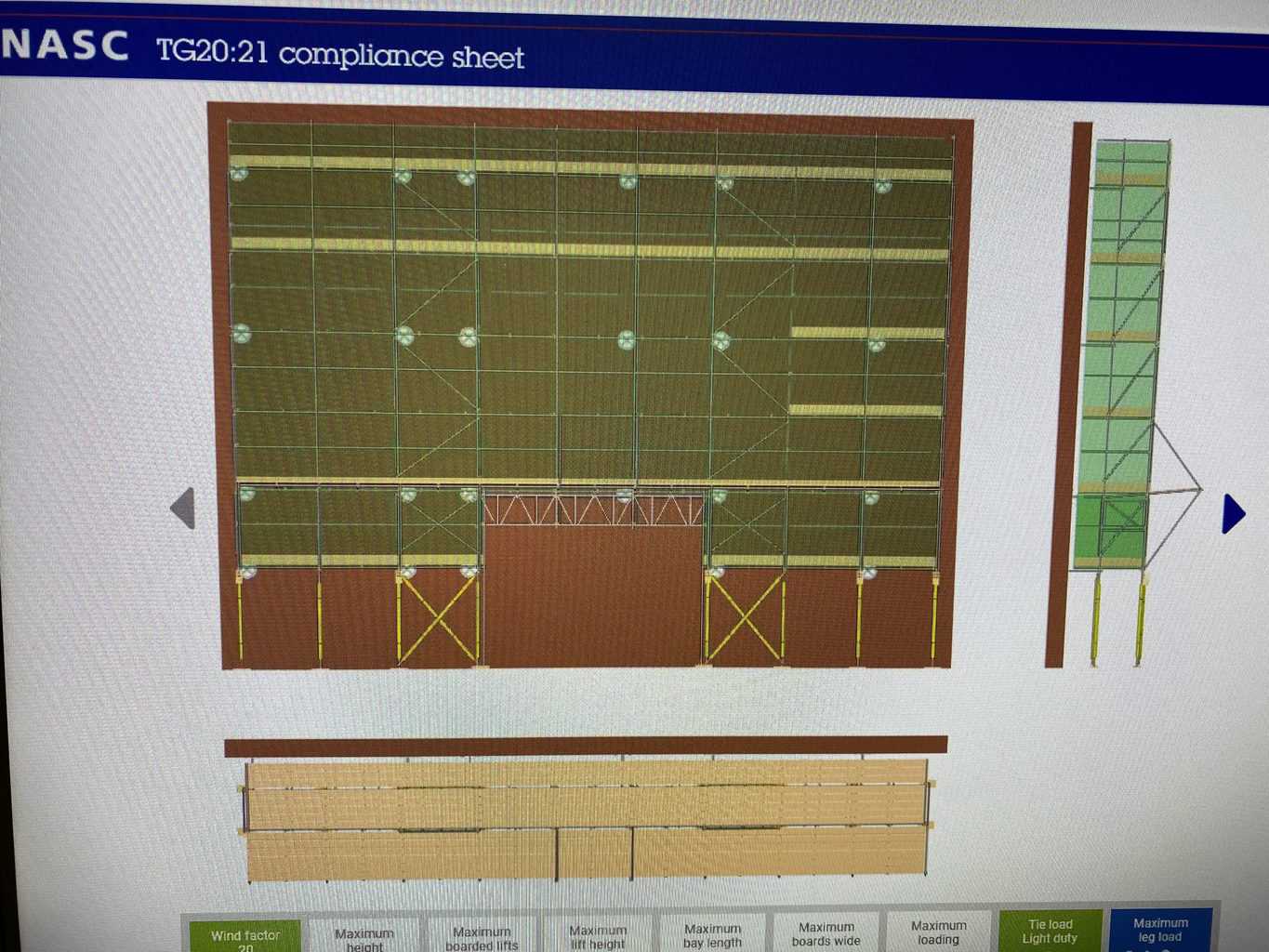
The TG20 compliance sheet will now be double-sided with the illustration and principal compliance criteria on the front side and the detailed compliance criteria listed on the reverse in landscape format.
Lynn Way said: “TG20:13 was a huge step forward for the scaffolding industry, revolutionising the way scaffolding contractors produce day-to-day scaffolding designs and ensure their scaffolding projects are safe and compliant.
“TG20:21 is another step forward. Not only has the scope of TG20 been expanded but it’s also been further simplified – making it easier than ever to use and covering a broader range of scaffold designs.
“On top of this, the TG20:21 suite will be accessible via a dedicated digital portal, again, making it much more user friendly. I’d like to thank all the NASC Committees that played a part in working on TG20:21 as well as our long-standing software developers CADS for their efforts in bringing it to life.
“Of course, the work doesn’t stop here and we’ll continue to innovate and improve in any way we can to make the scaffolding industry safer for all.”
Bill Hill: ONS suicide statistics highlight need for vital work

As well as the word unprecedented, we are now hearing the words mental health every day. That’s good because it means people are talking about the issues. But I was truly saddened to see the recent data published by the Office for National Statistics (ONS), which found that male suicides are now at their highest in two decades and suicides peaked in the 45 to 55 age category.
As a male-dominated industry, we know that construction workers will account for a huge proportion of these figures. I hardly dare think about what that means for this year and I hate to use the word ‘figures’. These are people, and everyone that takes their own life leaves behind parents, children, brothers, sisters and friends. The ripple is far-reaching and devastating.
We already know that construction workers are on the highly vulnerable list. Over 85% of the workforce are male and over 50% of the sector is made up of self-employed, agency staff or on zero-hour contract workers. The lack of job security can contribute significantly to poor mental health. And when they do get work, it can be away from home in an unfamiliar area without their normal support network of family and friends. Working long hours, trying to keep everyone happy including family, their boss, the main contractor and the client, often to extremely tight deadlines can simply be too much.
I have said before that I have sleepless nights trying to think of how we can get our services to individuals in crisis before they take their life. I am convinced that if given the opportunity we could manage to turn some away from suicide.
But despite the pandemic, I am proud to say that our charity has been able to respond to the needs of the industry.
Calls to our 24/7 helpline increased by 56% at the outbreak of the pandemic and our case load has almost doubled. 48% of the cases we manage are in the 40 to 60 age group and from lower income job categories in the sector. This is the most vulnerable group. Many have had a lifetime of physical labour and their bodies are failing but they need to keep working to support their families. Retirement for them is another lifetime away.
A crucial element of our charity strategy is to provide more pro-active interventions to support the industry’s mental wellbeing. This includes our free and confidential 24/7 Construction Industry Helpline and supporting app. We have also ensured the widespread availability of free construction focussed training programmes. These range from hour long interactive wellbeing sessions through to the full two day MHFA England approved Mental Health First Aider course. This will ensure that companies have access to a robust wellbeing strategy to support every level of their organisation from the boots on the ground workforce through to senior management.
One of the key findings of our recently published 2019 Impact Report was that 62% of emergency financial grants were to pay for daily living costs, paying bills and clearing rent arrears. Financial wellbeing is one of the key factors affecting mental health and the introduction of ‘bang on budget’ financial management sessions, aim to directly address these issues.
The fallout of Covid-19 has also seen an increasing number of redundancies across the industry so we have now also added two sessions aimed at improving employability with ‘At the Interview’ and a ‘CV Workshop’.
Our charity is hugely grateful for the generosity of the industry that allows all our charitable work to be free to the workforce but it would be great if we could reduce the cases by finding ways to better retain the productivity of these vulnerable skilled workers.
Both the pandemic and the impending “B” word has accelerated the use of technology in our industry. So perhaps focussing on retraining this age group on working with new machinery and technology might lower the calls to our helpline and give this workforce another 20 years working life and a retirement to look forward to.
Our mission is that no construction worker or their family should be alone in a crisis and being able to respond so quickly to the needs of our construction community means that we really can make a difference.
If you or anyone you know is struggling, you can reach out for free and confidential support through our 24/7 Construction Industry helplines.
UK 0345 605 1956, ROI 1800 939 122
George Roberts unveils its global rebrand

George Roberts Ltd, one of the UK’s leading independent suppliers of quality scaffolding and access equipment, has unveiled its global rebrand which will be launched across the industry.
George Roberts fresh new look signifies the progressive direction of the company and matches the evolution of its products, which consistently meet the daily challenges of its customers around the world.
One of the key drivers for the rebrand was to demonstrate that George Roberts Ltd is expanding, the company said today.Its expanding on all levels with wider international growth, a greater product offering, increased reliability and safety measures, alongside its ongoing commitment to support its customers to deliver their projects.
George Roberts Ltd says it holds a unique position within the construction industry as it offers expert advice across all sectors and has arguably the largest stockholding in the UK.
The well-known Liverpool based business also provides nationwide delivery within 48 hours.
Its global rebrand and its key values have been predominantly showcased throughout their new revitalized website www.georgeroberts.com, modernised logos as well as a fully co-ordinated Customer Service line to ensure a 360 approach across all communications, which will be supported with campaigns in all channels. George Roberts Ltd, who works with many leading brands at the forefront of the industry, will utilize the new platform to showcase the fact that it is a solutions-focused company, with over 25 years’ of history within the industry, and working across a wide range of sectors such as the Construction, Industrial, Rail, Oil & Gas and Marine industries. Danny Wood, Sales Director at George Roberts said: “We are absolutely delighted to launch our new and innovative approach for George Roberts Ltd as it encapsulates our company values and demonstrates our forward-thinking mantra for the years ahead. Our customers operate in complex and demanding situations and it is imperative that we are quick and agile in our thought process which is why we wanted to build a new brand identity which showcases that we are moving with the times whilst retaining our clients’ needs at the core of our business. This new look for George Roberts will also cement our place as a globally recognised company who offers a truly reliable service with a cost-effective solution for our customers – wherever they are in the world.”