
Allen & Foxworthy has completed the scaffolding package for the first phase of refurbishment work to the gates at Buckingham Palace, working alongside heritage main contractor Daedalus Conservation.
The project marks the Swindon firm’s first operational use of Layher equipment and follows earlier work delivered for Daedalus at Hampton Court Palace.
Buckingham Palace is not the kind of building that can simply close while work takes place. As well as serving as the Sovereign’s official London residence, it remains a fully operational building, hosting almost 100,000 guests each year while attracting more than 15 million tourists to its gates.
Since 2017, the palace has also remained operational throughout a ten-year programme to replace electrical, plumbing and heating services largely untouched since the 1950s.
The gate restoration had to be delivered with the same care for security, public access and the continuing operation of the palace.
Behind the scaffold, the railings were stripped back for refurbishment, repainting and regilding. The ornamental gate lights were removed and taken off site for restoration, while the surrounding stonework was cleaned, repaired and, where required, replaced.
For now, the work covers two columns and a single gate. The opening phase is intended to prove the approach before any decision is made on further sections around the palace perimeter.
A route through Hampton Court
Allen & Foxworthy’s appointment followed the completion of the gatehouse scaffold at Hampton Court Palace for Daedalus Conservation.
When the conservation contractor subsequently secured the Buckingham Palace package, Allen & Foxworthy was brought in to develop the access solution.
The project is a natural fit for the Royal Warrant-holding scaffold contractor. Its heritage portfolio includes work at Windsor Castle, Hampton Court Palace and Blenheim Palace.
However, this is the firm’s first substantial project at Buckingham Palace.
Hiding the scaffold in plain sight
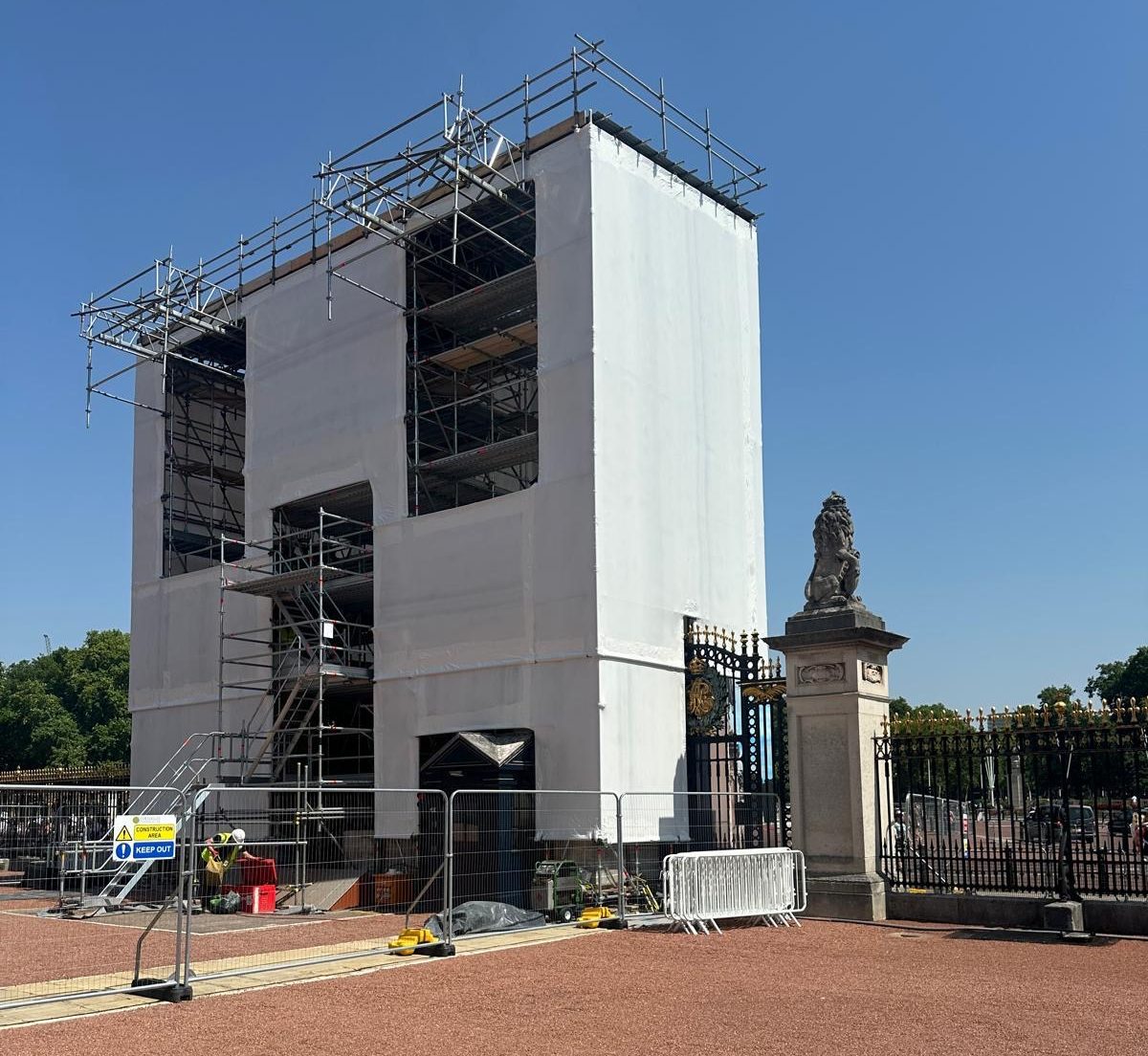
Most people passing the palace would struggle to appreciate the scale of the structure behind its enclosure.
The public-facing scaffold carries a printed streetscape graphic approximately four metres high. Viewed from the pavement, it creates the impression of looking along the road rather than directly at a temporary works enclosure.

Behind the print is a scaffold rising to approximately eight lifts at its highest point, including the temporary roof.
The structure is founded on 24 tonnes of kentledge contained within a reinforced base frame. Beneath the temporary roof, an overhead NIKO lifting system spans the two columns, helping the restoration team remove the ornamental lights and handle replacement stone.
The result is a structure that appears relatively unobtrusive from outside, but provides a substantial working and lifting environment behind the hoarding.
A move away from tube and fitting
The project had initially been priced using tube and fitting.
That approach changed after Allen & Foxworthy managing director Paul Allen visited Layher’s manufacturing complex in Güglingen, southern Germany, with Layher UK managing director Sean Pike.
Allen believed the flexibility of Layher’s Allround system, including its O-profile decking arrangement and specialist components, was particularly well suited to the gate structure and the associated lifting operations.
Layher prepared the initial system concept and material take-off before arranging for the required equipment to be supplied to the project.
On site, individual decks could be positioned and secured as they were installed, rather than waiting for an entire platform to be completed before the boards were locked down.
The system also allowed the working lifts to be positioned at the heights required by the restoration team, accommodating the existing gates, railings, stonework and lights.
“Many people will look at this and think it is a relatively straightforward scaffold, but it came with a considerable number of challenges,” said Paul Allen.
“Deliveries had to be carefully coordinated, the team was working alongside large crowds, and activity was restricted around guard changes four days a week. We also had just a two-week window to complete the scaffold.
“Despite those challenges, we handed the structure over two days ahead of schedule. That was down to meticulous planning, a strong site team and our decision to partner with Layher and build the scaffold using its system rather than tube and fitting.
“Allen & Foxworthy is extremely grateful for the work the Layher team put into making the collaboration a success.
“We are also immensely proud to hold our second Royal Warrant and honoured to have been entrusted to provide our services at another of this country’s most significant historic buildings.”
Planning for the palace
Layher’s involvement extended beyond the supply of equipment.
The company prepared the system concept and material take-off, while the detailed scaffold design and structural calculations were completed by Chris Birch, working with Allen & Foxworthy.
Before mobilisation, the site scaffolders attended Layher’s UK facility for a familiarisation build.
The team assembled the equipment, reviewed its specialist components and rehearsed elements of the proposed scaffold before arriving at Buckingham Palace.
This preparation proved important because the programme allowed only two weeks to erect the structure, complete the sheeting and coordinate the installation of the hoarding.
On the first day, the team arrived at approximately 6.30 am to establish the footprint, install the initial kentledge and raise the external structure to four metres.
The scaffold could not initially extend above the height of the hoarding because of the need to maintain the security of the palace perimeter.
At 3 pm, the area was handed over to the hoarding contractor, which worked through the night to secure the external boundary. From that point, the remainder of the scaffold was accessed and erected from inside the palace grounds.
Work also had to stop during scheduled guard changes four days a week.
For a team travelling from Swindon into central London each morning, those interruptions placed further pressure on an already tight programme.
The scaffold was nevertheless completed and handed over two days ahead of schedule.
A first at the palace
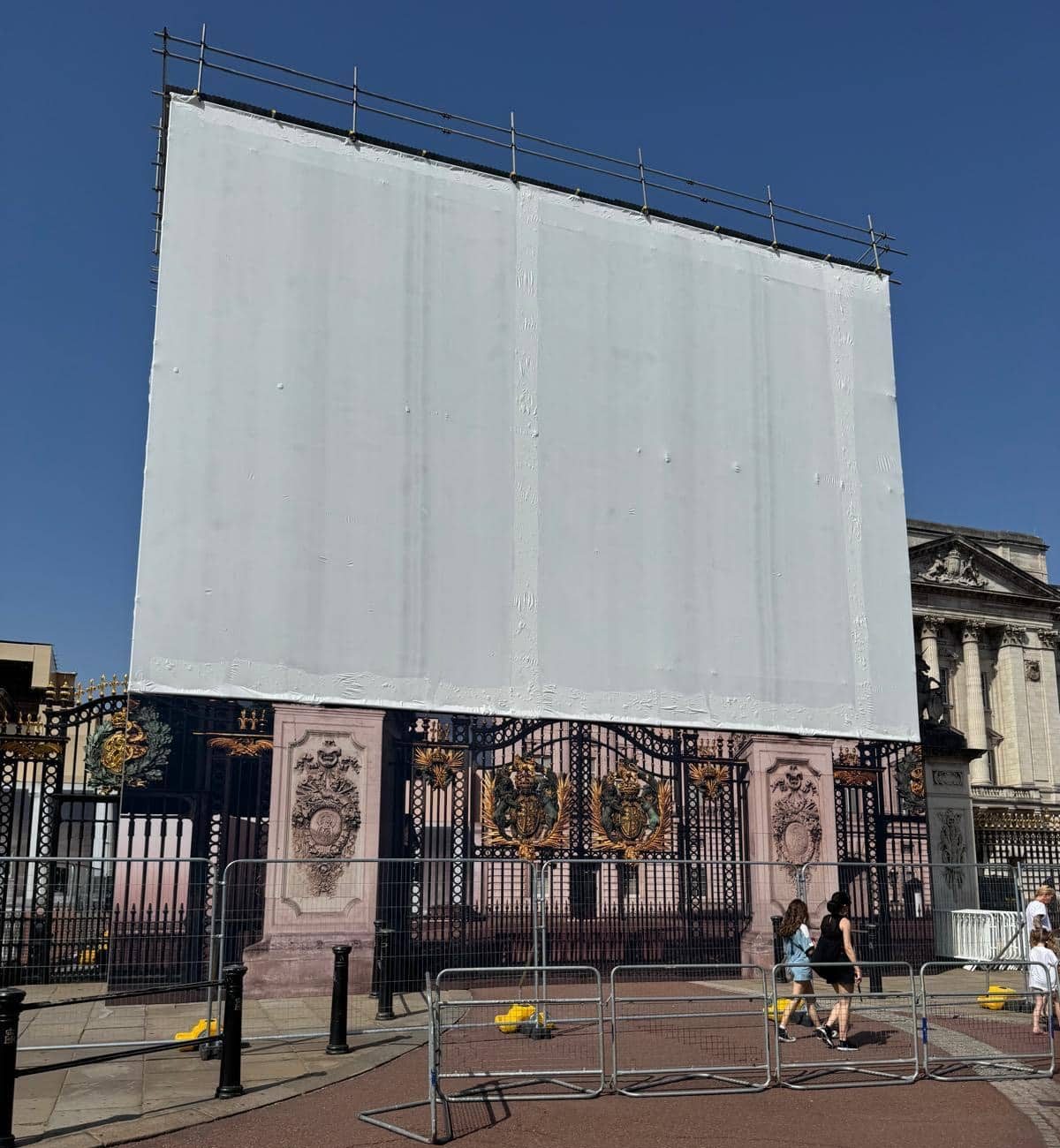
The completed structure has been well received, and discussions are under way regarding a possible second gate.
Should that phase proceed, the existing scaffold would first need to be fully dismantled and stored before being rebuilt at the next location. Palace access requirements mean that only one gate can be closed at a time.
For Allen & Foxworthy, the project adds Buckingham Palace to a heritage portfolio that already includes Blenheim Palace and Hampton Court Palace.
It has also established a new working relationship with Layher.
“Working with Allen & Foxworthy at Buckingham Palace has been a fantastic example of true collaboration and our approach to strategic partnership,” said Sean Pike, managing director of Layher UK.
“At Layher, we do far more than simply supply equipment. We work alongside our customers, listen to the challenges and provide the technical expertise, products and support needed to help make each project a success.
“We are incredibly proud to have played our part in such a prestigious and historic project, and even prouder to have supported the Allen & Foxworthy team every step of the way.”
From the initial factory visit and familiarisation build to equipment supply and technical support, the project demonstrated Layher’s 4×S approach of Service, Support, Solutions and Supply throughout the planning, erection and handover stages.