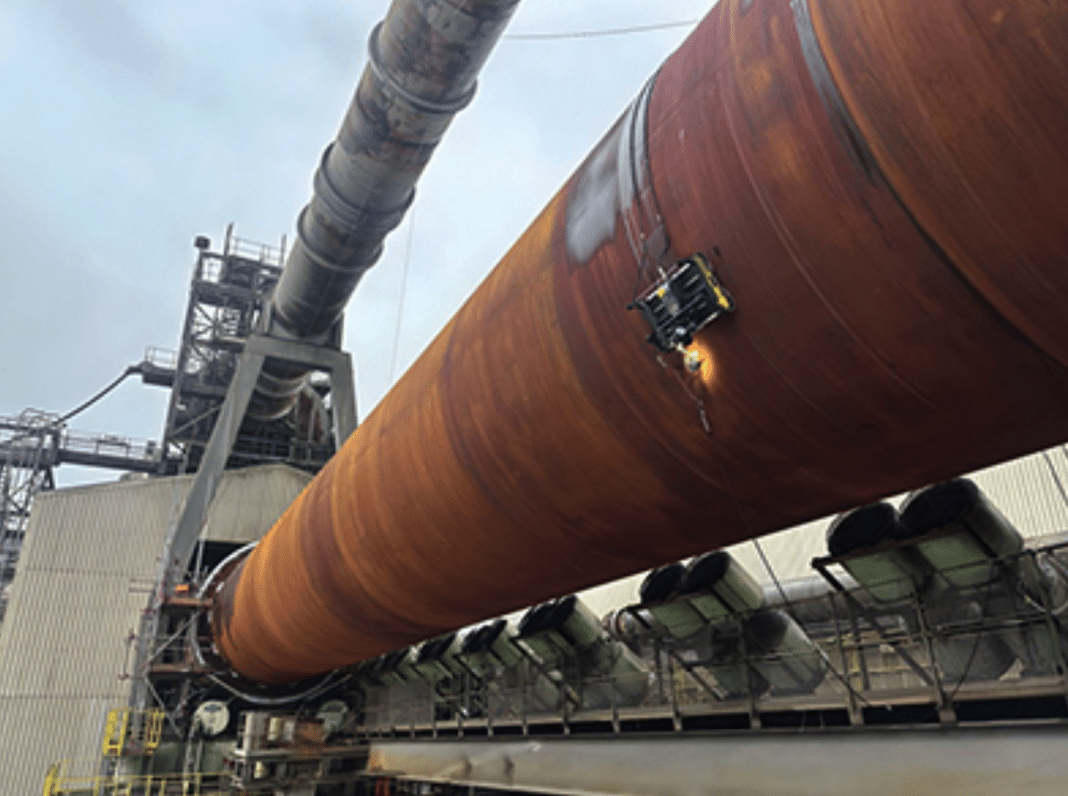
A wall-climbing robot has completed ultrasonic testing across a 70m rotary kiln at Cemex’s Rugby cement plant, removing the need for personnel to work at height and avoiding a conventional scaffold or rope-access operation.
Birmingham-based HausBots worked with industrial inspection specialist Sutro Group to carry out the ultrasonic testing campaign across the full shell of the kiln, which measures 70m long and 6m in diameter.
The inspection required a large number of ultrasonic A-scan thickness readings to assess the integrity of the kiln shell. Its size and position on support rollers, together with drive gear and tyre assemblies along its length, create a significant access challenge.
According to the project team, completing the same inspection conventionally would have required scaffolding or rope access along the kiln. Instead, technicians used HausBots’ remote-controlled HB3 crawler to collect readings without personnel accessing the structure directly.
Inspection without work at height
The crawler uses HausBots’ AeroGrip technology, which creates a pressure differential to hold the machine against a surface rather than relying on magnetic attraction. This allows the platform to operate on ferrous and non-ferrous materials.
Sutro Group technicians operated the crawler and collected ultrasonic thickness spot readings across the kiln shell on a 1m by 1m grid.
HausBots says the HB3 can carry payloads of up to 25kg and operate in winds of up to 45mph. Those are manufacturer specifications rather than independently verified performance claims.
The companies said the inspection produced the thickness data required by Cemex’s asset integrity team while avoiding the preparatory access operation normally associated with the work.
Richard Denmead, technical director at Sutro Group, said the robot was on the asset and collecting data within hours, adding that conventional access would have changed both the timescale and cost of the inspection.
A changing role for temporary access
The project is significant for the scaffolding sector because it demonstrates how remote inspection technology can remove the need for temporary access during some data-gathering tasks.
It does not remove the requirement for scaffolding where personnel need physical access to carry out repairs, replacement or maintenance. However, robotic inspection could reduce the amount of temporary access required during the assessment stage of industrial shutdowns and maintenance programmes.
HausBots and Sutro Group formalised a wider partnership in 2025 to combine robotic platforms with non-destructive testing services. HausBots says its crawlers are already used across energy, nuclear, water and infrastructure applications.