Tube Industries has revised its outlook for imported scaffold tube, forecasting that the UK’s new carbon border charge could add around 15p per foot from January 2027.
In a customer update issued on 9 October, Trevor Inns said the supplier now expected prices to rise in the new year. That reverses its September view that CBAM would have a modest effect and tube prices would remain steady through the first quarter.
Inns put the anticipated increase at 10p to 18p per foot, with around 15p as the company’s central estimate. He said the range depended on “the final default values and each mill’s verified emissions data” and expected the eventual figure to be towards the upper end.
The figures are Tube Industries’ forecast. Scaffmag has not independently verified the underlying calculation, and the update does not set out the assumptions needed to reproduce it. The government has not set a flat CBAM charge per foot of scaffold tube.
How the charge will work
The UK Carbon Border Adjustment Mechanism starts on 1 January 2027. It will apply to specified imports in five sectors, including iron and steel, with the aim of bringing their carbon cost closer to that faced by UK manufacturers.
Liability sits with the importer, subject to the scheme’s registration rules and exemptions. Contractors purchasing from a UK wholesaler would therefore need to distinguish any change in the supplier’s selling price from the importer’s actual tax calculation.
Under the emissions regulations, the calculation uses the weight of the imported goods and their relevant embodied emissions. Importers can use verified production emissions data or government default values. A tube’s length alone does not determine its CBAM cost.
The rate regulations link the quarterly sector rate to UK Emissions Trading Scheme auction prices, adjusted for domestic free allocation. Qualifying carbon prices incurred overseas can reduce the liability, subject to the relief and verification rules.
HMRC says sector rates will be published at the beginning of each quarter from 1 January 2027. Its current policy summary says default emissions values will be published before the scheme begins. Those inputs matter when assessing a supplier’s forecast.
Product codes matter
The goods listed in the Finance Act 2026 include seamless iron and steel tubes under heading 7304, other tubes including welded products under 7306, and tube or pipe fittings under 7307.
Coverage depends on a product’s customs classification. A general description such as “scaffolding fittings” does not establish the applicable code or a uniform charge per item, and a tube forecast cannot simply be applied to every coupler or fitting.
Changed price outlook
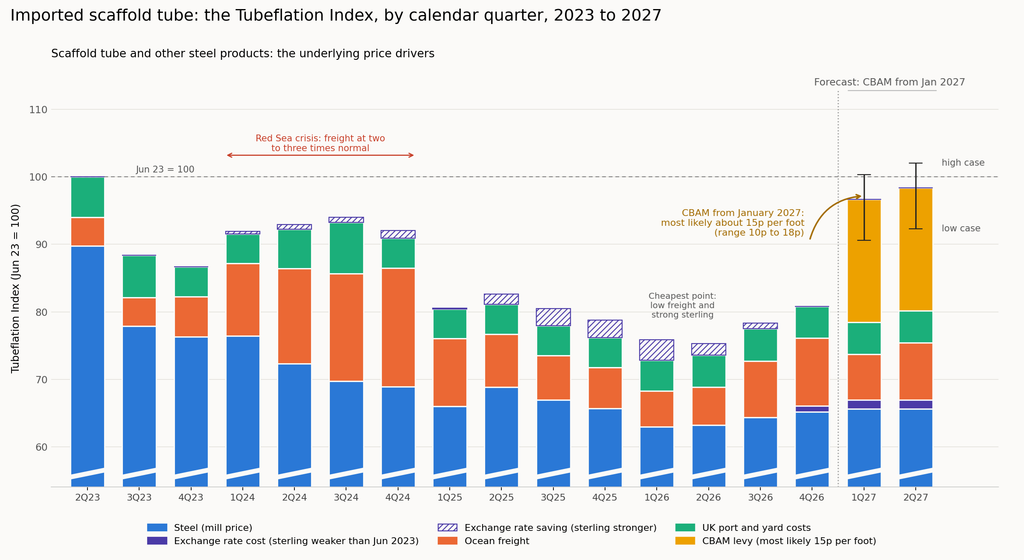
Tube Industries’ update forecasts that imported tube costs will move back towards 2023 levels in early 2027. Inns expects freight costs to ease after the current import rush, but says that would be insufficient to offset the increase he anticipates from CBAM.
The latest assessment follows the company’s warning in June about freight pressure on scaffold material costs. For businesses pricing work into 2027, it adds another variable to purchasing plans, although the size of any increase in individual supplier quotations remains uncertain.