Industrial Textiles and Plastics (ITP) Ltd, a Yorkshire-based manufacturer specialising in protective textiles for the construction sector, has announced a major investment to expand its production capacity.
The Easingwold company has installed a new state-of-the-art large-format digital printer, a move it says will enhance the quality and efficiency of its printed scaffold sheeting and temporary containment products.
ITP said the investment, which forms part of a wider plan to upgrade its infrastructure and resources, will allow it to meet growing demand for high-resolution, wide-format printing across a range of construction applications.
“We have experienced growing demand for extra-large logos, high-impact visuals, and intricate detailing, particularly for full-scale façade reproductions on historic building refurbishments,” said Carl Morse, Managing Director of ITP.
“The addition of another digital printer at our factory will enable us to further develop our offering for applications such as scaffold sheeting, vented sheeting, PVC banners, air mesh banners, and keder sheeting.”
As well as installing the new printer, ITP has carried out factory refurbishments and upgraded its flexographic printing facilities. It has also committed to additional training and the recruitment of extra resources as part of its growth strategy.
The firm’s Sales Director, Matt Thompson, said the enhanced capability would help meet the rising demand for certified flame-retardant products.
“Reliable fire protection is critical in the construction industry,” he said. “Our printed sheeting is third-party certified to meet flame retardancy standards for both external and internal use, helping contractors to comply with regulations on major projects.”
Founded in North Yorkshire, ITP manufactures a broad range of temporary site protection products, including debris netting, filter sheeting, insulated sheeting and acoustic barriers. It also produces a variety of construction membranes designed for building envelope protection, such as breather membranes, vapour control layers, and roofing underlays.
The company supplies its products globally through a growing export division, with an expanding presence in multiple international markets.
With the help of laser positioning and mobile devices, teams can now ensure that what’s planned digitally is executed precisely on the ground—minimising errors and significantly reducing the need for paper drawings.
“This is about turning the digital twin into a real-world reality,” said Sean Pike, UK MD, representing Layher and who gave Scaffmag a stand tour. “SIM2Field brings planning accuracy and transparency to the frontline of scaffolding operations.”
By using a total station aligned with reference points from the model, SIM2Field allows scaffolders to project scaffold layouts onto the construction site floor, aligning base spindles and ensuring accurate height and placement.
It is particularly effective for complex or high-precision installations, such as in industrial facilities or intricate restoration works.
Complementing this is the new SIM2Field XR App, which uses augmented reality to visualise 3D scaffold structures on-site via tablets. The app provides detailed part breakdowns, interactive material lists, and even an ‘exploded view’ for clearer assembly guidance—offering a paperless, connected approach to work preparation and quality control.
These innovations are part of Layher’s wider digitalisation strategy, which also includes tools for CAD planning, virtual reality walkthroughs, and 3D laser scanning—positioning the company at the forefront of digital transformation in scaffolding and construction.
As digital workflows become increasingly vital to the scaffolding industry, SIM2Field marks a significant step toward turning virtual plans into tangible, time-efficient builds.

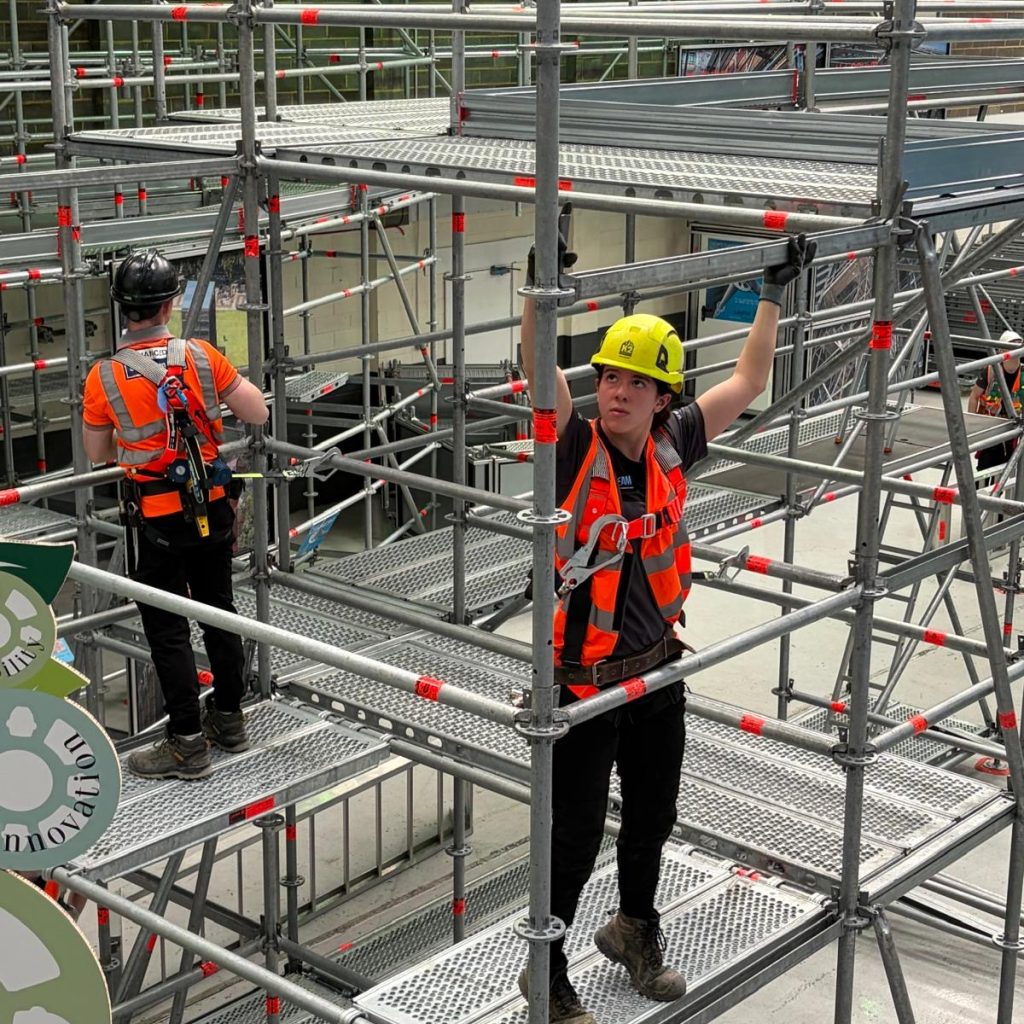
A centrepiece of the joint stand is a 30-metre scaffold tower, constructed using AT-PAC’s Ringlock system and Doka’s UniKit heavy-duty platform. The structure features a walkable viewing deck and houses several new products developed jointly by the two firms.
Among the innovations are:
MPBS (Multipurpose Beam System): A modular system offering longer spans and fewer components, compatible with Ringlock and ideal for complex scaffolding geometries.
PAS Escape Stair System: A steel staircase solution for high-traffic environments, including public infrastructure and industrial sites, offering child-safety features and full Ringlock compatibility.
Ringlock Hybrid Standard: Designed for façade and refurbishment works, combining the benefits of frame and modular scaffolding for greater flexibility and ease of use.
Ringshore: A new frame shoring system built on the Ringlock platform, boasting faster assembly and reduced labour requirements.
Each system has been developed to align with the needs of both industrial and construction clients.
Mr Zumaglini emphasised the importance of synergy across the group.
“Our internal collaboration means that every innovation is grounded in real-world application. The aim is always the same – to make scaffolding faster, safer and more efficient,” he said.
Its presence at bauma marks a pivotal moment in its international growth strategy as AT-PAC continues expanding its European footprint, ambitioning to become one of the top 3 global scaffolding brands.