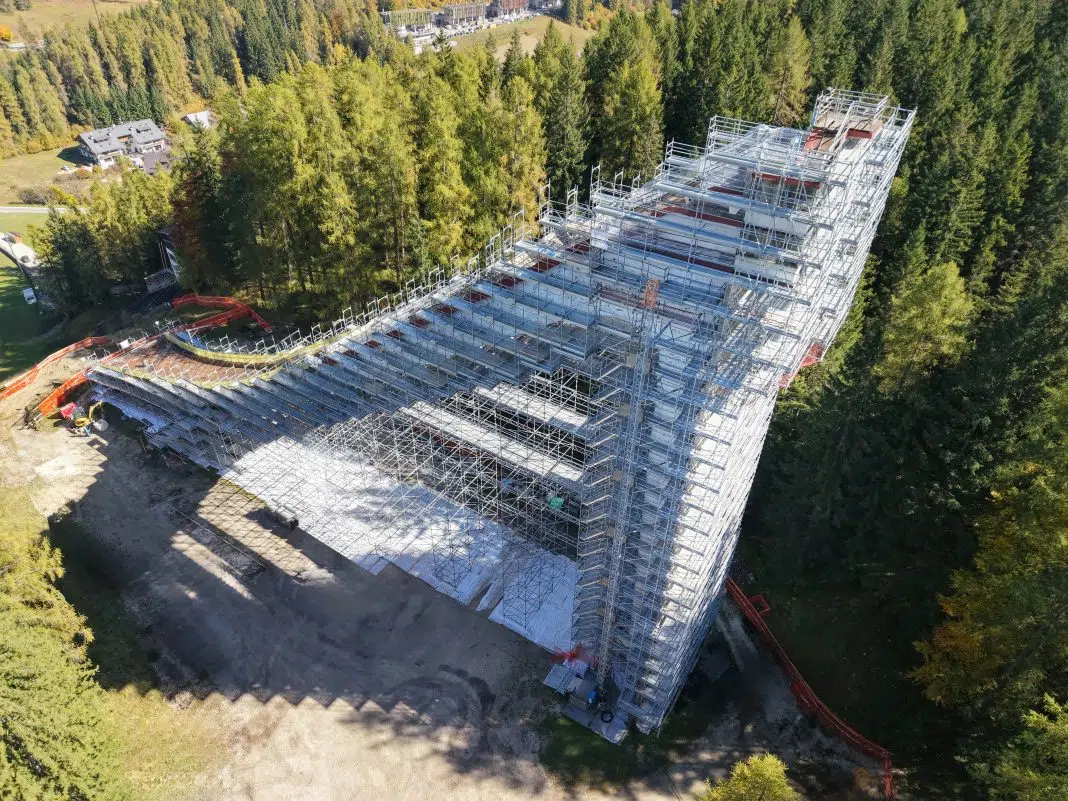
When the iconic Zuel ski jump in Cortina d’Ampezzo needed renovation ahead of the 2026 Winter Olympics, the project demanded more than standard scaffolding solutions. The 51-metre tower and 83-metre inrun ramp, perched in the Venetian Alps and exposed to fierce mountain winds, required engineering precision that would test even experienced contractors.
Italian manufacturer Pilosio, working with scaffolding contractor Euroedile, delivered a solution that demonstrates how modern scaffold engineering can meet complex architectural challenges whilst respecting historic landmarks.
The Challenge
The Zuel ski jump has been a fixture of the Cortina d’Ampezzo basin since hosting events during the 1956 Winter Olympics. Its distinctive silhouette, familiar to generations of visitors and immortalised in James Bond films, had gradually deteriorated over the decades.
Restoring the structure presented several significant obstacles. The ski jump’s irregular geometry, with its steeply inclined inrun ramp and vertical tower, meant standard scaffolding configurations would not work. The site’s altitude and exposed position subjected any temporary structures to strong winds. Meanwhile, the building’s status as a local landmark demanded an approach that would harmonise with the surrounding landscape.
Bergamo-based contractor Ecoedile commissioned Euroedile Scaffolding to design and erect the scaffolding. The brief was clear: fully encapsulate the ski jump to enable comprehensive restoration whilst maintaining structural integrity and worker safety throughout.
The Solution
Euroedile’s project manager, surveyor Daniele Crosato, knew the project required detailed planning before a single tube reached site. His team began with full 3D modelling of the temporary structures, creating a digital twin that could be shared with site management and used to identify potential issues before installation.
“This model enabled us to identify a crucial aspect: the temporary structures were designed to transfer all loads directly to the ground,” Crosato explains. The approach eliminated the need to anchor into the historic structure itself, protecting the building fabric whilst ensuring stability.
The solution ultimately required 160 tonnes of steel and aluminium temporary structures, comprising 22 kilometres of linear steel tube and 2,700 square metres of working platforms—equivalent to ten tennis courts of safe working area at height.
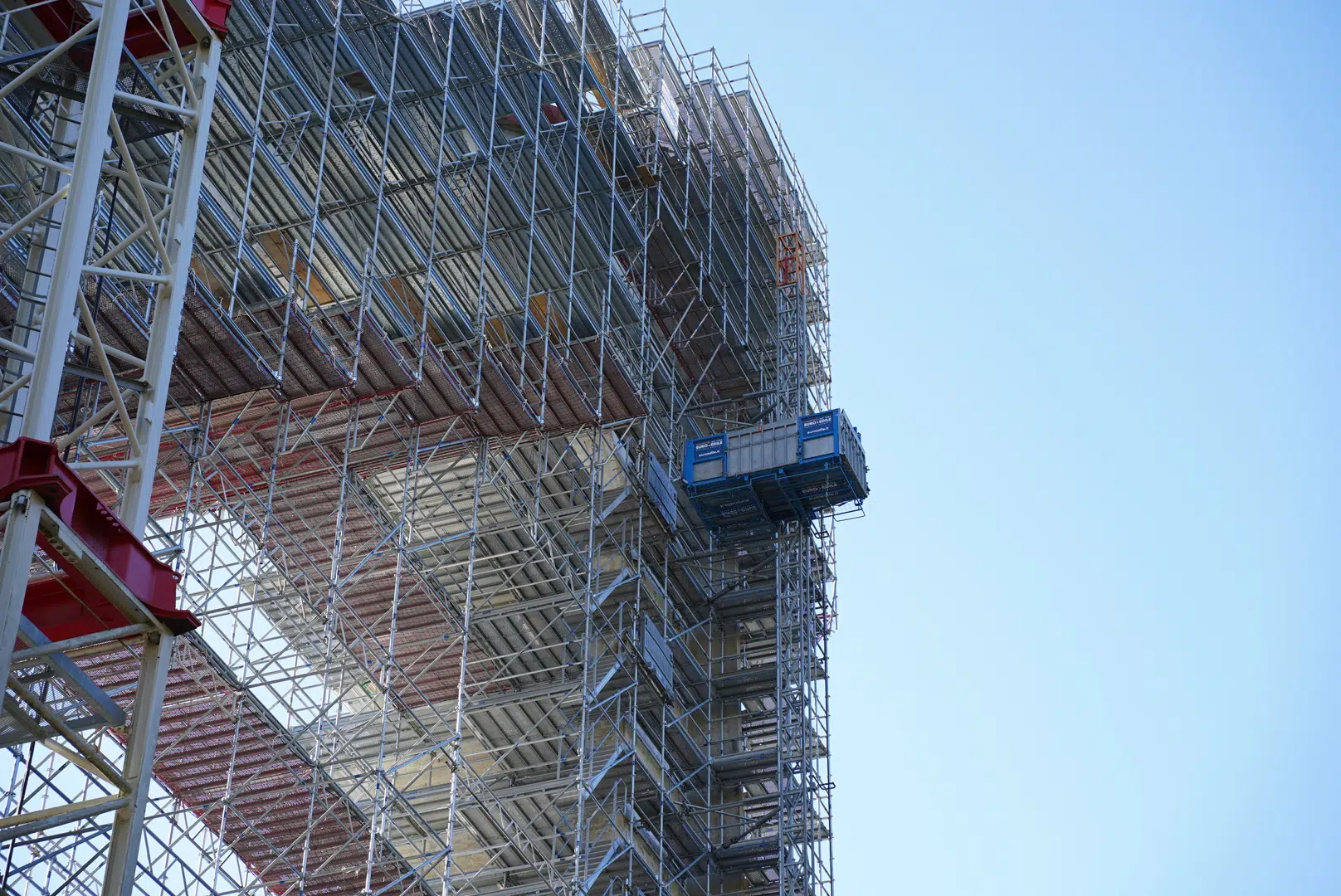
Euroedile selected Pilosio’s MP multidirectional scaffolding system as the backbone of the installation. The system’s versatility proved essential in adapting to the ski jump’s complex geometry, allowing standards and ledgers to follow the varying inclinations and curves along both the inrun ramp and tower.
“The MP system’s four-way connectivity gave us the flexibility to configure the scaffold around a highly non-standard structure,” says Crosato. “We needed that adaptability to maintain structural stability whilst supporting working loads, equipment and personnel in an exposed environment.”
Access and Logistics
Getting workers and materials to working height on a structure of this scale presented its own challenges. Euroedile installed four suspended walkways extending from the central tower to stepped platforms beneath the ramp, providing quick access to key working areas.
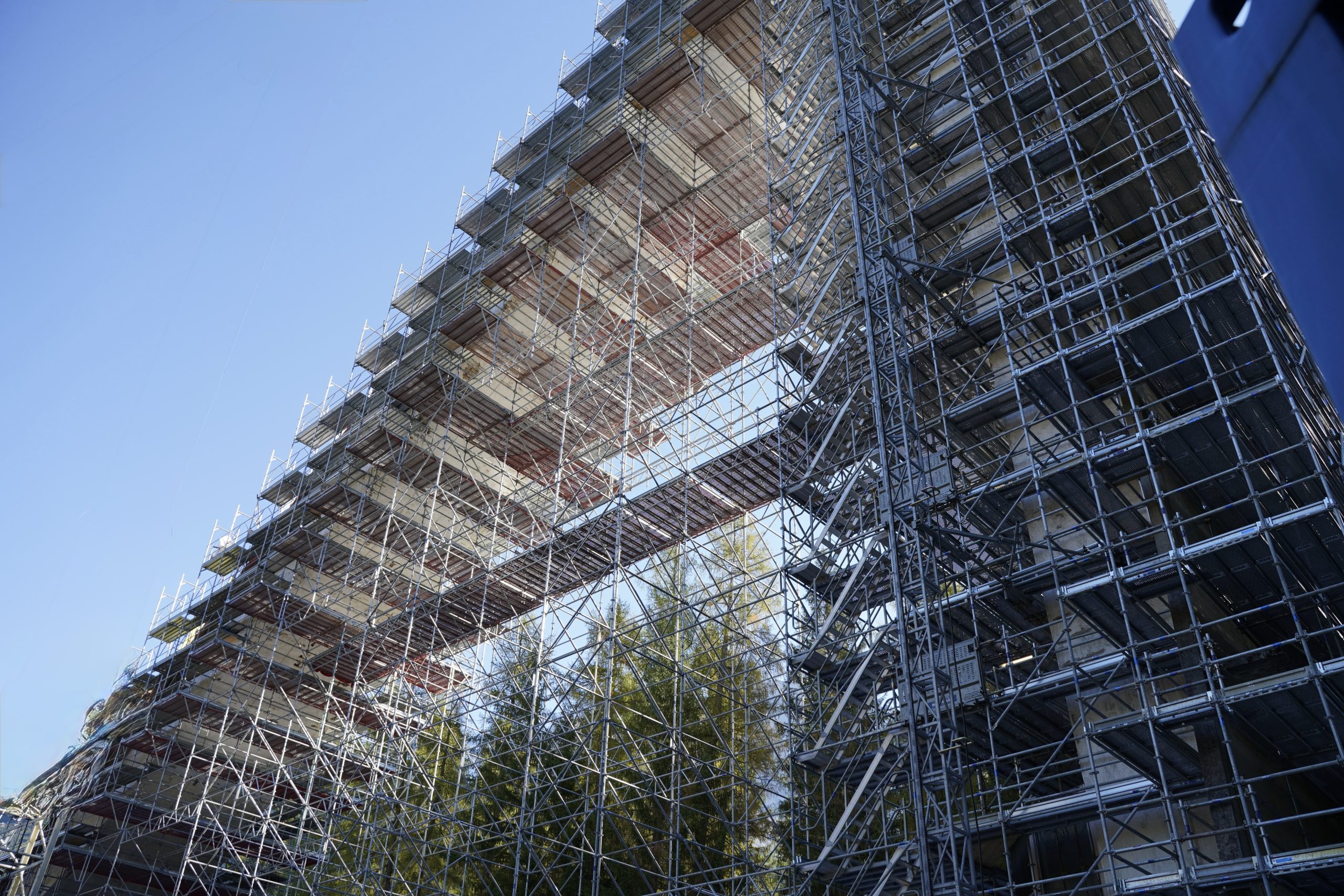
For vertical transport, the team employed Pilosio’s Up transport platform, using it to lift both materials and personnel to the upper levels. Whilst the platform provided the fastest route to height, safety considerations meant installing a full-height access stairway as an emergency escape route for the workforce.
The logistics of moving 160 tonnes of scaffold components onto an alpine site, then assembling them around an irregular structure at height, required careful sequencing. The 3D model proved invaluable here, allowing the team to plan the build sequence and identify potential bottlenecks before they became site problems.
The Pilosio Perspective
For Pilosio, based in Tavagnacco, the project represents the kind of high-profile application where their engineered systems can demonstrate their capabilities. Company president Nereo Parisotto sees the installation as more than just scaffolding.
“A symbol that, for years, everyone entering the Ampezzo basin has seen on the left, gradually fading under the effects of time and decay,” he notes. “Looking at it today, mid-transformation, we see not only its glorious past but also the engineering developed by our technical team, who set out to design structures in harmony and perfect balance with the surrounding environment.”
The shiny steel grid of standards and ledgers has created what Parisotto describes as a structural geometry that magnifies rather than obscures the landmark. The installation has become something of a local attraction itself, with residents stopping to photograph the wrapped structure.
Technical Specs
The scale of the installation reflects the complexity of the challenge:
- Tower height: 51 meters
- Inrun ramp length: 83 meters
- Total structure weight: 160 tons (steel and aluminium)
- Linear tube: 22 kilometers
- Working platform area: 2,700 square meters
- Access walkways: Four suspended units
- Vertical transport: Pilosio Up platform with multiple landings
- Emergency access: Full-height stairway
All loads were transferred directly to ground level, with the scaffold designed to withstand wind loading whilst maintaining stability across its full height.
Lessons and Outcomes
The project demonstrates several principles that apply beyond this specific installation. Full 3D modelling allowed the team to identify and solve problems digitally before they became expensive site issues. The MP multidirectional system’s versatility proved essential when working with non-standard geometry. Meanwhile, careful attention to access and logistics ensured the scaffold served as an effective working platform rather than simply meeting minimum safety requirements.
Ecoedile’s restoration work is progressing with the support of Euroedile’s temporary structures. The scaffold is scheduled for dismantling during the first months of 2026, when the restored ski jump will be returned to the community ahead of the Winter Olympics.
The story does not end there. Pilosio’s structures will be redeployed for restoration of the ski jump’s side stands, also part of the overall contract awarded to Ecoedile. The ability to adapt and reuse the temporary structures across different phases demonstrates the economic value of well-engineered scaffold systems on complex projects.
For Pilosio and Euroedile, the Cortina ski jump represents a showcase project—the kind of high-profile, technically demanding installation that tests systems and capabilities. As the scaffold currently enveloping the structure catches the alpine light, it stands as a testament to modern scaffold engineering meeting historic architecture.
This article was originally published in Issue 28 of the ScaffMag magazine.