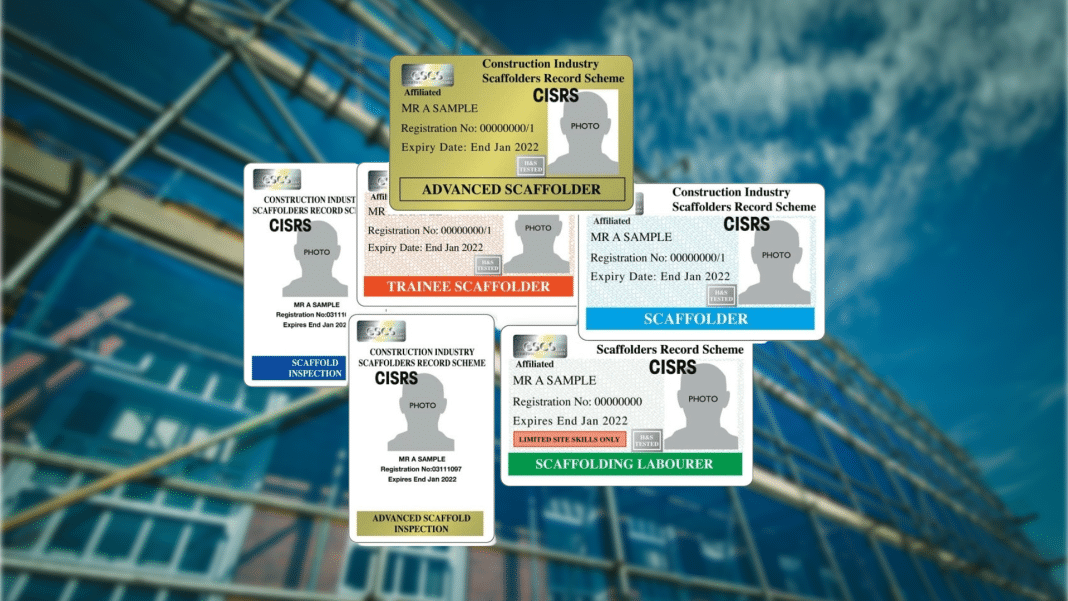
CISRS has said it could withdraw its notice to leave CSCS if agreement can be reached over the Construction Leadership Council rule at the centre of the dispute.
The scaffolding competence scheme gave its clearest explanation yet of the possible route to remaining within CSCS during an industry webinar on Tuesday.
CISRS said its preferred outcome is for the Construction Leadership Council (CLC) to amend Clause 4 of its Industry Card Schemes recommendation so the scheme can continue covering scaffolders working across construction and other industries.
If that happens, CISRS said the termination notice it served at the beginning of September can be withdrawn.
If agreement cannot be reached, CISRS says an independent scheme will be ready when its CSCS licence ends on 1 June 2027.
The position gives the industry a clearer picture of the next nine months following CISRS’s announcement on 8 September that it planned to leave CSCS.
Clause 4 remains at centre of dispute
The dispute centres on the CLC’s March 2024 recommendation covering industry card schemes.
Clause 4 states that cards carrying the CSCS logo will not be issued for non-construction-related occupations or people visiting sites. The same recommendation says clients, contractors, trade associations and government should specify schemes carrying the CSCS logo, with no equivalents accepted.
CISRS argues that this creates a problem because scaffolders routinely move between construction and sectors including petrochemical, marine, aviation, nuclear and events.
During Tuesday’s webinar, CISRS said a survey of the 20 largest NASC members found 45% of their work was carried out in non-construction settings. One contractor reported that 82% of its work fell outside construction.
Clive Dickin, Group CEO of NASC and CISRS, called for the wording of Clause 4 to be tightened.
He said: “If we can just tighten those words up, please, CLC, CSCS, we’ll be in a good position.”
CISRS said discussions with the CLC and other parties are continuing.
The published CLC recommendation currently remains unchanged.
Nine-month notice gives CISRS time
CISRS said it served notice itself after taking legal advice that its current use of the CSCS licence could put the scheme in breach of the CLC requirements.
The organisation feared that waiting could leave it facing termination of its licence with only 90 days’ notice.
Instead, the notice served at the beginning of September created a nine-month period before 1 June.
Dickin told the webinar that CISRS can rescind its termination notice during that period if a solution is agreed.
The explanation follows criticism from the Scaffolding Training Alliance and others over the lack of wider consultation before CISRS announced its plans earlier this month.
Scaffolding Association enters the dispute
The Scaffolding Association has also challenged the planned withdrawal, issuing an open letter to industry on Tuesday calling for urgent action, transparency and independent oversight during the notice period.
The Association said its own member survey found no evidence of meaningful consultation across the wider scaffolding contractor base before the decision was taken, including among respondents who are also NASC members.
It also said it had received clarification via Build UK that the Construction Leadership Council requirements are not intended to prevent someone holding a CSCS-logo card from working in another sector or workplace, and that the CLC and its members will work with CSCS to ensure there continues to be an industry card for scaffolding which meets the required standards and carries the CSCS logo.
The Association has called for independent oversight of CISRS during the notice period and immediate engagement with the wider industry on future CSCS-recognised scaffolding competence arrangements.
CISRS previously told Scaffmag that consulting before taking formal action could have exposed cardholders, training centres and employers to a much shorter transition if its licence was revoked.
Existing cards protected for full term
CISRS also gave stronger assurances over existing cards.
It said current CISRS cards carrying the CSCS logo will remain valid for their full five-year term, which it said is protected under its contract with CSCS.
Qualifications, training standards, assessments and training centres are also due to remain unchanged whichever route is taken.
The original CISRS announcement on 8 September said new and renewed cards would begin to be issued without the CSCS logo from June 2027 if the scheme leaves the CSCS framework.
Site acceptance still needs resolving
Future access to construction sites remains one of the biggest questions around an independent CISRS card.
Build UK’s current Training Standard lists CISRS among the schemes carrying the CSCS logo that should be accepted on site. The standard follows the CLC position on CSCS-logo schemes.
CISRS said on Tuesday that it is developing API connections allowing contractors and clients to check cards through their own HR and site-access systems regardless of the eventual CSCS position.
Verification is only one part of the issue. Major construction clients would still need a clear basis for accepting a future CISRS card without the CSCS logo if the two organisations ultimately separate.
CISRS has said it is working with the CLC and CSCS during the transition period to resolve those questions.
Further changes planned
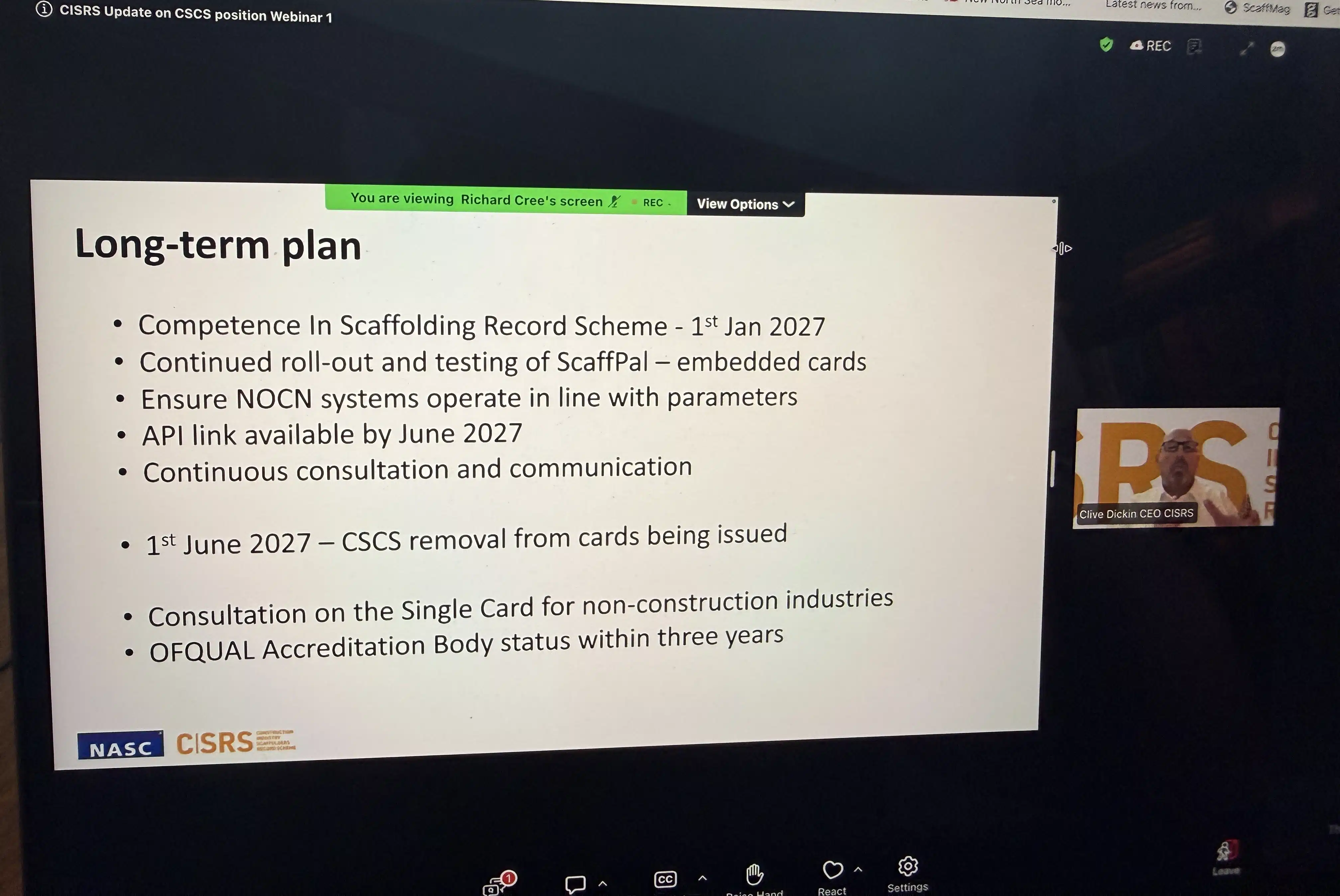
The webinar also gave more detail on longer-term changes to the scheme.
CISRS plans to become the Competence in Scaffolding Record Scheme from 1 January 2027 while retaining the CISRS initials.
It also intends to rebrand cards issued through its overseas scheme to make them easier to distinguish from UK cards, before introducing a wider global scheme planned for 2028.
The organisation reiterated its intention to pursue Ofqual recognition and said its ScafPal digital platform will continue to be developed.
CISRS has committed to publishing the full recording of Tuesday’s webinar along with written answers to questions it did not have time to address. A further webinar is also planned.