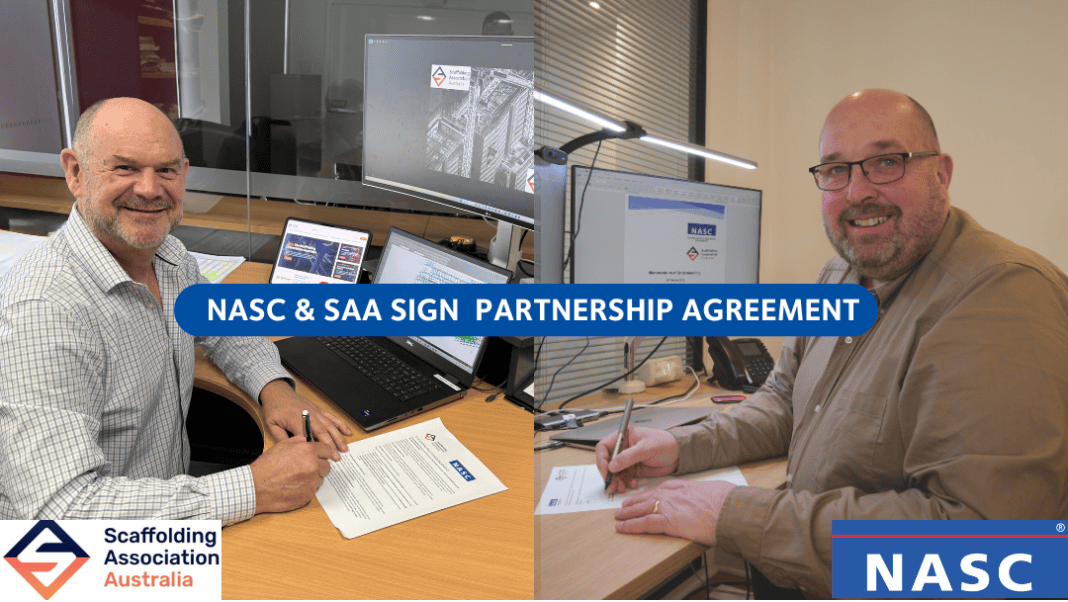
In a landmark move for the global scaffolding industry, the UK’s National Access and Scaffolding Confederation (NASC) and the Scaffolding Association Australia (SAA) have signed a Memorandum of Understanding (MoU) aimed at strengthening international cooperation and raising safety standards across the sector.
The strategic agreement, signed in both London and Brisbane, is seen as a significant step forward in aligning standards, training, and best practices between the two countries — and potentially, further afield.
The MoU outlines a commitment to share expertise, improve training, and support the development of safer, more efficient scaffolding and access systems. It builds on each organisation’s existing networks and expertise with a clear goal: to foster a globally recognised standard of excellence within the industry.
Clive Dickin, Chief Executive of NASC, described the agreement as a “major milestone”.
“This is another major milestone in the establishment of a global access and scaffolding sector working to uniformly high standards of safety and compliance,” he said. “We want all scaffolders, regardless of where they work in the world, to benefit from the same protections and standards.”
He also urged those commissioning scaffolding services to prioritise contractors who align with these high standards, helping to embed safety into procurement processes globally.
Robert Thiess, National Chair and Managing Director of the SAA, echoed the enthusiasm.“We’re absolutely thrilled about this agreement,” he said. “It’s a big step towards better and safer standards of scaffolding around the world. We look forward to working closely with NASC to make this vision a reality.”
Four Pillars of Partnership
The new partnership will focus on four key areas:
- Training and Education: Exchanging best practices from the UK and Australia to elevate workforce development.
- Equipment Testing: Sharing knowledge on scaffold and access equipment testing to improve user safety.
- Operational Efficiency: Collaborating on methods to deliver access solutions more efficiently while reducing risks.
- Standards Recognition: Working towards mutual recognition of membership and educational standards.
A Global Network of Expertise
Founded over 80 years ago, NASC represents over 800 members in the UK and offers training, consultancy, and support services. SAA, meanwhile, plays a key role in shaping access and scaffolding standards across Australia and has strong ties within the Australasian construction sector.
The new agreement also complements existing international partnerships. Both NASC and SAA have a similar MoU in place with Scaffolding, Access & Rigging New Zealand (SARNZ), forming a growing alliance of industry bodies committed to improving safety and raising the bar worldwide.
As the scaffolding industry continues to evolve in an increasingly connected world, both organisations say they are confident this partnership will lead to “high-impact advancements” in safety, innovation and international cooperation.