Former NASC MD Joins Temporary Works Forum

Robin James, who served as the managing director of the National Access and Scaffolding Confederation (NASC) for over 20 years, has taken on a new role as Operations Director at the Temporary Works Forum (TWf).
James officially left the NASC on October 31, 2022, after significantly increasing NASC membership numbers and staff during his tenure.
In his new role at TWf, James aims to advance the forum’s essential work while promoting greater industry engagement. He announced his intent to share further updates at the next TWf quarterly meeting, which will be held at the Institution of Civil Engineers (ICE) in London on June 14, 2023.
“I’d like to take this opportunity to introduce myself to the TWf members, and the wider temporary works community,” said James.
“I am delighted to accept the challenge of taking the vital work of the TWf forward to the next level, and the equally important task of promoting greater engagement with its work by the wider industry.”
During his time at the NASC, James played a crucial role in raising the profile of the NASC Hire, Sale and Manufacturing Committee. One of his key achievements includes the development of the NASC Code of Practice Product audit. This initiative set minimum standards for core scaffolding products supplied to the UK scaffold contracting sector by NASC supplier members.
James has also engaged extensively with UK industry stakeholder bodies, including the Health and Safety Executive (HSE), Construction Leadership Council (CLC), Build UK, Construction Industry Training Board (CITB), Access Industry Forum (AIF), Joint Tax Committee (JTC), and CLG Group. His work helped forge and develop key relationships to benefit the NASC contracting membership within the construction sector.
In his statement, James also paid tribute to his predecessor at the TWf, David Thomas, who will retire as TWf Secretary and Director after the June quarterly meeting. “David’s diligence and dedication has helped the TWf make its mark upon the industry. I feel honoured to be asked to take this forward, and I look forward to your support and engagement,” James added.
James’s appointment to the TWf marks a vital step in continuing the forum’s mission. His wealth of experience and established industry relationships are anticipated to contribute significantly to the advancement of the Temporary Works Forum in the coming years.
Working at Height Regulations May Be Spared in EU-era Law Overhaul
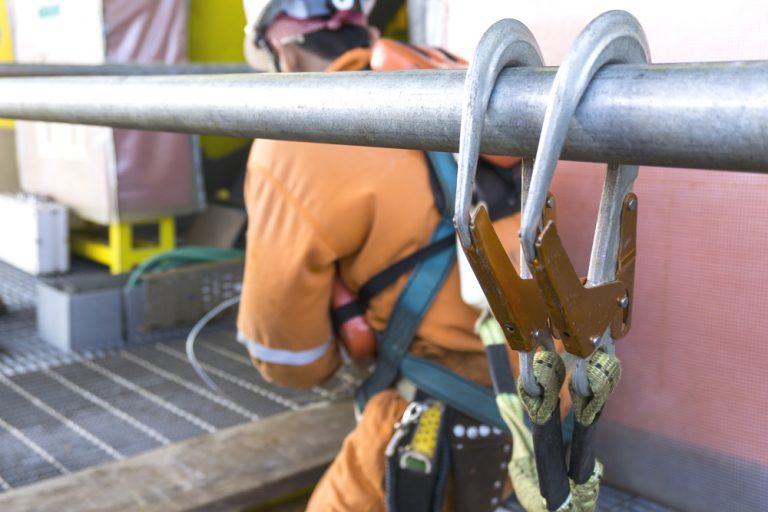
In what appears to be a major policy reversal, the UK Government has today announced that it will not proceed wholly with the planned repeal of retained EU laws, including the vital Working at Height Regulations.
The legislation was initially slated for removal at the end of 2023 as part of the Revocation and Reform Bill, but indications suggest it will now remain in force. Official confirmation, however, is still awaited.
The controversial Bill, initially aimed at expunging EU-derived laws from the UK statute book in the aftermath of Brexit, had targeted over 2,400 regulations for elimination. However, today’s media reports suggest that just 600 pieces of EU-era legislation will be scrapped, significantly less than the 4,000 initially proposed.
Key safety regulations, including the Working at Height Regulations, the Manual Handling Operations Regulations, and the Personal Protective Equipment at Work Regulations, are now expected to be retained.
The Access Industry Forum (AIF), which had been actively campaigning against the repeal of the Work at Height Regulations, will likely view this as a victory for worker safety.
The AIF has previously pointed out that these regulations, although originating from an EU directive, have been a significant part of UK law for nearly two decades and were neither unfit for purpose nor burdensome.
Alongside the AIF, the ten principal trade associations and federations involved in work at height had submitted written evidence to the House of Commons Public Bill Committee, making a compelling case for the continuation of these laws.
Industry Reaction
Robert Candy, Chief Executive of the Scaffolding Association, expressed optimism about the imminent announcement, stating, “I am delighted that today’s announcement appears to confirm that common sense has prevailed and that these vitally important regulations will be retained. Our relentless engagement with ministers and officials over recent months has helped them understand the consequences of scrapping these regulations. I am grateful that they acted in the interests of construction worker safety.” The AIF had also urged various sectors to write to their MPs, advocating for the Working at Height Regulations to be integrated into UK law and exempted from ‘sunset clauses’ within the EU Law (Revocation and Reform) Bill.Turning the Tide: Layher Scaffolding Solutions for Thames River Challenges

Hertfordshire-based Extreme Scaffolding, in collaboration with Layher UK, successfully tackled the high tidal range of the Thames River to establish a core sampling platform on the river wall.
In the bustling heart of London, the Thames River flows with an ever-changing rhythm dictated by its tides which can rise and fall by up to 7 meters. Recently, Extreme Scaffolding Services took on a unique scaffolding project that required overcoming these enormous tidal challenges to provide a safe and stable working platform for core sampling on the river wall.
With limited time and accessibility, the team collaborated with system scaffolding experts Layher UK, based in Letchworth, for an innovative solution.
The project location required ingenuity and careful planning. Extreme Scaffolding had to transport materials through a busy police car park and over the wall to reach the riverbed. The team worked diligently to minimise disruptions and ensure a smooth workflow.
 Tidal Constraints and the Need for Speed
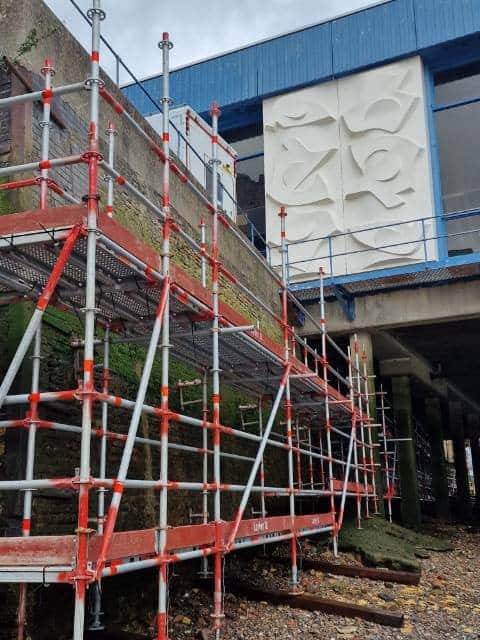
The Thames River’s tides only allowed for a tight working window for only 3-4 hours per day for scaffolders. To tackle this challenge, Extreme Scaffolding opted for Layher’s Allround system scaffold, known for its rapid assembly and disassembly. In addition, Layher’s steel decks featured holes that allowed water to flow through, easing the challenges posed by the tides.
Custom Scaffold Design by Layher UK & Extreme Scaffolding
Furthermore, the partnership between Layher UK and Extreme Scaffolding played a crucial role in the project’s success in the design phase. They calculated the scaffold designs specifically tailored to the unique challenges and requirements of the Thames River Wall project. This collaboration ensured the most efficient use of Layher’s system scaffold and maximised its potential.
Extreme Scaffolding utilised railway sleepers as a solid foundation as the scaffold was based on the riverbed. The client prepared the riverbed using a mini digger delivered to the site via a boat. The scaffold structure was then secured to the river wall using Gallo Brackets, ensuring stability and safety for those working on the platform.
Extreme Scaffolding’s innovative use of Layher’s system scaffold, paired with diligent planning and a strong collaboration with Layher UK, allowed the team to overcome the challenges posed by the Thames River tides.
Kevin Graves, Extreme Scaffolding Services Operations Manager, said, “This project stands as a testament to our company’s ability to adapt and deliver results under demanding conditions. With the successful core sampling platform in place, the client can now gather crucial data to understand better and maintain the river wall, ensuring the safety and stability of London’s iconic waterway.”
Sean Pike, Layher UK’s Managing Director, added, “This is an unusual use of our system in that the added complication of the structure is subject to the tide. Working close and in customer partnership with the design elements has helped with the success and safe erection and delivery by all involved at Extreme”.
Tidal Constraints and the Need for Speed
The Thames River’s tides only allowed for a tight working window for only 3-4 hours per day for scaffolders. To tackle this challenge, Extreme Scaffolding opted for Layher’s Allround system scaffold, known for its rapid assembly and disassembly. In addition, Layher’s steel decks featured holes that allowed water to flow through, easing the challenges posed by the tides.
Custom Scaffold Design by Layher UK & Extreme Scaffolding
Furthermore, the partnership between Layher UK and Extreme Scaffolding played a crucial role in the project’s success in the design phase. They calculated the scaffold designs specifically tailored to the unique challenges and requirements of the Thames River Wall project. This collaboration ensured the most efficient use of Layher’s system scaffold and maximised its potential.
Extreme Scaffolding utilised railway sleepers as a solid foundation as the scaffold was based on the riverbed. The client prepared the riverbed using a mini digger delivered to the site via a boat. The scaffold structure was then secured to the river wall using Gallo Brackets, ensuring stability and safety for those working on the platform.
Extreme Scaffolding’s innovative use of Layher’s system scaffold, paired with diligent planning and a strong collaboration with Layher UK, allowed the team to overcome the challenges posed by the Thames River tides.
Kevin Graves, Extreme Scaffolding Services Operations Manager, said, “This project stands as a testament to our company’s ability to adapt and deliver results under demanding conditions. With the successful core sampling platform in place, the client can now gather crucial data to understand better and maintain the river wall, ensuring the safety and stability of London’s iconic waterway.”
Sean Pike, Layher UK’s Managing Director, added, “This is an unusual use of our system in that the added complication of the structure is subject to the tide. Working close and in customer partnership with the design elements has helped with the success and safe erection and delivery by all involved at Extreme”.
 Tidal Constraints and the Need for Speed
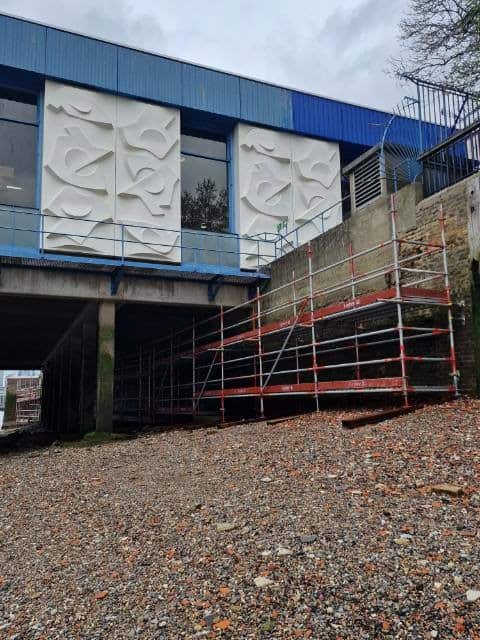
The Thames River’s tides only allowed for a tight working window for only 3-4 hours per day for scaffolders. To tackle this challenge, Extreme Scaffolding opted for Layher’s Allround system scaffold, known for its rapid assembly and disassembly. In addition, Layher’s steel decks featured holes that allowed water to flow through, easing the challenges posed by the tides.
Custom Scaffold Design by Layher UK & Extreme Scaffolding
Furthermore, the partnership between Layher UK and Extreme Scaffolding played a crucial role in the project’s success in the design phase. They calculated the scaffold designs specifically tailored to the unique challenges and requirements of the Thames River Wall project. This collaboration ensured the most efficient use of Layher’s system scaffold and maximised its potential.
Extreme Scaffolding utilised railway sleepers as a solid foundation as the scaffold was based on the riverbed. The client prepared the riverbed using a mini digger delivered to the site via a boat. The scaffold structure was then secured to the river wall using Gallo Brackets, ensuring stability and safety for those working on the platform.
Tidal Constraints and the Need for Speed
The Thames River’s tides only allowed for a tight working window for only 3-4 hours per day for scaffolders. To tackle this challenge, Extreme Scaffolding opted for Layher’s Allround system scaffold, known for its rapid assembly and disassembly. In addition, Layher’s steel decks featured holes that allowed water to flow through, easing the challenges posed by the tides.
Custom Scaffold Design by Layher UK & Extreme Scaffolding
Furthermore, the partnership between Layher UK and Extreme Scaffolding played a crucial role in the project’s success in the design phase. They calculated the scaffold designs specifically tailored to the unique challenges and requirements of the Thames River Wall project. This collaboration ensured the most efficient use of Layher’s system scaffold and maximised its potential.
Extreme Scaffolding utilised railway sleepers as a solid foundation as the scaffold was based on the riverbed. The client prepared the riverbed using a mini digger delivered to the site via a boat. The scaffold structure was then secured to the river wall using Gallo Brackets, ensuring stability and safety for those working on the platform.
 Extreme Scaffolding’s innovative use of Layher’s system scaffold, paired with diligent planning and a strong collaboration with Layher UK, allowed the team to overcome the challenges posed by the Thames River tides.
Kevin Graves, Extreme Scaffolding Services Operations Manager, said, “This project stands as a testament to our company’s ability to adapt and deliver results under demanding conditions. With the successful core sampling platform in place, the client can now gather crucial data to understand better and maintain the river wall, ensuring the safety and stability of London’s iconic waterway.”
Sean Pike, Layher UK’s Managing Director, added, “This is an unusual use of our system in that the added complication of the structure is subject to the tide. Working close and in customer partnership with the design elements has helped with the success and safe erection and delivery by all involved at Extreme”.
Extreme Scaffolding’s innovative use of Layher’s system scaffold, paired with diligent planning and a strong collaboration with Layher UK, allowed the team to overcome the challenges posed by the Thames River tides.
Kevin Graves, Extreme Scaffolding Services Operations Manager, said, “This project stands as a testament to our company’s ability to adapt and deliver results under demanding conditions. With the successful core sampling platform in place, the client can now gather crucial data to understand better and maintain the river wall, ensuring the safety and stability of London’s iconic waterway.”
Sean Pike, Layher UK’s Managing Director, added, “This is an unusual use of our system in that the added complication of the structure is subject to the tide. Working close and in customer partnership with the design elements has helped with the success and safe erection and delivery by all involved at Extreme”. CISRS Partners with Training Centres for Subsidised Summer Courses

The Construction Industry Scaffolders Record Scheme (CISRS), in collaboration with a selection of approved training centres, has announced its plan to offer a series of subsidised Continuing Professional Development (CPD) courses this summer across the United Kingdom.
The initiative will provide an opportunity for delegates to attend these courses at a reduced cost of £50. The initiative has been made possible through agreements with various training providers. Since the program’s inception, over 25,000 operatives have retained their CISRS status, having successfully completed the two-day programme.
“We’ve always been committed to improving accessibility to high-quality training in our industry. This summer’s initiative is another step in that direction,” said a CISRS representative. “Our arrangement with our partners allows us to offer this CPD program at a nominal cost, and we are grateful for their cooperation.”
Over 100 of these subsidised courses will be available at different locations nationwide. The initiative, which is expected to benefit thousands of individuals, will see CISRS reinvest around £400,000 back into the industry, providing support to stakeholders who hold the industry-recognised qualification and card.
The subsidised CPD courses will be held at the following centres:
• AIS Survivex (North Shields) 22-23 May 2023
• Aspects Total Training (Coventry) 26-27 June 2023
• CITB NI (Northern Ireland) 2-3 August 2023
• CWIC (Swansea) 9-10 August 2023
• Construction College Midlands (Birmingham) 31July-1st August 2023
• Fulcrum Scaffold Safety & Training (Mostyn) 15-16 June 2023
• Fulcrum Scaffold Safety Training & Working at Height Safety Solutions (North Shields) 1-2 June 2023
• Lawsons Training (Workington) 12-13 September 2023
• LTC (Cullompton) 28-29 September 2023
• LTC (Plymouth) 17-18 August 2023
• NCC East (Bircham Newton) 29-30 July 2023
• NCC Scotland (Inchinnan) 16-17 August 2023
• NCC South (Erith) 12-13 August 2023
• NETA (Stockton) 20-21 July 2023
• Safety and Access (Nottingham) 7-8 August 2023
• Safety and Access (Immingham) 11-12 September 2023
• Simian (Warrington) 13-14 June 2023
• Simian (Waltham Forest) 25-26 July 2023
• Simian (Weston Super Mare) 1-2 August 2023
• Simian (Anglesey) 13-14 July 2023
• Training 2000 (Blackburn) 28-29 June 2023
“This initiative is a testament to our ongoing commitment to developing the skills of our workforce, and we are delighted with the response from our training centres. More centres than ever have joined up to this summer’s initiative, and we appreciate their help in redistributing funds back into the industry,” added the CISRS representative.
Courses will be offered on a first-come, first-served basis, with interested parties encouraged to contact the training centres directly to check availability. The list of participating centres, dates, and contact details are available on the CISRS website.
Offshore Scaffolders Join Peers in Resuming 48-hour Strike
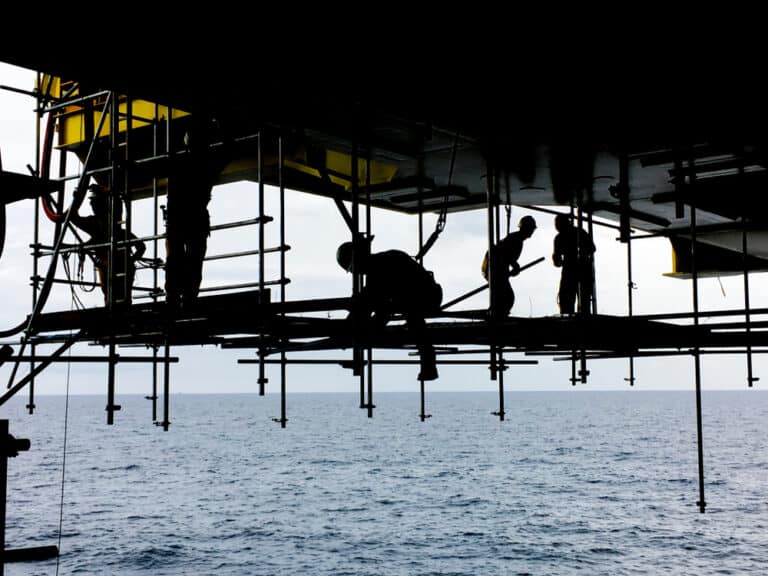
Unite the union has announced that approximately 1200 offshore contractors, including scaffolders, will resume a 48-hour strike from today (10 May) until Friday (12 May) due to a growing dispute over jobs, pay, and conditions in the offshore sector.
The strike is expected to impact major oil and gas operators such as Apache, BP, Harbour Energy, Enquest, Ithaca, Repsol, Shell, and TAQA.
Workers involved are from various fields, such as electrical, production, and mechanical technicians, as well as deck crew, crane operators, pipefitters, platers, and riggers employed by Bilfinger UK Limited, Petrofac Facilities Management, Stork Technical Services, Sparrows Offshore Services, and Wood Group.
Unite has previously criticised the government’s lack of intervention regarding the substantial profits made by oil and gas corporations, with BP and Shell earning combined first-quarter profits of nearly £11.7 billion.
Unite’s general secretary, Sharon Graham, emphasised the union’s determination to fight for better jobs, pay, and conditions in the offshore sector and challenge “unfettered corporate greed.”
The strike is expected to involve around 200 Bilfinger contractors working on BP and Repsol assets, approximately 650 Stork offshore members due to unimproved pay offers, and 200 offshore workers employed by Sparrows. Unite members working for Petrofac on the Ithaca FPF1 and those employed by the Wood Group on TAQA installations will also participate in the strike, totalling around 150 members.
John Boland, Unite industrial officer, highlighted that the offshore sector is witnessing the largest wave of industrial action in a generation. He further emphasised the union members’ willingness to fight for improved pay, fairer and safer working rotas, and holidays.
The strike follows a previous 48-hour stoppage (24-26 April), as reported by scaffmag, that caused severe disruptions to the operations of major oil and gas operators, including the shutdown of the CNR Ninian Central and Ninian South platforms and delays in planned works on other platforms.
Hydrajaws Reinforces Connection with Metesco
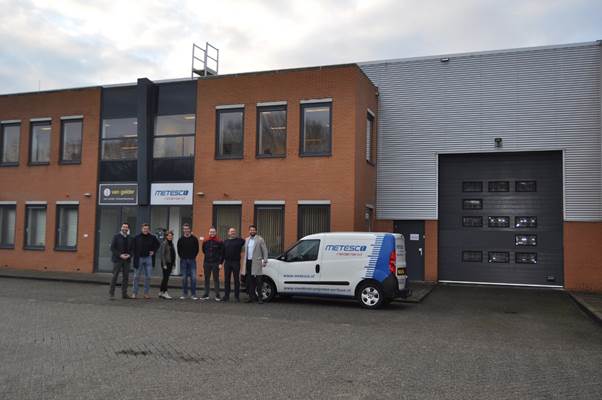
Hydrajaws, the world’s largest and most trusted designer and producer of pull testers, is marking its 35th anniversary in 2023 with the announcement of formalising its long-standing alliance with Netherlands-based Metesco.
The two companies have solidified their relationship by officially designating Metesco as an authorised distributor and Approved Service Centre for Hydrajaws in the Netherlands, Benelux, and Germany. This decision demonstrates the trust and confidence Hydrajaws places in Metesco’s capacity to deliver the highest levels of service and support to its extensive customer base in the Benelux markets.
Stephen Hynes, Hydrajaws Managing Director, shared his enthusiasm about the strengthened partnership: “The company is delighted to formalise its long-standing relationship with Metesco and offer customers an even higher level of service and support. Hydrajaws has been collaborating with Metesco for many years and has the utmost confidence in their ability to provide the highest levels of service and support to its customers,” he said.
Metesco, a prominent provider of calibration and repair services for force and torque measurement instruments, is well-regarded for its expertise in the field. The company is currently pursuing ISO 17025 accreditation and has been offering calibration and repair services for numerous years.
As a trusted market brand, Hydrajaws partners with industry associations and anchor and fixing OEMs such as Ejot, Fischer, Rawlplug, and Klimas, among others, and regularly exports to over 70 countries. Hydrajaws is committed to delivering top-quality products and services to its customers and is thrilled to provide this additional layer of service and support through its collaboration with Metesco.
Since 2014, Hydrajaws has been at the forefront of transforming how anchor testing is captured, verified, and effortlessly shared within organisations and with clients, thanks to its launch of the first Bluetooth reporting system. Hydrajaws has recently released its new, free-to-use Bluetooth reporting app, Verify Pro, which includes all the functionality of the previous app. For customers with larger engineering teams working across multiple sites and tasks, Hydrajaws has also introduced Verify TEAMS to enable more effective collaboration of resources and management and communication of tasks and test reports.
Construction Sector Tops UK Insolvency List

According to recent data from the Insolvency Service, the UK construction industry has recorded the highest number of insolvencies across all sectors in the 12 months leading up to March 2023.
A total of 4,165 insolvencies were lodged in the first three months of 2023 alone, accounting for nearly one-fifth (19%) of all cases in industries with captured data.
Following the construction industry were the wholesale and retail trade and repair of vehicles (3,518 insolvencies, 16% of cases) and accommodation and food services (2,951 insolvencies, 13% of cases). This continues the trend of construction having the highest quarterly number of insolvencies among all industrial sectors.
In terms of overall company insolvencies, there was an 18% increase compared to the same first-quarter period in 2022. Company insolvency statistics for England and Wales, together with figures for Scotland and Northern Ireland, show a 4% decrease in total company insolvencies in Q1 2023 compared to Q4 2022. After seasonal adjustments, England and Wales registered a total of 5,747 company insolvencies in Q1 2023.
Scotland experienced a significant increase in company insolvencies, with 297 cases reported in Q1 2023, a 41% increase compared to the same quarter in 2022. In contrast, Northern Ireland saw a decrease of 29% with 40 company insolvencies in Q1 2023 compared to Q1 2022.
Over the 12 months ending Q1 2023, 1 in every 197 companies faced liquidation, a higher ratio than those recorded in the 12-month periods ending Q4 2022 and Q1 2022.
Powerclad FR Sheeting Plays Key Role in London’s Massive Hallsville Quarter Regeneration

ITP’s Powerclad FR scaffold sheeting is being utilised at Hallsville Quarter in Canning Town, one of London’s most significant regeneration projects.
The site, a joint venture between London Borough of Newham and Linkcity, is part of the massive £3.7bn Canning Town and Custom House SPD regeneration framework.
This ambitious project will deliver 1,100 new homes, over 323,000 sq ft of leisure and retail space, and more than 32,000 sq ft of space for community facilities, as well as new public spaces, pedestrian links, cyclist provisions, and 1,100 secure parking spaces.
“The Hallsville Quarter is a critical part of the transformation of Canning Town, providing contemporary living, leisure, and retail spaces that are essential for creating a thriving community and establishing a lasting legacy,” says a representative from the joint venture partnership.
Designed by Hawkins Brown, Phase 3 of Hallsville Quarter features private rental homes, 143 shared ownership units, 199 affordable homes, including 50 extra-care apartments, 88,049 sq ft of retail and leisure space, and an integrated health centre.
The extensive installation of Powerclad FR at this phase offers protection and containment for high-rise buildings under construction.
Powerclad FR is a third-party tested and certified sheeting that achieves fire retardancy certification to TS 62 for external use and TS 63 for internal use for both plain and printed sheeting. Its fire safety credentials ensure full compliance with requirements for projects valued over £25m, as stated in the Joint Code of Practice on the Protection from Fire of Construction Sites and Buildings Undergoing Renovation.
In recent years, Powerclad FR has been utilised in various other landmark London projects, such as the deep retrofit and expansion of BT’s former headquarters near St Paul’s Cathedral and Royal Eden Docks, a prestigious mixed-use development east of Canary Wharf by Mount Anvil Homes. It was also employed in the transformation of London’s iconic Old War Office site into a world-class luxury hotel and apartment complex.
“Powerclad FR’s contribution to these high-profile projects highlights the importance of reliable, certified fire protection in the construction industry, ensuring safety and peace of mind for developers, contractors, and future residents alike,” adds the joint venture representative.
NASC Set to Unveil the Truth About its Membership
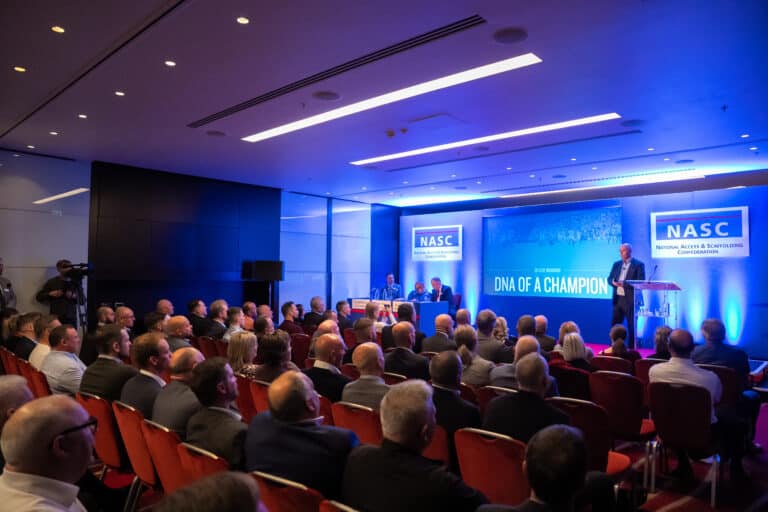
The National Access and Scaffolding Confederation (NASC) is set to unveil the truth about its membership and debunk popular myths in an upcoming webinar.
On Tuesday, June 13 at 10:00 am via Zoom, the “Join the NASC” event aims to debunk myths and misconceptions about the organisation and its membership, such as being an “old boys club,” a “cartel”, or “only for large companies”.
NASC represents a diverse range of contractors, from small to sizeable scaffolding organisations nationwide. But readers might be surprised to learn that over 65% of our members are actually SMEs, with a turnover of between £1m and £3m. The organisation has over 120 information members and growing, which includes main contractors, clients, and local authorities. NASC is encouraging these members to adopt “NASC Only” policies on their sites and tenders.
The webinar will offer attendees a chance to ask questions about what becoming an NASC member involves, including criteria, the auditing process, timescales and the benefits of being and NASC. Members of the Independent Auditing team will also be in attendance to discuss common issues identified during the audit process offer advice on how to pass.
NASC Membership Manager, Jamie McGuire, encourages non-NASC scaffolding contractors and eligible businesses to attend the webinar and address any concerns or misconceptions about joining the organisation.
“We are aware that there are divided opinions on the NASC and our application process, so during this webinar we welcome an opportunity to openly discuss any misconceptions that may be holding eligible businesses back from applying for NASC membership,” said McGuire.
Interested parties can register for the event at https://www.eventbrite.co.uk/e/join-the-nasc-tickets-626101966837 to learn the truth about NASC membership and its benefits.
ScaffPlan Chosen as Official Scaffold Design Platform for ScaffChamp 2023

The organisers of the annual Scaffolding Championships, known as ScaffChamp, have announced that ScaffPlan has been selected as the official scaffold design platform for this year’s event.
The competition, which showcases the top scaffolders from 11 different countries, is set to take place in Lithuania in May 2023.
Simon Boyes, CEO of ScaffPlan, expressed his excitement about the partnership, saying, “We are honoured to be selected as the official scaffold design platform for ScaffChamp 2023. We are committed to providing the best possible tools and support to help companies design and plan their scaffolds, and we are excited to be part of this impressive event. We have some major surprises in store for the event and will be releasing our newest software release live on stage.”
The two-day event, scheduled for May 26th and 27th, will be live-streamed for viewers across the globe. In addition to the thrilling competition, attendees can expect a number of showcases, stalls, activities, and giveaways.
Oleg Abramov, president of the Baltic Scaffold Association (BSA), praised the collaboration with ScaffPlan, stating, “At ScaffChamp, we’re thrilled to have ScaffPlan as our official scaffold design platform for the next three years. ScaffPlan’s cutting-edge technology and user-friendly interface make it the ideal choice for users looking to design and plan their scaffold structures with total accuracy. We’re proud to partner with ScaffPlan and excited to see how their innovative software will help the teams bring competition design to life. We believe this partnership will inspire future ScaffPlan users to pay attention to this revolutionary software on the market.”
As a leading provider of scaffold design software, ScaffPlan has been selected as a multi-year major event partner. The company will showcase the ease and constructability of top-secret scaffold designs once they have been revealed to the teams during the competition.
ScaffChamp 2023 promises to be an exciting event for scaffolders and scaffold enthusiasts alike. For more information about the event, visit www.scaffchamp.com. To learn more about ScaffPlan, go to www.scaffplan.com.