
New ONS figures shows suicide in construction on the rise

ADVERTISEMENT

Shocking new data from the ONS reveals that workers in construction are now nearly FOUR times more likely to take their own lives compared to other sectors in 2021.

The Lighthouse Construction Industry Charity has been the first to share what these figures mean for our construction community and what is being done to help address these shocking figures.

Since the Stevenson/Farmer report in 2017, the charity has been working with Professor Billy Hare at Glasgow Caledonian University (GCU) to analyse the number of suicides in construction occupations so they have a better understanding where to focus preventative measures to support the industry.

The number of suicides attributed to construction occupations in 2021 was 507, most of which are male (503). This figure constitutes a rise of 24 from the previous year and 25 more than the previous five year average and equates to 34 per 100,000 in employment. This is the highest rate since analysis of this data began at GCU.

The research identified that the number of suicides in construction rose from 26 to 34 per 100,000 in the seven years to 2021. It is often quoted that suicides within construction are three times that of the national industry average. Unfortunately, that figure is now nearer four times, meaning that workers in construction are nearly four times more likely to take their own lives compared to other sectors in 2021.

Professor Billy Hare of GCU said “Whilst it is unwise to react to a single year’s figures, the long-term rate of suicides is regrettably on an upward trajectory for those working in the construction industry, despite all the good work being done in recent years. This means we need to dig deeper to find and address the true root causes, and take collective action sooner rather than later.” 

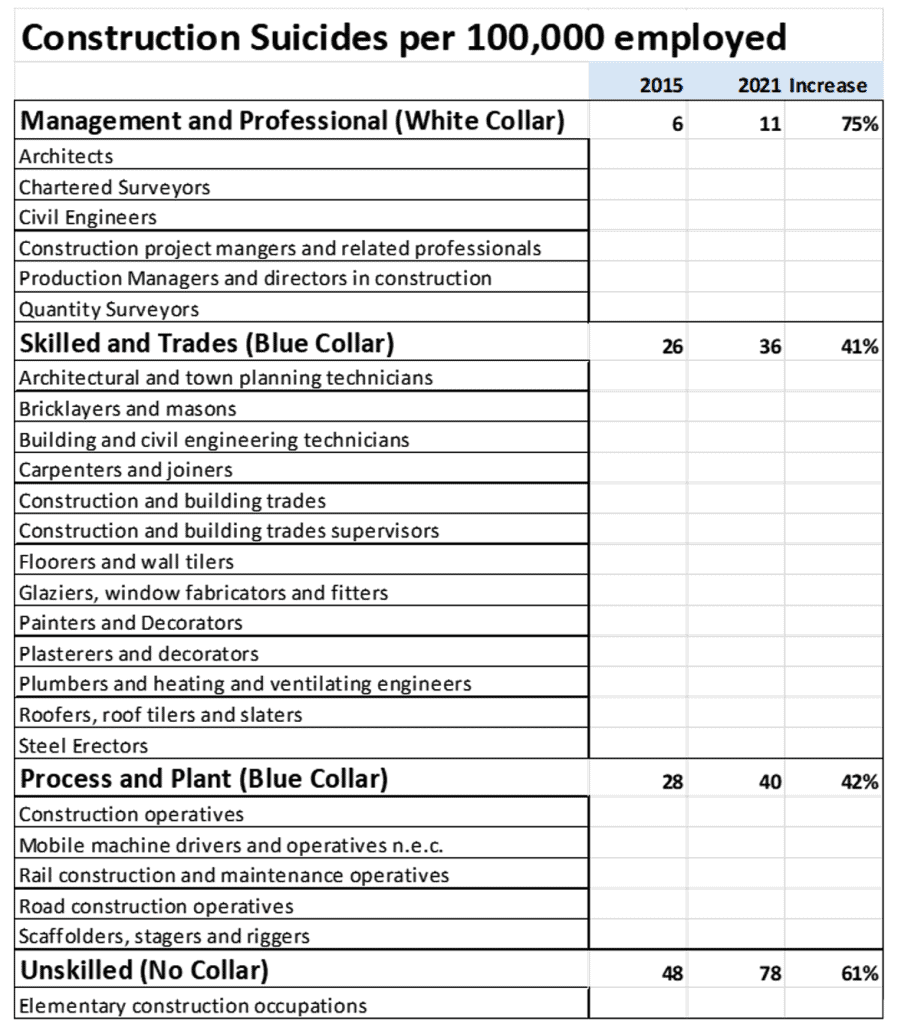
The summary table below shows the findings between occupational groups. In summary, every category has shown a significant increase since 2015.
Bill Hill, CEO of the Lighthouse Construction Industry Charity said, “Over 87% of our construction workforce are male and over 50% of the sector is made up of self employed, agency staff or zero hour contract workers. Financial insecurity is a major factor for poor wellbeing in our workforce and the pandemic added greater anxiety and emotional burden.

The industry and charities like ours have made huge strides in recognising and delivering programmes to improve wellbeing but the results from 2021 simply galvanise our resolve to do more. Our messages of support are not reaching the boots on the ground. We all have a moral responsibility and an economic imperative to work together to improve the wellbeing and welfare or our workers.”

The industry is doing more than ever to recognise and address this major issue and the Construction Leadership Council (CLC) has asked the Lighthouse Construction Industry Charity and Mates In Mind Charity to work together to co-chair a major project to improve wellbeing and welfare within construction along with initiatives to accelerate universal culture change to reduce stigma, break down barriers and increase awareness of support services.

This major initiative called Make It Visible will look to unite the CITB, HSE, Supply Chain School, trade and professional bodies, clients and contractors to formulate and execute a plan of action with key deliverables and measurement to drive the change necessary to improve the wellbeing of our workforce and ultimately reduce the suicides in our industry.

In January 2023 the industry will be invited to a presentation of a study conducted by GCU looking at all the research and industry best practice on wellbeing over the last two years. The participants will be asked to vote on the priorities for the Make It Visible initiative to work on.

Sarah Meek, Managing Director of Mates in Mind said “These latest statistics demonstrate that we need to do more as an industry to prevent people reaching the point of crisis, by addressing the causes that negatively impact on one’s mental health and thereby reduce the need for safety nets. 

There is much that we can do around prevention and employers should be encouraged to view their responsibility around this across their total workforce including their supply chain who, from our research earlier this year, have shown to be working with severe levels of anxiety.  With positive moves already beginning which sees mental health starting to feature in frameworks, we must continue building on this and encourage conversations around how contracts are both procured and awarded to address some of the factors that can have such a detrimental effect.”

The full report can be downloaded here : Construction project risk & value management | Glasgow Caledonian University | Scotland, UK (gcu.ac.uk)

Most popular ↑

Two workers killed in Spain after mast climbing platform collapse

Two workers have been killed following the collapse of...

Scottish offshore workers urged to consider scaffolding careers

The Construction Industry Training Board is targeting workers from...

Robot named Douglas begins work on Tilbury Douglas site

Tilbury Douglas has begun using a humanoid robot to...

NASC warns members over online conduct in new media policy

The National Access and Scaffolding Confederation said the new...

Latest news

New ONS figures shows suicide in construction on the rise

ADVERTISEMENT

Shocking new data from the ONS reveals that workers in construction are now nearly FOUR times more likely to take their own lives compared to other sectors in 2021.

The Lighthouse Construction Industry Charity has been the first to share what these figures mean for our construction community and what is being done to help address these shocking figures.

Since the Stevenson/Farmer report in 2017, the charity has been working with Professor Billy Hare at Glasgow Caledonian University (GCU) to analyse the number of suicides in construction occupations so they have a better understanding where to focus preventative measures to support the industry.

The number of suicides attributed to construction occupations in 2021 was 507, most of which are male (503). This figure constitutes a rise of 24 from the previous year and 25 more than the previous five year average and equates to 34 per 100,000 in employment. This is the highest rate since analysis of this data began at GCU.

The research identified that the number of suicides in construction rose from 26 to 34 per 100,000 in the seven years to 2021. It is often quoted that suicides within construction are three times that of the national industry average. Unfortunately, that figure is now nearer four times, meaning that workers in construction are nearly four times more likely to take their own lives compared to other sectors in 2021.

Professor Billy Hare of GCU said “Whilst it is unwise to react to a single year’s figures, the long-term rate of suicides is regrettably on an upward trajectory for those working in the construction industry, despite all the good work being done in recent years. This means we need to dig deeper to find and address the true root causes, and take collective action sooner rather than later.” 

The summary table below shows the findings between occupational groups. In summary, every category has shown a significant increase since 2015.

Bill Hill, CEO of the Lighthouse Construction Industry Charity said, “Over 87% of our construction workforce are male and over 50% of the sector is made up of self employed, agency staff or zero hour contract workers. Financial insecurity is a major factor for poor wellbeing in our workforce and the pandemic added greater anxiety and emotional burden.

The industry and charities like ours have made huge strides in recognising and delivering programmes to improve wellbeing but the results from 2021 simply galvanise our resolve to do more. Our messages of support are not reaching the boots on the ground. We all have a moral responsibility and an economic imperative to work together to improve the wellbeing and welfare or our workers.”

The industry is doing more than ever to recognise and address this major issue and the Construction Leadership Council (CLC) has asked the Lighthouse Construction Industry Charity and Mates In Mind Charity to work together to co-chair a major project to improve wellbeing and welfare within construction along with initiatives to accelerate universal culture change to reduce stigma, break down barriers and increase awareness of support services.

This major initiative called Make It Visible will look to unite the CITB, HSE, Supply Chain School, trade and professional bodies, clients and contractors to formulate and execute a plan of action with key deliverables and measurement to drive the change necessary to improve the wellbeing of our workforce and ultimately reduce the suicides in our industry.

In January 2023 the industry will be invited to a presentation of a study conducted by GCU looking at all the research and industry best practice on wellbeing over the last two years. The participants will be asked to vote on the priorities for the Make It Visible initiative to work on.

Sarah Meek, Managing Director of Mates in Mind said “These latest statistics demonstrate that we need to do more as an industry to prevent people reaching the point of crisis, by addressing the causes that negatively impact on one’s mental health and thereby reduce the need for safety nets. 

There is much that we can do around prevention and employers should be encouraged to view their responsibility around this across their total workforce including their supply chain who, from our research earlier this year, have shown to be working with severe levels of anxiety.  With positive moves already beginning which sees mental health starting to feature in frameworks, we must continue building on this and encourage conversations around how contracts are both procured and awarded to address some of the factors that can have such a detrimental effect.”

The full report can be downloaded here : Construction project risk & value management | Glasgow Caledonian University | Scotland, UK (gcu.ac.uk)
Popular Categories

Latest posts

Scaffolding firms urged to review RIDDOR procedures as HSE consults on changes

The Health and Safety Executive has launched a consultation on proposed changes to the Reporting of Injuries, Diseases and Dangerous Occurrences Regulations 2013, known...

Scottish offshore workers urged to consider scaffolding careers

The Construction Industry Training Board is targeting workers from Scotland’s offshore energy sector as part of efforts to widen the construction talent pool and...

NASC warns members over online conduct in new media policy

The National Access and Scaffolding Confederation said the new Social Media and General Media Policy sets expectations for how its members, CISRS centres and...

Two workers killed in Spain after mast climbing platform collapse

Two workers have been killed following the collapse of a twin mast climbing work platform in Benidorm, Spain. The incident happened on Wednesday, 22 April,...

Brogan wins Manchester student accommodation access package

Brogan Group has secured the powered access package for a student accommodation building in Manchester. The access specialist will provide several passenger and goods hoists...

‘Not every scaffolder is ok’: Alan Osborn backs mental health campaign at ScaffChamp

Alan Osborn is set to shave his head at ScaffChamp 2026 as part of a campaign to raise £5,000 for men’s mental health and...

Baton opens early adopter programme for scaffolding contractors

Baton has opened applications for its Early Adopter Programme, giving scaffolding contractors early access to a software platform designed specifically for construction subcontractors. The company...

SCA joins Coriant in move to widen access and industrial services capability

Coriant has announced the acquisition of specialist contractor SCA, in a move that further expands the group’s capabilities in access, temporary containment and industrial...

Robot named Douglas begins work on Tilbury Douglas site

Tilbury Douglas has begun using a humanoid robot to carry out administrative and data-collection tasks on a live construction site. The contractor says the...

HAKI reports sharp UK sales drop as construction starts stall

The Swedish-listed scaffolding and access safety group said UK revenues fell to SEK 52 million (£4.2 million) in the three months to 31 March,...

Spring Issue #29 | Past issues >>

Latest topics

Most popular ⚡︎

Two workers killed in Spain after mast climbing platform collapse

Two workers have been killed following the collapse of...

Scottish offshore workers urged to consider scaffolding careers

The Construction Industry Training Board is targeting workers from...

Robot named Douglas begins work on Tilbury Douglas site

Tilbury Douglas has begun using a humanoid robot to...

NASC warns members over online conduct in new media policy

The National Access and Scaffolding Confederation said the new...

Related articles

ADVERTISEMENTS
More from
Latest articles

TRAD UK launches charity campaign supporting Epilepsy Action

TRAD UK has launched a new fundraising campaign in support of Epilepsy Action, the...

Scaffolding firms urged to review RIDDOR procedures as HSE consults on changes

The Health and Safety Executive has launched a consultation on proposed changes to the...

Scottish offshore workers urged to consider scaffolding careers

The Construction Industry Training Board is targeting workers from Scotland’s offshore energy sector as...

NASC warns members over online conduct in new media policy

The National Access and Scaffolding Confederation said the new Social Media and General Media...

Two workers killed in Spain after mast climbing platform collapse

Two workers have been killed following the collapse of a twin mast climbing work...

Brogan wins Manchester student accommodation access package

Brogan Group has secured the powered access package for a student accommodation building in...