NASC Kickstart Numbers Soar Past 400

More than 430 work placements are now being offered to young jobseekers across the UK through the NASC’s Kickstart gateway.
A total of 77 NASC members – both contractors and suppliers – have signed up to the Kickstart Scheme through the NASC, committing to provide six-month work placements to out of work 18–24-year-olds. Fifty members signed up at the launch of the scheme earlier this year, providing scaffolding industry experience to 310 young people. According to the scaffolding trade body, the second wave of support has now seen this number swell to 434. The NASC says interviews with potential recruits have been carried in the past months and an increasing number of people have now started their placements. These include Brian Murray, who has joined Form Access Scaffolding Ltd. He said: “I really didn’t see much of a future for myself. But now thanks to Form Access Ltd and the Kickstart Scheme I’ve got a chance to be settled, learn a trade and get myself to a financially stable place.” Henry Annafi, NASC Training Officer, said: “NASC have really got behind the NASC’s Kickstart gateway. The initial interest was absolutely overwhelming and this has only gone from strength to strength. “Placements are now being made thick and fast, which has led to a second wave of support – with new members joining the gateway and those already signed up committing to take more young people on. “We’re proud to have the one of largest Kickstart gateways in the construction industry and the largest scaffolding gateway. I’d like to thank the NASC members once again for their enthusiasm. “Their efforts will bring 400+ new people into the industry for an initial six-month period. With many members already signalling their intent to convert these placements into full-time positions we’re confident that this will lead to hundreds of new scaffolding industry careers.”Scaffolding ‘Liftbot’ continues to raise the bar

Scaffmag speaks with Artem Kuchukov, Co-Founder of Kewazo the makers behind Liftbot – the robotic digital worker for scaffolding.
One of the men behind what has the potential to be one of the most revolutionary inventions in scaffolding is clear on the major problems facing the sector right now. They are three problems that directly informed the research and development behind LIFTBOT. “Safety, labour shortages, and rising costs,” says Artem Kuchukov, co-founder of Kewazo. After completing an MA in Construction Robotics from the Technical University of Munich, Kuchokov continued to explore the possibilities of automation for another two years before officially founding Kewazo GmbH in 2018 alongside business partner Ekaterina Grib. Skip to today, and the company has unveiled the fruits of that labour – a system that can makes the transportation of materials on-site, and into situ, safer and more efficient. Think steel girders sent to the 39th floor of a new London skyscraper, via robot, and you’re in the right ballpark. “Since the early stage of our development, we’ve always been talking to the scaffolding industry. All of them lead to the same result — that there are three main challenges: safety, labour shortages, and rising costs.” Kuchokov explains when we ask how the concept came about. But the development of LIFTBOT, which benefited from €3.8million of venture capital investment and €500,000 in state support, didn’t come without difficulties. “As with any startup, the biggest challenges for us were high uncertainty and limited resources,” he said. “Uncertainty in our case means you are doing something that nobody has done before, and so you need to be ready for questions that nobody has clear answers for. “Of course, people might think that there are transportation solutions already available on the market. But we found out that their adoption rate is very low in the scaffolding industry, that is why it was clear to us that we have to rethink how material handling is done in scaffolding today.”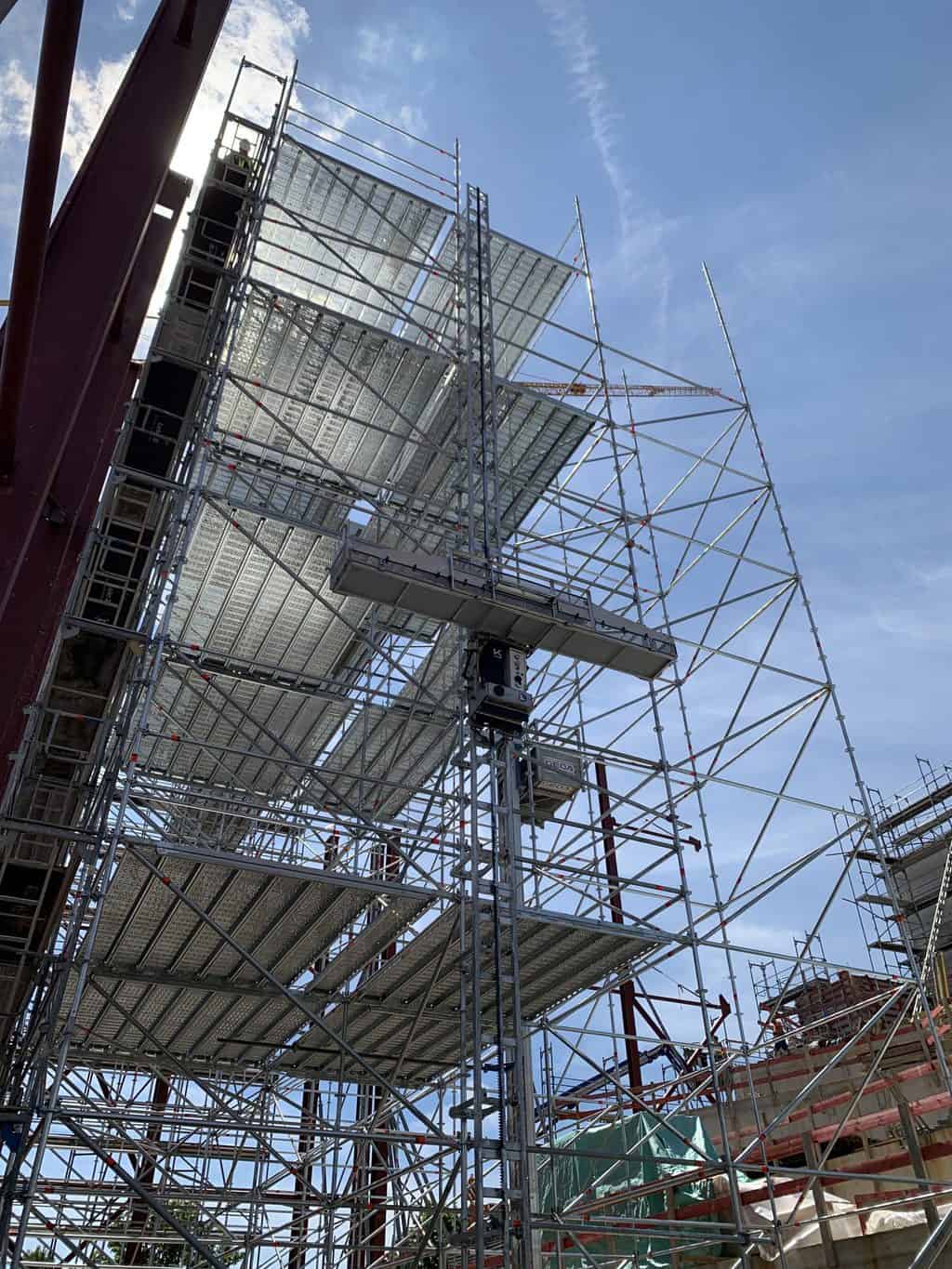 Mr Kuchukov went on to reveal the small team and relatively tight budget ensured the core idea was honed down to concentrate on the most significant benefits to users.
“We had to make clear decisions about features, and what we had to focus on. After countless hours spent with scaffolders, we identified three main priorities – installation flexibility, operational speed, and automated control,” he said.
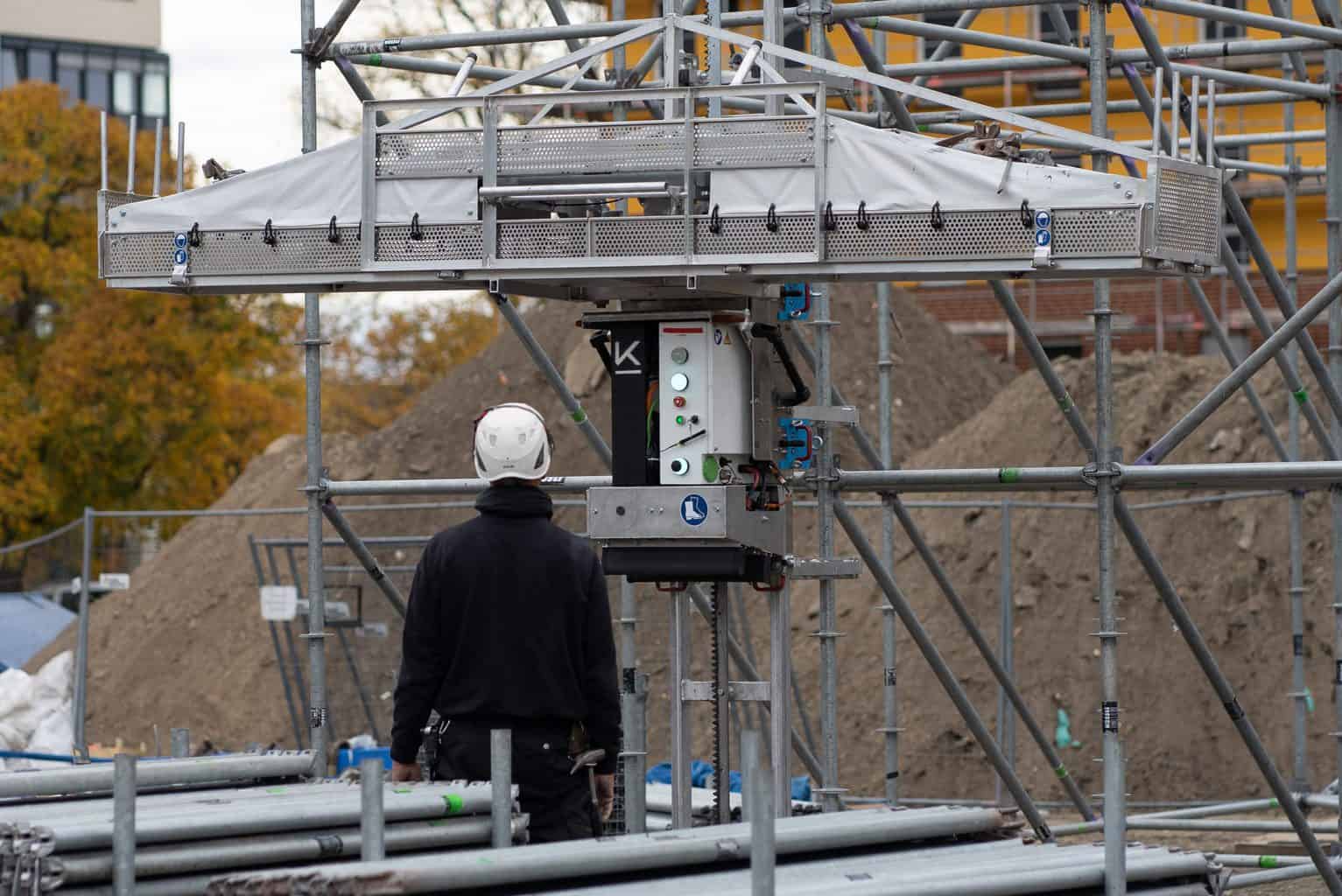
It’s hard to argue Kewazo achieved those goals. LIFTBOT’s 20-minute installation time, small physical footprint and simple, one-touch controls offer an affordable and easy-to-control time-saving opportunity for construction firms, many of which currently commit more than 70% of overall costs to labour.
Mr Kuchukov went on to reveal the small team and relatively tight budget ensured the core idea was honed down to concentrate on the most significant benefits to users.
“We had to make clear decisions about features, and what we had to focus on. After countless hours spent with scaffolders, we identified three main priorities – installation flexibility, operational speed, and automated control,” he said.
It’s hard to argue Kewazo achieved those goals. LIFTBOT’s 20-minute installation time, small physical footprint and simple, one-touch controls offer an affordable and easy-to-control time-saving opportunity for construction firms, many of which currently commit more than 70% of overall costs to labour.
 Put simply, then, the system is a cost-effective investment that can free up staff for other responsibilities — whether that’s on the same project or another undertaking. And with an official CE-certificate from TÜV Süd, one of the leading bodies in regulating powered access equipment, the safety aspect is already proven.
“We should be realistic about what can be done with robots. Construction sites are a very unstructured environment that requires human creativity,” Kuchokov replies when we ask about concerns relating to increased use of automation, and its impact on the jobs market.
“Think of this: in car manufacturing, for example, you can have welding robots working 24/7, sometimes even without lighting. The main reason for this is that everything is structured and predefined, you can secure the exact positioning of all elements. Now think of construction sites.
“Every construction site is unique, there is a lot of mess and things are not clean. Because of this, it’s simply not possible to have robots fully overtaking jobs in such a complex environment. At least in any cost-efficient manner. Despite all the progress in the areas of robotics and artificial intelligence, most probably, the situation will stay like this for at least the next few decades.
“The second point is the problem of labour shortage. Most of the companies around Europe struggle to find good scaffolders. This leads to missed opportunities and slower company growth. And as we’ve already seen in examples of other industries, automation can address this.”
While in many ways the system is a product of designers looking to other sectors for ideas on how to improve construction, the system’s functions are highly transferrable.
This means Kewazo GmbH hopes to see widespread adoption and uptake by firms in any sector that could benefit from automated transportation of materials, tools and more.
Put simply, then, the system is a cost-effective investment that can free up staff for other responsibilities — whether that’s on the same project or another undertaking. And with an official CE-certificate from TÜV Süd, one of the leading bodies in regulating powered access equipment, the safety aspect is already proven.
“We should be realistic about what can be done with robots. Construction sites are a very unstructured environment that requires human creativity,” Kuchokov replies when we ask about concerns relating to increased use of automation, and its impact on the jobs market.
“Think of this: in car manufacturing, for example, you can have welding robots working 24/7, sometimes even without lighting. The main reason for this is that everything is structured and predefined, you can secure the exact positioning of all elements. Now think of construction sites.
“Every construction site is unique, there is a lot of mess and things are not clean. Because of this, it’s simply not possible to have robots fully overtaking jobs in such a complex environment. At least in any cost-efficient manner. Despite all the progress in the areas of robotics and artificial intelligence, most probably, the situation will stay like this for at least the next few decades.
“The second point is the problem of labour shortage. Most of the companies around Europe struggle to find good scaffolders. This leads to missed opportunities and slower company growth. And as we’ve already seen in examples of other industries, automation can address this.”
While in many ways the system is a product of designers looking to other sectors for ideas on how to improve construction, the system’s functions are highly transferrable.
This means Kewazo GmbH hopes to see widespread adoption and uptake by firms in any sector that could benefit from automated transportation of materials, tools and more.
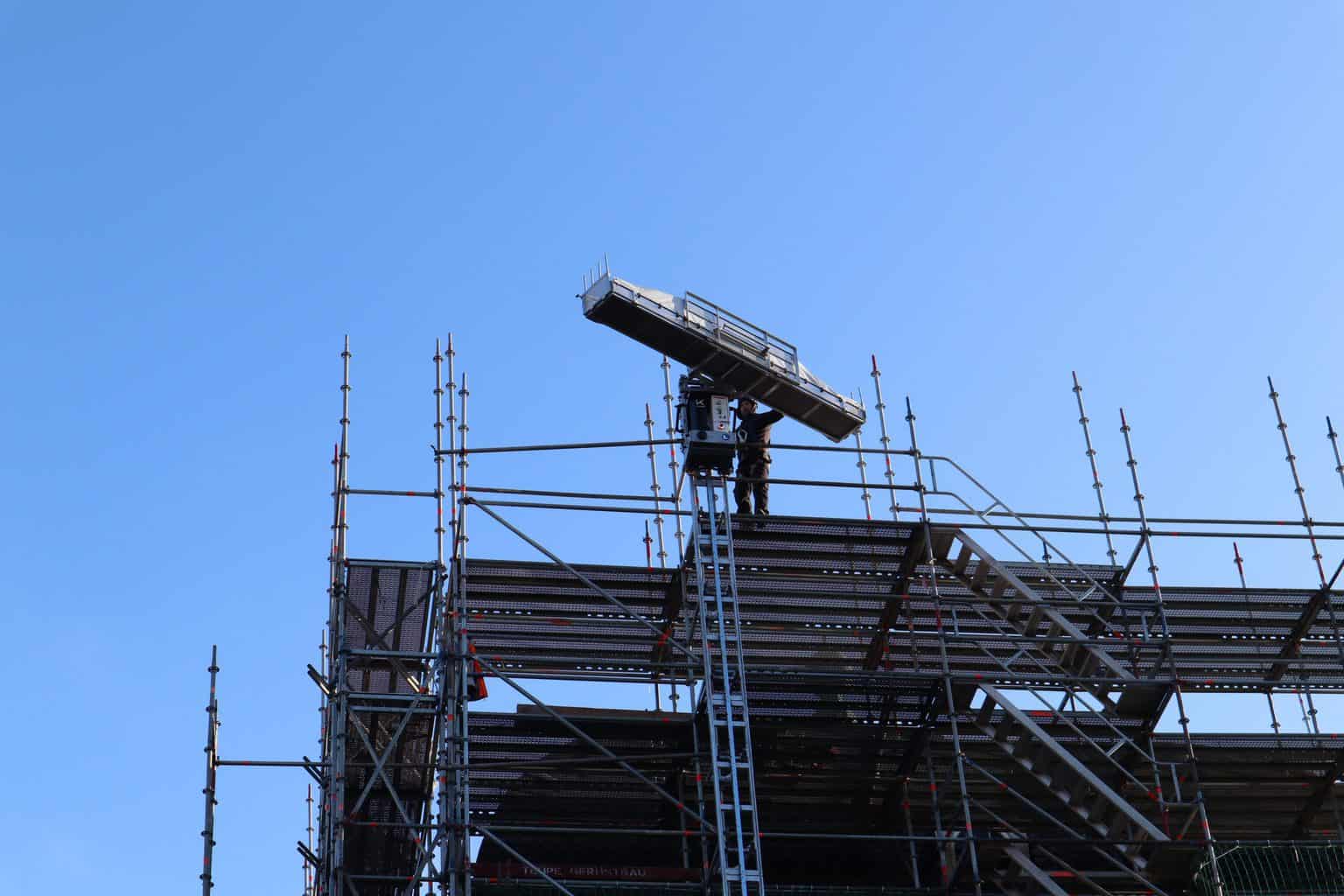 Some have already been using LIFTBOT with impressive results. As Kuchokov explains, since July 2019 the system’s impact has been studied across 30 different projects with startling impact. Not least companies benefiting from man-hour savings of up to 44%, whether that’s relating to scaffolding assembly, the ongoing transportation of building materials, or another delivery function.
“Maintenance of gas, oil and energy plants, and shipbuilding yards… Tests and pilots on real sites have shown that with LIFTBOT a three-man scaffolding crew can assemble almost any type of scaffolding faster than larger teams relying on manual transport,” Kuchokov says of the different environments that are proven to gain from Kewazo’s innovation.
“It’s important to note here, though, that saving man-hours doesn’t mean people losing their jobs. According to the feedback of some of our customers in Germany, for example, today the amount of available projects is around three times higher than what they can cover with their usual resources.
“This means that if there would be a possibility to free up a certain amount of people from being involved in certain jobs, this would allow companies to cover more jobs with the same resources.”
With the next decade or so set to be instrumental in determining the nature of the following century, companies must adapt and evolve to ensure they can thrive in a world that needs to become more efficient for a multitude of reasons.
That process is destined to involve changes in how people are employed, and what they are tasked with as part of that employment as a result of robotics and automation. With that in mind, it seems LIFTBOT is very much an invention for our times.
This article was first published in the ScaffMag Magazine Issue 12
Some have already been using LIFTBOT with impressive results. As Kuchokov explains, since July 2019 the system’s impact has been studied across 30 different projects with startling impact. Not least companies benefiting from man-hour savings of up to 44%, whether that’s relating to scaffolding assembly, the ongoing transportation of building materials, or another delivery function.
“Maintenance of gas, oil and energy plants, and shipbuilding yards… Tests and pilots on real sites have shown that with LIFTBOT a three-man scaffolding crew can assemble almost any type of scaffolding faster than larger teams relying on manual transport,” Kuchokov says of the different environments that are proven to gain from Kewazo’s innovation.
“It’s important to note here, though, that saving man-hours doesn’t mean people losing their jobs. According to the feedback of some of our customers in Germany, for example, today the amount of available projects is around three times higher than what they can cover with their usual resources.
“This means that if there would be a possibility to free up a certain amount of people from being involved in certain jobs, this would allow companies to cover more jobs with the same resources.”
With the next decade or so set to be instrumental in determining the nature of the following century, companies must adapt and evolve to ensure they can thrive in a world that needs to become more efficient for a multitude of reasons.
That process is destined to involve changes in how people are employed, and what they are tasked with as part of that employment as a result of robotics and automation. With that in mind, it seems LIFTBOT is very much an invention for our times.
This article was first published in the ScaffMag Magazine Issue 12 Exclusive: Alltask bolsters capabilities with acquisition of top scaffolding firm

Scaffolding specialist Alltask Ltd is set to strengthen and extend its capabilities after completing the acquisition of Luton based, EA Scaffolding & Systems Ltd
Privately owned, Kent-based, Alltask Ltd has exclusively revealed to Scaffmag that its just completed the acquisition and take-over of EA Scaffolding & Systems Ltd. With the acquisition, the company will now have two offices, its existing one in Rochester, Kent and the other office and depot in Luton, allowing Alltask to now serve the entire South of England. The strategic move allows Alltask to not only extend its geographical capabilities but also add many exciting new projects and clients to its growing portfolio. Alltask which employs over 300 people was formed in 1991 by Daniel Fincham and Doug Shearer, who remain owners of the business. The firm specialise in a range of cost-driven integrated solutions covering Scaffolding, Asbestos Management, and Thermal Insulation. Established in 1992, EA Scaffolding & Systems Limited offer a complete range of access, protection, support, and technical services to the construction, building maintenance, exhibition, and events industries. Scott West, Alltask Managing Director, commented, “We are delighted and proud to welcome the new company and to finalise and publicly announce the acquisition of EA Scaffolding & Systems. Both EAS and Alltask are recognised and respected industry names that are synonymous with safety and quality. This acquisition allows us to extend our geographical capabilities further while maintaining our fundamental core values. EAS has many exciting projects which, when added to Alltask’s portfolio of work, will make us a formidable force within the scaffold & access sector. We welcome every member of the EAS team into the Alltask family, knowing they will embrace our culture and ethos with the sole aim of being one of the safest, most efficient, reliable & innovative companies operating in the UK today.”Optimus Access launch new Well-Being initiative

Optimus Access Limited has launched a brand new ‘Your Well-Being’ Initiative, supported by the industry trade body the Scaffolding Association.
Over the past 3 months, the management team at Optimus Access Limited (OAL) along with representatives from trade organisation The Scaffolding Association, have been collaborating together with the single focus of creating a brand-new well-being framework, that will not only benefit just those at OAL but also the construction sector as a whole. The “Your Well-Being” program is a simple framework that has been specifically designed to be able to help with the early detection of potential well-being issues in staff. While also providing a structure and set protocols for management to follow should a potential issue be identified. “We wanted a system in place that gave us better tools to be able to help any of our staff who may encounter problems,” said OAL Health & Safety Director Michael Collier. “But it was important to us, that whatever we designed, wasn’t to put an extra burden on the staff. In the past, predominantly well-being programs have just meant lots of box-ticking, nothing of any substance. We weren’t happy with that; our staff are our greatest asset, so we wanted to be proactive and ensure we had a better structure in place.” Although the full details of the program cannot be released publicly to protect the confidential integrity of the program. The initiative is based on a simple traffic light system. With the differing levels triggering specific protocols. Some are a simple increase in monitoring, whereas others require seeking and referring professional help.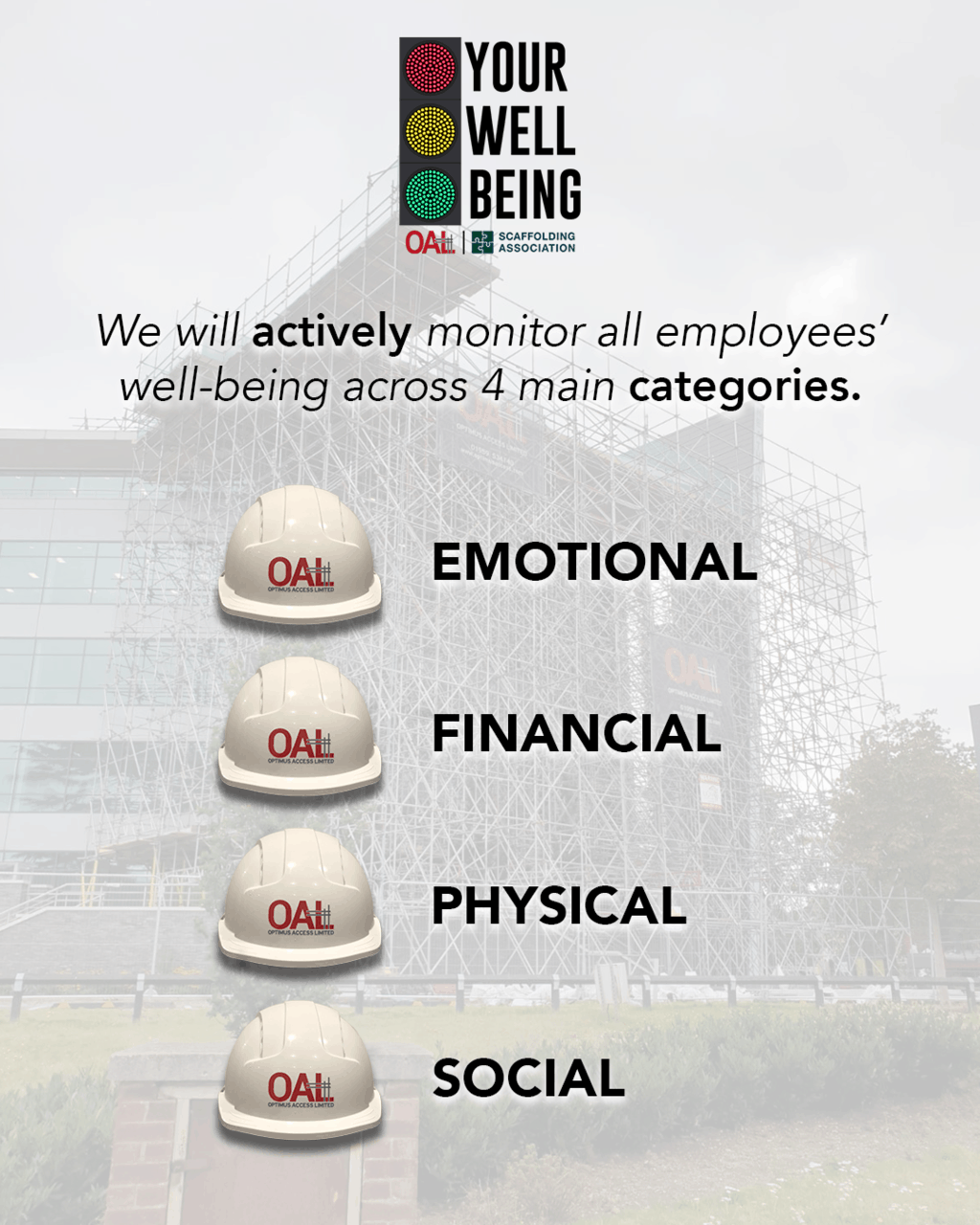 The framework allows the management team to react quickly if the need arises, rather than a problem arising then trying to figure out the best course of action. The program is designed to help identify potential issues across 4 main risk categories; Emotional, Physical, Financial & Social.
“Confidentially is obviously paramount, and we had to make sure that whatever we ended up with didn’t isolate anyone,” Said OAL Operations Director Todd Winter.
“Well-being is such a broad topic and all of us, at some stage have issues in our lives that would be deemed a potential well-being issue. Whether that be a loss of a relative, a breakdown of a relationship, ill-health or even addiction” explains Todd.
“Most of these problems sort themselves out with no need for extra support or intervention. But occasionally these issues can have bigger & lasting effects. The “Your Well-Being” program gives us the ability to proactively identify and support anyone who may need it. It will operate in such a way that each member of staff will be unaware of the level they are on, this is so there is no stigma attached to it. The last thing we want to do is drive any issues deeper,” said Todd.
Robert Candy Chief Executive of the Scaffolding Association went on to explain “Well-being issues, especially around Mental Health have had more column inches than ever before, but it’s a misconception that this is a new problem. There have always been these issues but as an industry, we are now better at recognising them than we have been in the past. One of the core problems is that intervention tends to be reactive, not proactive and that is what we wanted to set about changing with the team at Optimus.”
The benefit of the collaboration is it pooled the expertise of the staff from the two organisations. More people working together on the problem, the better the end result. “This was never just about us here at Optimus, that’s why we reached out to Robert & the Team,” said Michael.
“The Scaffolding Association is the biggest trade organisation in our industry, they deal with hundreds of scaffolding companies on a daily basis. So, it seemed logical to us to ask for their input. They would have encountered problems we hadn’t even thought about. Plus, we wanted to make sure it was designed in a way that could be useful for other companies.
Laying the foundations for other companies to adopt a similar program was one of the key objectives set at the outset. People may think we are mad to go to all this work then allow others to benefit from it. But some well-being matters are far more serious than the usual business rivalry,” exclaimed Todd.
“We are literally talking about people’s lives here; we have a framework now that could potentially save a person’s life. Why would we not share that? We are all scaffolders at the end of the day! Regardless of what name is on our truck.”
Of course, no system is ever 100% perfect and with the way of life as we know it changing at a faster rate now than ever before, it is important to keep the program under constant review.
Michael explained “The Scaffolding Association will play a key role going forward as they will likely see trends before we do. They have a bigger pool of data so generate more results. Having their brains to pick, increases the efficiency of the program in the future”
The Your Well-Being program also shows a commitment to increasing awareness around potential issues. As well as giving staff confidence that any issues will be treated confidentially & seriously.
Todd goes on to say “We all know what it is like, no one likes to talk when they are struggling. But if this initiative gives us the tools to identify just one person in need then it will all be worth it. But not only that if the launch of the Your Well-Being program gives one person who is struggling the confidence to reach out to us for help, then this will probably be the most important work we have ever done.”
The framework allows the management team to react quickly if the need arises, rather than a problem arising then trying to figure out the best course of action. The program is designed to help identify potential issues across 4 main risk categories; Emotional, Physical, Financial & Social.
“Confidentially is obviously paramount, and we had to make sure that whatever we ended up with didn’t isolate anyone,” Said OAL Operations Director Todd Winter.
“Well-being is such a broad topic and all of us, at some stage have issues in our lives that would be deemed a potential well-being issue. Whether that be a loss of a relative, a breakdown of a relationship, ill-health or even addiction” explains Todd.
“Most of these problems sort themselves out with no need for extra support or intervention. But occasionally these issues can have bigger & lasting effects. The “Your Well-Being” program gives us the ability to proactively identify and support anyone who may need it. It will operate in such a way that each member of staff will be unaware of the level they are on, this is so there is no stigma attached to it. The last thing we want to do is drive any issues deeper,” said Todd.
Robert Candy Chief Executive of the Scaffolding Association went on to explain “Well-being issues, especially around Mental Health have had more column inches than ever before, but it’s a misconception that this is a new problem. There have always been these issues but as an industry, we are now better at recognising them than we have been in the past. One of the core problems is that intervention tends to be reactive, not proactive and that is what we wanted to set about changing with the team at Optimus.”
The benefit of the collaboration is it pooled the expertise of the staff from the two organisations. More people working together on the problem, the better the end result. “This was never just about us here at Optimus, that’s why we reached out to Robert & the Team,” said Michael.
“The Scaffolding Association is the biggest trade organisation in our industry, they deal with hundreds of scaffolding companies on a daily basis. So, it seemed logical to us to ask for their input. They would have encountered problems we hadn’t even thought about. Plus, we wanted to make sure it was designed in a way that could be useful for other companies.
Laying the foundations for other companies to adopt a similar program was one of the key objectives set at the outset. People may think we are mad to go to all this work then allow others to benefit from it. But some well-being matters are far more serious than the usual business rivalry,” exclaimed Todd.
“We are literally talking about people’s lives here; we have a framework now that could potentially save a person’s life. Why would we not share that? We are all scaffolders at the end of the day! Regardless of what name is on our truck.”
Of course, no system is ever 100% perfect and with the way of life as we know it changing at a faster rate now than ever before, it is important to keep the program under constant review.
Michael explained “The Scaffolding Association will play a key role going forward as they will likely see trends before we do. They have a bigger pool of data so generate more results. Having their brains to pick, increases the efficiency of the program in the future”
The Your Well-Being program also shows a commitment to increasing awareness around potential issues. As well as giving staff confidence that any issues will be treated confidentially & seriously.
Todd goes on to say “We all know what it is like, no one likes to talk when they are struggling. But if this initiative gives us the tools to identify just one person in need then it will all be worth it. But not only that if the launch of the Your Well-Being program gives one person who is struggling the confidence to reach out to us for help, then this will probably be the most important work we have ever done.” Working at height breaches increase by 84%

The Building Safety Group (BSG) has reported an 84% increase in the number of ‘Working at Height’ breaches occurring on construction sites during the first quarter of 2021.
BSG’s latest figures were obtained following 4300 independent site inspections that took place between January and March this year. BGS’s report is a cause for concern as ‘Working at Height’ remains the biggest danger for construction workers. Statistics released by the Health and Safety Executive (HSE) in 2020 show that almost half of all construction accidents (47%) were from falls from height. There were 40 fatal injuries in 2019/20, slightly up on the 5-year average of 37 per year. 29 of these fatalities were due to falls from height. Over 60% of deaths during working at height involve falls from ladders, scaffolds, working platforms, roof edges and through fragile roofs. The Work at Height Regulations 2005 require employers and those in control of any work at height activity to ensure that the work is properly planned, well supervised and carried out by competent people.
In general terms, being competent to work at height means having the right skills, knowledge, training and experience. The precise definition of competence for a specific job depends on the nature of the work and the equipment being used.
“Working at Height is clearly the most dangerous activity carried out in the construction sector,” commented Andy Harper, Technical Support Manager at BSG.
“We can all do more to ensure that work is properly planned, supervised and conducted by qualified workers who have the required skills for the job in hand. Having the correct control measures in place and assessing the risk is also essential for avoiding accidents.
In addition, companies should try to complete as much work as possible from the ground, ensure safe access and egress and importantly, make certain that any equipment used is suitable and designed for that purpose, installed and used by a competent person and inspected as required by the Working at Height Regulations 2005 and relevant guidance.”
The Work at Height Regulations 2005 require employers and those in control of any work at height activity to ensure that the work is properly planned, well supervised and carried out by competent people.
In general terms, being competent to work at height means having the right skills, knowledge, training and experience. The precise definition of competence for a specific job depends on the nature of the work and the equipment being used.
“Working at Height is clearly the most dangerous activity carried out in the construction sector,” commented Andy Harper, Technical Support Manager at BSG.
“We can all do more to ensure that work is properly planned, supervised and conducted by qualified workers who have the required skills for the job in hand. Having the correct control measures in place and assessing the risk is also essential for avoiding accidents.
In addition, companies should try to complete as much work as possible from the ground, ensure safe access and egress and importantly, make certain that any equipment used is suitable and designed for that purpose, installed and used by a competent person and inspected as required by the Working at Height Regulations 2005 and relevant guidance.” VIDEO: What’s new in TG20:21?
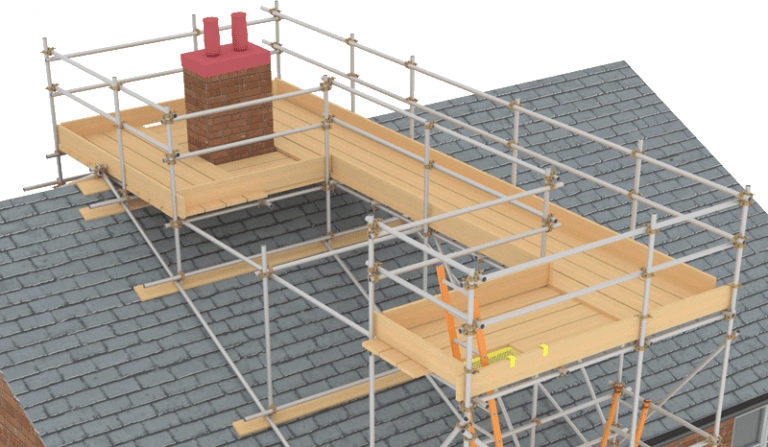
The NASC has posted an in-depth webinar video showing what’s changed in the latest guidance and how it builds upon the groundbreaking TG20:13 eGuide.
The hour-long video shown below is from the NASC’s and CADS highly attended TG20:21 webinar that went out live yesterday. More than 300 scaffolding contractors and other construction industry professionals attended the free webinar, they discovered how the TG20:21 eGuide enables users to produce a wide range of standard scaffolding structures without the need for bespoke design. In the video, Terry Roberts, of software developers CADS, explains how the latest version expands upon TG20:13, retaining its user-friendly look and feel, but includes a number of revisions to make the process of producing compliant scaffolding – in accordance with the European standard BS EN 12811 – even simpler, and incorporates a wider range of scaffolding types. TG20:21 additions include: Exterior birdcages, tube and fitting mobile towers, tube and fitting loading bays without beams and tied independent scaffolds with three inside boards are now included in the eGuide Access to the new TG20:21 guidance and eGuide is via the NASC’s new ePortal where the scaffolding trade body will host all future guidance notes. The NASC and CADS also hinted that the development of mobile apps could be in the pipeline as the ePortal develops over time.Rising materials prices – what can scaffolding contractors can do about it?

It’s been heartening to see how much effort and commitment has gone into revitalising the construction and scaffolding industries since the first lockdown just over a year ago. Working hard within Covid restrictions, we’ve all been doing our best to make sure that projects keep running, new developments can get started and that we can all work safely and productively to do our bit to get the economy back on track.
But we have been frustrated by some of the things that are out of our control – and one of the biggest examples of this is the price of raw materials increasing at unprecedented levels. In fact, Glynn Burrows, TRAD Group Purchasing Manager, wrote about this earlier in the year. He noted that timber and steel, particularly – the foundation materials for everything we do – had risen significantly in price over the past 12 months, and forecasted that we might start to see some stability by summer 2021. However, we have reservations about this as we are still seeing prices riding high, which means we’re not really expecting prices to stabilise – particularly steel prices – until much later in the year, potentially late autumn.
During the first quarter of this year, we’ve seen that there’s a significant demand from both the UK and the USA, as the construction industry gets back to projects that were stalled, or starts projects that are needed to help recovery. During the latter part of this year, I expect demand to rise as the major countries in Europe get a handle on their vaccination programmes and get their construction sector back up and running fully.
And we shouldn’t forget the industrial sector – I am expecting a spike in this market later in the year. Brick suppliers are gearing up to build new factories, so that they can meet the exceptional demand for bricks. So it’s clear that the demand is there across all areas of construction.
At TRAD Group, we’ve seen significant demand for both hire and sales across the board, but particularly from housebuilders, which shows us that this part of the industry is forging ahead, fuelled by the government’s measures to support homebuyers. It’s hard to see that the housing market will contract during the rest of the year – we expect it to expand.
So what does this mean for pricing?
Our view is that we are hopeful that the price of steel will stabilise by the latter part of 2021 – it is unlikely to come down, but we don’t think it will continue to increase. That means that tube and fittings prices should be less volatile and we can forecast prices with more certainty. Similarly, we expect the costs for plastics and other raw materials, which have also increased significantly, to steady over the next few months. The area where we expect continued price increases is timber. There is a huge demand for timber at the moment – prices have increased by 100% in recent weeks alone. All suppliers are budgeting to pay more for timber for the foreseeable future. Those costs, which would often have been absorbed by suppliers before, are now more likely to be passed on to some degree, meaning that contractors may also have to re-think their pricing. We do expect the costs of shipping to reduce over the coming months – this increased cost on top of the raw materials price increases have not helped the situation – but as a relatively small percentage of the overall procurement costs, we don’t expect this to make a huge difference.What can contractors do?
We, like others in the industry, are doing what we can to protect our customers and help them maintain their competitiveness and their margins. We know that scaffolding contractors have little or no control over price increases – and because these increases are happening across the board, they are going to find the same price issues wherever they go. Our advice is to: Look at current tender prices – it’s something that no business wants to do, but it may be time for contractors to look at their current tender prices. Margins are being squeezed and are likely to remain so and it’s likely that most companies are looking for ways to keep prices competitive whilst also being able to do work profitably. Consider hiring – for many contractors, we believe that hiring is a better option than buying at the moment. Hire rates are certainly likely to increase, as suppliers still need to invest in their stock, but it remains a more cost-effective way to utilise equipment on projects. Partially systemise your existing scaffolding – Readylok transoms and extendable transoms can help you reduce labour costs and get more from your existing stock. Convert to system scaffolding – whether hiring or buying, system scaffolding is a great option. What you spend on the system, you offset with lower labour costs, and this can help contractors to put together lower, more competitive quotes for clients without compromising quality. I’m a great advocate of system scaffolding, along with our own PLETTAC METRIX system available from TRAD UK, you can source alternative systems from other reputable, original manufacturers such as Layher, Haki and Peri as examples. Consider scrapping unwanted tube – scrap prices for steel are now at an all-time high per tonne and continue to increase. So if contractors have a corner of the yard that’s got odd-sized tube or other steel components that have been collected over the years, you can raise a bit of extra cash by scrapping. Why not sell? If you’ve got excess equipment, there’s never been a better time to sell. There is a good market for second-hand scaffolding equipment. At TRAD UK, we are always interested in buying second–hand equipment, so if contractors are looking to sell existing scaffolding so they can move to a hire-based model, or just to convert it into cash, we’d be interested to hear from them.Not all doom and gloom
Our sector is busy – we are seeing a huge demand across all our sectors – from housebuilding to major industrial projects. Many projects that have been in the pipeline simply can’t be cast aside – they are essential to infrastructure and growth. At the moment, certainly, raw materials pricing is a significant challenge. But I believe that, by working together and supporting our customers, we can come through this period together and build a stronger, more motivated and more collaborative industry that is successful and profitable in the long term.The UK’s Largest Temporary Roof installation made possible by the X factor

The Tidworth and Bulford infrastructure framework, worth in excess of £15bn, were part of a much larger plan to uplift capacities and improve overall facilities at a number of key MOD sites across England. This project provided high quality, fully serviced and purpose-built living and working accommodation for our returning soldiers.
In the UK, there is strong commitment to maintaining the overall health and wellbeing of service personnel, even after they have left the services. This project was to improve facilities at two army camps, meaning soldiers returning from demanding operations will receive the quality accommodation they deserve.
To ensure the building remains weather-proof and to enhance its whole-life performance, the entire exterior of the roof and the interior ceiling tiles were replaced. George Roberts Ltd were engaged to support the scaffolding contractor, Ideal Scaffolding Southern Ltd.
To allow unhindered renewal of the old roof along with access for internal works to replace the ceiling in the main building, a large scale bespoke temporary roof was provided along with some large internal scaffolds.

Negating the need of 450T of ballast – or 18 truck loads
During the first stage, the goal was to erect the internal birdcage measuring 37m long x 18m wide x 12m high using over 250 tonnes of scaffolding, within 3 weeks. The work was being undertaken during the first Covid-19 lockdown in the UK, therefore, care had to be taken to observe the Government’s Covid-19 guidelines. This proved challenging in maintaining social distancing, in particular when working at heights. The second phase of the project was to erect a temporary roof measuring 52m long x 42m wide with additional buttresses for an unsupported span of 38.5m in the centre section of the roof. A unique ‘Platypus’ percussion anchor point system was used to secure the free-standing structure at ground level. This unique lightweight and corrosion resistant anchor shaved weeks off the build programme, which otherwise would have required around 450 tonnes of ballast at the base of the scaffolding around the perimeter. Due to the sheer size of the truss beams, the roof bays had to be skilfully assembled at ground level on special rigs by Ideal Scaffolding Southern Ltd, then lifted into position on top of the support scaffold by a crane. This meant the roof was assembled, lifted into position (over a 3-lift programme) and fully sheeted in situ over a staggered 4-week period to maximise safety and productivity. The Keder roofing sheets supplied by George Roberts was manufactured exactly to size for best fit using a 610g/m flame retardant PVC material providing a watertight barrier, meaning roofing works would continue throughout the project, regardless of weather conditions.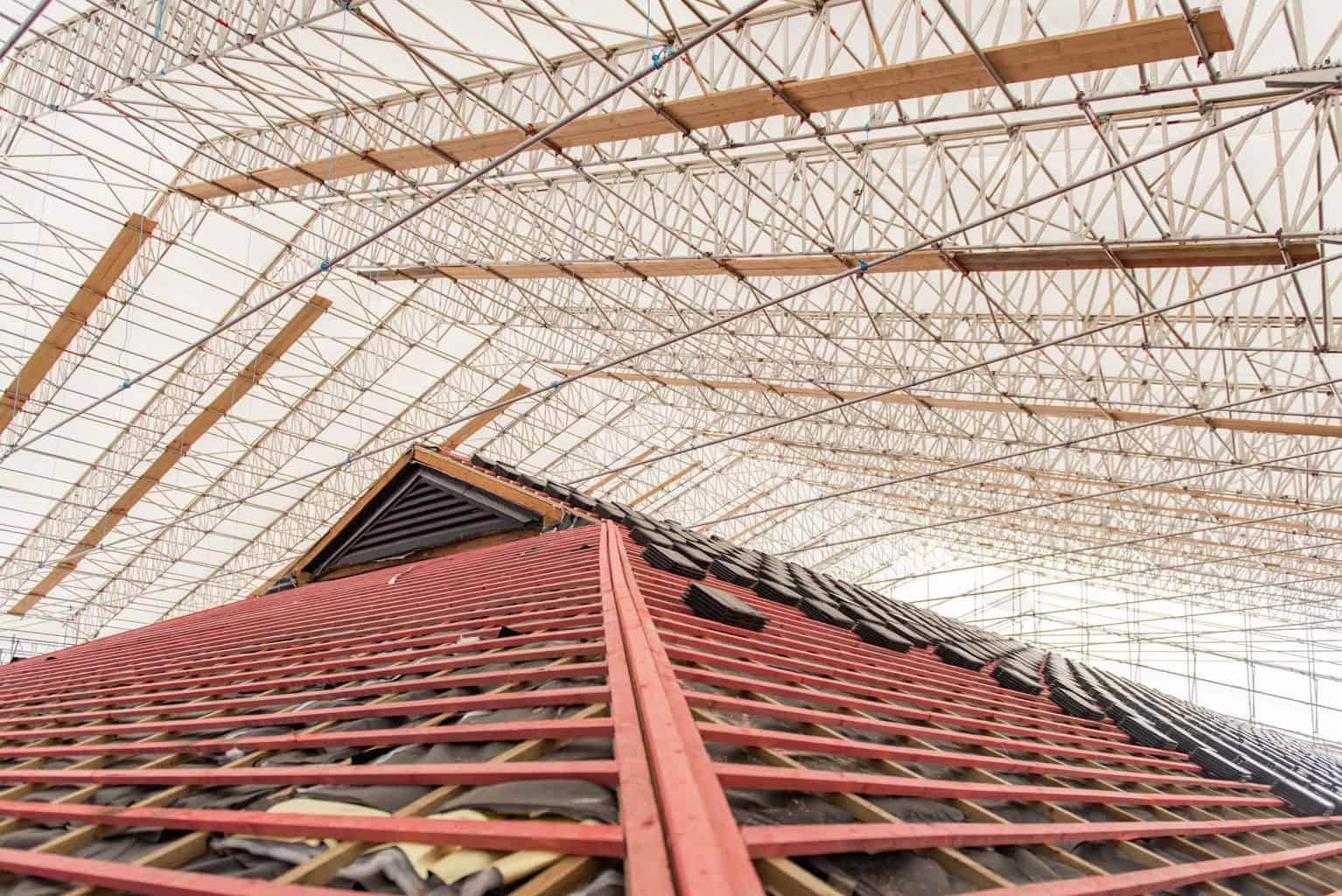
The X Factor
For most temporary roof applications, our standard 0.75m beam is more than sufficient, but because of the very large span requirement (42m) on this project, we needed to specify the heavier duty 1.3m deep X Beam – a first for George Roberts and Ideal Scaffolding. This also allowed productivity to be maintained using 3.07m & 2.57m bay widths throughout. Without having X Beams in our offering, this project simply wouldn’t have been possible. “The project was supported by George Roberts Ltd, who provided an invaluable service to supply all temporary roofing and scaffolding equipment needed. The flexibility & professionalism that the team of George Roberts demonstrated during the planning and execution of the project, proved to be a key component in its success. At the time of the project, the temporary roof was one of the largest in the country.” Darren Lee, the owner at Ideal Scaffolding Southern Ltd.Challenges
The main challenges for George Roberts Ltd were around the rapid supply of over 250 tonnes of equipment, 200 miles from our Liverpool depot over multiple loads. There were also engineering challenges due to the size of the building and roof span required, and also, tying into the structure was not permitted, meaning all supporting scaffolds needed to be free-standing. The scheme was expertly engineered by Optima Scaffold Designs in Bristol. Due to the very large span required, the UBIX temporary roof was designed utilising 1.3m deep aluminium X Beams. The roof was staggered in section to follow the natural plan size of the building which ranged in overall cover width from 34m to 44m. For this project George Roberts Ltd had to call on the services of Alan White Design and our licensed beam manufacturers Apollo to expertly engineer a brand new 18-degree Ridge Beam to form the main duo-pitch roof truss structure, along with the design of a bespoke aluminium diagonal brace and tension bar system to suit this gigantic free-standing structure. This represents a significant investment which will ensure Service personnel continue to have access to high quality sports facilities on the defence estate. At the time of this project in 2020 the external scaffolding at Tidworth boasted the biggest unsupported span within a temporary roof standing anywhere in the UK.Stats
Project comprised with earthworks, groundworks, drainage, reinforced concrete works for foundation slabs and external works to various types of accommodation blocks. Associated external works include access roads, footpaths, car parks, hardstanding, street furniture and lighting, bin stores, cycle racks and areas of hard and soft landscaping.- The overall plan cover size provided for this project on time and on budget was in excess of 2000m²
- The building was over 40 metres in width and all supporting scaffolding had to be completely free standing.
- Temporary roof covering a whopping 52m long x 42m wide.
- Each of the 19 trusses weighed up to 2.6 tonnes.
- Delivered over 250 tonnes of scaffolding equipment to site.
- The structure was fully weather contained in situ using our popular 610g/m² Flame Retardant PVC sheeting material that was tailored exactly to length to provide an exact fit.
- Tidworth project was one of the UK’s largest free-standing Temporary Roof structures.
- Project valued in excess of £15 billion
Equipment and Types of Scaffolding Supplied
George Roberts supplied scaffolding tubes, fittings, timber boards, Uniscaff Stair Tower & Loading Tower, flame retardant Power clad sheeting, aluminium X Beams and our UBIX temporary roof system.Scaffolding falls after London demo incident