Coventry Scaffolding helps Bromley Town Hall get a historic makeover
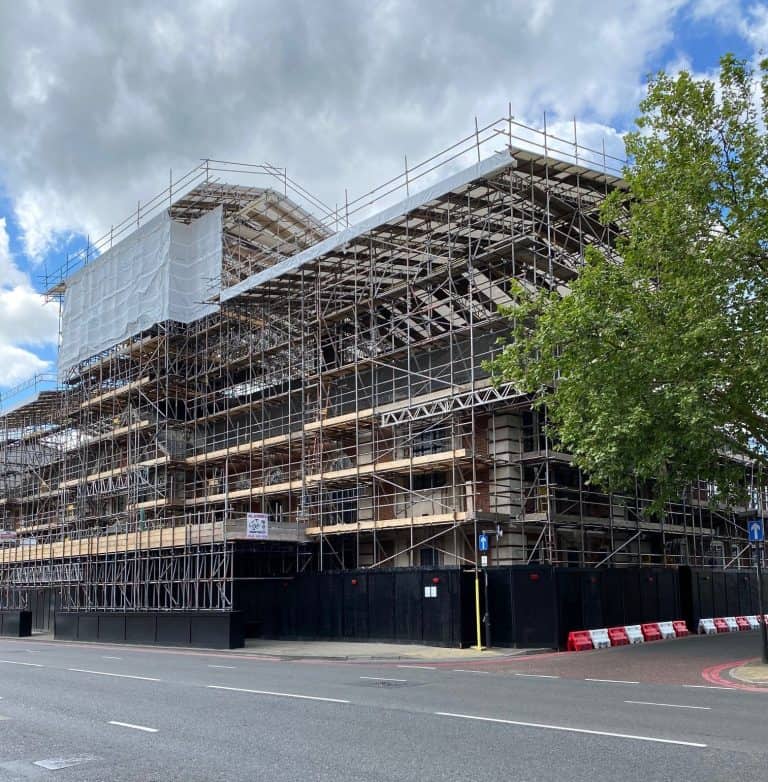
Coventry Scaffolding provides access scaffolds and temporary roofs for multi-million pound refurbishment and expansion of the historic Bromley Town Hall.
A leading independent scaffold contractor and Royal Warrant Holder, Coventry Scaffolding has said its pleased to be working alongside E2 Management Consulting on Castleforge Partners’ refurbishment and expansion of the Grade-II listed Bromley Town Hall in south east London. The firm has told Scaffmag work on the project commenced in November 2019 and was scheduled to run for 18 months. Despite delays caused by the pandemic, the transformation is set to be complete later this year. Originally built in 1906, Bromley Town Hall boasts a rich and interesting history. It played host to local rock legend David Bowie’s wedding to Angie in March 1970, and, more recently, acted as a film set for scenes in the Queen biopic Bohemian Rhapsody. In 1939 an Art Deco style extension was added to the site. It is reported that the extension also houses an underground nuclear fall-out shelter in the basement, which was built during the Cold War. The multi-million-pound project will see the site repurposed into a new complex consisting of 73,000ft² of co-working office space, a café/bar, indoor and outdoor communal space, and a hotel – which, rumour has it, will be ‘David Bowie’ themed. The new design will make use of many of the original period features, with restoration of cornices, domes and the ornate stone staircase, and repairs to the red brick façade. Once complete, it will give this part of Bromley a much-needed commercial boost and provide landscaped public space, all housed within the iconic historic buildings. Coventry Scaffolding designed, supplied and erected a huge amount of scaffolding to facilitate the ambitious project, forming access scaffolds to numerous buildings to provide a safe environment for the tradesmen and women working at height. Not only that, Coventry also installed nine temporary roofs – all standing at one time, but independent from one another – to provide protection from the unpredictable British weather for the duration of the project. Other work has included internal scaffolds, crash decks and hop ups.
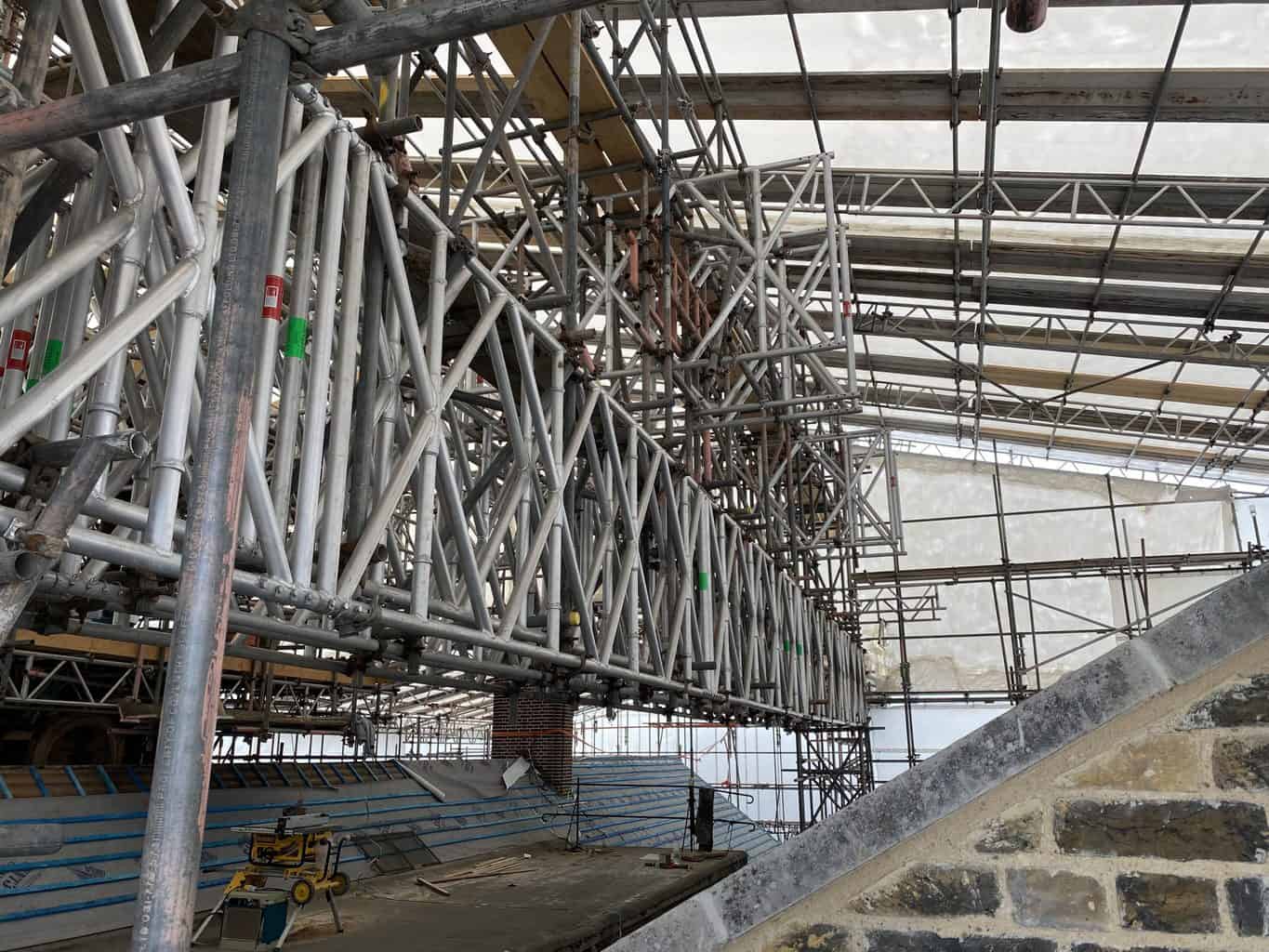 Mark Spurgeon has led the project for Coventry all the way from the initial tender invite through to delivery, and continues to do so as it starts to reach its conclusion. The project has been interesting to work on, but not without its challenges, especially when it came to erecting the temporary roofs.
“There were multiple changes to the design throughout the project for one reason or another,” he explains. “The 1939 roof was particularly difficult to erect due to the large pitched roofs and shape of the building, which is curved at one end. The 1907 roof also presented problems because of the stepped roof over the centre cupola section. I had many sleepless nights whenever we had high winds due to the number of temporary roofs we had up, but Wayne and his team had erected a first class scaffold and there were no problems”.
Coventry’s on-site supervisor and lead scaffolder, Wayne Foreman, has been involved in the project from day one. As he lives locally to the area, he looks forward to regularly seeing the finished site, and knowing he helped bring it to life: “It has been very challenging at times, especially putting up all the roofs one after the other, but at least when it is complete, I can look back proudly and say, I had a hand in that”.
Mark Spurgeon has led the project for Coventry all the way from the initial tender invite through to delivery, and continues to do so as it starts to reach its conclusion. The project has been interesting to work on, but not without its challenges, especially when it came to erecting the temporary roofs.
“There were multiple changes to the design throughout the project for one reason or another,” he explains. “The 1939 roof was particularly difficult to erect due to the large pitched roofs and shape of the building, which is curved at one end. The 1907 roof also presented problems because of the stepped roof over the centre cupola section. I had many sleepless nights whenever we had high winds due to the number of temporary roofs we had up, but Wayne and his team had erected a first class scaffold and there were no problems”.
Coventry’s on-site supervisor and lead scaffolder, Wayne Foreman, has been involved in the project from day one. As he lives locally to the area, he looks forward to regularly seeing the finished site, and knowing he helped bring it to life: “It has been very challenging at times, especially putting up all the roofs one after the other, but at least when it is complete, I can look back proudly and say, I had a hand in that”.
World’s largest construction trade fair postponed

Bauma, the world’s biggest and leading construction equipment trade fair held in Munich, Germany has been postponed to autumn 2022.
The announcement comes after the result of many discussions between Messe München and top industry representatives as well as the Advisory Board. The new date is October 24–30, 2022 according to an official press release. The press release goes on to say; Considering the particularly long planning times for exhibitors and organizers at the world’s largest trade show, the decision had to be made now. This provides exhibitors and visitors a secure planning basis for preparing the upcoming bauma. [Read our Highlights from Bauma 2019 when Scaffmag visited] Initially, Bauma was to be held from April 04 to 10, 2022. Despite the pandemic, both the industry’s response and the booking level was very high. However, in numerous discussions with customers, there was a growing recognition that the April date involved too many uncertainties in view of the global pandemic. The prevailing opinion was that it is currently difficult to assess whether worldwide travel—which is crucial for the success of the trade show—will be largely unhindered again in a year’s time. Global exhibitors, who expect customers from all over the world to attend Bauma and make correspondingly high investments in stand construction, logistics and hotel capacity, advocated a postponement. They saw the decisive benefit of the trade show—namely to bring together the entire industry and to be a hub for all markets—as being jeopardised if the April date were to be adhered to.
How Scaffolding Businesses Can Scale-up In The Midst Of A Pandemic

Business owner and entrepreneur, Greg Wilkes, who with over 20 years of experience running construction companies from the ground up, tells us businesses can not only survive in 2021 but also grow.
By now, we are all sick of talking and hearing about Coronavirus. Whilst we all welcome the roll-out of the vaccine so we can get back to ‘normal’, in reality, we know for most it will not be ‘business as usual’ for a very long time ahead. How about the scaffolding industry? What does 2021 have in store? How can your business not only survive this year, but rapidly scale up? In this article, we will look at 7 ways that you can scale up your scaffolding business.The Construction Industry
What does the current and near-future look like for the construction industry? You will be pleased to know things are still looking very bright. Unlike other industries like hospitality and aviation that have been hit really hard, the construction industry is still thriving and that is expected to continue throughout 2021. At the time of writing, construction sites have not been affected by the lockdowns. Also, the housing market is still strong. Whilst people are continuing to move, they will continue to renovate & extend their new homes, which means there is plenty of work for smaller scaffolding firms. Combine that with Boris Johnson’s commitment to Build, Build, Build announced last year during the pandemic, you can clearly see that the government wants to ensure construction infrastructure increases, rather than deceases. New home developments are still going strong and as a result, main contractors will be busy providing great opportunities for scaffolders.
In summary, there is a large demand for scaffolds currently and in the foreseeable future.
This is great news. However, not all businesses feel the same. They are anxious about what the future holds for their business and are reluctant to scale-up or unsure how to.
To follow are 7 ways you can scale your business in the midst of a pandemic:
New home developments are still going strong and as a result, main contractors will be busy providing great opportunities for scaffolders.
In summary, there is a large demand for scaffolds currently and in the foreseeable future.
This is great news. However, not all businesses feel the same. They are anxious about what the future holds for their business and are reluctant to scale-up or unsure how to.
To follow are 7 ways you can scale your business in the midst of a pandemic:
1. If you’re not growing you’re going backwards
Many scaffolding business owners will be fearful and will start to scale back. Not because they have seen something that suggests the construction industry is going to take a hit but because of the general fear in the population. They are worried that this industry will be next, so they err on the side of caution. Hence they go backwards. This climate gives you the chance to get the jump on those fearful & who are scaling back. If the work is there, take it and don’t be fearful of expanding.2. Taking Opportunities
Competitors with high overheads/debt may be going bust, this will give opportunities to snap up good staff & contracts Always keep an eye on your competitors and what they are up to. Find out who your target customers are using for their contracts and be sure they know who you are so that you are waiting in the wings as soon as the company either goes bust or isn’t meeting their standards of service. If a company does go bust and you are looking for good staff, get in contact with the owner, offer your condolences and honestly tell them you are looking for good quality staff, can he give you the contacts for the ones he has had to let go. Most decent bosses would be delighted to find their hardworking, loyal team members a new job as letting go of your staff is one of the most painful parts of your business going bust.3. Environment
Something we will hear about non-stop over the next decade is the environment. Our world is becoming increasingly aware of the damage being done to our planet and as government and businesses have strict targets to reach by 2030 to radically reduce our carbon footprint. If you can find ways to make your business greener, this will give you a massive edge over your competitors when pitching to clients and trying to win contracts.4. Scale up smart
Keep lean (low overheads) don’t commit to hiring offices, keep remote. Keep hold of capital in case there is a downturn, so consider leasing options rather buying new vehicles to create a cash buffer.5. Marketing
Gone are the days when you could stick an ad in the yellow pages and business would come to you. These days there seems to be a million ways to advertise and everyone is pointing you in a different direction. If you get it wrong and use the wrong platforms, you can spend a lot of time and effort trying to promote your business with limited or zero return. You need to be clear on who you are targeting and where they are hanging out in the virtual world. For example, if you are a small scaffolding firm that wants to increase your local business, then you are likely hoping to gain business from homeowners renovating. Estate Agents, Builders, Roofers, painters and decorators etc. might be the contacts you want to network with to gain business. Do you think randomly posting daily on your Twitter, Facebook and Instagram pages will bring these kinds of contacts to your doorstep? Unlikely. You will need to strategically target them through email campaigns, paid (and well-targeted) Facebook ads, direct outreach through LinkedIn or to their SM profiles. Consider joining specialist groups within these platforms, as this is where they are likely to be. If you are a larger scaffolding firm targeting larger contracts, email marketing is likely to yield good results. LinkedIn is an amazing way to reach the inbox of the exact person you are looking to reach without having to get through that tough receptionist. You can also try lead generation sites like Glenigans which list thousands of projects each week along with main contractor contact details.6. Online Presence
When you go to book a hotel, what is the first thing you do before you book it? Most people would check the reviews, they would be looking on TripAdvisor or something similar to weigh up if that hotel is as it appears. The same can be said for any business. When people are looking to use a new service, they will check the online reviews so if you don’t have many (or any) you will likely be losing custom. Get hold of all previous customers and ask them for a review, if they were happy with your service. Send them a link directly to it to make it easy for them. If they are willing, get them to review you across several platforms from Google, Trustpilot, Facebook business & Yell (these all rank highly in the Google algorithm)7. Operating Systems
Having good operating systems is vital if you want to rapidly scale up your scaffolding business successfully. From CRM systems, to automating your sales and marketing, software for estimating, stock control and accountancy. It’s important to get the best systems in place that automate as much of the work as possible which leaves you more time to focus on the important aspects of growing the business rather than administration. You ideally want to be able to look at how each area of your business is operating at a glance. This will raise any red flags & you can decide which areas need improvement.Conclusion
If you own a scaffolding business there is ample opportunity now and throughout the year to rapidly scale up your business. With the right systems in place, loyal staff and a good marketing plan, you will be all set to achieve amazing results. If you would like more information on practical ways to scale your business, I am offering Scaffmag readers a free copy of my Amazon #1 book: Building Your Future- A step by step guide to creating a £1m+ construction business. This article was first published in the ScaffMag Magazine Issue 12Company fined for breaching work at height regs

A construction company has been fined after HSE inspectors found unsafe working at height practises and other unsafe site operations during a routine inspection.
Kidderminster Magistrates’ Court heard that on 8 October 2019, a routine inspection was undertaken at a construction site in Redditch, Worcestershire following a report of a fall from height. During the inspection there was evidence of poor management of work at height, and numerous other uncontrolled site safety risks. This included unsafe work on a flat roof where there was no edge protection as required by the regulations to prevent a fall from height, despite there having been a fall from the same flat roof eight days earlier. Prohibition Notices were served immediately in response to the work at height breach and for unsafe access and egress into the building. An Improvement Notice was served in relation to planning for work at height and a Notification of Contravention was also served for other identified failings. SSF Construction Limited of The Old Foundry, Ash Street, Bilston, West Midlands pleaded guilty to breaching the Work at Height Regulations 2005 and the Construction (Design and Management) Regulations 2015. They were fined £48,000 and ordered to pay costs of £3,443. Speaking after the hearing, HSE inspector Chris Gregory said: “The company had not learnt the lesson from the recent fall from height and failed to ensure that appropriate fall prevention or mitigation measures had been put in place, so there was the potential for further falls from height and serious injuries or fatalities. Other significant risks identified during the inspection confirmed a widespread failure to manage and monitor the site to protect workers and others from foreseeable risks. “Those in control of work have a responsibility to ensure that work activities are appropriately planned, managed and monitored, and that suitable control measures are both identified and implemented. “HSE will not hesitate to take proactive enforcement action against those that fall below the required standards – it is clear that in this case we were left with no choice but issue these notices and prosecute.”Pay rise agreed for construction workers

Builders and Unite the union have agreed a 1.5% pay rise for construction workers.
The pay rise has been agreed for the 2021/22 year following successful pay negotiations between the Federation of Master Builders (FMB) and Unite the union.The Building and Allied Trades Joint Industrial Council (BATJIC) has agreed a one-year deal involving a 1.5% pay rise to come into effect in June 2021.
This follows the successful conclusion of pay negotiations between the FMB, on behalf of small to medium-sized (SME) construction employers, and Unite the Union, on behalf of operatives.
The key information is as follows:
- BATJIC has agreed a one-year deal involving a 1.5% pay rise over the next year;
- The adult general operative rate increases to £10.22 per hour;
- The NVQ3 advanced craft rate increases to £13.37 per hour;
- The changes will come into effect as of Monday 21 June 2021.
Brian Berry, Chief Executive of the FMB, said: “2020 was an unprecedented and challenging year for small to medium-sized building firms. This agreement seeks to balance the uncertainty that they continue to face with the need to reward the construction workforce who have continued to go to work during the pandemic.
I hope this pay increase sends a positive message to tradespeople, and potential new entrants, that construction is a sustainable and rewarding industry to work in.”
Jerry Swain, the National Officer for Construction at Unite the union, said: “Unite understands these are uncertain times we are currently living through and also recognises that unlike other construction agreements, last year there was an increase in the BATJIC pay rates. While of course Unite would have liked to have seen a larger increase, we are pleased to be able to say; that during this pandemic we have maintained the spending power of our member’s pay under this agreement. This is important if we are to attract and retain workers to our industry at a time when the Government is looking to construction to build back better and provide much-needed jobs.”
Industry facing spiralling materials costs
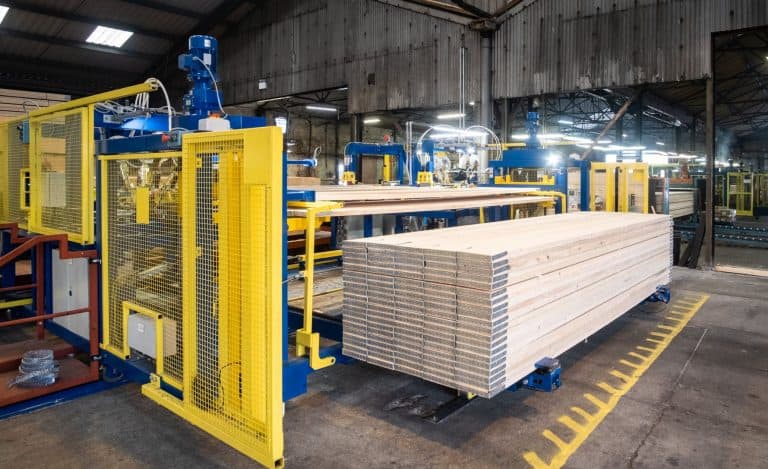
A leading UK construction trade body has issued a warning over spiralling materials costs as a result of disruptions brought about by the twin impact of coronavirus and Brexit.
The Builders Merchants Federation, members of which manufacture 76% of building products in the UK, raised the flag late-January after months of travel uncertainty, and ongoing confusion surrounding new import and export rules and border controls following the United Kingdom’s departure from the EU at the start of the year. The news adds to an increasingly problematic outlook for British construction. Record house prices set in 2020 are expected to falter in the coming months as purchases fail to complete ahead of the tax holiday deadline on March 31, 2021. Meanwhile, land value in some towns and cities has also fallen as more and more businesses are seriously considering a future in which remote working is often the norm, or at least an option, reducing the pressure for people to live in major urban areas. Alongside evidence of limited availability of roofing materials, the organisation pointed to an average 20% increase in the price of timber. But while the timing would suggest a sector responding to huge logistical challenges and changes brought about by European and worldwide circumstances in the last year, for some in the industry this is as much about phenomenal demand as it is anything else – with more materials understandably being used when there is high demand for property in general. “As the biggest manufacture of timber scaffold boards in the UK we would like to think we are getting an extremely good deal on the raw material, but over the last year we have seen our costs spiral to levels never seen before,” said Ollie Appleby, director of Brent Scaffold Boards Ltd. “The cost of timber has been very stable for a number of years, it has only been over the last 18 months we have seen it start to creep up, with huge increases in the last six months,” he continued, before explaining that the only way in which prices might now fall is if the appetite for timber materials and associated products does the same. “The only way timber prices will reduce is when the globe demand subsides. Brexit has had a small impact to costs but the overall cost is down to high log prices, delivery costs and global demand.” This article was first published in the ScaffMag Magazine Issue 12NASC to hold free TG20:21 webinar

Scaffolding trade body the NASC is set to hold a free TG20:21 webinar to give users a better understanding of the new and updated guidance.
The live online event that takes place on Tuesday 27th April at 10am follows the launch of the updated and expanded scaffolding compliance software TG20:21. People can register to attend the free webinar here: https://www.eventbrite.co.uk/e/tg2021-the-nascs-upgraded-and-expanded-scaffolding-compliance-software-registration-151207966097 Users of the new TG20:21 eGuide can produce a wide range of standard scaffolding structures, without the need for bespoke design. The latest version builds upon the groundbreaking TG20:13. TG20:21 has retained its user-friendly look and feel, but includes a number of revisions to make the process of producing compliant scaffolding – in accordance with the European standard BS EN 12811 – even simpler, and incorporates a wider range of scaffolding types. Additions include exterior birdcages, tube and fitting mobile towers, tube and fitting loading bays without beams, and tied independent scaffolds with three inside boards. Also, TG20 compliance sheets are now double-sided, with an illustration and principal compliance criteria on the front, and detailed compliance criteria listed on the reverse. TG20:21 is available on an annual subscription basis, costing £300 + VAT per login per year, which is discounted to £75 for NASC full members. To ensure the transition from TG20:13 to TG20:21 is as fair as possible, there is a period of free use of the new software for existing users, which can be accessed using the TG20:13 serial number.Contract awards return to above average levels since September

Contract awards have returned to above historical average levels for the first time since September 2020.
In March 2021, contract awards increased by 22% compared to February to £5.8 billion, according to industry analysts Barbour ABI. The experts say the main change in activity was a very large increase in the hotel and leisure sector. The latest edition of their Economic & Construction Market Review, highlights levels of construction contract values awarded across Great Britain. Sector analysis shows that Residential contract awards remained stable in March at historical average levels, after picking up in February. Activity was £2.0 billion in the month, compared to £1.9 billion in February and £1.6 billion in January. Over 2020, residential contract awards averaged £1.7 billion. The hotel and leisure sector contract awards value reached £1.0 billion in March as the planning approvals activity converted to contract awards. Commenting on the figures, Tom Hall, Chief Economist at Barbour ABI and AMA Research said, “After a weak recovery over the second half of 2020 and the beginning of 2021, March saw a definite improvement across the planning environment. Importantly increases were seen in the commercially sensitive sectors of hotel and leisure in contract awards, and residential and commercial in planning approvals. However, this is only one month of improvement and the planning environment is notoriously volatile. The catch-up of “lost” contract awards since the start of the pandemic amounts to some £15bn of projects, or around 20-25% of the annual contract award value. We would therefore expect a significant amount of catch up over the next couple of months as the economy reopens to strengthen a currently weak construction pipeline. All things equal this is some much-needed positive news for the sector after an exceptionally challenging 12 months.” Download the full report here.Celebrating A Female Scaffolders Success
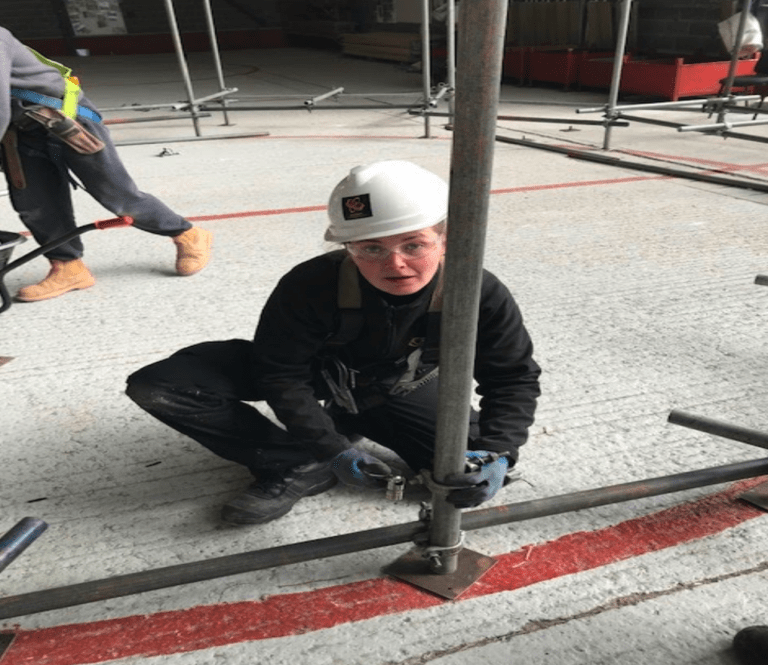
As the world slowly emerged from lockdown the scaffolding industry had real cause to celebrate female success in what is still largely a male-dominated world. It proved to be a fitting tribute not just to International Women’s Day but to both diversity and inclusion in the workplace as Scaffmag discovered.
Meeting new and progressive industry needs to deliver training in an equal and inclusive society must be the aim of any forward-thinking company. The world is changing rapidly, and with many former practices rejected in favour of a much more positive 21st-century approach, bringing something fresh to the workplace is simply priceless.
UK based Enigma Industrial Services, a long-term customer of Safety & Access Ltd, have worked together to deliver a compelling and uplifting example of first-class inclusion. And rightly so, as the scaffolding and associated construction trades can now boast having one of the top female scaffolders in the trade. In doing so they’ve sent out a clear message to all females considering a career in this highly skilled field of work.
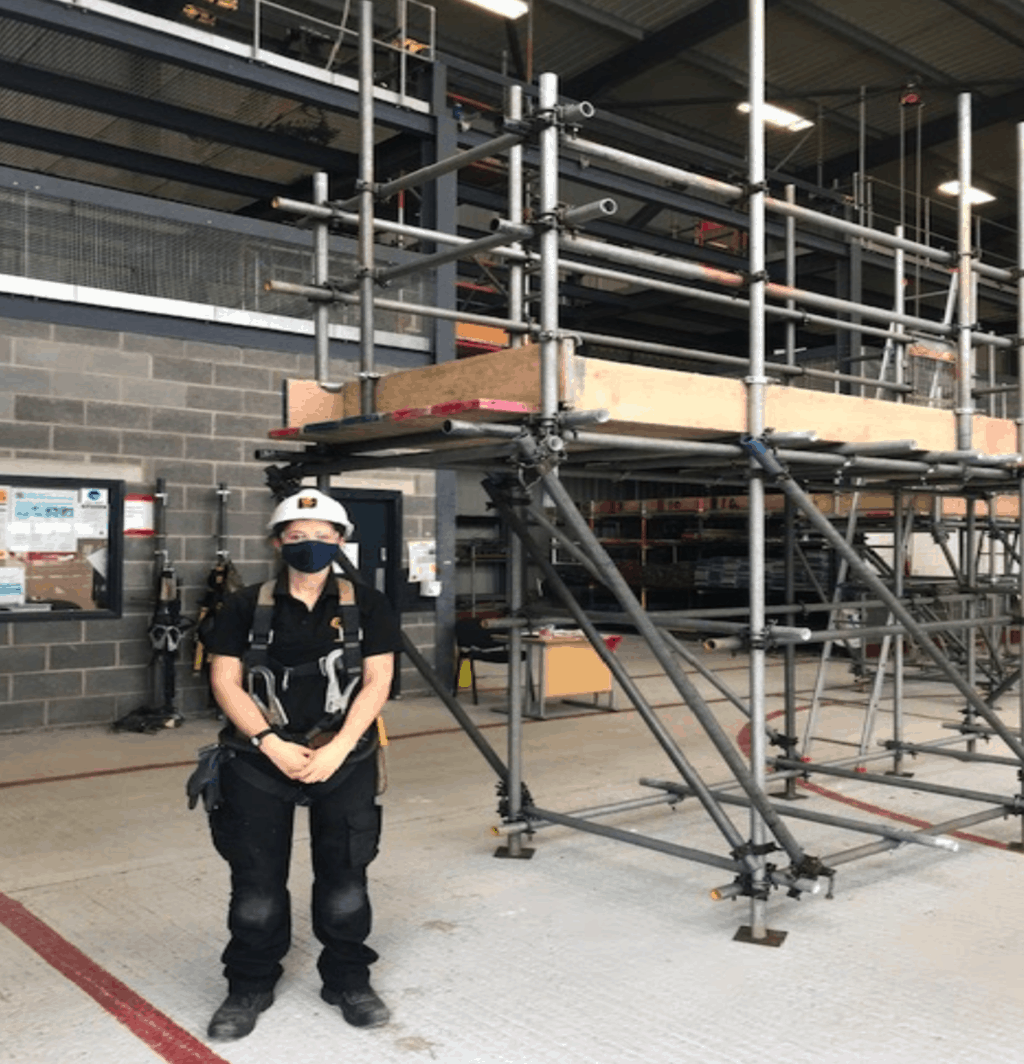
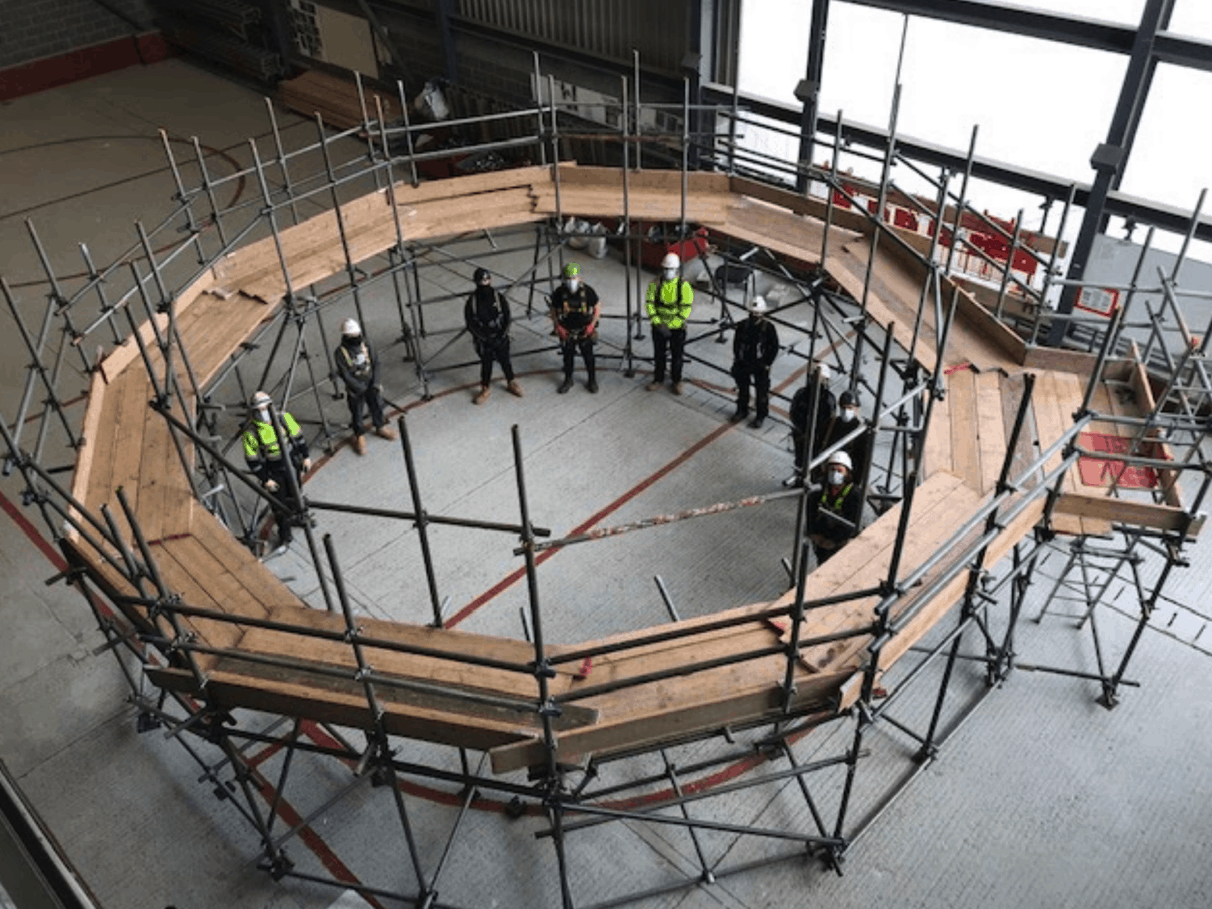
Safety & Access were delighted to host Anne Marie at their Humberside Training Facility for her Construction Industry Scaffolders Record Scheme or CISRS Part Two Scaffolders Course and Level Two NVQ recently.
 Safety & Access are one of the UK’s leading scaffolding and access training and H&S consultancy providers, offering a wide range of professional support services to a broad range of industry sectors.
Their training portfolio includes courses for both management and operatives – all delivered by experienced staff – either on-site or at one of several purpose-built training centres, located in Humberside, the East Midlands, the Middle East, Far East and beyond.
Anne Marie has already attended her one-day new entrant course and her 10-day CISRS Part One Scaffolders Course prior to attending the final course, enabling her to register as a fully qualified and competent scaffolder. In terms of investment, £1.3K pales into insignificance when anyone looks at the skills and drive Anne Marie will be giving to the industry as she moves into the future.
It means this talented lady can look forward to a progressive career in a historically male-dominated environment, with a clear commitment from Enigma Industrial Services within equality and diversity. In fact, this is both a compelling and uplifting example to all females considering a career in any of the associated construction trades.
She’s been spending time as a scaffolder working on the Syngenta Huddersfield Site in West Yorkshire working within a scaffolding team and erecting and dismantling access scaffolds for plant maintenance works at the prestigious site.
Safety & Access are one of the UK’s leading scaffolding and access training and H&S consultancy providers, offering a wide range of professional support services to a broad range of industry sectors.
Their training portfolio includes courses for both management and operatives – all delivered by experienced staff – either on-site or at one of several purpose-built training centres, located in Humberside, the East Midlands, the Middle East, Far East and beyond.
Anne Marie has already attended her one-day new entrant course and her 10-day CISRS Part One Scaffolders Course prior to attending the final course, enabling her to register as a fully qualified and competent scaffolder. In terms of investment, £1.3K pales into insignificance when anyone looks at the skills and drive Anne Marie will be giving to the industry as she moves into the future.
It means this talented lady can look forward to a progressive career in a historically male-dominated environment, with a clear commitment from Enigma Industrial Services within equality and diversity. In fact, this is both a compelling and uplifting example to all females considering a career in any of the associated construction trades.
She’s been spending time as a scaffolder working on the Syngenta Huddersfield Site in West Yorkshire working within a scaffolding team and erecting and dismantling access scaffolds for plant maintenance works at the prestigious site.
 Rick Statham, at Safety & Access, commented: “We are delighted to have Anne Marie with us for her CISRS Training and it’s fantastic to see females moving into these traditionally male roles in construction.
“Anne Marie sets a great example to all women considering a trade in the construction industry and as the sector is very buoyant in the UK it can provide very attractive salary opportunities for all and a long-term future in the industry with plenty of opportunities to progress.”
Roy Rogers QSHE & Energy Director Enigma Industrial Services Ltd, added: “The company are proud to witness Anne Marie’s progress in her chosen career and seeing the development from yard staff to now progressing on to her CISRS Part 2 Scaffolder Course at Safety & Access.
“Anne-Marie, demonstrates that diversity in the scaffolding industry is slowly gaining momentum managing the demands of her job at Syngenta Huddersfield and continuous development.”
The success of Anne Marie certainly proved to be an appropriate way to highlight International Women’s Day back in March. And after the events of the past 18 months, it’s great to be able to celebrate a scaffolders success.
Rick Statham, at Safety & Access, commented: “We are delighted to have Anne Marie with us for her CISRS Training and it’s fantastic to see females moving into these traditionally male roles in construction.
“Anne Marie sets a great example to all women considering a trade in the construction industry and as the sector is very buoyant in the UK it can provide very attractive salary opportunities for all and a long-term future in the industry with plenty of opportunities to progress.”
Roy Rogers QSHE & Energy Director Enigma Industrial Services Ltd, added: “The company are proud to witness Anne Marie’s progress in her chosen career and seeing the development from yard staff to now progressing on to her CISRS Part 2 Scaffolder Course at Safety & Access.
“Anne-Marie, demonstrates that diversity in the scaffolding industry is slowly gaining momentum managing the demands of her job at Syngenta Huddersfield and continuous development.”
The success of Anne Marie certainly proved to be an appropriate way to highlight International Women’s Day back in March. And after the events of the past 18 months, it’s great to be able to celebrate a scaffolders success.
 Safety & Access are one of the UK’s leading scaffolding and access training and H&S consultancy providers, offering a wide range of professional support services to a broad range of industry sectors.
Their training portfolio includes courses for both management and operatives – all delivered by experienced staff – either on-site or at one of several purpose-built training centres, located in Humberside, the East Midlands, the Middle East, Far East and beyond.
Anne Marie has already attended her one-day new entrant course and her 10-day CISRS Part One Scaffolders Course prior to attending the final course, enabling her to register as a fully qualified and competent scaffolder. In terms of investment, £1.3K pales into insignificance when anyone looks at the skills and drive Anne Marie will be giving to the industry as she moves into the future.
It means this talented lady can look forward to a progressive career in a historically male-dominated environment, with a clear commitment from Enigma Industrial Services within equality and diversity. In fact, this is both a compelling and uplifting example to all females considering a career in any of the associated construction trades.
She’s been spending time as a scaffolder working on the Syngenta Huddersfield Site in West Yorkshire working within a scaffolding team and erecting and dismantling access scaffolds for plant maintenance works at the prestigious site.
Safety & Access are one of the UK’s leading scaffolding and access training and H&S consultancy providers, offering a wide range of professional support services to a broad range of industry sectors.
Their training portfolio includes courses for both management and operatives – all delivered by experienced staff – either on-site or at one of several purpose-built training centres, located in Humberside, the East Midlands, the Middle East, Far East and beyond.
Anne Marie has already attended her one-day new entrant course and her 10-day CISRS Part One Scaffolders Course prior to attending the final course, enabling her to register as a fully qualified and competent scaffolder. In terms of investment, £1.3K pales into insignificance when anyone looks at the skills and drive Anne Marie will be giving to the industry as she moves into the future.
It means this talented lady can look forward to a progressive career in a historically male-dominated environment, with a clear commitment from Enigma Industrial Services within equality and diversity. In fact, this is both a compelling and uplifting example to all females considering a career in any of the associated construction trades.
She’s been spending time as a scaffolder working on the Syngenta Huddersfield Site in West Yorkshire working within a scaffolding team and erecting and dismantling access scaffolds for plant maintenance works at the prestigious site.
 Rick Statham, at Safety & Access, commented: “We are delighted to have Anne Marie with us for her CISRS Training and it’s fantastic to see females moving into these traditionally male roles in construction.
“Anne Marie sets a great example to all women considering a trade in the construction industry and as the sector is very buoyant in the UK it can provide very attractive salary opportunities for all and a long-term future in the industry with plenty of opportunities to progress.”
Roy Rogers QSHE & Energy Director Enigma Industrial Services Ltd, added: “The company are proud to witness Anne Marie’s progress in her chosen career and seeing the development from yard staff to now progressing on to her CISRS Part 2 Scaffolder Course at Safety & Access.
“Anne-Marie, demonstrates that diversity in the scaffolding industry is slowly gaining momentum managing the demands of her job at Syngenta Huddersfield and continuous development.”
The success of Anne Marie certainly proved to be an appropriate way to highlight International Women’s Day back in March. And after the events of the past 18 months, it’s great to be able to celebrate a scaffolders success.
Rick Statham, at Safety & Access, commented: “We are delighted to have Anne Marie with us for her CISRS Training and it’s fantastic to see females moving into these traditionally male roles in construction.
“Anne Marie sets a great example to all women considering a trade in the construction industry and as the sector is very buoyant in the UK it can provide very attractive salary opportunities for all and a long-term future in the industry with plenty of opportunities to progress.”
Roy Rogers QSHE & Energy Director Enigma Industrial Services Ltd, added: “The company are proud to witness Anne Marie’s progress in her chosen career and seeing the development from yard staff to now progressing on to her CISRS Part 2 Scaffolder Course at Safety & Access.
“Anne-Marie, demonstrates that diversity in the scaffolding industry is slowly gaining momentum managing the demands of her job at Syngenta Huddersfield and continuous development.”
The success of Anne Marie certainly proved to be an appropriate way to highlight International Women’s Day back in March. And after the events of the past 18 months, it’s great to be able to celebrate a scaffolders success.