Construction tops insolvency table with 3,866 failures

Construction recorded more company insolvencies than any other industry in England and Wales over the past year, despite a modest fall in failures.

Insolvency Service figures show 3,866 construction companies entered insolvency in the 12 months to August 2026. That was 2% fewer than in the previous 12 months, but still accounted for 17% of all cases where an industry was recorded.

August alone saw 294 construction insolvencies, compared with 292 in the same month last year.

Specialist contractors accounted for 164 of August’s cases, or nearly 56% of the construction total. However, failures in the “specialised construction activities” category were down from 179 a year earlier, according to RSM UK’s analysis.

For scaffolding and access businesses, the breakdown offers a picture of the wider contracting market. It does not establish whether insolvencies among scaffolding firms themselves are rising or falling.

Kelly Boorman, head of construction at RSM UK, said uncertainty over future workloads, infrastructure spending and financing continued to weigh on the sector.

She pointed to weaker private housing demand and cuts to major developers’ housebuilding targets, with pressure on project viability feeding through the supply chain. Clearer spending commitments and access to affordable debt would help businesses plan, she said.

The annual decline is encouraging, but does not by itself establish a sustained recovery. The Insolvency Service also cautions that industry totals are provisional and that a higher number of failures does not necessarily mean a higher risk of insolvency, because sectors differ in size.

SAIA Education Foundation to launch scholarship programme

The Scaffold & Access Industry Association (SAIA) Education Foundation will begin accepting scholarship applications from 1 January 2027, offering financial support to people working in the US scaffold and access industry.

The new scholarship programme will support education, training and professional development, with the aim of helping people already working in the sector build their skills and progress their careers.

SAIAEF said the scheme is part of a new chapter for the Foundation and is intended to give more people across the scaffold and access industry the chance to invest in further learning and development.

The Foundation also linked education with improved safety, stronger knowledge-sharing and career progression across the industry.

Further details on eligibility, scholarship values and the application process have not yet been announced.

Applications are due to open on 1 January 2027.

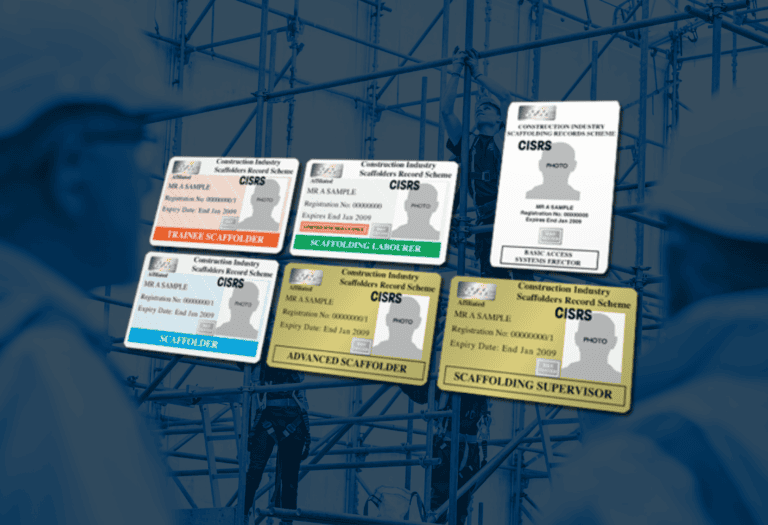
CISRS to hold industry webinar on CSCS departure

CISRS will hold an industry webinar on 22 September to explain its decision to leave the Construction Skills Certification Scheme and answer questions about what happens next.

The session follows the CISRS Board’s decision to terminate its membership of CSCS, with the scheme citing legal concerns over its ability to comply with Construction Leadership Council Industry Card Scheme Rules.

CISRS said updated legal advice found the scheme was at “undue risk” because it was in breach of the rules.

The organisation said a detailed review of the CLC requirements, issued in March 2024, concluded that CISRS could not fully comply while continuing to meet the needs of the wider scaffolding and access industry.

CISRS argues that scaffolding certification must work across sectors beyond construction, reflecting the use of scaffolders in industrial, infrastructure and other specialist environments.

The decision to leave CSCS has prompted widespread discussion across the scaffolding sector, particularly around future card recognition and access to construction sites once CISRS cards no longer carry the CSCS logo.

The webinar will give employers, training providers and scaffolders the chance to question CISRS directly about the decision and the transition ahead.

It will take place at 2pm on Tuesday 22 September.

CISRS said the session would also look at how remaining uncertainties around the future of the scheme could be resolved.

Layher UK extends ScaffEx principal sponsorship for three years

0

Layher UK has signed a new three-year agreement to remain principal sponsor of ScaffEx, extending its backing of the industry exhibition beyond ScaffEx26.

NASC confirmed the renewal this week, saying the system scaffolding manufacturer will continue as principal sponsor for the next three years.

The agreement follows Layher’s original three-year sponsorship of ScaffEx, which began with the first event in Belfast in 2024 and continued through the 2025 and 2026 editions in Manchester.

Sean Pike, Managing Director of Layher UK, said: “I honestly couldn’t be prouder that we’ve retained our sponsorship of ScaffEx for another three years, taking our partnership through to 2030.

“For me, this is about so much more than a sponsorship. It’s a reflection of the people behind it. I’m incredibly proud of the wider Layher team, whose passion, commitment and teamwork make everything we do possible.

“Our customers, our partners and the wider industry are at the heart of what we do, and ScaffEx gives us the opportunity to bring those relationships together, celebrate our industry and look towards its future.

“To have the trust and support to continue this partnership through to 2030 is a huge privilege, and one that I know means just as much to the whole Layher team.

“There would be no stand, no presence and no partnership without the dedication of the people behind it, and that’s what makes me most proud.”

Clive Dickin, Group CEO of NASC and CISRS, also confirmed the extension.

He said: “I’m also delighted to announce that Layher will be principal sponsor of ScaffEx for the next three years. This kind of long-term backing is what allows us to keep building the event and we’re grateful for their support.”

ScaffEx26 took place at Manchester Central on 10 and 11 September, with Layher again serving as principal sponsor.

Scaffolding targets full WorldSkills Ireland competition place

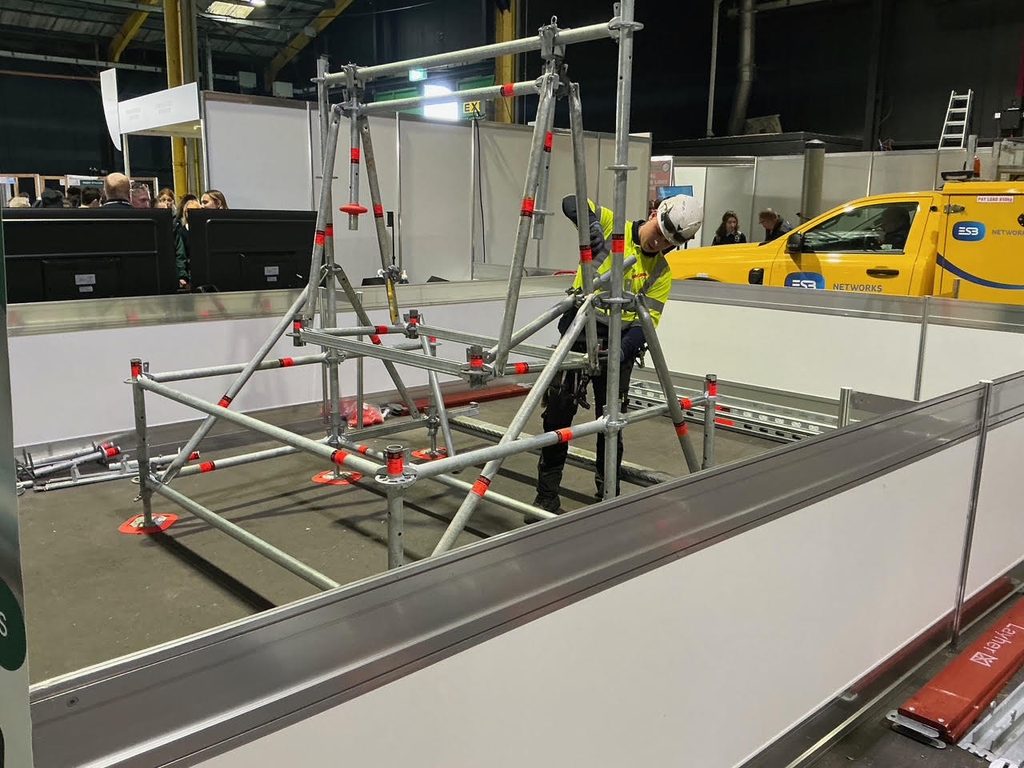
Scaffolding apprentices have taken part in a live skills demonstration at WorldSkills Ireland 2026, with hopes that the trade could become a full competition category at next year’s event.

The demonstration at the RDS in Dublin involved apprentices from the two-year Scaffolding Apprenticeship Programme delivered at the LOETB National Construction Training Campus in Mount Lucas, Co. Offaly.

Dave Mosley took on the role of Chief Examiner for the scaffolding demonstration, overseeing competitors as they carried out practical tasks based around industry training and safety standards.

Scaffolding instructor Fergus Sheerin was also involved, with the completed structure built by apprentices forming part of the display for visitors attending the event.

Putting scaffolding in front of new entrants

WorldSkills Ireland brings together apprentices, students, employers and training providers, giving young people an opportunity to see different skilled trades first-hand.

For scaffolding, the demonstration gave visitors a closer look at the practical skills required in the trade and the apprenticeship route now available in Ireland.

Apprentices carried out a series of practical scaffolding tasks throughout the event, giving those attending an opportunity to see the training standards expected during the programme.

The Mount Lucas campus was represented by Campus Manager John Kelly, Scaffolding Apprenticeship Programme Manager Yvonne Kearney, Amy Hanlon and Darren Burke.

Full competition targeted for 2027

Those involved now hope the demonstration can lead to scaffolding becoming a full live competition category at WorldSkills Ireland in 2027.

That would move the trade beyond demonstration status and place scaffolding alongside other recognised skills competitions at the event.

The Scaffolding Apprenticeship Programme is delivered at the LOETB National Construction Training Campus in Mount Lucas, Daingean, Co. Offaly.

Further information about the apprenticeship programme is available from Mount Lucas on [email protected] or +353 57 936 2508.

Revscaff backs new scaffolding division with seven-figure Layher investment

0

Revscaff Safety Systems has placed a seven-figure order with Layher as it builds a new scaffolding operation within its wider construction safety group.

The investment, which was revealed around ScaffEx26 in Manchester, follows plans drawn up in early 2025 to add scaffolding to the services already provided by sister businesses Prodek Safety Systems and Revnet Safety Systems.

Revscaff has brought Andy Roze and Mark Huggins into the operation, with Group Managing Director Chris Bateman saying their scaffolding management experience had been an important part of establishing the new business.

The company then began assessing which scaffold system and supplier it wanted to use.

Layher system scaffold chosen for new operation

Bateman said Revscaff decided to build the business around system scaffold after reviewing the different options available.

He said the company saw advantages in faster assembly, reduced labour requirements and greater structural predictability compared with traditional tube and fitting scaffolding.

Image credit: RevScaff

That led to a wider review of manufacturers before Revscaff selected Layher.

Bateman said: “We conducted a careful market and supplier analysis exercise to identify the system scaffold supplier we wanted to work with.

“We were very impressed with the product that Layher offers and also the immediate support available in supporting us in our investment.”

The resulting order is understood to be worth seven figures and gives the newly established operation a significant stockholding as it begins developing its scaffolding workload.

Training and technical support

Bateman said Layher had also worked with Revscaff during the development of the business, including training for management and operational teams and advice on the products required.

Technical support and product availability were also factors in the decision.

He added: “Within a short space of time we concluded that forming a strategic partnership with Layher was the direction to take.

“The team at Layher have supported us in the development of our business plan, offered training to management and operational teams and guided us on the key products to work with.”

Revscaff Safety Systems Ltd was incorporated in November 2025 and is based at Wardles Business Park in Howden, East Yorkshire, alongside other businesses within the group.

The company is headed by Bateman, who is also involved in Prodek Safety Systems, Revdek Safety Decking and Revnet Safety Systems.

The seven-figure Layher investment gives the group a dedicated scaffolding capability alongside its existing work in areas including safety decking, safety netting and edge protection.

Scaffolding rises to fourth in OSHA’s most-cited safety standards

Preliminary figures for the 2026 fiscal year show 1,725 violations of OSHA’s scaffolding standard, 29 CFR 1926.451, recorded up to August 31.

The National Safety Council announced the figures this week at the Safety Congress & Expo in Indianapolis.

Scaffolding ranked sixth in the final FY2025 list, meaning it has moved up two places this year. Fall Protection – General Requirements remains at number one, with 4,041 violations. Hazard Communication was second with 1,961, followed by Lockout/Tagout with 1,863.

Scaffolding came fourth, ahead of ladders with 1,659 violations.

Higher ranking does not mean more violations

The higher ranking does not mean scaffolding violations are rising. The National Safety Council said every standard in this year’s Top 10 had received fewer citations than the previous year.

The latest figures are also preliminary. They cover the period from October 1, 2025 to August 31, 2026, while last year’s figures were based on the full fiscal year.

Final FY2025 figures showed 2,286 scaffolding violations. That means the two totals should not be compared directly.

What the new figures do show is that scaffolding has moved higher in OSHA’s overall ranking compared with other commonly cited safety standards. OSHA’s scaffolding rules cover a wide range of areas including platforms, foundations, access, inspections, fall protection and the overall strength and stability of a scaffold.

The rules also require scaffolds to be checked by a competent person before each work shift and after anything that could affect their safety.

Prent Cline, acting deputy director of OSHA’s Directorate of Enforcement Programs, said employers need to keep identifying hazards and putting them right. “It takes vigilance on the worksites to identify the hazards and get them corrected,” he said.

The figures do not only relate to specialist scaffold contractors. OSHA’s scaffolding rules apply across construction, including employers and workers in trades such as masonry, roofing, framing and siding where scaffolds are used.

A fuller breakdown of OSHA’s FY2026 Top 10 is expected later this year.

What ScaffEx 2026 says about where scaffolding is heading

0

THE DEBRIEF – THE EDITOR’S TAKE ON THE BRACE YOURSELF PODCAST

I spent two busy days at ScaffEx 2026 and there was plenty to look at. New systems, roofing products, software, automation, augmented reality and equipment filled Manchester Central, while exhibitors had clearly invested heavily in making their stands bigger and more ambitious than before.

But the most interesting conversations I heard around the show had little to do with the equipment itself.

That comes across clearly in the latest episode of The Brace Yourself Podcast, recorded on the exhibition floor by Simon Boyes and Ben Beaumont. The episode moves around the show, taking in contractors, suppliers and industry figures on some of the broader challenges facing scaffolding businesses, and one theme comes through repeatedly: the companies thinking hardest about their people, processes and leadership may gain just as much advantage as those investing in the latest product.

Giving people a stake in the business

One of the strongest conversations is with James Brearley of Rose System Scaffolding. Brearley explains that when he established the business, one of his early decisions was to give members of the senior management team shares in the company, a deliberate attempt to create genuine commitment from day one.

“When things went wrong, when we had tough things like Covid, Ukraine, war, and we were wobbling, everybody came together. How are we getting through this? Not how are you getting through? It’s your business. No, no, no, it’s us as a team.”

Nine years later, those same senior people remain with the business.

But Brearley also makes a useful distinction. Customers don’t care how a contractor has structured its ownership or whether employees have shares. They care about delivery. The value of having people invested in the business comes from what that commitment produces: better planning, consistency and a team that takes responsibility for delivering what has been promised.

As Brearley puts it: “You’ve got to deliver what you say you’re going to deliver.”

Technology has become much more practical

Technology was one of the most visible themes across ScaffEx, but compared with a few years ago the conversation has moved on. Contractors are less interested in technology because it looks impressive; they want to know what problem it solves.

Brearley describes how Rose uses ScaffPlan for modelling, Monday.com for planning and workflows, and mobile systems for scaffold handovers. The impact, he says, is practical: better planning has allowed the business to reduce unnecessary movements of equipment and scale without continually adding administrative staff.

“Technology has allowed us to scale up a business without necessarily adding loads of extra staff.”

For me, that’s the more important technology story from this year’s show. The question is no longer whether scaffolding should embrace digital tools. It’s whether a particular system saves time, improves safety, reduces waste or helps the business operate more efficiently.

The owner cannot make every decision

The conversation with Brearley also moves into leadership and how his own role has changed as the company has grown. He now sees much of his job as developing and mentoring the next generation, with younger members of the team increasingly driving technology and innovation, researching new systems and putting proposals back to senior management.

His advice is simple: “You’ve got to let the business innovate… but you’ve got to let your staff fly.”

It lands in an industry full of owner-led businesses. The skills required to start a scaffolding company are not the same skills required to run one when it has 50, 100 or several hundred people. Eventually, owners have to build people around them who can make decisions without asking permission every five minutes. Otherwise, the owner becomes the bottleneck.

Culture has to be visible

That issue continues in another substantial conversation with Adam Millgate and Shane Wood from KAS Scaffolding. Their discussion focuses on company culture and, importantly, how something that can sound fairly vague is turned into day-to-day behaviour.

For KAS, that starts from the moment somebody joins the business. New starters are given branded clothing and told what the company expects in terms of behaviour, presentation, PPE and standards. It costs money before the business even knows whether that employee will work out, but the directors see it as part of setting expectations from day one.

They also talk about giving managers and employees enough freedom to make decisions and accepting that sometimes those decisions will be wrong. The distinction they make is between making a mistake and continually repeating the same mistake.

“They can’t always find us every five minutes to say, ‘What do I do here?’”

That approach only works if people know they won’t be punished for a reasonable decision that turns out badly. It’s the best definition of culture I’ve heard in a long time: culture is what happens when the directors are not standing on the job.

Keeping scaffolders is about more than pay

The same discussion tackles a problem familiar to almost every scaffolding contractor: staff retention. Scaffolders can move quickly when another company offers more money, and KAS openly discusses having employees leave for better-paid positions elsewhere, only for many of them to return.

That experience challenged the immediate assumption that the answer was simply to increase wages. Pay matters, obviously. But so do stability, the way people are treated, the working environment and whether employees believe their employer will support them.

The directors describe helping workers financially at difficult points, including with loans and personal circumstances, while acknowledging that sometimes people still leave afterwards. Their response is not to stop helping everybody else.

As one of them puts it: “Kindness costs nothing. And you shouldn’t let one bad experience make you… insinuate that everyone else is the same.”

More than products

Towards the end of the episode, NASC chair David Brown describes the enthusiasm around this year’s event and points to its growing scale, while AT-PAC UK and Ireland managing director Charles Stratford reflects on heavy traffic through the company’s stand and interest from engineers in its products.

That, I think, sums up ScaffEx 2026. The equipment still matters, and the ability to see products, handle them and talk directly to the people behind them remains one of the main reasons for attending an exhibition. But the conversations around those products are becoming broader: how to build a business that keeps good people, where technology genuinely removes wasted time, and how much decision-making still depends on the owner.

And underneath all of it, the question I keep coming back to from the KAS conversation: what standards are you prepared to accept when nobody is watching?

The latest episode of The Brace Yourself Podcast, recorded at ScaffEx 2026 in Manchester, is available through the Brace Yourself channels. ScaffMag is the show’s Official Media Partner.

ITP launches flame-retardant shrink wrap for scaffold containment

Industrial Textiles & Plastics (ITP) has added a new flame-retardant shrink wrap to its Powerclad range for use on construction and industrial sites.

Powerclad FR Tite is aimed at scaffolders, contractors and specialist installers needing temporary containment around refurbishment, maintenance and other works.

According to ITP, the sheeting is designed to create a dust-tight, weather-protected working area while helping contain dust and debris. The company says it is particularly suited to external applications where temporary protection and fire performance are project requirements.

Fire performance

ITP says Powerclad FR Tite has been tested to EN ISO 11925 and is Warringtonfire TS 62 certified. The shrink wrap is available in a range of sizes.

Matt Thompson, Sales Director at ITP, said: “Powerclad FR Tite builds on the proven performance of our Powerclad range and responds directly to the needs of contractors who require dependable temporary containment with enhanced fire performance.”

The product is available now through ITP for construction, refurbishment, maintenance and industrial applications.

CISRS says CSCS licence was at risk as STA calls for consultation

CISRS says it decided to leave CSCS after receiving legal advice that the scheme was in breach of Construction Leadership Council requirements and risked having its licence revoked.

In a statement sent to Scaffmag today, CISRS said the issue centres on Clause 4 of the CLC’s Industry Card Schemes requirements.

The clause says cards carrying the CSCS logo should not be issued for non-construction occupations or people visiting sites. CISRS cards are used across the scaffolding and access industry, including sectors outside construction.

CISRS said: “Following legal advice, the CISRS Board took the decision to protect the scheme after being advised that CISRS was in breach of Clause 4 of the Construction Leadership Council (CLC) Industry Card Schemes requirements.”

The Board said consultation could not resolve the conflict between the CLC requirements and the way CISRS cards are used.

It said delaying formal action could have left the industry facing a much shorter transition period.

“Delaying action to consult would also have exposed CISRS to the risk of its CSCS licence being revoked, potentially leaving training centres, employers, contractors, employees and cardholders with only a few months to respond,” CISRS said.

The scheme also said discussions it understood to be private were made public by other stakeholders while possible solutions were still being considered.

The legal advice and the Board’s detailed assessment have not been published.

STA questions lack of consultation

The CISRS response follows an open letter from the Scaffolding Training Alliance, dated 10 September, calling for formal consultation and firm guidance on card recognition and site access.

The STA said it supports the principle of one competence card for scaffolders working across construction and other industries.

But it criticised the way the decision was made, claiming training centres, employers, scaffolders and apprentices were not consulted before the announcement.

The STA describes itself as an informal association of principals from CISRS-accredited training centres.

In a 2025 statement, the STA said 23 training organisations and centre locations had contributed to its formation. The full list can be viewed in the STA’s original LinkedIn post. The group has not published an up-to-date membership list or publicly explained its governance, decision-making structure or who is authorised to speak on its behalf.

It said no centre known to the group had been informed or invited to contribute before the plans were announced.

CISRS announced on 8 September that it would become the Competence in Scaffolding Record Scheme on 1 January 2027, retaining the CISRS initials.

It plans to leave the CSCS Alliance on 1 June 2027.

CISRS says the change will allow scaffolders to use one competence card across construction, utilities, marine, aviation and petrochemical work. It argues that remaining under the current CSCS licence could lead to duplicate cards for people working across different sectors.

Six requests from training providers

  1. A joint CISRS and CSCS statement confirming site-access arrangements and card validity.
  2. Guidance for scaffolders and employers on card verification after 1 June 2027.
  3. Publication of the evidence, legal advice summary and governance decisions behind the withdrawal.
  4. Early access to draft scheme documents, including proposed changes to manuals, contracts or audits.
  5. A structured consultation involving training centres, employers and scaffolders.
  6. An assurance that UK scaffolding standards will remain unchanged through the reform and rebrand.

The letter also raises questions about apprentices who will still be progressing through CISRS programmes when the change takes effect.

The STA wants assurance that their qualifications, progression and cards will remain recognised throughout their programmes.

Training providers have also asked whether Training Manual 4.0 will be revised, whether centre contracts will change and how audits, sanctions and trainer requirements will be managed during the transition.

Site access remains unanswered

CISRS has said existing cards will remain valid for their normal duration and at the same sites as before. Current qualifications, training programmes, assessment routes and card-verification systems will remain in place.

From June 2027, new and renewed cards will have a different design and will no longer carry the CSCS logo.

How construction clients will treat those cards has yet to be explained publicly.

Build UK’s current Training Standard supports the CLC position that the industry should specify recognised card schemes carrying the CSCS logo, with “no equivalents accepted”.

The STA said employers need to know whether clients will accept the revised CISRS card and whether contractual requirements will change.

CISRS said setting 1 June 2027 as the departure date had created time to work with the scaffolding and access industry on an agreed solution.

“CISRS’s preference is to achieve that solution collaboratively. But if agreement can’t be reached, contingency plans are in place to provide a fully functional solution for clients, scaffolding contractors, training providers and cardholders, with the objective of ensuring continued recognition of competence and access to relevant sites from June 2027 and beyond,” it said.

CISRS said any solution must serve the whole scaffolding and access industry, maintain standards and avoid costly duplication.

Details of the contingency plans have not been released. No change has been announced to the current Build UK requirements covering cards without the CSCS logo.