“I think you probably should not use shrink wrap sheeting for your next project” says company Director.
Steve Irlam of Rhino Shrink Wrap Martial Supplies has recently blogged about the advantages and disadvantages of using Shrink Wrap Sheeting. Within his informative article below Steve also highlights the responsibilities contractors face when using this specialised material.
Traditional scaffold sheeting, like ‘Monarflex’, has long been available and provides some weather protection and a degree of ‘containment’ for many projects. Applied to the scaffolding in 2-3m wide strips, this product is low cost, widely available and every scaffolder has a ‘rough’ idea how to fit it.
Shrink wrap sheeting, used for the last 15 years by the majority of the top 100 scaffolders and contractors in the UK on bridges, railways, power stations, airports – (anywhere where the sheeting detaching could have serious consequences for safety or the environment) is a more specialised activity. Because of this, scaffolders and contractors normally only consider shrink wrap when they are looking for a higher level of performance in one or more of the following areas;
Containment – Activities such as shot blasting, generate residues which can be harmful to the environment. Because individual shrink wrap sheets are joined using a heat welding process, they create a ‘continuously bonded skin’ around a project. Traditional plastic sheeting and duct tape will not ‘cut it’ anymore for responsible contractors.
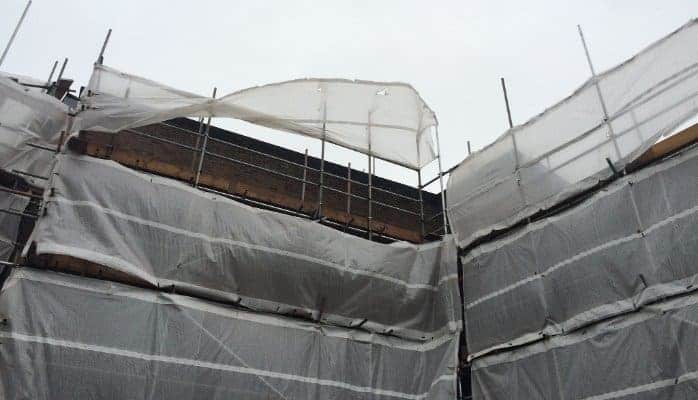
Weather resistance – One of the first large scale uses for shrink wrap sheeting in the UK was the encapsulation and containment of scaffolding around the Forth Rail Bridge in Scotland where wind speeds could exceed 100mph. The environmental problems caused by detached sheeting and toxic paint residues being deposited in the Firth of Forth were prevented by using shrink wrap. Since then, shrink wrap sheeting has been used extensively by a wide range of clients such as Network Rail, National Grid and ‘heritage’ projects; anywhere detached sheeting could have serious implications.
With a high performance product comes the responsibility to ensure that the scaffolding structure is engineered to withstand wind loads, (including point loadings). It is important that the specialist shrink wrap installers work together with scaffold designers, scaffolders and contractors.
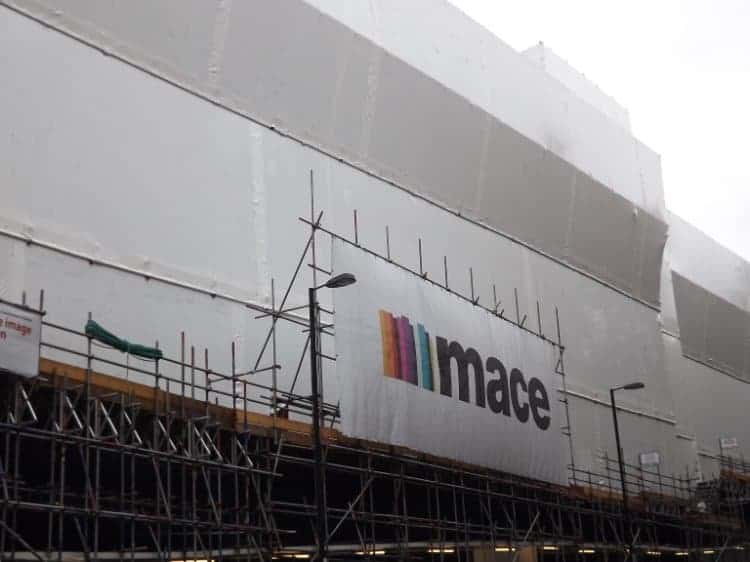
Appearance – The smart & professional appearance of scaffold sheeting, can be a benefit to contractors, particularly on high profile sites in urban areas such as Central London. Additionally, where scaffolding is erected around buildings which are occupied, such as hospitals or apartments, the noise of traditional scaffold sheeting flapping can cause complaints. Because shrink wrap sheeting is heat shrunk very tightly around the scaffolding, this problem can be minimised.
Despite the benefits of shrink wrap for scaffolding encapsulation and containment, here are 5 reasons you might not want to use shrink wrap on your next project;
1. YOU CAN’T WAIT FOR A WEATHER WINDOW
Once fitted and heat shrunk ‘drum tight’, scaffold shrink wrap is very resilient to wet and windy weather. However, to fit shrink wrap sheeting over and around a scaffolding structure successfully needs good weather during installation to get the best results, particularly to get that ‘signature’ drum tight finish from the heat shrink process.
2. YOU ARE ON A VERY TIGHT BUDGET
Although shrink wrap sheeting material costs from only £1.35/m2, shrink wrap will never be able to undercut traditional scaffold sheeting on price alone. With scaffold shrink wrap there will always be some extra labour costs for fitting by trained teams. Clients who need the extra performance of scaffold shrink wrap, generally understand the extra costs involved. If you just need a ‘bit of sheeting’ for a client who wants the lowest price at all costs then probably a traditional scaffold sheeting product like Monarflex is a better option. When using a shrink wrap scaffold sheet always make sure you obtain an up to date specification and flame retardant certificate, a ‘cheap’ shrink wrap may not have been engineered specifically for scaffolding use.
3. THE SITE WON’T ALLOW HOT AIR GUNS
The ability of scaffold shrink wrap to withstand high winds derives from it’s ability to be heat shrunk ‘drum tight’ around the scaffolding structure and to do this requires hot air to be blown across the surface of the sheet by a hot air gun! Shrink wrapping guns are usually powered by propane gas as this creates a powerful heat source that is able to shrink large areas rapidly. Industrial grade electric heat guns are available but compared to a propane gas shrink wrap gun the electric tools are slow, heavy and expensive tools and are not considered of practical use for the shrink wrapping of scaffolding.
4. YOU NEED TO MAKE LOTS OF ADAPTIONS
Traditional reinforced scaffold sheeting is easily removed and so ideal for situations where lots of adaptions are needed to the scaffolding structure. Once the shrink wrap has been heat welded into place, it cannot easily be removed and refitted.
5. THE SCAFFOLDING STRUCTURE IS NOT FLUSH
To get the full benefits from shrink wrapping, the scaffold structure should be ‘flush’ with no protruding ledgers, transoms or standards. This is particularly true where a high level of environmental containment is needed (such as a shot blasting and painting). Protruding tubes make fitting a sheet difficult and it can be time consuming to tape around each scaffold tube protrusion. If the structure cannot be built flush, or you do not want to cut any tubes then a traditional sheeting might be a better option.
In summary, shrink wrap sheeting is definitely not for every scaffolder or contractor.
Used correctly, shrink wrap sheeting can be very effective but like any tool, with a high level of performance comes a responsibility to ensure that the product is fitted properly and with proper regard to planning to ensure safe outcomes.
I hope you find this information useful. If you think others would too, please share!
I don’t claim to be an ‘expert’, I am always learning something, but the information in this article is based on many years personal experience setting up and running multiple shrink wrap installation teams and supplying materials to scaffold companies and construction contractors.
You can find more ‘how to’ guides, shrink wrapping case studies and product information at www.rhinoshrinkwrap.com
By Steve Irlam
See the original blog here