
Ad
Saturday, February 7, 2026

Guest design article: How Do Ties Work ?

ADVERTISEMENT

Image5Guest Technical Article By IDH, The Independent Design House

IDH was incorporated in July 2011 and established to provide specialist Scaffold DesignFormwork Design & general Temporary Works Design consultancy serving Sub-Contractors, Main Contractors and Client developers.

How Do Ties Work ?

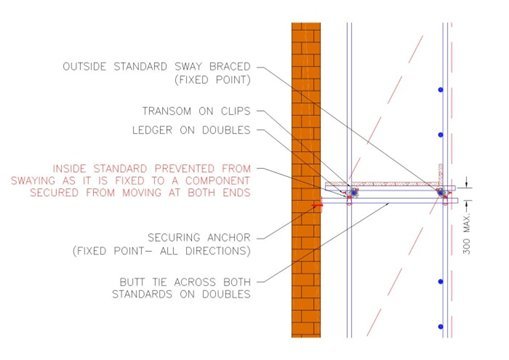
To stabilise a scaffold we tie it to the adjacent building as the scaffold is erected.  Conventionally this is done by means of an anchor fixing in to the façade and then a tie tube on doubles across both standards and all within 300mm of the ledger / standard interface.  This point being a node (point of NO DE-flection).

Depending on a number of factors such as geographic location, netting, sheeting, height and load we determine in the design process what tie pattern to adopt and the frequency of ties.

Ties however, undertake more than one function. 

Firstly they prevent the scaffold from pulling away from the building – but if this is the case why not fix them at all standards, or for that matter at every 4 standards for instance.

In addition to providing this pull restraint, they also stabilise the scaffold from swaying parallel to the building and contribute to the effective length of the standard in question.
ties

Sway stability parallel to the building is provided by a combination of the tie tube and the face brace.  By installing the correct sway bracing, the outside line is prevented from moving parallel to the building.  By securing the tie tube to the building façade and the outside line we now have a tube which is prevented from movement at both ends.  When the inside line is now secured to this tube (with doubles) the inside line is now also prevented from moving parallel to the building by the bending resistance of this tie tube.  This is why inside lines are not sway braced!

In some designed circumstances it may be a requirement to tie to the inside line only or miss ties altogether.  When these scenarios occur the scaffold should be designed as we no longer have that sway restraint present and alternative measures need to be considered such as plan bracing or V-ties.

For more explanation on this and other technical scaffold design subjects visit the IDH blog: http://www.idh-design.co.uk/blog/

Author: Tim Burt on Google+
ADVERTISEMENT

Popular Categories

Latest news

Twenty teams confirmed for ScaffChamp 2026 in Vilnius

ScaffChamp powered by Layher has confirmed all 20 teams for its 2026 competition, following nearly five months of registrations and enquiries from around the...

Safety crackdown follows boy’s death caused by unsecured scaffolding

New safety standards covering the transport of scaffolding and other construction materials have been introduced following the death of a schoolboy killed by an...

Scaffolding demand expected to rise as construction returns to growth

UK construction activity is expected to recover in 2026 after a subdued year, with growth forecast to strengthen through to 2027, according to a...

Global demand to push scaffolding market to $16bn by end of decade

The global scaffolding and accessories market is expected to grow to $16.3bn by 2030, adding more than $4bn in value over the next four...

CSCS Smart Check reaches 60 million scans

The CSCS Smart Check platform has recorded its 60 millionth scan, highlighting its growing role in workforce verification and compliance across the construction industry. The...

Viktor Voroncov to leave Layher Baltic after 15 years

Viktor Voroncov is to leave Layher Baltic UAB at the end of January, bringing to a close a 15-year career with the company. In a...

HAKI opens new Swiss subsidiary to support regional growth

The HAKI Group has launched HAKI Safety SA, based in Thônex in the canton of Geneva, marking a further step in its expansion across...

China joins IASA as global membership continues to expand

China has become the latest country to join the International Access and Scaffolding Association (IASA), following the China Formwork and Scaffold Association’s decision to...

UK construction growth cut to 1.7% as housing sector weakens

Growth in the UK construction industry has been downgraded to 1.7% for 2026, almost half the figure predicted three months ago. The Construction Products Association...

Rainham, Zenith and TEi join new industrial services group Coriant

Rainham, Zenith and TEi have announced they are joining Coriant, a newly established UK-based industrial and infrastructure maintenance services group. The launch of Coriant follows...

Latest news

ADVERTISEMENT

Magazine

Winter Issue #28 | Past issues >>

Popular

Safety crackdown follows boy’s death caused by unsecured scaffolding

New safety standards covering the transport of scaffolding and...

Scaffolding demand expected to rise as construction returns to growth

UK construction activity is expected to recover in 2026...

Global demand to push scaffolding market to $16bn by end of decade

The global scaffolding and accessories market is expected to...

CSCS Smart Check reaches 60 million scans

The CSCS Smart Check platform has recorded its 60...

Viktor Voroncov to leave Layher Baltic after 15 years

Viktor Voroncov is to leave Layher Baltic UAB at...

Related articles

ADVERTISEMENTS

Latest topics

AFIX Group secures German approval and opens new branch near Munich

AFIX Group has taken a significant step in its...

Twenty teams confirmed for ScaffChamp 2026 in Vilnius

ScaffChamp powered by Layher has confirmed all 20 teams...

Safety crackdown follows boy’s death caused by unsecured scaffolding

New safety standards covering the transport of scaffolding and...

Scaffolding demand expected to rise as construction returns to growth

UK construction activity is expected to recover in 2026...
ADVERTISEMENTS