
In the Foreword to the new NASC guidance SG4:10 Philip White (Head of Construction, HSE) states,
“This revision represents a step change in the way scaffold contractors should erect their scaffold structures. The guidance is straightforward and comprehensive and represents best practice within the industry”
Since its introduction in the mid-nineties Safety Guidance Number 4 (SG4) from the National Access and Scaffolding Confederation (NASC) has become the established minimum standard for fall prevention in the scaffolding industry. SG4 rose to prominence following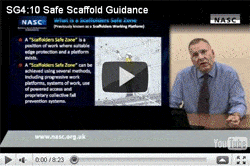 the major revision in 2000 (SG4:00) as it represented a significant change and challenge to the established methods of working that had been practiced for decades.
In 2000, the updated revision (SG4:00) saw the introduction of a new methodology that was christened the ‘tunnelling principle’, where the scaffolder’s priority on any working platform was to progressively create a safe working platform with guardrail protection and correctly supported working platforms, in the same manner a miner shores up a tunnel as it is excavated – thus minimising the time exposed to risk. This was also the first occasion where scaffolders were now expected to wear personal fall protection equipment (safety harnesses) at all times, as standard.
The priority now was to provide a ‘safe zone’ utilising collective measures before resorting to personal protection. However, it was still recognised that there was an inherent risk of a fall in scaffolding operations that could not be completely avoided therefore scaffolders would need to be clipped on whenever exposed to a risk of a fall and not traversing themselves and materials. The tunnelling principle made an allowance for scaffolders to traverse, unprotected, along a boarded lift for the maximum length of materials they were guardrailing with e.g. a maximum of 6.4m (21ft).
SG4 was again revised and updated in 2005 to reflect the requirements of the new Work at Height Regulations (WAHR), introduced that year, and included guidance on developments in technology in the intervening years. Innovations included amongst others; newcollective protection methods that could remove the unprotected traversing element of the tunnelling principle and new anchor devices that enabled scaffolders to attached their harnesses to higher points above the working platform, thereby reducing fall distances.
A change of emphasis in the new regulations for collective protection over personal was already supported by the SG4:05 guidance. However, to further promote innovations in collective protection equipment and methods an interim guidance note was issued in September 2008 (SG4:05 Appendix A). The aim was to raise the profile and promote collective measures available to scaffolders and employers. Many of these innovative new products and systems of work have been devised by scaffolders and contractors, which include a variety of cost effective solutions which is normally the major objection to change by many employers.
In agreement with the Health and Safety Executive SG4 is revised every 5 years and work on the next revision is well underway. The working party is aiming to complete revisions of both the management guide (SG4) and the user guide (SG4 You) for approval by the HSE, NASC Council and Membership for a launch before the end of the year (2010).
The new SG4:10 – ‘Preventing Falls in Scaffolding’ – will see more emphasis on the creation of a ‘Safe Zone’ by scaffolders covering a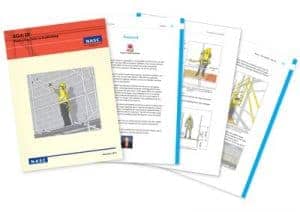 variety of safe methods. This revision will also see the removal of the practice of the ‘unprotected traversing element’ from the tunnelling principle. The initial impact to the Industry to implement these new measures will be significant for those who have not yet embraced the systems of work promoted by SG4:05 and Appendix A. Interestingly the NASC’s analysis of the ‘unprotected traversing element’ shows that it represented only a small percentage of the scaffolder’s working day. The NASC accepts that in practice the ‘unprotected traverse’ fails to comply with current legislation. However at the time of the previous revisions, it was accepted by the HSE as areasonably practicable solution in the absence of other alternatives. It has to be recognised that the initial investment and increased future overheads is a major factor to be taken into consideration by Scaffolding Contractors, however, the guidance will help ensure scaffolders and their employers work safer and comply with the law.
“The HSE will no longer accept the unprotected traversing element of the tunnelling principle that featured in previous versions of the guide [SG4:10]”
Philip White, Head of Construction, HSE
The NASC and HSE acknowledge that there are scaffolders and contractors who still do not comply with the current guidance. This is evident in any town or city by the tell-tale signs scaffolders leave behind i.e. no Scaffolder’s guardrails or intermediate transoms. It is clear that you don’t have to actually see scaffolders working to know whether they have even attempted to work to SG4.
The NASC considers collective protection as passive protection, for example a guardrail will remain in place and provide protection should someone fall against it, whereas personal fall protection equipment (harnesses) is ‘personal’ or ‘active’ protection that must be attached to afford any benefit to the user. A number of NASC Members are already routinely working with collective protection measures and report increased demand from Principal Contractors and Clients for the same.
To order your copy of SG4:10 Preventing Falls from Scaffolding please click here
Source: The NASC