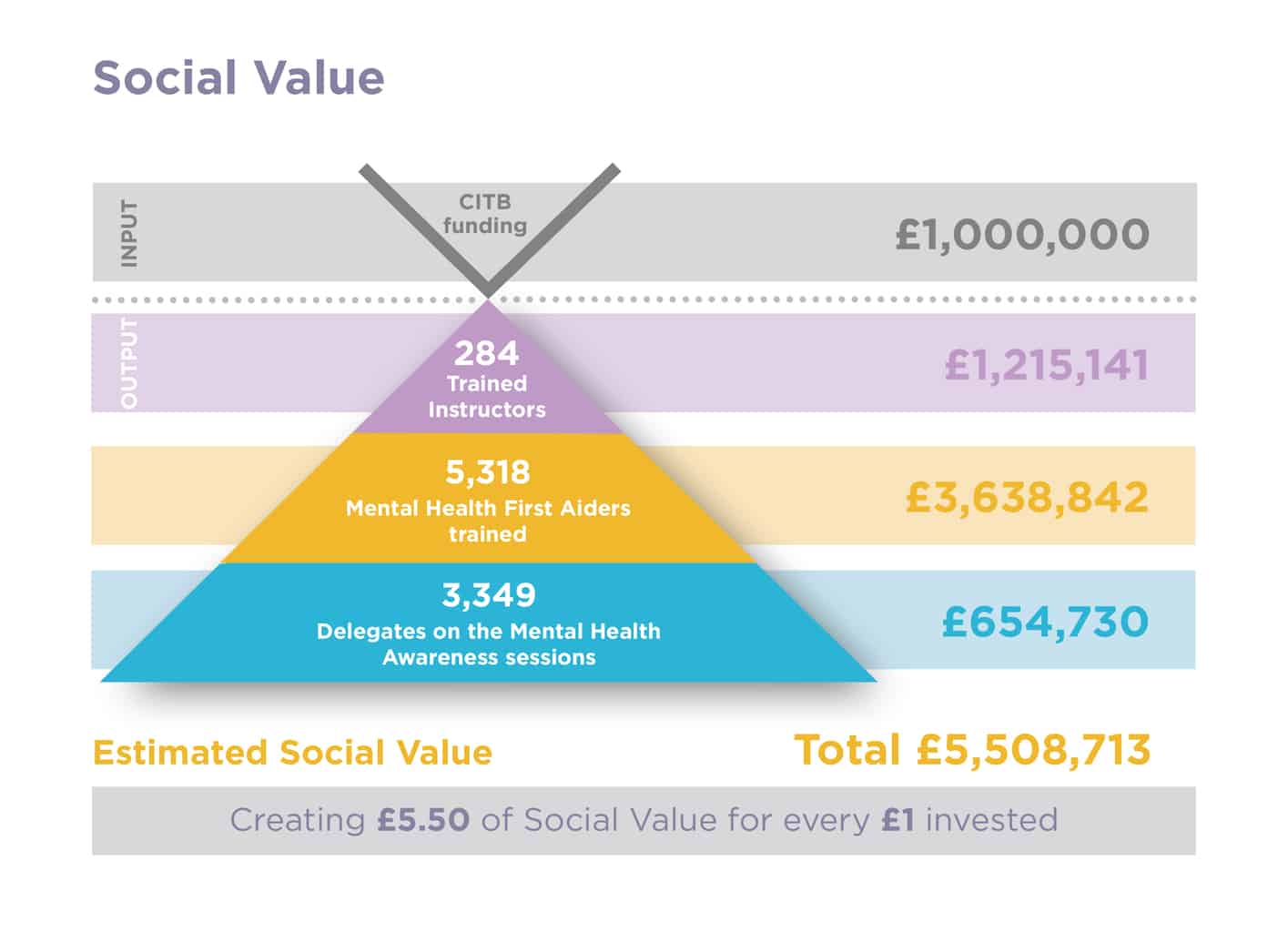
Building Mental Health, the CITB and the Lighthouse Construction Industry Charity have published a report detailing the social value of their Mental Health First Aid Instructors Programme; an initiative to train 288 construction industry dedicated Mental Health First Aid Instructors. The Social Value Report shows that for every £1 invested there has been £5.50 of Social Value to society.
This amazing result is despite the challenges presented by the Covid-19 pandemic, which meant that the programme had to be extended by a year. The programme achieved 99% of its target for training instructors and 166% of its target for training Mental Health First Aiders (MHFA) to operate in the industry on a daily basis.
‘Building Mental Health’ was launched by a working group of construction industry leaders and experts in 2018 in response to findings published the previous year in the ‘Thriving at Work’, Stevenson/Farmer review of mental health and employers. Commissioned by the Government, the report looked into how employers could provide better support to employees, including those with poor mental health or wellbeing, to remain in and thrive at work.
The Thriving at Work review identified not only the immediate human cost of poor mental health at work, but also the knock on impacts for society and the economy. It cited that employers are losing billions of pounds because employees are less productive, less effective, or off sick. In construction alone, stress, anxiety and depression accounts for a fifth of all work related illness.
One of the key objectives of the Building Mental Health Programme was to address the findings of the Thriving at Work report and provide companies of all sizes a portal of free and easily accessible information so that they could develop a positive mental health culture in their organisations. Contributions from across the industry ensured that an array of comprehensive support and expert guidance was easily accessible by all. The programme also includes a 5-step framework to better mental health, which focussed on the importance of pro-active training to support the industry.
To help support the aims of the Building Mental Health framework, a specific training project was created and managed by the Lighthouse Construction Industry Charity and funded with £1m from the CITB in May 2018 to deliver a programme of bespoke construction-based instructor courses to achieve the following key objectives:
- Train 288 Mental Health First Aid Instructors
- Trained instructors to subsequently train 3,000 Mental Health First Aiders (MHFAs) in the industry
- To encourage the industry to engage and embrace the mental health agenda and raise awareness of mental health issues in the industry in general
- To make best practice and information readily and wherever possible freely available
- To ensure that the industry takes a huge leap forward to reduce the stigma surrounding mental health by getting the conversation started while educating as many as possible about where and when to seek help.
The MHFA Instructors course lasts seven days but is delivered over a six week period to allow for reflection on the complex issues raised. Attendees said that hearing first hand from guest speakers who were prepared to share their personal mental wellbeing experiences provided invaluable insight into real life journeys and helped to get behind the raw figures. Many reported that being on the course was both emotionally challenging and life changing.
Key Achievements of the MHFA Instructors Programme
- 284 Mental Health First Aid Instructors trained resulted in £1,215,141 of social value
- Instructors delivered training to 5,318 Mental Health First Aiders, outperforming target by 66% and resulting in £3,638,842 of social value
- 3349 Mental Health Awareness courses delivered £654,730 of social value
- Total social value of the Mental Health First Aid Instructors Programme £5,508,713
The report clearly shows that expectations have been surpassed, but there is no room for complacency.
Deborah Madden, CITB Engagement Director, said: “This project has outstripped expectations by helping to train over 5,000 mental health first aiders. Their impact will be enormous, providing vital support to people when they need it most. Mental health and wellbeing in construction is a large and complex issue that won’t be tackled overnight, but this project is an important step in the right direction.”
Bill Hill CEO of the Lighthouse Construction Industry Charity added, “As one of the founder members of Building Mental Health we are delighted by the social value this training programme has delivered and we now have another 5000 front line mental health first aiders. The report cites that the instructors trained are under no illusion that the industry still remains much closer to the start of the journey towards de-stigmatizing poor mental health than the end, but there are extremely positive outcomes so far. Together, we have been able to offer a fresh, industry-wide approach to ensure mental health support is available for all and to drive a more inclusive and caring cultural change in our industry for this generation and the next.”
Simon Blake, CEO of MHFA England commented “As well as demonstrating incredible social value, the ‘Mental Health First Aiders Programme’ is helping to tackle the stigma of mental health in the construction industry. We want everyone to be able to talk freely about mental health and seek support when needed. The construction industry now has the highest number of Mental Health First Aid Instructors of any other vertical industry channel which is a huge achievement. We look forward to continuing this ground breaking partnership in the years ahead.”