Subscription required
Peoples Safety Ltd’s deployment of the Ringlock modular system has shown how engineered components can bring the adaptability, accuracy and efficiency that sensitive, multi-phase projects demand.
Working for Robertson Construction Central East, Peoples Safety has relied heavily on AT-PAC’s Ringlock to overcome challenges that would have been far more time-consuming and expensive with tube and fitting alone.
The Grand Old Lady gets a new lease of life
Despite operating continuously since 1906, the Grade A-listed theatre had reached the point where a comprehensive restoration project was unavoidable. The three-year refurbishment aims to preserve the building’s architectural character while finally delivering step-free access, enhanced backstage facilities and a raised fly tower capable of supporting modern productions.
The King’s Theatre opened on 8 December 1906 with Cinderella, establishing a pantomime tradition that endures today. Philanthropist Andrew Carnegie laid the foundation stone, and architect J. D. Swanston designed the venue as a deliberate rival to the Royal Lyceum.
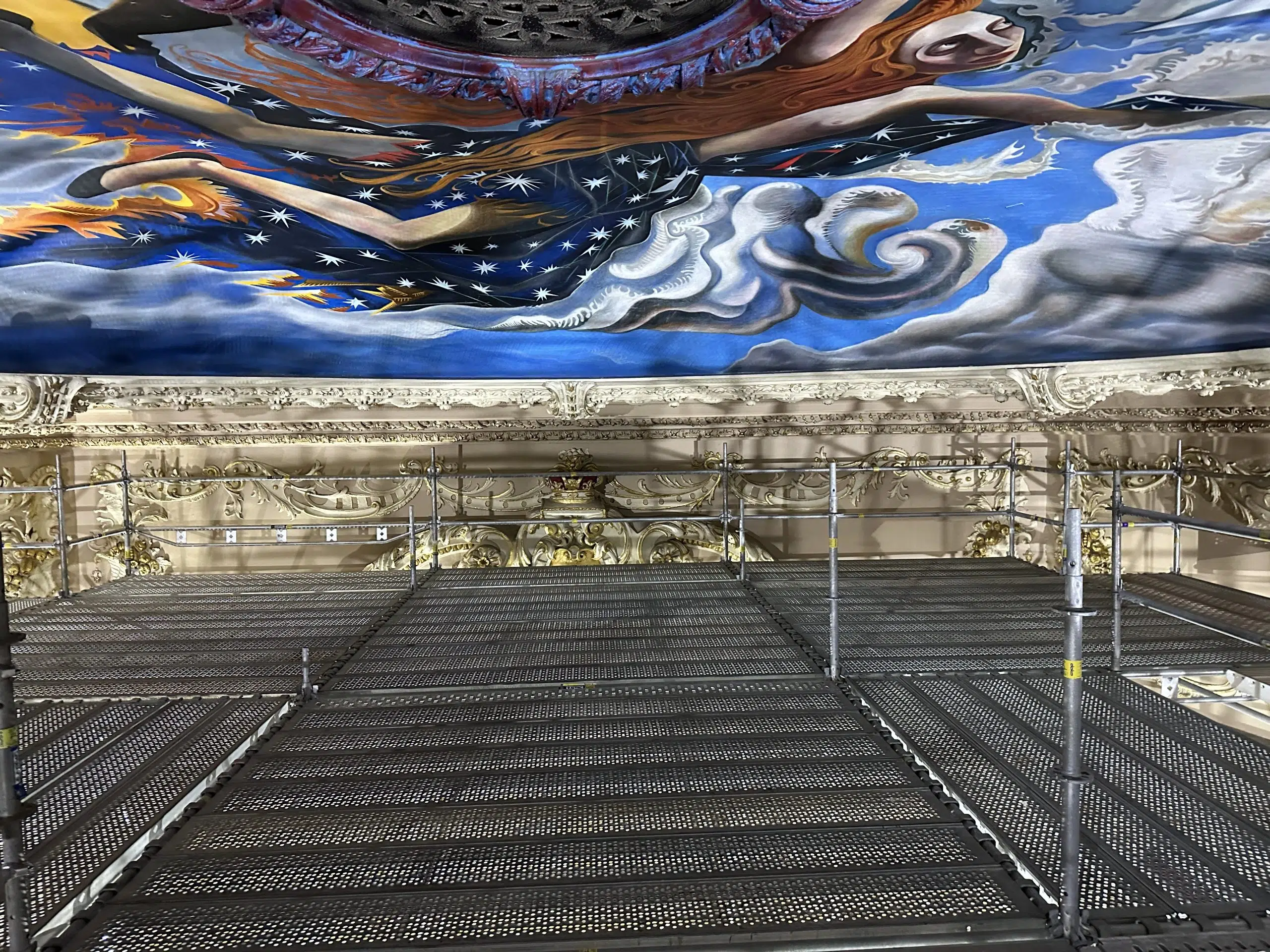
Known locally as the “People’s Theatre”, it is recognised as Scotland’s oldest continuously operating theatre. In 2013, artist John Byrne added a distinctive ceiling mural inside the main dome, which has since become one of the building’s best-known features.
Building a scaffold inside a scaffold
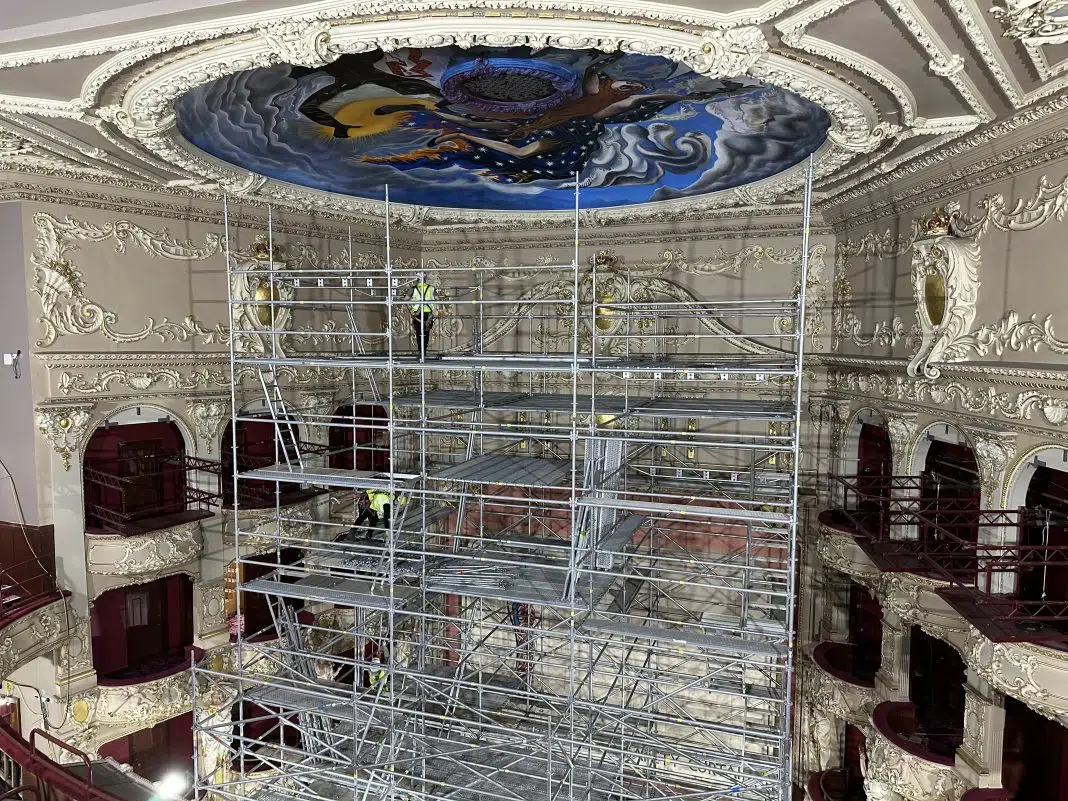
A central element of the internal works is a full-height birdcage scaffold constructed inside the auditorium. AT-PAC’s Ringlock modular design proved critical here. The system’s standardised components allowed Peoples Safety to create a precisely aligned structure that could follow the auditorium’s irregular curves and varying geometries with far greater accuracy than conventional tube and fitting.
The birdcage provides controlled access to Byrne’s painted dome while protecting the fragile Edwardian plasterwork below. Just as importantly, AT-PAC’s engineered connections enabled rapid assembly, allowing the team to build the structure efficiently and with reduced programme impact.
One of the most demanding parts of the project is raising the fly tower by 4.5 metres. Peoples Safety originally constructed a 19-metre internal scaffold to support the removal of old rigging and steelwork. As the engineering plan evolved, this was extended to 24 metres to accommodate the new roof structure.
This mid-project redesign demonstrated one of AT-PAC’s key advantages: the ability to modify, extend or reconfigure existing structures without dismantling large sections of scaffold. The modular system meant the team could respond to design changes quickly, maintaining safety and continuity while avoiding cost escalation.
Making it fit where it should not
Heritage buildings rarely offer straightforward scaffold access, and the King’s Theatre is no exception. AT-PAC’s versatility enabled Peoples Safety to engineer bespoke solutions in the tightest corners of the building.
External scaffolds wrap the theatre along Tarvit Street and around the front and rear façades. The 22-metre-high structure incorporates a fully boarded rubble chute and was adapted to allow site cabins to remain in place, an example of how the modular system can be shaped to suit site logistics.
Internally, AT-PAC came into its own in the narrow Edwardian passageways. The compact components allowed the Peoples Safety team to erect lifting frames capable of guiding new steel stair sections through tight spaces with millimetre-level control.
The system’s uniform geometry also ensured each configuration delivered the required stability, even in confined areas where tube and fitting would have been slower and more complex.

Overhead protection at scale
A 16-metre-high crash deck system, built using AT-PAC Ringlock components, has provided robust overhead protection throughout the auditorium works. The deck incorporates hard barriers and Monoflex sheeting and is designed to support multiple working levels.
AT-PAC’s Ringlock load-bearing capacity meant the crash deck could handle the weight of trades working above, below and across its platforms without compromising heritage elements.
“A permanent scaffold presence was maintained on site,” says John Peoples, MD of Peoples Safety Ltd. “Given the building’s age, layout and the various challenges encountered, we worked closely with fellow subcontractors to address issues and meet their operational requirements.”
The company has developed strong working relationships with bricklaying, steelwork and specialist conservation teams, with scaffold alterations carried out efficiently as new requirements emerged.
Peoples Safety has now completed around 90 per cent of the main scaffold package. The remaining work involves supporting final stone repairs and ongoing internal tasks as other contractors progress towards the planned Summer 2026 reopening.
Why modular matters on heritage projects
The King’s Theatre project shows why AT-PAC’s Ringlock modular system is well-suited to heritage restoration. The system offers:
• Flexibility to respond to unforeseen discoveries during strip-out
• Fast modifications without extensive dismantling
• Precision-engineered components that adapt to irregular geometry
• High load capacity for multi-level internal work
• Faster, cleaner assembly that reduces disruption inside historic spaces
• Predictable, repeatable connections that simplify inspection and maintenance
In historic structures where each phase reveals new challenges, modular scaffolding can save weeks of programme time and considerable labour costs. AT-PAC’s performance at the King’s Theatre demonstrates how the right engineered system supports both heritage protection and construction efficiency.
For Peoples Safety, the project stands as a showcase of their ability to deliver large-scale, technically challenging access solutions. For AT-PAC, it is a high-profile example of a system designed for modern construction but proving its worth in the most traditional of environments.