Scaffolder hits back over ‘woke builders’ story

0

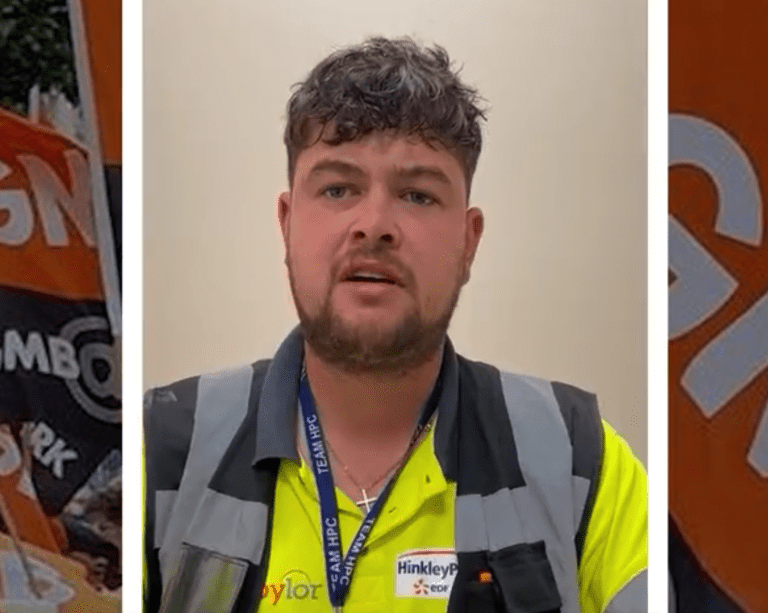
Hinkley Point C scaffolder Jamie Busby has launched a hard-hitting attack at the Daily Mail after the newspaper ran a story branding today’s construction workers as ‘woke’.

The article posted by the Daily Mail online carried the headline ‘UK builders go WOKE’ in a story about them discussing their feelings with colleagues.
The workers are described by the paper as being ‘sensitive souls’ who shun unhealthy foods and take an active interest in yoga and meditation. Scaffolder Jamie Busby was so shocked and annoyed at reading the article that he filmed himself firing back at the newspaper, telling them to ‘give your heads a wobble’. In a video, which was shot by the GMB Union, he explained that talking to colleagues on-site could save lives, and it was not a laughing matter. Speaking on camera Jamie Busby said: “I’m a GMB Union Rep currently in construction at HPC (Hinkley Point C), Europe’s largest construction site and I’ve got a message for the Mail newspaper about your story calling us all ‘woke’. “We work long hours in a manual job for long stretches away from our family and friends. “We have the highest suicide rate among male occupations. It’s not easy being away from your home and family but I guess you wouldn’t understand that. “So if you think it’s a laugh to take the mick out of us about yoga and meditation and other things, like our feelings, speaking to each other about our mental health, you need to give your head a wobble and get in the real world. “Mental health is massive and people need to speak to each other. Talking to each other saves lives. “Forget your divisive culture wars and your ‘woke’ narratives and we’ll carry on looking after each other here and our mental health at HPC and we’ll carry on reading a proper newspaper as well. “And we absolutely love a breakfast, so get your facts right!”

HAKI owners acquire French height safety company

0
Midway Holdings – owners of system scaffolding manufacturer HAKI have signed an agreement to acquire all of the shares in the French company Novakorp Systems SARL, with effect from 1 July 2022. Novakorp Systems develops, sells, and markets safety products for work at height in France which is the largest market, where Paris dominates, and the main focus is new construction. Novakorp Systems perfectly complements the Safe Access Solutions business area with solutions for safe work at height. HAKI says that in addition to the geographical expansion, the acquisition also provides opportunities for synergies with Safe Access Solutions’ supply chain. Novakorp Systems was founded in 2010 and today has 11 employees. The company’s headquarters are in Bordeaux with warehousing and logistics operations in Lyon. Novakorp Systems’ operations are similar to Vertemax, which HAKI acquired in 2021. Thomas Schuller CEO of HAKI said: “Novakorp Systems has a strong product portfolio for safe work at height and is thus an excellent complement to our existing operations within Safe Access Solutions. We see good synergies, mainly through opportunities for a joint supply chain with Vertemax and HAKI. It is with great pleasure that we welcome Novakorp’s employees to the HAKI family.” Novakorp’s founder and CEO Georges Simioni added: We look forward to being a part of Midway and are confident that this will enable us to create even more value for our customers. With our joint product portfolio, we create a good platform for continued growth.

G&M Group launches next generation Safe Deck Hybrid system

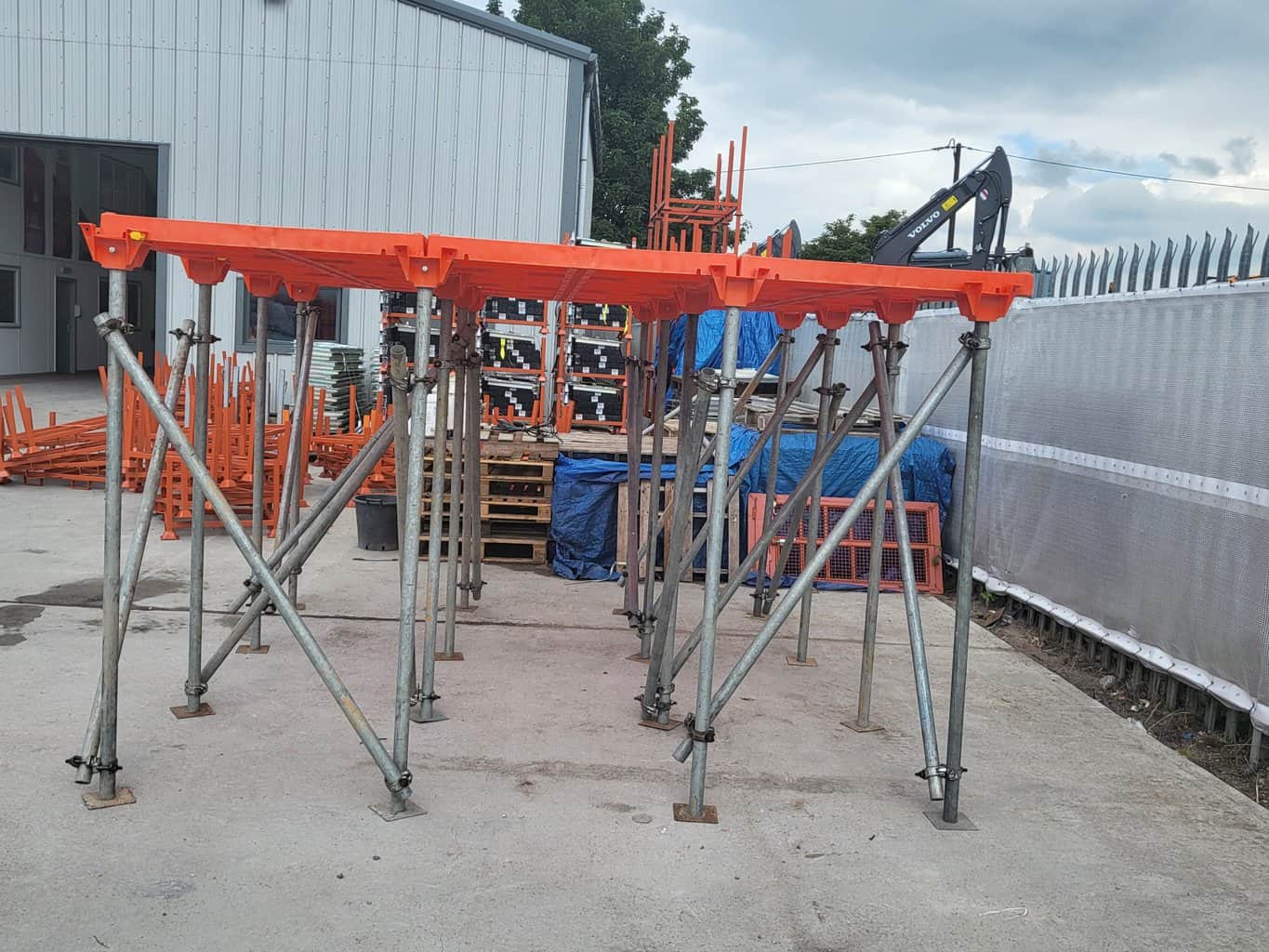
The G&M Group has launched its G&M Safe Deck Hybrid system that’s designed to dovetail with traditional scaffolding. The all-new working G&M platform hybrid connector has been designed to allow the standard system to be used with industry-standard 48.3mm steel tube and fitting scaffolding or key clamp fittings with G&M’s Safe Deck panels fitting on top as the working platform. The fast, safe and innovative G&M Safe Deck Hybrid system is one of the first systems of its kind to be brought to the UK construction sector that offers maximum versatility, ease of use and productivity on-site. The G&M Safe Deck Hybrid system is fully compatible with scaffold jacks or base plates. This enables a wide variety of bay configurations to suit project sizes and, like G&M Safe Deck itself, it is also another freestanding system solution allowing the mix of steel or plastic legs to be utilised, for maximum ease of use. Fully compatible with existing base/head units and tested to load Class 4 to BS EN 12811-1, the G&M Safe Deck Hybrid system is available for nationwide hire or purchase from the UK-wide G&M Group depots. G&M Group Managing Director, Mark Pickles said: “The G&M Safe Deck Hybrid system is the next generation of our market-leading, highly cost-effective working platform system that’s taken the UK construction scene by storm.  It offers quick and simple superior protection of site personnel whilst working at height and the ability to be able to dovetail with existing scaffold temporary works, safely and compliantly. “Along with G&M Safe Deck freestanding and our Modular Access Platform (MAP) system, this new hybrid system is the third major product launch since the pandemic and showcases the prolific safety innovation we offer our housebuilding, timber frame, scaffolding and other construction clients right across the country.  It’s cost effective, quick and easy to use we are excited to launch it to our nationwide clients.”  The all-new G&M Safe Deck Hybrid system is available for hire and sale nationwide now.

WellMax Scaffolding reach for the sky to help restore millennium glory

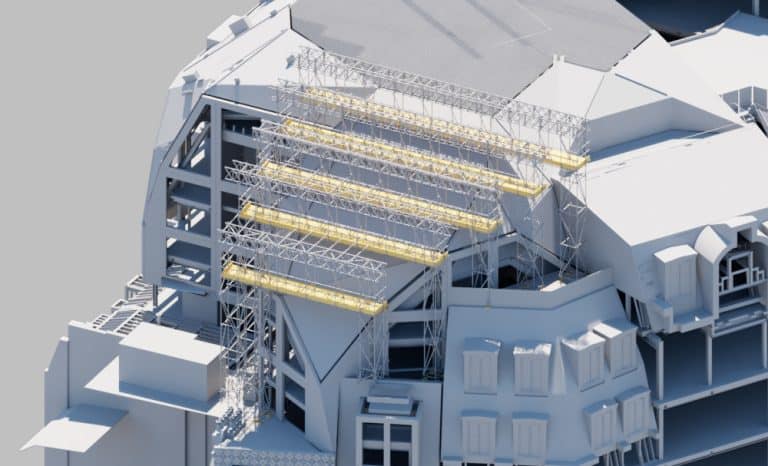
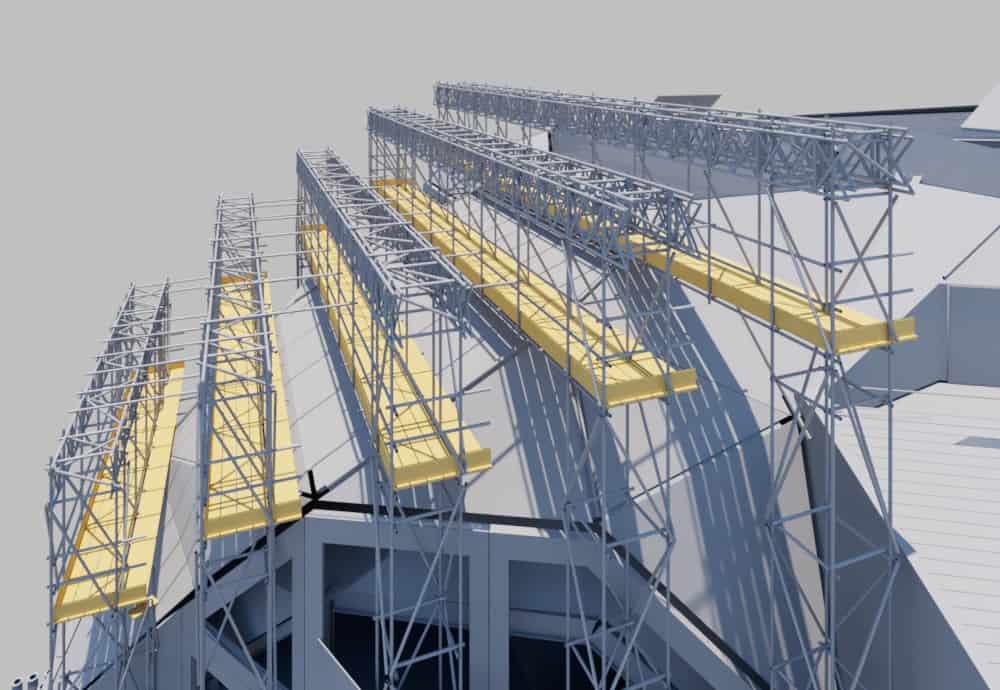
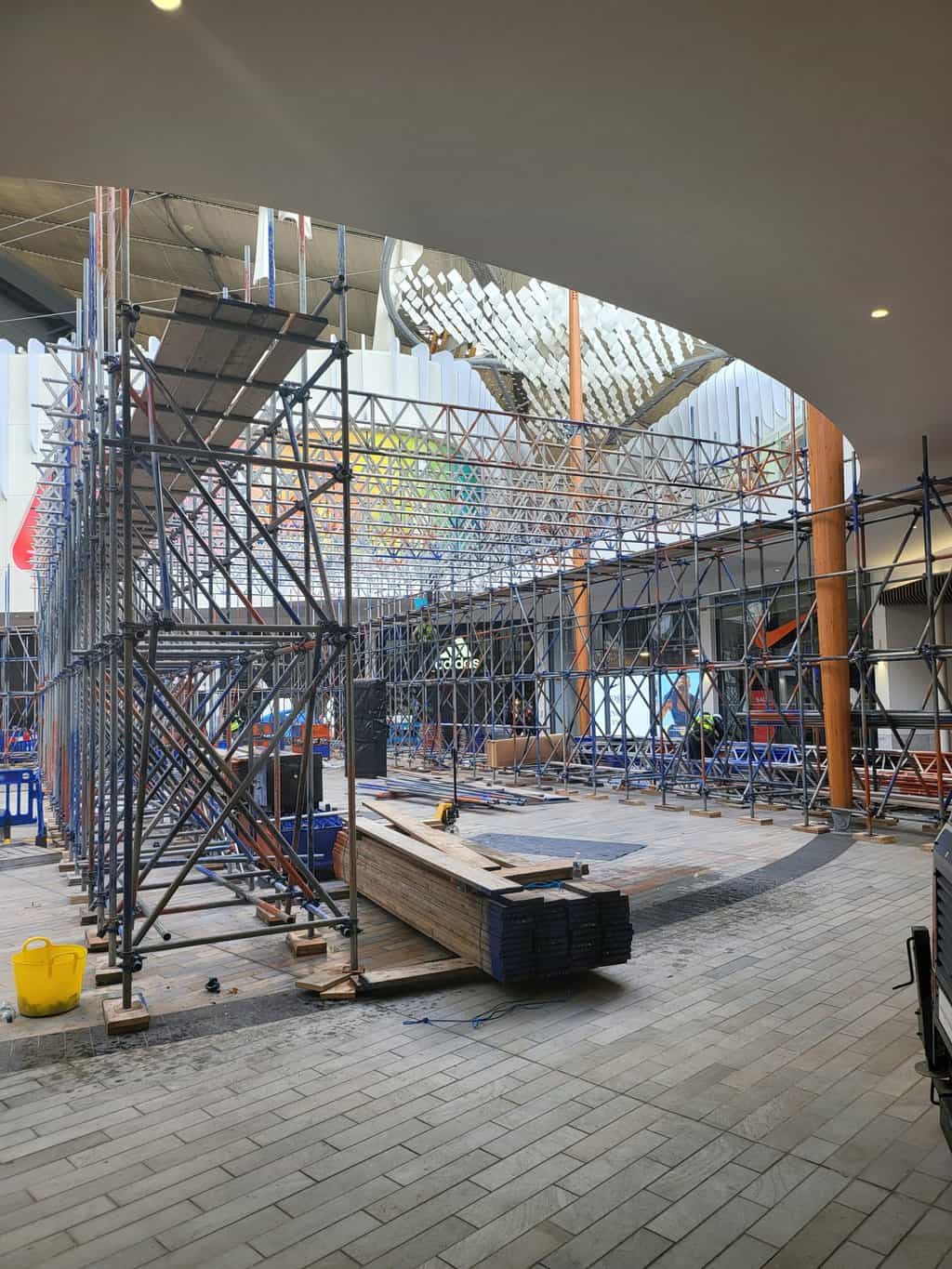
WellMax Scaffolding reaches for the sky to help restore millennium glory. Grahame Anderson discovers that although working to very tight deadlines and various challenges, this iconic London structure was able to open its doors again after falling victim to Storm Eunice. The venue has the second-highest capacity of any indoor arena in the UK and was initially constructed to house an exhibition celebrating the turn of the new millennium. But even this brilliantly designed superstructure can suffer in the face of mother nature and the worst weather she can unleash. In fact, Storm Eunice that hit the UK in February well and truly left her mark on the building’s roof ripping away some of the famous white material, leaving it seriously exposed in parts. WellMax Scaffolding reach for the sky to help restore millennium glory at O2 In terms of its repair, it needed a project team well versed in such emergencies – a group of highly skilled, specialist contractors able to handle the pressure to enable the dome to re-open safely in a short timeframe. These essential repairs would not have been possible without a protective temporary gantry to allow safe pedestrian and emergency service vehicles access to enable the arena to reopen as quickly as possible. WellMax Scaffolding was the ideal choice to provide such a solution, renowned for their experience and technical expertise in projects both of this scale and stature.  It was important to get the site back operational again following a tough two-years due to the pandemic let alone expensive damage from one of the fiercest storms the capital has ever experienced. With the entertainment industry suffering heavily, everyone involved needed to be fully focused on the task ahead. Across the weekend of 19 Feb, the area had to firstly be assessed by the fire marshals, venue management and the client. Site visits and meetings could then take place with the necessary trades to determine what was required. A WellMax spokesperson takes up the story: “Following our initial first visit and awaiting further instructions from our client, WellMax senior management set the wheels in motion preparing for our attendance on site. “In collaboration with our scaffolding design engineers, discussions took place to classify the loadings and design requirements and also to get RAMS prepared. Materials were then loaded onto our lorries at our yard as the scaffolding site team became fully operational. Everything had to be ready on-site at the O2 for a cold start on Monday morning, 21 Feb. “Basic principles, regulations and specifications were discussed with the specialist trades with a completion date of works by all trades set at noon on Friday of that week. The reality was it left just over four days to get the job done. “Prior to our works commencing, WellMax Managing Director Russell Maxwell-Smith, met with our scaffolding team on site to speak about the importance of this project. This included the tight deadline and the need for close cohesive working with the other trades and asking for their support to deliver his commitment to the client. “Everyone set to working around the clock to meet the Friday deadline. There was constant communication with the scaffolding design engineers, checking and clarifying points as the works progressed.  Whilst undertaking our own works, we worked hand in glove with the hoarding contractors to ensure maximum productivity completing sections of the gantry together.” Scaffmag has learned a planned methodical programme was utilised in order to achieve smooth progress stages throughout the project. This involved electricians and fire engineers along with the highly trained scaffolders. The scaffold structure was effectively a T-shape, with the body of the T, a 60m long, 11m wide and 6m high gantry. Where the gantry met the arena gate entrance, this formed the head of the T-shape creating a further 35m long area. The entire gantry was bridged and suspended throughout to maintain pedestrian and emergency vehicle access. WellMax Scaffolding reach for the sky to help restore millennium glory at O2 WellMax added: “We installed a 5kn/m2 protection deck with a mono-pitched temporary roof, tied back to the main structural foundations with a bespoke beamed raking system. By developing and installing this tying in system, we were able to remove the need for 100T of kentledge. “Throughout the entire challenge, everybody worked with the sole objective of delivering the project for the Friday 12pm deadline. There was no status/hierarchy amongst any of the trades, everybody got involved and every trade pulled together.” WellMax Scaffolding reach for the sky to help restore millennium glory at O2 Behind the scenes back at WellMax offices, the yard staff, drivers, management and engineers were all busy ensuring a smooth flow of support and resources needed by the team working on site. The company continued work on the emergency project as everyday business carried on. Thanks to an impressive and well-managed labour resource allocation and owned stock, WellMax were able to mobilise teams and materials quickly to site for the Monday morning start.
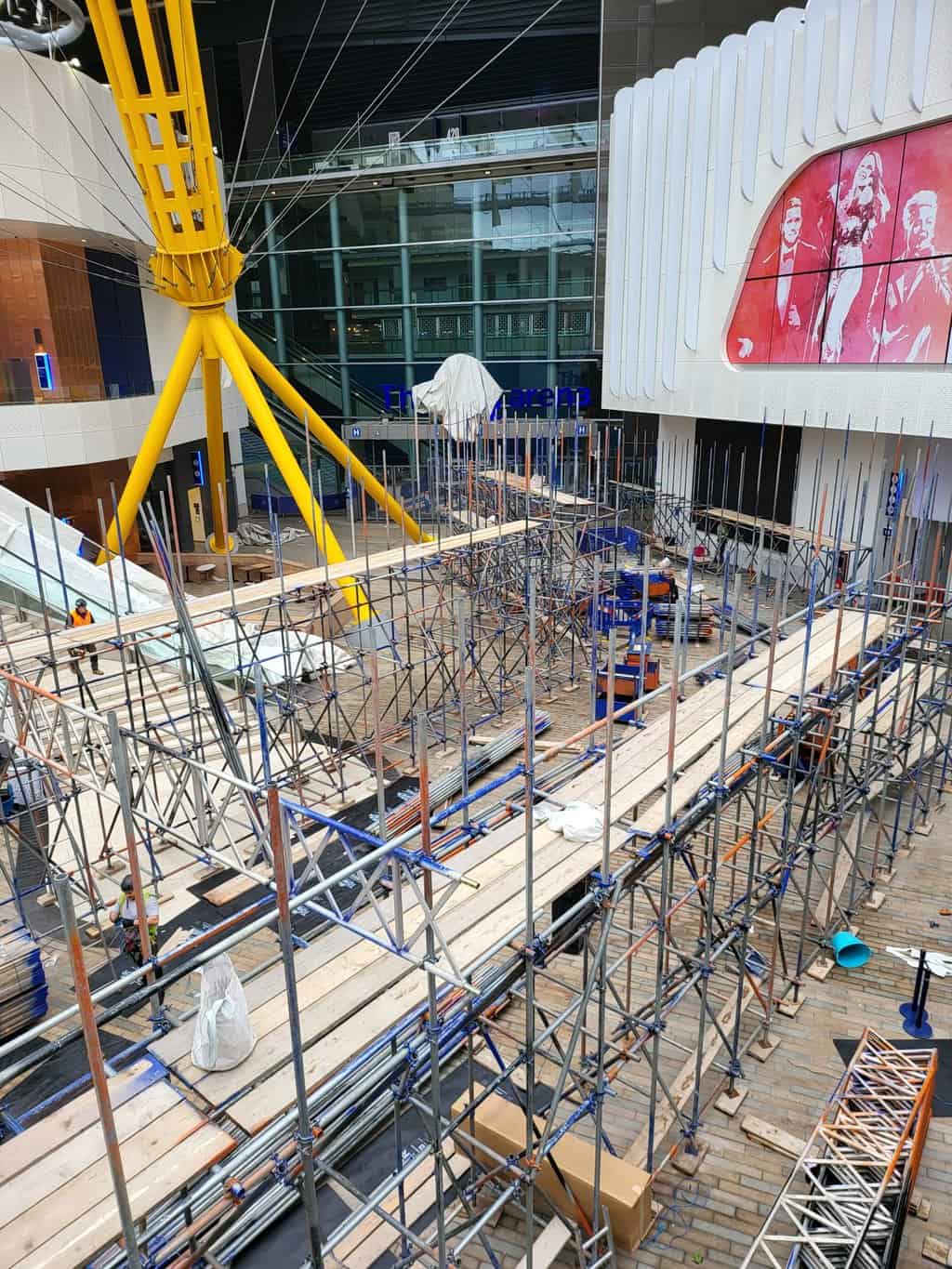
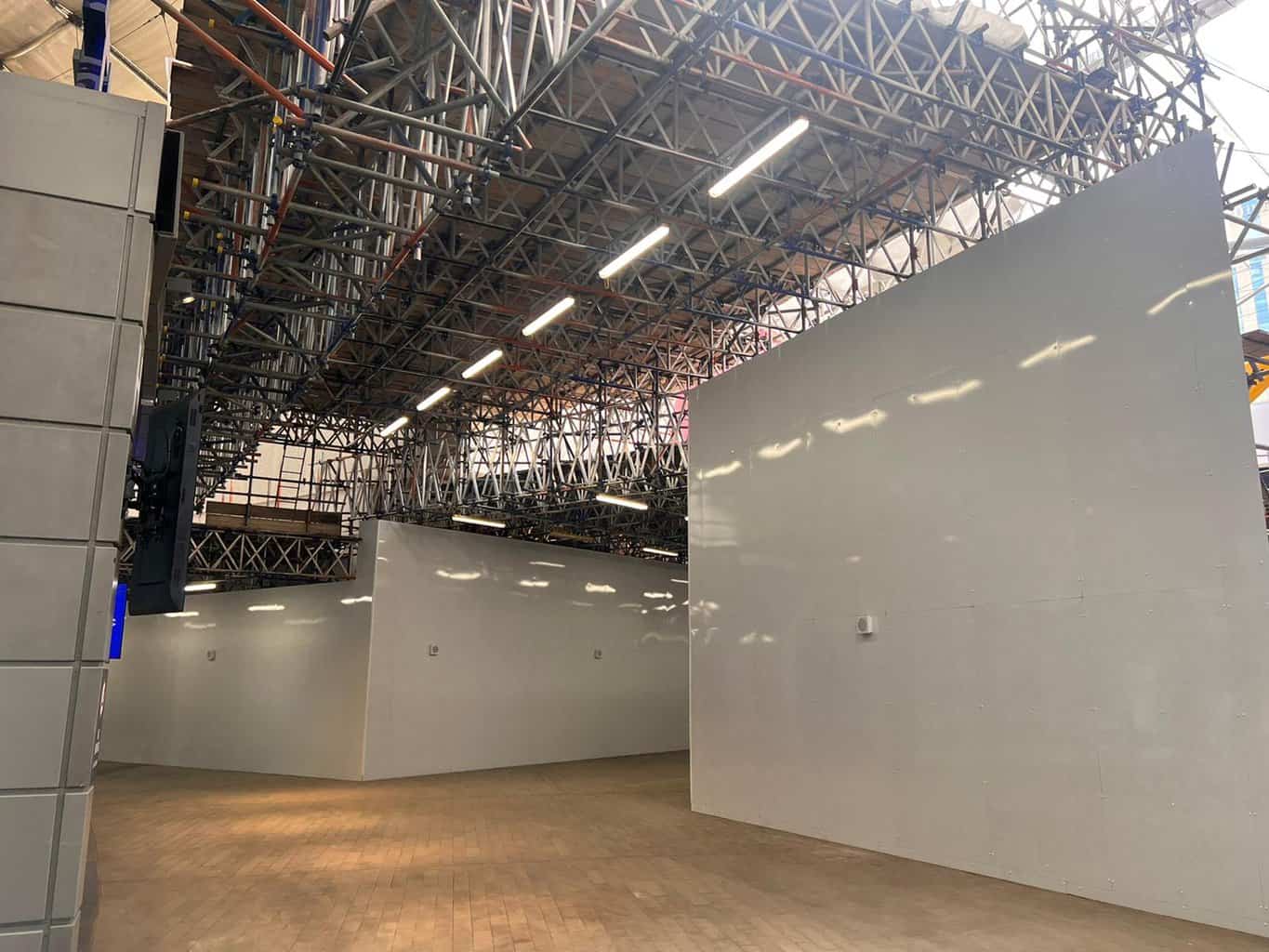
200 tonnes of scaffolding

More than 200T of scaffolding materials was installed to an engineering standard in a little over 96 hours often in the pouring rain. WellMax Scaffolding reach for the sky to help restore millennium glory at O2 The timescale of Friday was critical as the venue was due to host a UB40 concert that evening – no pressure then!! Incredibly, the 12pm deadline was met by all the trades to enable a full multi-disciplined inspection and sign off to be achieved. What’s more no remedial works were required. In terms of the UK scaffolding industry, once again proof positive emerged, we have some of the best scaffolders and construction workers on the planet. Russell Maxwell-Smith told us: “I would like to thank everyone involved on this project including, but not limited to the client’s team, Deconstruct (UK), other subcontractors, our supply chain and lastly, most importantly for me, the WellMax team both on and off site for their cohesive teamwork and approach to this timely critical project.” And so, Former UB40 member Ali Campbell was able to “tear the roof off” again in the nicest possible sense when he reopened the venue in a show honouring his late bandmate Astro. Raise a glass to WellMax – Red Red Wine anyone? This article was first published in the ScaffMag Magazine Issue 16
There’s always one more thing to learn…no matter how senior you are

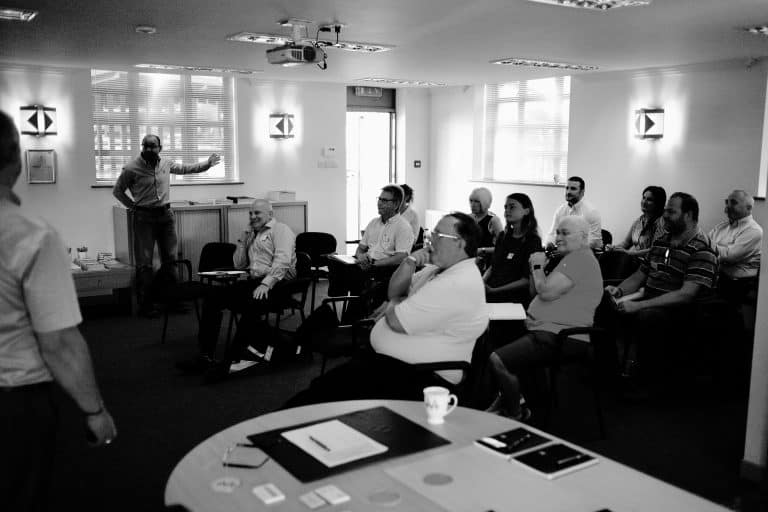
Billy Jones, Managing Director of Millcroft Services, discusses the importance of lifelong learning at all levels within a scaffolding business Successful people are often asked about the secret to their success and there are many different answers, depending on the nature of their role and how they measure achievement. But there is one thing they all have in common: an ability to learn and keep on learning. As the late Steve Jobs, founder of Apple, said: “Learn continually – there’s always ‘one more thing’ to learn.” At Millcroft, that’s a philosophy that we have put at the heart of our business. Training and personnel development are so central to how we operate that we have our own CITB Safety Plus accredited training centre at our head quarters in Greenwich and certified trainers on our team. But skill development is not just a priority for the site team and those seeking to further their career through training; it is also a priority for our leadership team who embrace the concept of continuous learning and understand the value of constantly adding to their skills and experience. Our leadership team has decades of experience gained in both hands-on site activity and managerial responsibilities. As directors who have grown up within a family business, myself and my brother Sam Jones have been learning about construction and scaffolding since we were practising our times tables. But we both subscribe to the theory that there is always something new to learn and new ways of applying skills and knowledge to overcome challenges and enhance our service delivery. Moreover, we work in a sector where there is constant change across all kinds of operational areas, from health & safety and compliance, to construction methodologies and client requirements. Both myself and Sam have recently successfully completed NVQ level 6 qualifications in construction management as have our Operations Director Mark Stimpson and Health & Safety Advisor Richard Ramkissoon. The qualification is equivalent to a degree and the course content complements the knowledge and experience our directors have already acquired during their careers, covering disciplines as diverse as programme planning, health & safety, quality control and relationship management. Meanwhile, our Group Head of HSEQ Mike Wright has completed an NVQ Level 6 in occupational safety and health, building on his knowledge, experience and qualifications in this important aspect of our business. At Millcroft we lead training in-house both for our own team and for the clients that come to us so it’s critical that we have current and wide-ranging knowledge. It’s also important that everyone who trains with us has complete confidence that they’re learning from people with certified expertise and authority. Training and skill development at a senior level within Millcroft delivers value for the business and our clients in multiple ways. As a dynamic and ambitious business, learning is part of our commitment to delivering best practice and offering a smooth and efficient service for our clients. It is integral to quality-oriented operational management and our culture of continuous improvement. Learning is the process of questioning everything, so, when our directors invest time in training, it develops their ability to problem-solve and innovate in an ingrained discipline that influences the way they lead the business. The senior team’s commitment to learning also influences the rest of our team. For many businesses, there is an emphasis on staff training, but the mandate is not carried through to management level. This can be especially true of family businesses where the leadership team has been born and bred in the scaffolding sector and does not perceive a need for training at director level. At Millcroft, we have seen the value of training for the senior team not only in building the skills and knowledge of directors and heads of departments, but also in inspiring the whole team about the benefits and value it brings. When we developed our mental health awareness training and rolled this out to the whole team, we ensured that the initiative involved everyone at all levels. Our Group Head of HSEQ Mike Wright developed and delivered the training in a workshop style so that he was personally involved in exploring the topic with each cohort of staff, and all the directors also completed the course, establishing the importance of both training and mental health within the business. Finally, it is our clients who benefit most from the training that our directors and senior managers complete. For them, this investment means that we offer a service that provides a best practice approach across all areas of project planning and delivery, operational management, financial management and collaboration. The skills our senior team develop when they pursue advanced learning permeate through the company, along with a culture of always being the best that we can be. Fundamentally, therefore, at the successful completion of every job, we are firmly focused on what we have learned and how those lessons can be applied to do even better on our next project. This article was first published in the ScaffMag Magazine Issue 16
Altrad Awarded Long-term Offshore Maintenance Contract for TotalEnergies

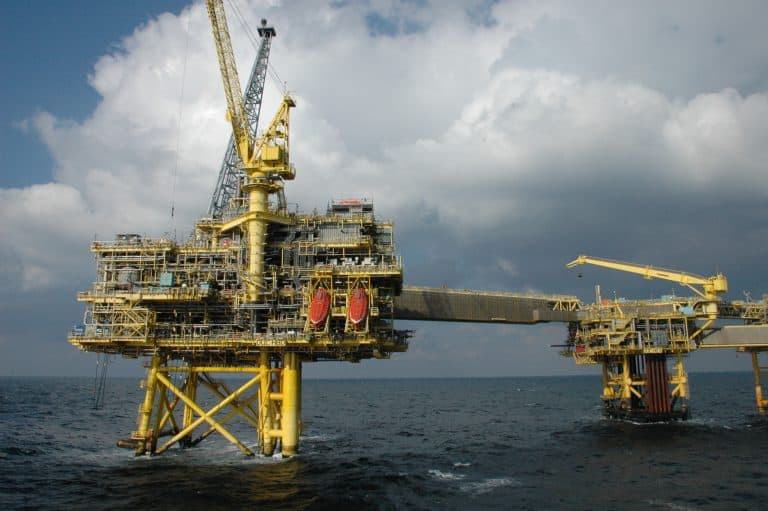
Altrad has secured a multi-million pound, five-year (with an option of two additional, two-year extensions) contract to support the fabric maintenance of TotalEnergies’ offshore assets in the North Sea, Denmark. The contract, which will become operational on 1st October 2022 adds to Altrad’s success earlier this month, when it also secured the Integrity Recovery Project (IRP) for TotalEnergies in Denmark. Altrad’s Director of Business Development & Strategy – Peter Hughes said, “We are delighted to have secured both these contracts with TotalEnergies, which builds upon our successful strategic relationship that spans back over several decades. We look forward to working collaboratively with TotalEnergies, whilst using our industry leading skills and capabilities to enhance the performance of these contracts, to be the best they can be”. The award of these contracts will increase Altrad’s offshore team numbers in Denmark and their new talented people will be valued and encouraged to develop fulfilling careers. Jens Moerk – CEO of Altrad Services A/S added, “We are extremely pleased to have been awarded these contracts by TotalEnergies, which will be delivered in a value enhancing manner – using a combination of our local resources and facilities – and the skills and experience of the wider Altrad organisation.”

G-Deck launch new DUAL bracket

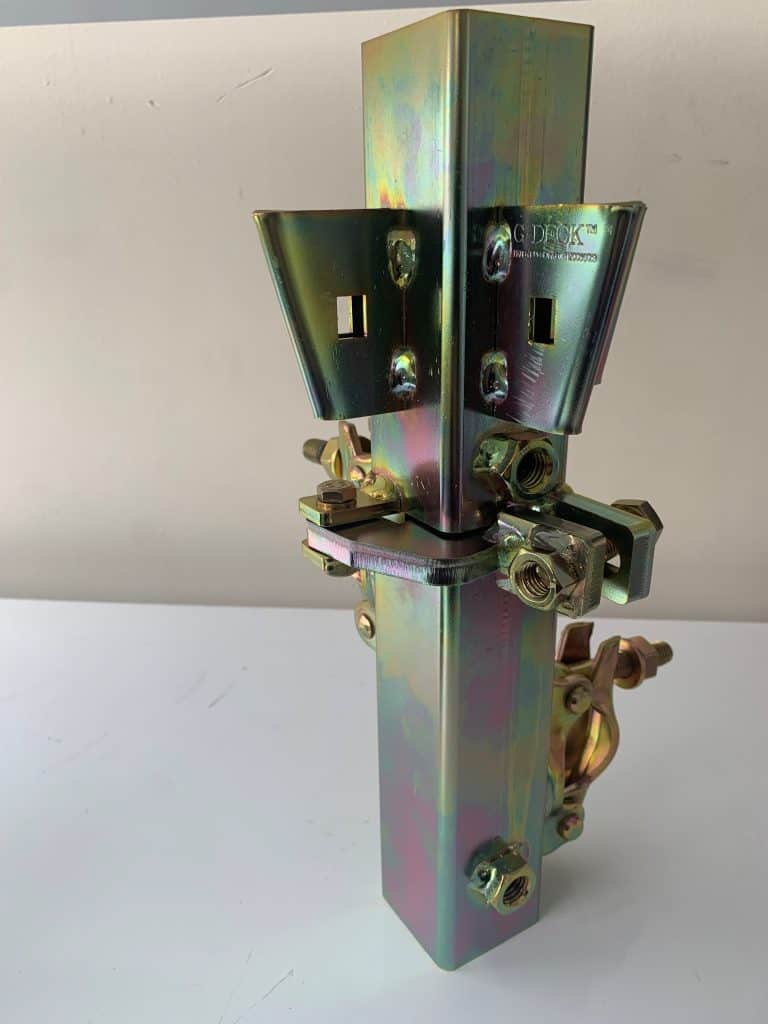
G-Deck has released a new DUAL bracket for its scaffold hybrid DUAL safety platform system. The new bracket allows it to be fixed to a standard scaffold tube either using the external fittings provided or straight through the bracket. This means users no longer need legs to create platforms as it can be fixed to scaffold tubes, perfect for voids and tricky areas. G-Deck says its always developing the system for the better. Its STANDARD system has already seen a deck weight reduction development this year which has seen 3.4kg wiped off the overall weight. Now sees the next innovation for the company this year for its  DUAL system. This new patent-pending bracket changes everything for scaffolders, says G-Deck. “We have called it ‘DUAL ANYWHERE’. The new features now enable our DUAL brackets to be fixed to, or a tube fed through to create a platform WITHOUT having to use a leg. “You can install the bracket using the external fittings provided, but now and possibly most exciting is you can place a scaffold tube all the way through and fix it at any point needed along. This is achieved with our V press tooth feature that grips and stops the bracket from moving once tightened.” “Perfect for stairwells, perfect for voids, perfect for areas where you can’t get legs in, it truly does allow the DUAL platform to be erected anywhere. We’re really excited to release this and continue the huge success DUAL has been.” For further details on the DUAL Anywhere email: [email protected] or visit www.gdecking.com 0116 2510352

AIS Survivex and British Forces Resettlement Service forge partnership

Leading training provider, AIS Survivex, has sealed a deal with the British Forces Resettlement Service (BFRS) to support those looking to work in the global energy sector after leaving military life.  

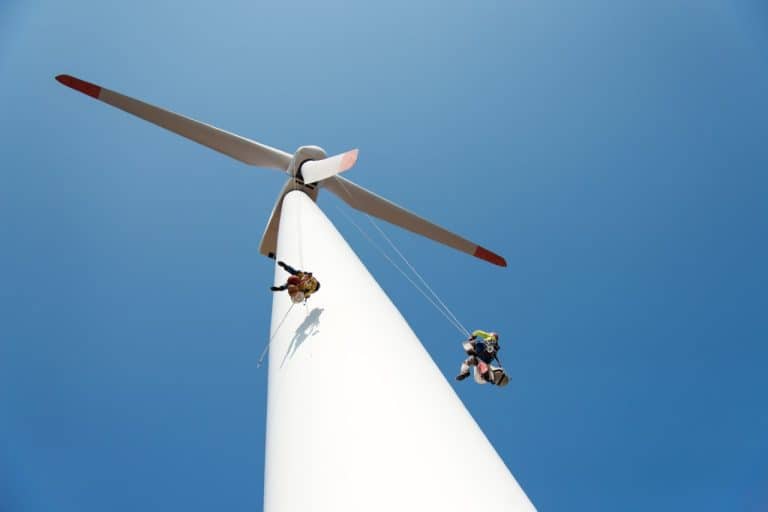
The deal will see AIS Survivex become BFRS Gold Plus Sponsors and work closely with BFRS to help former military personnel retrain for new careers in the energy industry, particularly wind and renewables. 

As well as attending a series of military careers events across the UK to promote energy sector careers and provide advice and guidance to BFRS members, AIS Survivex is developing tailored training packages to give ex-forces the right skills to get their first energy opportunity. 

BFRS works with companies across the UK looking to hire, retrain and offer career advice to the armed forces community leaving service.  

Neil Dean, operations director at BFRS, said: “This is an extremely important partnership for us and together with AIS Survivex, we want to lead the market in transitioning ex-military into new and meaningful energy sector careers through the launch of Military2Energy, which is specifically designed to filter people from the military to careers in energy. 

“The energy sector has always been a popular career choice for ex-armed forces and even more so in the current market, which offers lots of opportunities. The UK wind industry alone needs more than 43,000 new workers by 2026 according to the Offshore Wind Industry Council.

“AIS Survivex is helping us to raise awareness of these opportunities at a series of military careers events. The next event will take place in Leicester on 16th June and after that Tidworth on 15th September so I’d urge people to come along to find out more.”

Linzi Ryan, Head of Marketing at AIS Survivex, said: “We are delighted to sign this agreement with BFRS and become the partner of choice for military personnel looking to successfully transition their skills into the global energy sector. 

“We have extensive experience of training people for energy and work closely with key employers to develop career opportunities for those going through the resettlement process. As well as ensuring former military personnel have a smooth transition into civilian life, this also opens up the possibility of securing a full-time job within the exciting and dynamic energy sector. We are an ELCAS-approved supplier so ex-forces personnel can also access funding to help pay for training.”

There are lots of synergies between military life and working in the global energy sector and AIS Survivex has a proven track record of helping former military personnel transition into new careers. One example is former Royal Marine, Jonathan Askew.

Cramlington-born, Jonathan was a mortarman working with rifles and mortars but, after developing tinnitus, was medically discharged.  After training with AIS Survivex, Jonathan secured a full-time job as a wind technician.

Jonathan said: “Coming out of the Royal Marines with no technical experience felt very much like starting from scratch and it was a huge transition to where I am now. I’ve now got extremely marketable skills and feel completely prepared for my wind career.”

AIS Survivex has set up a dedicated hotline to provide specialist help and advice for military personnel thinking about an energy sector career. Email [email protected] or call +44 (0) 191 3410 395.

CISRS CPD Phase 2 Pilot takes place 

0
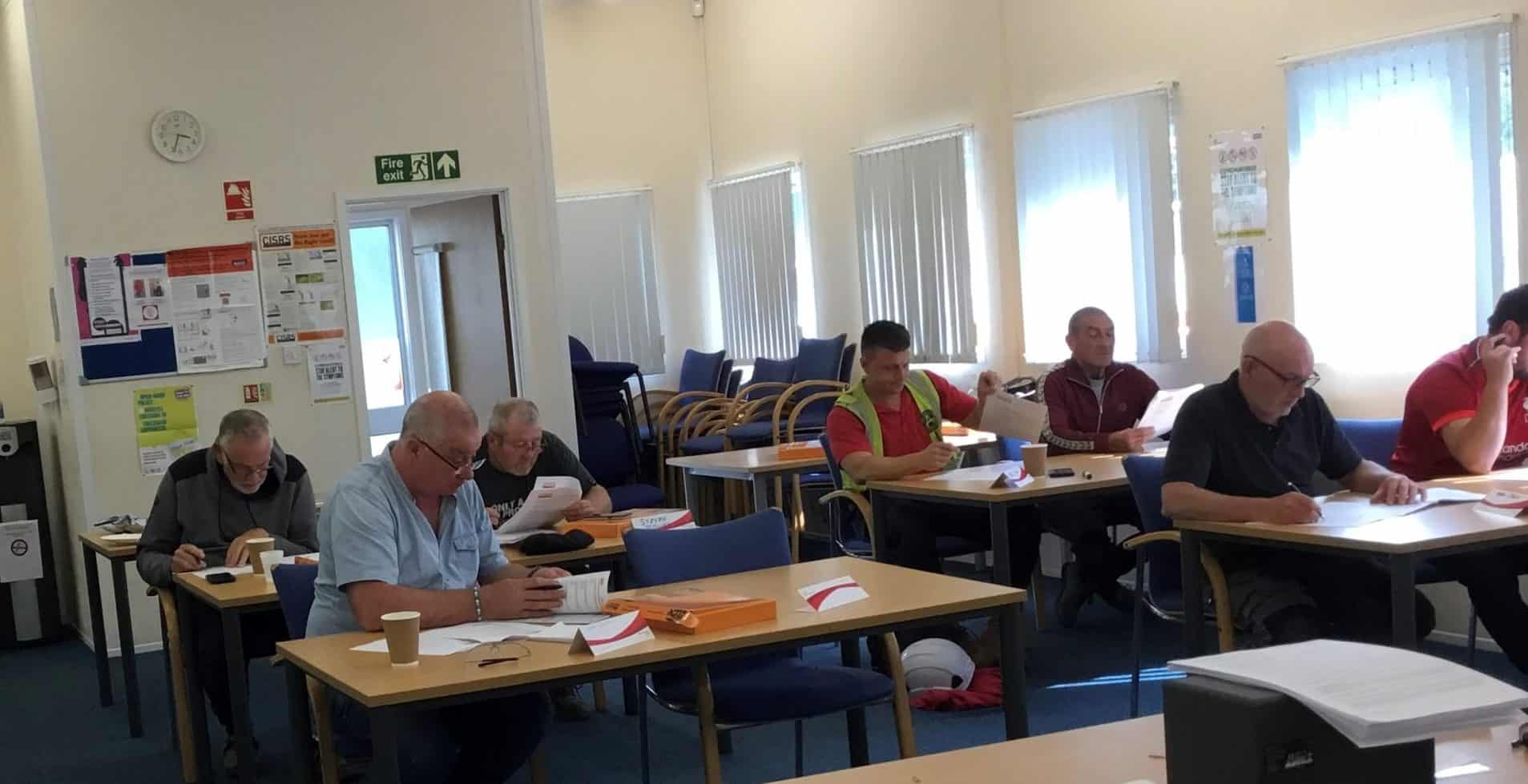
CISRS carried out a trial run of the revised content for the new CPD course content at Construction College Midlands, Kings Norton, Birmingham last week. The subsidised course was delivered by CISRS Compliance Manager Tony Barry. It was a return to familiar territory for Tony who had worked at the college (previously NCC Midlands) as a CISRS Lead Instructor for over 20 years prior to taking up his role with CISRS. CISRS scaffolder CPD was originally launched in July 2017, with the first 5- year cycle of CPD and card renewals due to come to completion at the end of next month. After initial resistance to the launch of the programme CISRS CPD has widely become accepted within the sector with over 20,000 operatives having attended the programme in this period. Ben Ekins, Contracts Director and Advanced Scaffolder with NASC member Midland Scaffold Services, who attended the course said: “Some companies work hard to keep their workforce up to date with changes going on in the industry. Sadly, this is not the case for everyone and lots of scaffolders move employers pretty regularly so it makes sense that everyone comes back into the centre once every 5 years for a refresher.   “Whoever you work for or however much you think you know it’s worthwhile making sure you kept up to date with changes in the industry.”  A survey went out to industry regarding the CPD programme looking for suggested changes to the content, delivery etc. The consultation document remained open for a 3-month period, within that time only around 400 responses were received. The survey responses were taken into consideration along with the views of Access & Scaffolding Industry Training Organisation (ASITO) and it was concluded that the CPD format would remain, a 2-day programme which includes the additional Mobile Access Tower (MATS) and Inspection endorsement plus the Health Safety and Behavioural test for Phase 2. Additional content on Health, including HAVS and Noise, Temporary works and increased inspection content will also be bolstered by the imminent launch of revised editions of SG4, SG6 and TG1. Dave Mosley, CISRS Managing Director, was also in attendance at the course last week, assessing the delivery of the proposed programme and also renewing his CISRS card. He said: “The course went well but still requires a few minor tweaks which Tony is already addressing. Once these have been completed, he will deliver a webinar for CISRS-approved providers in order to bring them up to speed with the changes prior to the launch of phase 2.”  The new course will go live from Monday 1st August 2022.

Mythbusting: a case against internal design teams

0
Andrew Kitley, scaffold design specialist and Managing Director of structural engineering consultancy KITALL, argues internal design teams are not the be-all and end-all.
Andrew Kitley
I’ve noticed something recently: the structural engineering industry is rife with company directors touting their internal scaffold design teams. In this era of FOMO where we all feel our shortfalls keenly, it’s enough to make the average small-to-medium-sized player feel inadequate. But I call BS. Most companies don’t have an internal design ‘team’, but one engineer. Claiming to have a team made up of just one is faking it ‘til you make it… to the extreme. It’s time to own up to the fact that you don’t do everything – and there’s really nothing wrong with that. To be effective, especially in a complex industry, a team needs a depth of experience and competence. This simply can’t be attained from just one or two team members. When I talk to people in the industry and ask them what advantages they think relate to an internal design team, they usually tell me that most tenders for larger projects require concepts and internal designs, and doing this internally gives them the illusion of no cost. Secondly, they say that if they need to reduce their bid, they can throw the design in for free. Thirdly, they can tell their clients that they have an internal team, as clients like this. Lastly – and this is not something anyone would admit to, but I’ve definitely experienced it myself first-hand – they can bully an internal engineer into doing something they probably shouldn’t.  

Busting the myths

I’ve come across so many misconceptions around internal design teams in my 15 years in the industry. Let’s take a look at a few of them. Internal teams are cheaper, as you’re only paying their wages. This seems true if you compare hourly rates, but hourly rates alone don’t tell the full story. Let’s say your internal team costs you £22 per person per hour and your external contractor costs £65 per hour. You’ll probably find that your internal team will take four hours to complete the job, while the external team takes two hours – so that’s £88 versus £130. Then you have to factor in the company overheads, which might bring the costs to almost equal. Internal teams are good at innovating because they’re supported by a team of experienced scaffolders. Innovation is so important, but this argument fails to take into account the expertise of most external design contractors. What would be better than being supported by a team of, say, 20 or 30 great scaffold contractors across the country and the world who have the most diverse set of experiences possible? External engineers are exposed to all sorts of challenging construction projects, large and small. At KITALL, we’ve delivered some of the country’s largest construction projects. Our experience means we can look at complex problems from different angles and challenge the status quo. We come up with innovative cost-saving solutions that others don’t, because we’ve already seen five different solutions across similar projects and can devise the best solution by merging those into one. Internal teams are well trained. This may be the case with some companies, but certainly not many. Most large scaffold design consultancies like KITALL hire engineers with vast experience in temporary works and even permanent works. This means their people have a deeper knowledge of engineering as a whole. This also means that consultancies can solve any complex problems you and your clients might face – something that 70% of scaffold designers can’t. For example, those on my team have the ability to check the foundations and advise on impacts to the existing structure – I’ll share more on this in a future article. At KITALL, we spent £92,000 on developing software and software systems last year, plus £23,000 on training courses, and we allowed significant time for our staff to undertake professional development. This year will see us hire 12 external specialists to teach skills that will develop the team and business for the future. I interview engineers all the time and I know this is not happening in most internal teams. But I want to add a caveat here to say that this does not apply to all companies – large corporate companies don’t seem to suffer the same problems as small-to-medium-sized enterprises. Companies like Actavo, BrandSafway and Enigma definitely have a solid reputation. Times are changing and we must keep up Scaffold design is changing, and most people in the industry don’t seem to see that. In two to three years’ time we’ll see the same shockwaves travel through our industry as we did the demolition industry, and many will be left sitting here wondering what happened. It’s time for scaffold designers to step up and take ownership of their skills and expertise and challenge the stigma that so clearly exists. We sometimes forget that we’re an engineering practice. If you ask a civil engineering student what sort of work they want to do when they graduate, you won’t hear them say ‘temporary works’. As a group, temporary works specialists are looked down upon within the engineering industry. But the truth is that companies would simply not be able to deliver ambitious projects without us. In the 70+ interviews I’ve either been part of or have chaired, I’ve mentioned freestanding structures and have asked the interviewee what the first thing they would consider. Approximately 60% of respondents get the answer wrong. The ones who do respond correctly have either come from good design consultancies, or have worked in other engineering disciplines. This figure should be 100%, we have to work to change this. I often hear people say “it’s always been done like this” or “it’s only scaffolding”. Well, times are changing. The majority of our work now is in checking buildings that are having scaffolding constructed around them, and the main contractors are, these days, much less likely to suffer fools. If you’re not following the British standards or Eurocodes for drawing standards, completing full carefully considered and understandable calculations, prioritising career development through the Institution of Civil Engineers (ICE) or the Institution of Structural Engineers (IStructE), and demonstrating an understanding of the structure you’re founding on, then you won’t survive in this industry. It’s clear that we all have a lot to do to move with the times and, if I’m honest, not much time to do it in. So, let’s support each other to help elevate the industry, because change is going to happen whether we like it or not. This article was first published in the ScaffMag Magazine Issue 16