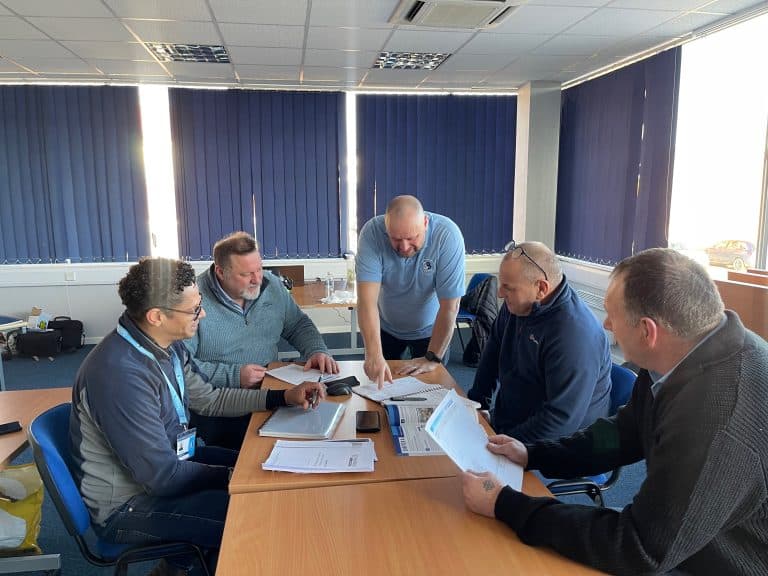
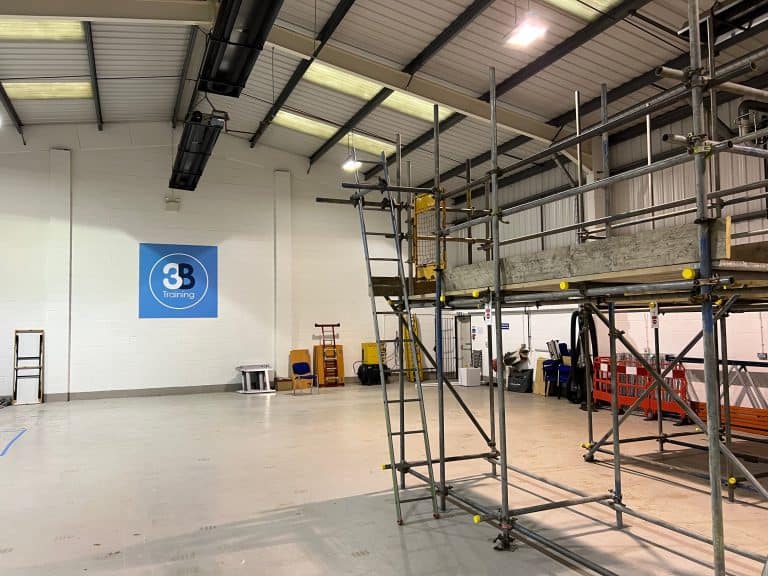
Wigan-based 3B Training, a leading multi-accredited health and safety training company, has doubled its course delivery team by adding ten new trainers and three NVQ assessors to its team. The move aims to continue the company’s growth and expand its portfolio. The new trainers bring highly valued experience in the construction sector, which will provide improved quality and consistency of delivery.The new trainers have been provided with the L3 Award in Education and Training to ensure they can deliver training to the high standards expected by the industry. The training delivery team is a crucial part of 3B Training’s growth plans, including acquiring Higher Safety Training in Blackburn and opening a new training venue in Leeds in 2022.Managing Director of 3B Training, Mat Bewley, said, “The addition of more construction experts into our training team vastly expands our knowledge base and continues our aim to be a world-class training provider of choice. We can now provide more courses directly than ever before.”Established for over 12 years, 3B Training delivers Health and Safety, First Aid, Plant, eLearning and NVQ Training to over 30,000 people annually across the UK’s housing, social housing, construction, civil engineering, and utilities sectors. The company holds several impressive industry accreditations, including CITB, IOSH, NEBOSH, UKATA, GQA, NPORS, CISRS, PASMA, IPAF, EUSR, and Highfield. 3B is a member of Build UK and holds gold NEBOSH status.
Acorn Event Structures, one of the UK’s largest providers of event structures, has appointed Heath Brown as its new Managing Director.Heath Brown, Acorn Event Structures, new Managing Director.
Heath Brown, a well-known industry figure, has announced his arrival at Leeds-based Acorn Event Structures, where he looks forward to bringing his operational experience and knowledge into use as its new Managing Director.
Acorn is one of the largest providers of indoor and outdoor temporary structures and staging, working in the event, film, television, and sporting sectors. Established in 1996, Acorn has been delivering world-class stages and other structural equipment to an array of global clients. Its impressive client portfolio includes the BBC, ITV Studio and the popular Creamfields festivals, to name but a few.
Brown’s appointment is seen by many as a positive step for Acorn, who are eager to tap into his wealth of experience and expertise. With over 35 years of experience in engineering and scaffolding throughout his career, Brown has been highly regarded for his product knowledge and innovative approach to design and delivery.
Commenting on his appointment, Brown said: “After speaking with Andy and Rebecca Nutter of Acorn Event Structures, I could not resist the fantastic opportunity they offered me. The biggest Events Company in the UK, the amount of stock, materials, and stages, plus the innovative ideas, totally blew me away, alongside Andy and Rebecca’s drive and enthusiasm for the business to keep taking it forward. I can’t wait to get started next week.”
Acorn Event Structures’ Director Rebecca Nutter welcomed Brown to the team, saying: “We are delighted that Heath Brown will be joining us as MD. Heath’s appointment will enable Acorn to strengthen the management team to enable future growth and development of the business.Heath has a vast amount of knowledge in the industry and has a lot to offer we look forward to Heath starting and the future opportunities this will bring. Exciting times ahead,” she said.
Altrad Group, a global leader in scaffolding and industrial maintenance services, has released its Full-Year Results for the year ended 31 August 2022, and the results are very impressive. With solid financial and operational performance exceeding expectations, Altrad’s high activity levels in mergers and acquisitions have played a significant role in the Group’s growth. As a result, its investments have added c.€1.8 billion of annualised revenue and 20,000 new employees, expanding the Group’s offering and strengthening its position as a global leader in the space.Ran Oren, Co-CEO of Altrad Group, commented on the results: “I am pleased to report on another year of impressive growth for the Group as we continue to deliver steady organic and inorganic growth. The Group’s performance is that much more impressive given the continued challenges of Covid through the winter months, which impacted productivity in certain markets, as well as challenges associated with raw material and supply chain fluctuations driven by the conflict in Ukraine.”The Group’s focus on cost control and ability to react quickly to market movements helped to address inflationary impacts. A significant development during the period for Altrad was securing a €2.4bn facility, which enabled the Group to refinance existing debt and support its working capital requirements. During the financial year, Altrad signed or closed 11 deals that added €1.8 billion of diversified, recurring revenue streams and expanded the Group’s geographic footprint and specialist service offering. The acquisitions include smaller deals tailored to specific market needs and more important deals that bring major complementarities in services and strategic synergies. For example, the purchase of Endel enhances Altrad’s specialist offering for the Nuclear sector in France, and the acquisition of Doosan Babcock expands Altrad’s Renewables capabilities.Ran Oren commented on the continued strategic expansion: “These acquisitions will continue the strategic expansion of Altrad’s geographic footprint and specialist service offering, and the Group’s position as a global leader in industrial maintenance services will be further cemented. With a services order book at €4 billion and an impressive financial performance, Altrad Group is well-positioned for continued growth in the future.”
TRAD Group has announced its charity nominees for the 2023 fundraising campaign, building on its previous success of raising over £100,000 for various organisations since 2021. This year, the company will be supporting Cancer Research, Marie Curie, and Anthony Nolan through a series of events, including the nationwide Swimathon taking place from May 12th to 14th.The Swimathon will bring together teams of swimmers from each TRAD depot to participate in swimming challenges at 450 public swimming pools across the country. The challenges will range from 400m to 5k, and the event is open to individuals and relay teams. In addition to the Swimathon, TRAD will also participate in the Great North Swim for Anthony Nolan, an open water swimming challenge at Lake Windermere with distances ranging from half a mile to 10k.TRAD Group recognises the value of supporting charitable organisations not only from a financial perspective but also from a teamwork and relationship-building perspective. According to Des Moore, CEO at TRAD, these events provide a unique opportunity for employees to come together and positively impact the community.Also, in addition to the nationwide events, TRAD will also support its local communities by partnering with food and hygiene banks to provide regular monthly donations. Heidi Taylor, part of the team managing fundraising events, says: “it’s important to work with our local communities to support them during this cost of living crisis.”The public can support TRAD’s 2023 charity appeal by donating at https://www.collectionpot.com/pot/3072327/.TRAD Group continues to demonstrate its commitment to positively impacting the communities it serves and supporting important causes through its fundraising efforts. With the 2023 campaign, the company hopes to build on its previous success and make an even more significant impact on the lives of those in need.
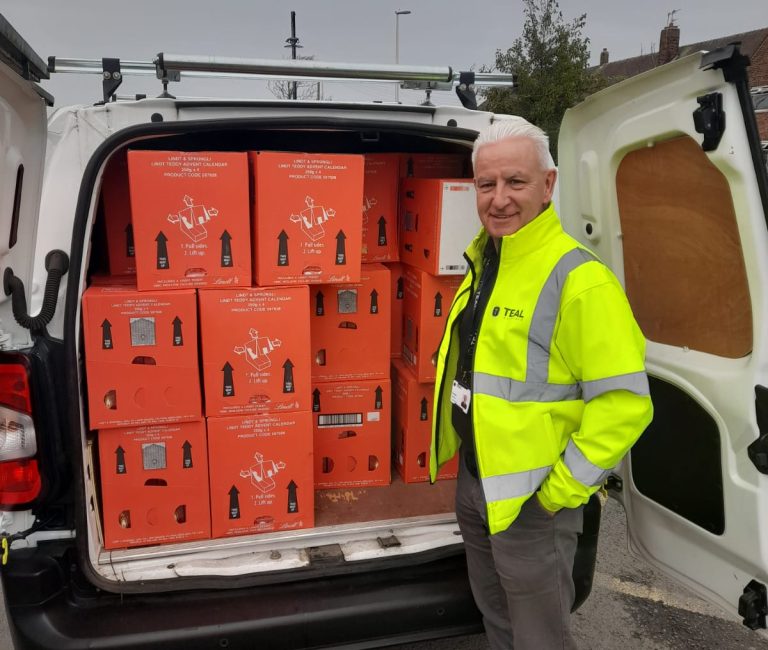
Teal Scaffolding, a leading firm in the North West of England, has announced that it will continue its Social Impact Initiative into 2023. The initiative will feature a range of community-focused events and activities aimed at giving back to local communities, businesses, and charities.Dan McGregor, Head of Operations at Teal Scaffolding, spoke about the company’s commitment to making a difference: “At Teal Scaffolding, we are passionate about giving back to our local community, businesses, and charities. We take our responsibility to offer support and contribute to the success of others very seriously. That’s why we annually prioritise monetary and time-based donations to various non-profit organisations and initiatives.”In addition to providing financial support, Teal Scaffold is also committed to raising awareness for the causes it supports. “We want to make a real difference in the communities in which we operate, and we believe that by spreading awareness for these causes, we can help non-profit organisations reach their goals,” said McGregor.Teal Scaffold has strongly supported men’s suicide prevention charity, ANDYSMANCLUB, the Testicular Cancer Network, and the local community-based environmental group Taking Roots. The company has also partnered with His Church Charity to spread Christmas cheer to the Blackpool-based community hub, The Grange.“We are a scaffolding firm that truly cares about going the extra mile for our clients and their communities,” said McGregor. With its commitment to communities and focus on making a positive impact, Teal Scaffold remains one of many industry leaders.
Starting today, Scaffolders and other trades at the GSK plant in Irvine employed by contractor Kaefer Limited will go on strike for a week in a dispute over bonus payments. Around 40 workers, who are members of Unite and work in engineering construction roles, are seeking a bonus payment of £2.37 per hour, the maximum allowed under the National Agreement for the Engineering Construction Industry. The strike is the second round of industrial action taken by the workers, who have also instituted an ongoing discontinuous overtime ban. The strike will involve electricians, scaffolders, cable pullers, and labourers and will impact the plant’s maintenance.“Unite stands fully behind our members taking a further round of strike action at the GSK-operated plant in Irvine,” said Unite General Secretary Sharon Graham. “Kaefer is still refusing to award our members what they are entitled to under a UK-wide agreement.”“The new round of strike action, which will last for a week, reflects the anger and disappointment our members feel at how they are being treated,” added Unite Industrial Officer Paul Bennett. “We are only asking for what our members are entitled to, yet Kaefer seems determined to prolong this dispute rather than work with us to resolve it.”The disagreement over the bonus payments remains unresolved. Unite has not ruled out further strikes as the workers continue to fight for their rights.
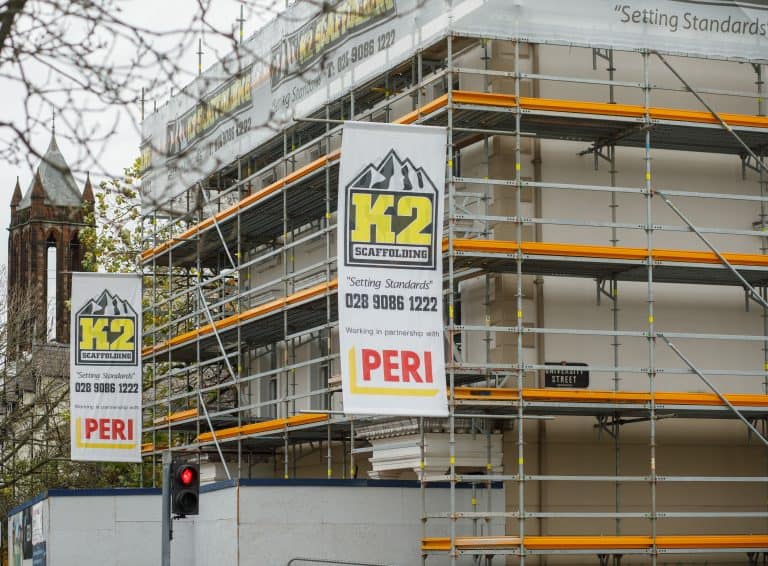
Northern Ireland-based scaffolding company K2 Scaffolding has announced its partnership with supplier PERI, investing over £400k in PERI’s scaffolding range. The partnership marks the first time PERI and K2 Scaffolding have worked together.According to K2 Scaffolding, the addition of the PERI UP scaffolding system to its product portfolio will aid in its growth plans and allow the company to take on larger construction projects. The family-run business has already put its investment to use, with its first PERI UP project underway at the Seamus Heaney Centre at Queen’s University Belfast.PERI expressed excitement about its long-term partnership with K2 Scaffolding, with a commitment to supporting the scaffolding contractor’s expansion into new sectors with its products. Charles Stratford, Business Development Manager at PERI UP, commented on the partnership, saying, “Continuity is vital for any contractor in this industry. By working directly with PERI as their manufacturer, engineer and rental partner of scaffolding solutions, K2 Scaffolding can benefit from a shorter supply chain and more flexibility around their project requirements. With the support of our logistics network across the UK, we can directly support K2 Scaffolding with its plans to scale up and diversify its project portfolio in any sector and region. Additionally, a versatile product like the PERI UP system makes those transitions between sectors more seamless. K2 Scaffolding is already a well-established brand in Northern Ireland and we are looking forward to helping the team develop the business around other parts of the UK.”Tara Johnston, Financial Controller at K2 Scaffolding, said, “We believe the system’s simplicity, speed, and flexibility will enable us to take on more ambitious projects and support our growth plans.” The partnership between K2 Scaffolding and PERI is expected to bring significant growth opportunities for the scaffolding company.
Wigan-based 3B Training, a leading multi-accredited health and safety training company, has launched its new IPAF and PASMA training facilities in Doncaster. The approved training provider for both IPAF and PASMA, 3B Training, aims to broaden access to suitable training for the construction industry in the area.3B Training’s Doncaster venue boasts state-of-the-art facilities, including mobile elevating work platforms (MEWPs), scaffold towers and scaffold set-ups for IPAF courses and mobile access towers for PASMA training. The IPAF and PASMA courses provide delegates with practical training to operate safely in a construction environment. With falling from height being a common cause of fatalities in the industry, 3B Training’s courses aim to reduce the number of casualties.“Expanding the training facilities is part of 3B Training’s aim to be a world-class training provider of choice,” says 3B Training’s Managing Director, Matt Bewley. The company has expanded its delivery team by doubling the number of trainers over the past year, bringing in more construction sector experience to improve delegate outcomes. With over 12 years of experience, 3B Training delivers health and safety, first aid, plant, eLearning and NVQ training to over 30,000 people annually.Bewley added: “The addition of these facilities at our Doncaster venue is a testament to our commitment to providing the best possible training to the construction industry. We are proud to be a Build UK member and hold gold NEBOSH status.”For more information about the IPAF and PASMA courses at 3B Training’s Blackburn and Doncaster venues, please visit 3btraining.com.
Doka, a leading global supplier of formwork based in Amstetten, Austria, has fully acquired AT-PAC, a US-based scaffolding manufacturer.
This acquisition positions Doka as a one-stop-shop for formwork and scaffolding solutions in the construction industry, as it enhances the company’s new global business segment, “Industrial Scaffolding”. AT-PAC, on the other hand, gains full access to a global market through this acquisition.
The potential for cooperation between Doka and AT-PAC was demonstrated at the Bauma 2022 trade fair in Munich, where the two companies impressed visitors with a dual-branded stand that generated significant interest. The 30-meter high Ringlock scaffolding tower, climbed by 7,000 visitors, was a highlight of the event. The tower offered stunning views of the trade fair grounds from its 20-meter viewing platform.
Doka CEO, Robert Hauser, expressed his excitement about the acquisition, saying, “I am very enthusiastic about the opportunities that will be offered to existing and future customers, providing them with a wealth of knowledge, integrated products, and turnkey solutions for formwork, shoring, and scaffolding from a single source.”
Josh Dundon, previously the COO of AT-PAC, has been announced as the company’s new CEO. In a statement, Dundon said, “It is an exciting milestone for AT-PAC to become 100% part of the Doka and thus the Umdasch Group family. It further strengthens and demonstrates the success of our partnership since its inception 3 years ago.”
He added, “The combination of Doka’s industry-leading formwork solutions and extensive global sales network with AT-PAC’s high-quality products, services, and talent will create incredible value for our customers and opportunities for our employees worldwide.”
The acquisition of AT-PAC by Doka is expected to bring many benefits to the construction industry. Customers can now enjoy comprehensive global site solutions from a single source, while employees of both companies will have access to a wealth of knowledge, skills, and resources.
The combination of Doka’s expertise in formwork and AT-PAC’s experience in scaffolding is expected to drive growth and innovation in the industry.
The energy sector is set to see a flurry of activity as 20 of the industry’s most prominent employers head to AIS Survivex’s annual Energy Career Events. The events aim to match potential candidates with recruiters for both current vacancies and upcoming 2023 projects. This year’s event is expected to be the largest yet, with companies such as Bilfinger, Wood, Stork, AGR, Atlas Professionals, and Hydrasun among those in attendance.There will be a wide range of job opportunities at the events, including green hand positions for newcomers to the offshore industry and experienced roles in offshore construction, such as rigging, pipefitting, and mechanical and electrical jobs.Senior HSEQ Advisor at Atlas Professionals, Mark McDonald, stated that they have a number of upcoming projects and are looking to attract both experienced and inexperienced talent. He added: “As well as our ongoing recruitment contracts, we have at least four rigs coming into work in the North Sea and will be looking for crews to support these.”The free events will be held on Wednesday, February 15th in Aberdeen and Thursday, February 16th in Newcastle and are open to anyone. In addition to offering the opportunity to meet potential employers and recruiters face-to-face, attendees will also gain valuable insight into upcoming projects and opportunities in 2023.According to Linzi Ryan, Head of Marketing at AIS Survivex, the global energy sector is bustling and expected to continue throughout 2023. She urged anyone looking for information about opportunities in the oil and gas or wind sector to sign up for the event.With 20 companies already signed up, this year’s Energy Career Event is expected to be the biggest yet. It offers a unique opportunity for job seekers to meet with recruiters and gain valuable industry insight. To register for the event, please follow the link: https://bit.ly/3XE8y19