Scaffolder and Son’s Toy Scaffolding Offers Priceless Help for Kent Hospital
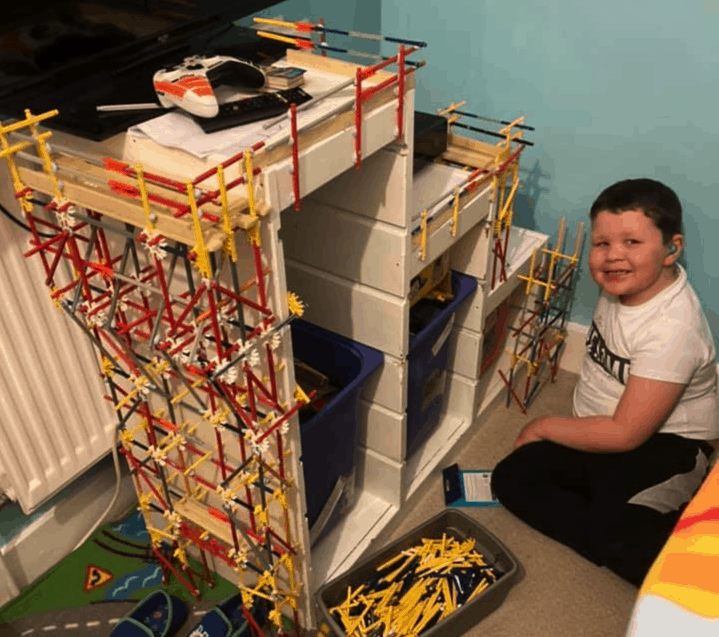
Kent-based scaffolder Lee Camden and his son Frankie are constructing a charity fundraising project to help the Oliver Fisher Neonatal ward at Medway Hospital buy vital equipment.
It’s a personal mission fired up from the day medical staff saved his newborn son’s life, at a time when he wasn’t expected to get through the first 24 hours. Two weeks overdue Frankie had six probes attached to him as he fought for life. In fact, Frankie was just 20 minutes away from being stillborn. Both parents were told he might not be able to walk, talk or even hear, but somehow he pulled through. Six years on from that fraught and fearful day, Frankie is turning into a strong and vibrant youngster, though he does need hearing aid devices. It’s just a reminder of what a lot of love, determination and skill from those amazing NHS staff can achieve even in the darkest of hours. And don’t bet on Frankie eventually following his dad into the scaffolding business, as he’s already becoming highly skilled at organising very special toy scaffolding at home. It’s all part of a fascinating family story as Lee explained: “It all goes back to my own dad, Phill Camden because, from the moment I became aware of what was going on around me, I wanted to be a scaffolder. He got me a kit very much like Meccano, except it was toy scaffolding. It was fantastic putting structures together and it taught me such a lot at a young age. “The scaffolding bug never left me, so it was no surprise I eventually ended up in this wonderful industry. I still had the toy kit in the loft and Frankie knew about it – he kept asking me to get out Grandad’s kit. Soon Frankie was creating some impressive mini scaffolding around the house especially on the stairs.”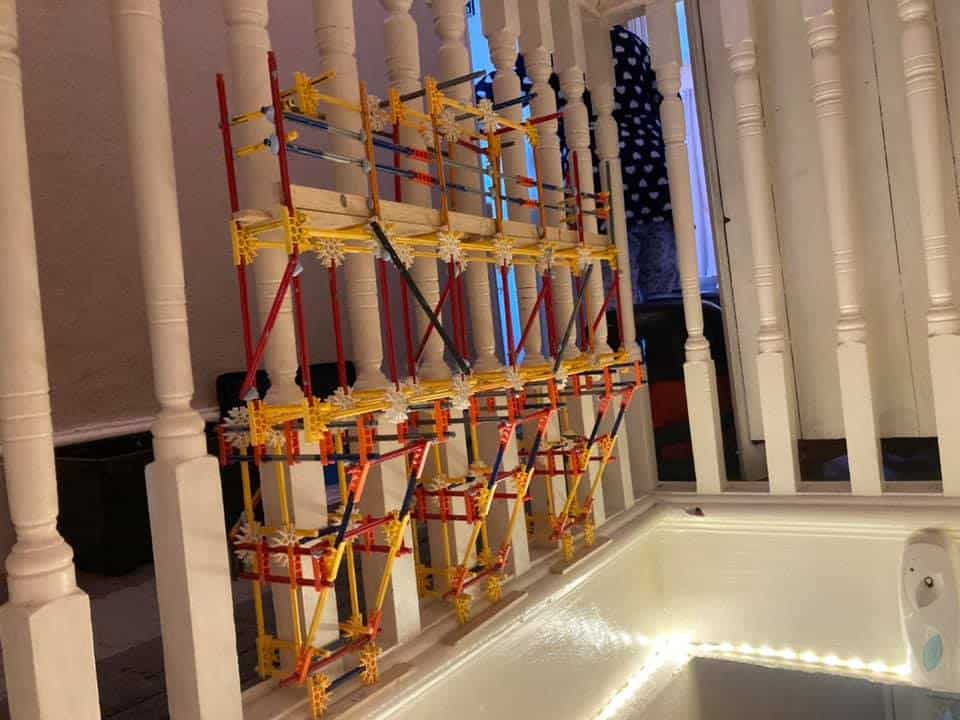
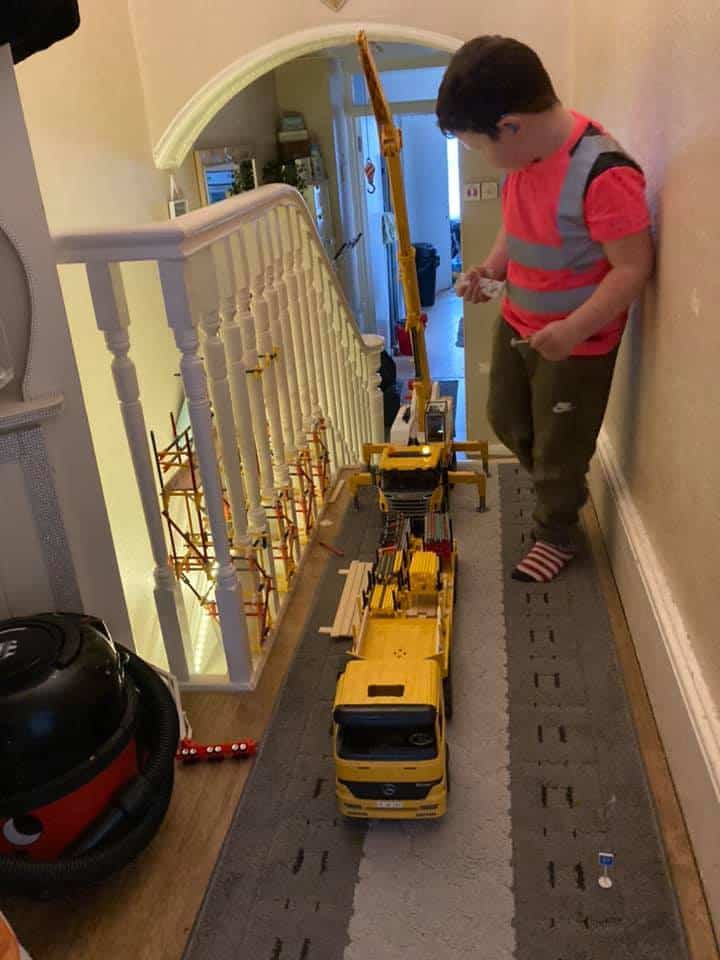 So far Lee and Frankie have managed to raise more than £1,000 for the hospital – there’s no specific target – just to get as much money as possible, so the ward can buy what it needs to keep improving their services. They don’t get any special budget from the NHS, so a lot of equipment is provided through donations.
The Oliver Fisher Baby Unit is a tertiary neonatal facility caring for babies who require intensive care. They care for babies from Medway and the surrounding South-East Thames region including Dartford, Gravesend, Maidstone and Tunbridge Wells. It’s a 36-cot unit.
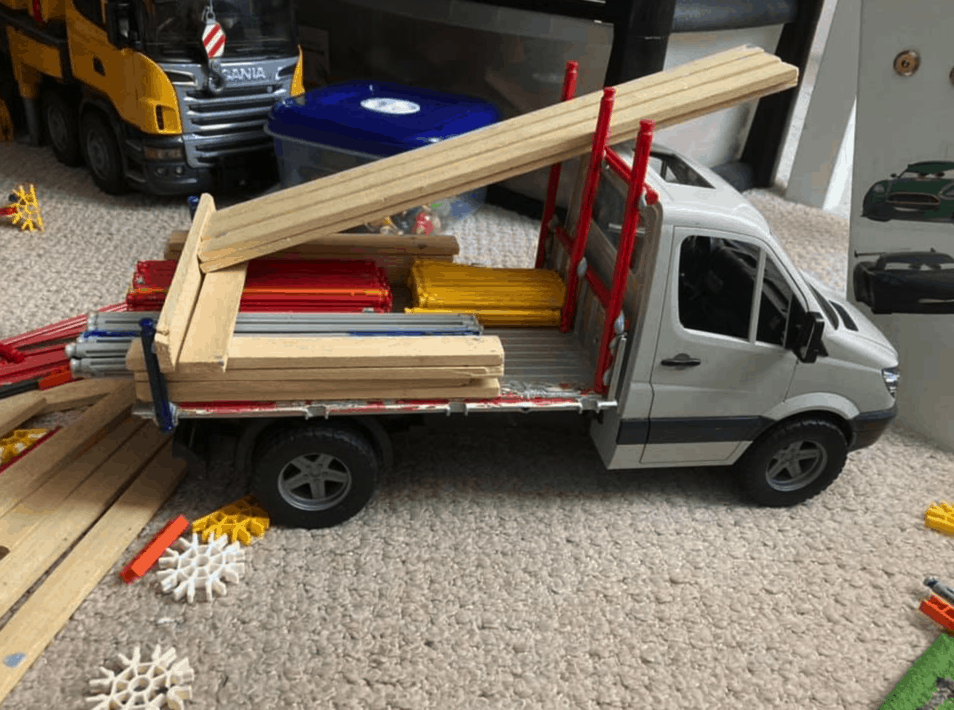
Lee began making toy scaffolding sets in order to sell them with £10 profit on each set going to the unit. They include a sprinter half back, tube, fittings, boards, one ladder and yard fencing. Enough to build a 20 x 30 structure.
So far Lee and Frankie have managed to raise more than £1,000 for the hospital – there’s no specific target – just to get as much money as possible, so the ward can buy what it needs to keep improving their services. They don’t get any special budget from the NHS, so a lot of equipment is provided through donations.
The Oliver Fisher Baby Unit is a tertiary neonatal facility caring for babies who require intensive care. They care for babies from Medway and the surrounding South-East Thames region including Dartford, Gravesend, Maidstone and Tunbridge Wells. It’s a 36-cot unit.
Lee began making toy scaffolding sets in order to sell them with £10 profit on each set going to the unit. They include a sprinter half back, tube, fittings, boards, one ladder and yard fencing. Enough to build a 20 x 30 structure.
 He added: “To be honest it would be great to get a work clothing range we can sell to make more money for the hospital. We’re already carrying out research and hope to be able to put the plan into action very soon.
“We’ve also been talking about arranging a soapbox race day involving scaffolders and builders. We’ll do whatever possible to keep the fundraising going. The Ward staff certainly saved my son’s life and a lot of others since, so I’m passionate about helping them as much as possible especially during such difficult times.”
Frankie’s toy scaffolding is becoming quite a social media hit across the UK – in fact, Lee might just have created a new trend. More importantly, it’s building funds for a vital unit in the heart of the NHS, saving lives at the same time. So why not play your part in this wonderful story?
You can donate to Frankie’s charity fundraising project by visiting their GoFundme page here: https://www.gofundme.com/f/toy-scaffolding?utm_campaign=p_lico+share-sheet&utm_medium=copy_link&utm_source=customer
He added: “To be honest it would be great to get a work clothing range we can sell to make more money for the hospital. We’re already carrying out research and hope to be able to put the plan into action very soon.
“We’ve also been talking about arranging a soapbox race day involving scaffolders and builders. We’ll do whatever possible to keep the fundraising going. The Ward staff certainly saved my son’s life and a lot of others since, so I’m passionate about helping them as much as possible especially during such difficult times.”
Frankie’s toy scaffolding is becoming quite a social media hit across the UK – in fact, Lee might just have created a new trend. More importantly, it’s building funds for a vital unit in the heart of the NHS, saving lives at the same time. So why not play your part in this wonderful story?
You can donate to Frankie’s charity fundraising project by visiting their GoFundme page here: https://www.gofundme.com/f/toy-scaffolding?utm_campaign=p_lico+share-sheet&utm_medium=copy_link&utm_source=customer
Avontus Appoints New Global Sales Director

John Brocklehurst brings his extensive experience in scaffolding business and practices to spearhead Avontus’s global sales efforts.
Scaffolding software firm Avontus that’s headquartered in the USA, has appointed John Brocklehurst as the company’s new Global Sales Director. John, who is based in the United Kingdom, has expertise in scaffolding business around the world, with a specialty in sales, engineering, and design. He brings with him over 30 years of experience working for multinational companies on both onshore and offshore projects. Avontus serves scaffolding businesses all over the world from its offices in the US, UK, Australia, and South Africa. With 19 years in the industry, the scaffolding technology company develops innovative software solutions such as Avontus Quantify, Avontus DGKR Scaffolding become Carbon Neutral as they set Net Zero Carbon roadmap

GKR Scaffolding has become the first scaffolding specialist to become Carbon Neutral after introducing a number of sustainability measures including moving their entire fleet to HVO fuel.
The business has been working with Engie to fully audit their carbon footprint and put in place a robust roadmap to become Net Zero Carbon by December 2023. GKR identified that 63% of the business’ carbon emissions were attributed to its fleet of lorries as it was phasing in new Scania L-Series cabs which are also 5-Star Direct Vision. The first of GKR Scaffolding’s new fleet has hit London’s roads fuelled with Hydrotreated Vegetable Oil (HVO). However, the remainder of the existing fleet can also use HVO as an alternative to diesel. The business had already moved to using UK generated 100% renewable electricity in all its offices and facilities and has worked with Engie to identify suitable carbon offset programmes. The offset project being used is a Plant A Tree – Protect A Tree initiative that plants trees in the UK and also protects trees in the Brazilian Amazon via an ‘avoided deforestation programme’. So, for every tree planted in the UK, a tonne of carbon will be saved on another continent.Roadmap to Net Zero Carbon
Engie’s audit for GKR has established their Net Zero Carbon strategy of which becoming Carbon Neutral is the first milestone. Being Carbon Neutral means that the business’ remaining carbon emissions are balanced by offsets. The target now is to be net-zero by 2023 where no carbon emissions will derive from the business and therefore offsets are not required. GKR’s roadmap incorporates trialling composite materials to replace plastics such as tube end caps, using electric forklift trucks and implementing a green policy on steel purchasing to lower requirement on raw materials.The move to HVO fuel to drive carbon neutrality
The Scania L-Series is the first of the investment in moving GKR’s fleet over to 5 Star Direct Vision cabs to contribute to both safer streets whilst reducing CO2 emissions. HVO fuel is being used due to analysis showing it reduces CO2 emissions by 91% without affecting the performance of the Euro VI engines. HVO fuel is manufactured by hydrotreating waste fats and vegetable oils from sustainable and renewable sources. The HVO supplier used by GKR has the International Sustainability and Carbon Certification. Being 100% hydrocarbon, HVO has better performance and stability than other biofuels and is a popular green alternative available at the pump in many countries in Europe such as Sweden and Finland. The construction industry is working together throughout the supply chain to reduce carbon emissions. GKR will be proactively supporting the sustainability targets of the principal contractors they work with as part of their supply chain. Jason Millett, Group Board member at Mace, said: “Adopting and trialling HVO fuels across our construction sites is a green initiative that we’re driving as part of our bold carbon reduction ambitions set out in Mace’s 2026 Business Strategy. Working together with our supply chain will be vital in realising the benefits of using this hydrocarbon and encouraging its widespread adoption as a green alternative to other polluting fuels. We can achieve much more by collaborating than we could achieve by working alone and our goal is to share these low carbon innovative solutions with the rest of the industry. To pursue a sustainable world, it’s important for the industry to continue working together with our supply chain partners, driving forward innovative low carbon delivery solutions and completely transforming the way we create project and programmes.”Cleaner and safer streets
As well as its sustainability credentials, the new fleet will also be 5 Star Direct Vision which enhances protection for vulnerable road users such as cyclists. The Direct Vision Standard is a requirement of all heavy goods vehicles over 12 tonnes travelling through, or operating in, Greater London. The star rating indicates how easily the HGV driver can see directly through their cab window and has been put in place to protect all road users. The initiative forms part of the Mayor of London’s Vision Zero plan to eliminate all deaths and serious injuries on London’s transport network by 2041. Neil Rowswell, Managing Director at GKR Scaffolding, stated: “Our move to 5 Star Direct Vision plays a huge part in addressing our responsibility to keep people safe on our roads. We have also been committed to finding sustainable solutions, even before we planned our Net Zero Carbon strategy. We are still researching electric as battery technology improves, but in the meantime, HVO is an excellent alternative allowing us to reduce carbon emissions in a sustainable way. The construction industry is quite rightly being held accountable for the impact we have on the environment and the communities we operate in. We intend to play our part.” GKR will be signing up as a Business Champion for the Construction Leadership Council ConstructZero programme and has already signed the Pledge To Net Zero commitment for businesses.NASC 2021 Report Shows Safety Remains High With Members
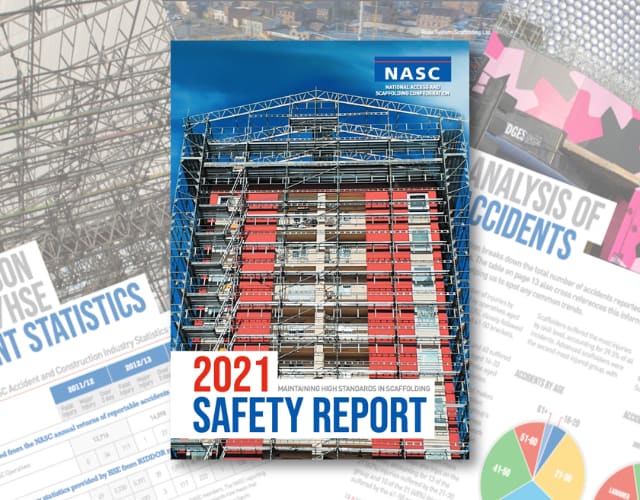
NASC Contractor members have recorded their second-lowest figure for accidents and injuries in 2020 according to data revealed in the NASC 2021 Safety Report.
NASC one of the UK’s leading scaffolding trade bodies has published its most comprehensive annual Safety Report to date containing accident statistics, analysis and plans to further improve scaffolding industry safety standards. The 2021 Safety Report shows NASC Contractor members that employ more than 16,000 operatives collectively, reported just 81 incidents in 2020 which is the second-lowest figure recorded. The previous year (2019) saw an all-time low of just 74 incidents. The NASC says this means that in 2020 99.5% of its member-employed operatives went through the year accident and injury-free. Data also shows there were no operative fatalities within its membership, for the eighth consecutive year. For the 2021 Safety Report, the NASC collected more detailed accident information than ever before from its Contractor members. This enabled the NASC to delve deeper into the statistics, identifying a number of trends and common causes of accidents and injuries. The report shows, for example, that the main causes of slips and trips were human error (55%), followed by poor site housekeeping and poor ground conditions (both 19%), and that 69% of all recorded operative falls from height were suffered by those in the 31-40 age bracket. Read the full report here: NASC 2021 Safety Report Armed with this new data, the NASC is now working towards addressing the various issues identified. Robin James, NASC Managing Director, said: “The 2021 Safety Report shows NASC Contractor members continue to work to the highest standards – with just 81 incidents reported. It should be remembered that during 2020 members were faced with challenging Covid-19 related working conditions, with operatives forced to significantly change the way they worked on site. “Members rose to this challenge, not only continuing to operate wherever possible – in line with Government guidance – but also ensuring safety standards were not compromised.” Lynn Way, NASC President, added: “Whilst we’re proud of the headlines figures contained within this year’s Safety Report, this publication is intended to be much more than just a line in the sand, an annual yardstick to measure general safety success against previous years. “It is also a way in which we can learn why incidents occurred with a view to developing ways in which to reduce them – benefiting both NASC members and the wider scaffolding and construction industries. “To support this endeavour, this year we changed the way in which we gather accident information from NASC members. As a result, this year’s analysis is boosted by a more defined and detailed set of accident returns. This extra information has enabled us to delve much deeper into the 81 incidents reported, identifying potential causes and trends hidden beneath the figures and making recommendations that we hope will lead to safety improvements throughout the industry.”World’s first pilot of flexible working on construction sites finds wellbeing soars
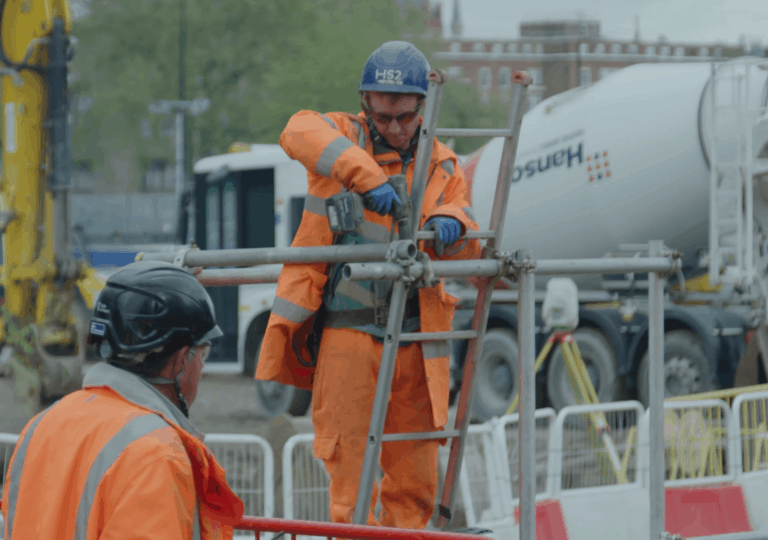
Four of the UK’s largest construction companies have pioneered an 18-month pilot project, that found flexible working practices for tradespeople on construction sites can work.
Flexible working consultants Timewise have today published the results of their ground-breaking Timewise Construction Pioneers programme – an 18-month project that has re-designed shift patterns in onsite roles, to enable more flexible working, enhanced wellbeing and improved work-life balance. Construction giants BAM Construct, BAM Nuttall, Skanska UK and Willmott Dixon took part in the pilot that ran between June 2020 and February 2021. Build UK partnered with Timewise on the programme, and the CITB and Barclays LifeSkills supported its rollout. Pilot managers Timewise tested whether it is possible to improve the wellbeing of those working on-site through changing the hours and times of working, as well as considering home-based working where possible. The goal was to identify if this was possible to achieve without budgets or deadlines being affected, across a range of sites and projects. The pilots took place in a range of locations, from an HS2 site in London through to a substation build near Weston Super Mare, amongst teams employing between 14 and 120 workers.Case for action
Over 3m people work in the UK construction sector contributing 9% of the economy. It is hoped that flexible working can help address a range of issues within the sector:- Better wellbeing: 1 in 4 construction workers are thought to have considered suicide. This has been tied to the long hours culture in Construction, as well as a range of other factors.3
- Decreased rates of absence: £160m per year is lost in sickness absence.4
- Diversity and gender equality: just 3 in 20 construction workers are women5
- Only 10% of job vacancies offer flexible working falling to 2% for keyworker roles. 6
Outline of pilots
Timewise used a system it has developed for location-based roles which need to cover a long working day – which it calls the ‘shift-life balance’ model. It tested different types of flexible working7 across the different sites:- BAM Construct: tested a team-based approach to flexible working. Tested a consultative method of setting shifts that takes workers’ personal preferences into account. This is similar to work Timewise has conducted with nurses in the NHS.
- BAM Nuttall: tested a flexi-day approach in which workers could accumulate additional hours in exchange for one day off each month. A large portion of workers were living away and preferred to tag a flexi-day onto a weekend, to enjoy extended time at home.
- Skanska UK: earlier starts and finishes – Skanska UK trialled TWO different approaches with two different teams within the Skanska Costain STRABAG (SCS) Joint Venture, both revolving around earlier start and finish times:
- Output based: The foreperson works with a planner to develop a more detailed version of the schedule of work, broken down into weekly and daily objectives. Working hours are set, based on the outputs to be achieved each day.
- Staggered : The foreperson alternates start times between the teams each week, so that all workers get the pattern they want every other week. In addition to this, workers are given a choice of break times.
- Willmott Dixon: Willmott Dixon used the expertise of Timewise to support commitments they had already made to staff (to limit hours worked to 45 per week inclusive of breaks, and to ensure that an agile working plan is in place for all teams and on all new projects).
Results
There was a broad positive shift in wellbeing, with many workers speaking of improvements to their family life and sense of wellbeing. Some stated that they would consider the ability to work flexibly as a key criteria when applying for future jobs. Managers reported a greater sense of trust, ownership and a better team dynamic. All the Pioneer firms reported no negative impact on budgets or timeframes. Some data suggests adjustments to working patterns could drive savings on labour costs due to enhanced productivity. Furthermore, the project achieved the following:- 75% INCREASE in a sense of wellbeing – participants who felt their working hours gave them enough time to look after their own health and wellbeing rose from 48% to 84%.
- Overwork DECREASED – participants agreeing that they regularly work beyond their contracted hours decreased from more than half, to just over a third (51% to 34%).
- Guilt DECREASED – at the start of the project, nearly half of all participants felt guilty of they started later or finished earlier than others onsite. This portion decreased to a third (47% to 33%).
- Trust in colleagues working remotely INCREASED – respondents agreeing with the following phrase: “if someone works from home, I am not sure they are working as hard as they would be on site” decreased from 48% to 33%.
 Emma Stewart MBE, director of development at Timewise, said: “This programme has proved, beyond doubt, that flexible working can work even in complex site-based industries such as construction. In a sector that is all about overcoming challenges with innovation, perhaps that should be no surprise. Our trailblazing Pioneers: BAM Construct, BAM Nuttall, Skanska UK and Willmott Dixon have shown that wellbeing and balance should be possible to achieve for the whole workforce – not just those in-office roles. And in doing so have provided a blueprint that we hope will drive wider industry change.
Working practices no longer need to be a block to attracting the best and most diverse possible talent Our thanks also go to Build UK for its vision and foresight in catalysing this unique project.”
Suzannah Nichol MBE, chief executive of Build UK, says: “Flexible working has enabled me to continue my career in construction for over 30 years, and this report will help others to do the same. Our industry offers a fantastic range of opportunities, and Timewise and our pioneers have proved that flexible working is possible, even for site-based teams.
By sharing what works, we can help companies across the sector create a working environment that will attract and retain a diverse workforce, making construction a positive career choice for everyone. It’s a win-win, and I can’t wait to see what happens next.”
Emma Stewart MBE, director of development at Timewise, said: “This programme has proved, beyond doubt, that flexible working can work even in complex site-based industries such as construction. In a sector that is all about overcoming challenges with innovation, perhaps that should be no surprise. Our trailblazing Pioneers: BAM Construct, BAM Nuttall, Skanska UK and Willmott Dixon have shown that wellbeing and balance should be possible to achieve for the whole workforce – not just those in-office roles. And in doing so have provided a blueprint that we hope will drive wider industry change.
Working practices no longer need to be a block to attracting the best and most diverse possible talent Our thanks also go to Build UK for its vision and foresight in catalysing this unique project.”
Suzannah Nichol MBE, chief executive of Build UK, says: “Flexible working has enabled me to continue my career in construction for over 30 years, and this report will help others to do the same. Our industry offers a fantastic range of opportunities, and Timewise and our pioneers have proved that flexible working is possible, even for site-based teams.
By sharing what works, we can help companies across the sector create a working environment that will attract and retain a diverse workforce, making construction a positive career choice for everyone. It’s a win-win, and I can’t wait to see what happens next.” North Yorkshire scaffolding firm awarded top accreditation

Five years’ hard work and investment by Infiniti Scaffolding has seen the Scarborough-based business gain a coveted NASC Full Contractor Member accreditation.
Out of several thousand active UK scaffolding businesses, Infiniti Scaffolding is now the only one of NASC’s 300 member approved companies within a 50-mile radius of Scarborough. NASC is one of the UK’s access and scaffolding national trade body and is regarded by many as a benchmark for quality, safety and professionalism, with its accreditation accepted as one of the highest industry standards by the Health and Safety Executive and other government and public sector bodies. Infiniti Scaffolding director Lisa Naylor said: “Gaining the NASC accreditation is a tremendous achievement for us as it recognises the hard work and dedication by our staff and management to ensure that we reached one of our primary goals. “As health and safety become more paramount in the construction and building maintenance sector an increasing number of main contractors, local authorities, housing associations, public and private sector hospitals and schools are specifying in tenders that the NASC accreditation is a prerequisite for scaffolding providers. “Our accreditation reassures any Infiniti Scaffolding customer that we are part of the UK trade body which produces industry-recognised safety and technical guidance. The required investment in time and money is also an indication that we are serious, high quality, long-term players in the scaffolding sector.” Infiniti Scaffolding’s accreditation process started with an in-depth initial application, a full desktop audit of the application and an information verification visit to Infiniti Scaffolding’s premises. “As NASC auditors put a big emphasis on their visits to job sites we were really pleased that Infiniti Scaffolding’s on-site practices met their high standards,” added Mrs Naylor.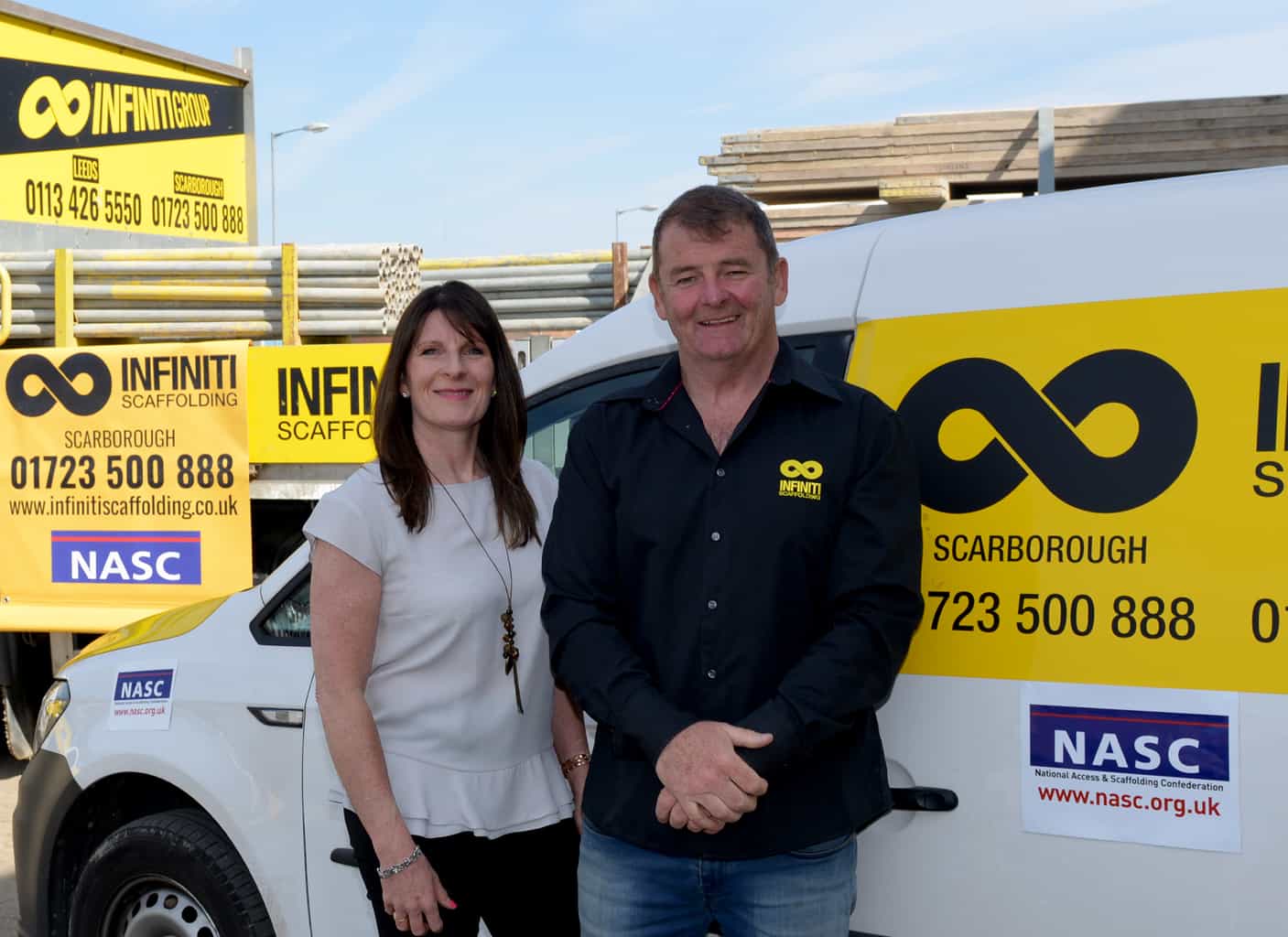 As part of the ongoing NASC accreditation compliance, Infiniti Scaffolding’s own sites and job sites will be re-audited every two years with the company agreeing to abide by the NASC code of conduct.
The hard-earned accreditation is already paying dividends for Infiniti Scaffolding as previously inaccessible markets open up.
As part of the ongoing NASC accreditation compliance, Infiniti Scaffolding’s own sites and job sites will be re-audited every two years with the company agreeing to abide by the NASC code of conduct.
The hard-earned accreditation is already paying dividends for Infiniti Scaffolding as previously inaccessible markets open up. New scaffold training centre celebrates successful first course

A brand new scaffold training centre in North Wales has successfully trained its first cohort of scaffolders.
The Busnes@LlandrilloMenai’s Centre for Infrastructure, Skills and Technology (CIST) at Llangefni, Anglesey held the scaffolding course recently, delivered by Simian Risk Management and with support for learners from the CITB. The £2.1 million training facility was supported by the Welsh Government Energy Island funding, and now allows learners in North Wales to take a scaffolding course locally rather than having to travel to the North West or West Midlands of England. Among those completing the course as the first step to his career as a scaffolder was Kyle O’Connor, from Anglesey Scaffolding Company Ltd. He said: “I really enjoyed the course, and the course tutor has been excellent throughout, with friendly staff at the centre. The facilities for scaffolding training at CIST are fantastic, and it is great see it based on Anglesey which provides opportunities for scaffolders to be trained locally rather than having to travel several hundred miles.”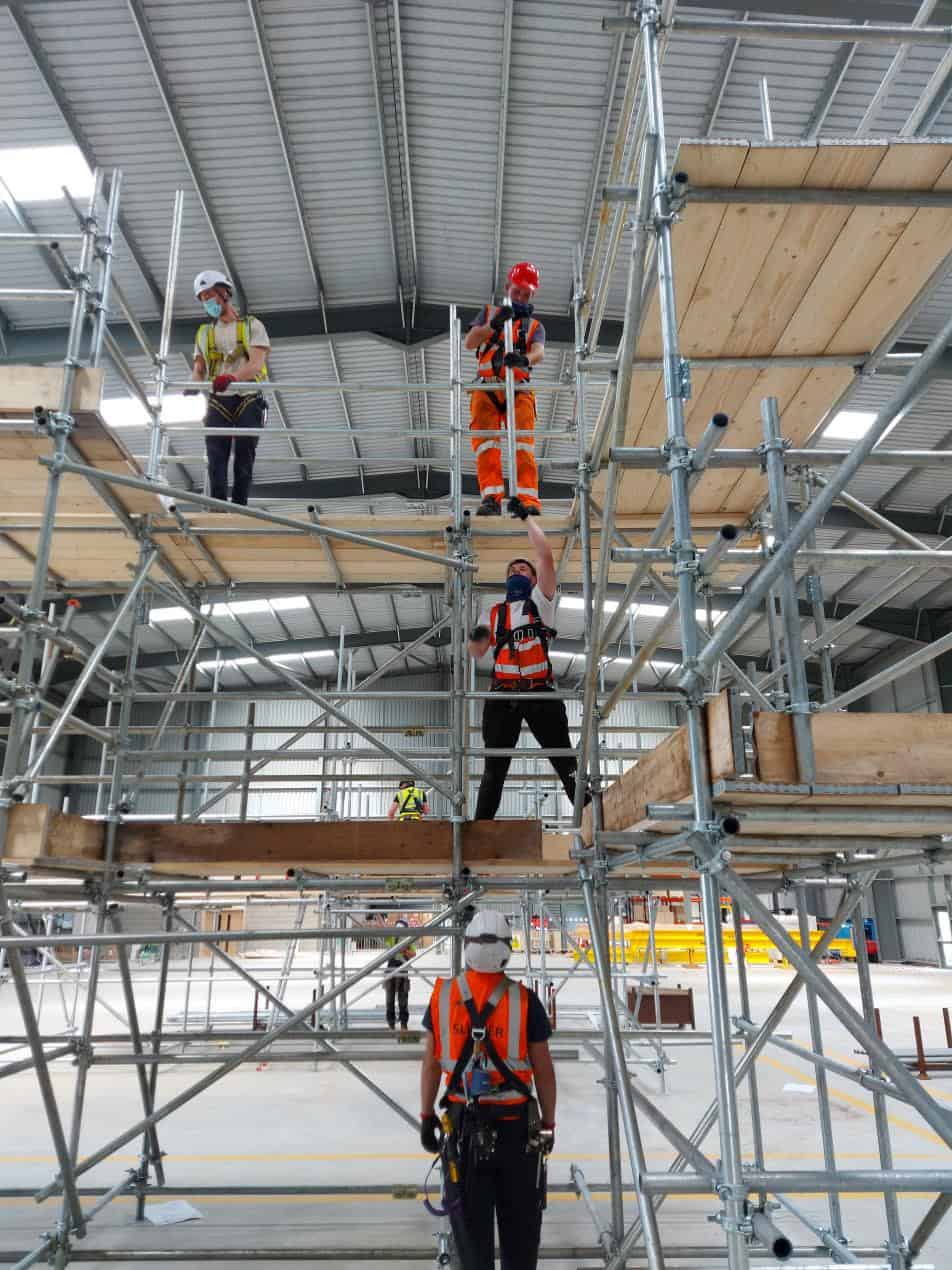 The completion of the first course comes as a welcome boost for Welsh construction, which is set to bounce back strongly from the Covid-19 pandemic with a 4.1% annual growth in work.
To meet this boon, Welsh construction will need an additional 9,250 workers by 2025, on top of the forecast staff growth of 0.7% – an extra 1,850 workers per year.
CITB Wales’ Engagement Director Mark Bodger said: “The early success of this centre provides a real boost for Welsh construction, and shows how we’re working with our partners to help the industry in Wales meet its recruitment needs to hit its ambitious targets and help lead the way in Britain’s post-Covid economic recovery.
We look forward to seeing further successes from Busnes@LlandrilloMenai’s CIST Centre, Llangefni, complemented by the investment CITB is making into training hubs across Wales to help convince more people that construction is the right sector for them to enjoy a rewarding career in.”
The completion of the first course comes as a welcome boost for Welsh construction, which is set to bounce back strongly from the Covid-19 pandemic with a 4.1% annual growth in work.
To meet this boon, Welsh construction will need an additional 9,250 workers by 2025, on top of the forecast staff growth of 0.7% – an extra 1,850 workers per year.
CITB Wales’ Engagement Director Mark Bodger said: “The early success of this centre provides a real boost for Welsh construction, and shows how we’re working with our partners to help the industry in Wales meet its recruitment needs to hit its ambitious targets and help lead the way in Britain’s post-Covid economic recovery.
We look forward to seeing further successes from Busnes@LlandrilloMenai’s CIST Centre, Llangefni, complemented by the investment CITB is making into training hubs across Wales to help convince more people that construction is the right sector for them to enjoy a rewarding career in.” Actavo scoops three RoSPA awards

Actavo has been awarded three awards from the Royal Society for the Prevention of Accidents.
Actavo has announced that it has secured three prestigious, internationally recognised awards in recognition of its work in the area of health and safety, at the annual Health and Safety Awards organised by the Royal Society for the Prevention of Accidents (RoSPA) in the UK. All three RoSPA awards recognise Actavo for its long-term achievements in the area of health and safety. Actavo Industrial Solutions UK and Actavo Hire & Sales UK have been awarded the RoSPA Order of Distinction Award following 17 consecutive years of achieving Gold Awards. Actavo Network & In-Home was awarded the RoSPA President’s Award, which recognises the company’s achievement of winning the Gold Award for 10 consecutive years, and Actavo Group was awarded the RoSPA Fleet Safety Gold Medal, in recognition of five consecutive years of Gold Awards in this category. The annual awards are categorised by different levels of achievement: Merit, Bronze, Silver and Gold, as well as long-term awards that recognise companies for achieving Gold Awards for multiple consecutive years. Organisations receiving a RoSPA Award are recognised as being world-leaders in health and safety practice. Every year, nearly 2,000 entrants vie to achieve the highest possible accolade in what is the UK’s longest-running health and safety industry awards. Brian Kelly, Group CEO of Actavo, said: “Actavo is extremely proud to have received these three distinguished awards from the Royal Society for the Prevention of Accidents. These annual awards are among the foremost international accolades that you can receive the health and safety sector It is particularly gratifying to have received this recognition for Actavo’s long-term track record of excellence in this area, especially given the recent challenges of the pandemic. Safety is our number 1 Value, with all our teams internationally focusing on our ‘live safety’ value every day, using the Actavo Golden Rules, safeguarding themselves, their colleagues, our clients, customers and the communities in which we operate. These awards are recognition of our culture”. Julia Small, RoSPA’s Achievements Director, said: “The RoSPA Awards scheme is the longest-running of its kind in the UK, but it receives entries from organisations across the globe, making it one of the most sought-after achievement awards for health and safety worldwide. RoSPA is very proud of the achievements of its entrants, and with this award we recognise the best of the best, those organisations that have gone the extra mile, raising the bar for the delivery of safety in the workplace.”Andrew Smith Leads Avontus Software into Strategic New Growth
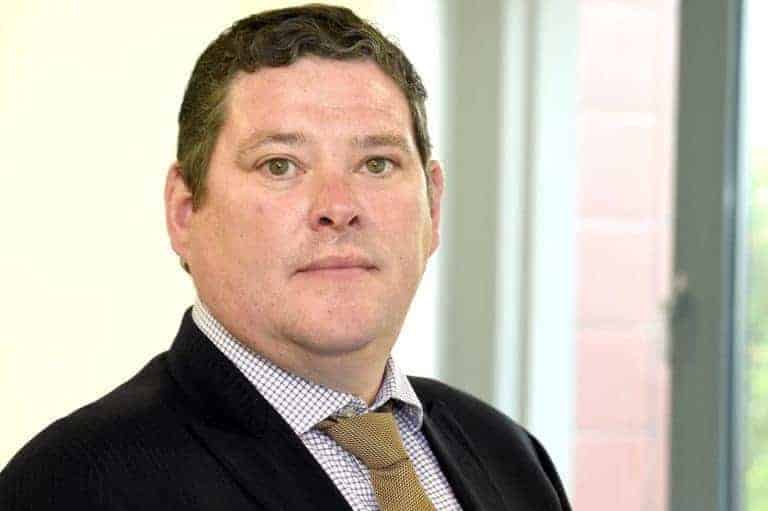
Andrew Smith, former Vice President of Operations at Avontus Software, has now been promoted to CEO after seven years of driving operational excellence and growth in the company.
Avontus Software, headquartered in the US, has announced internal changes in its management team. Andrew Smith is now the CEO of one of the most advanced industry-leading scaffolding software companies, replacing Brian Webb, the outgoing CEO and founder of the company.
Moving forward, it’s understood Webb will refocus his efforts on software development and design, which is where his passion lies.
Andrew Smith has served the company as Vice President of Operations since 2018. Prior to that role, he led the sales team as Sales Director of EMEA since joining the company in 2014. This promotion comes at a pivotal time in the company’s 19-year history, as the management team focuses their efforts on accelerating growth and international expansion.
“Andrew’s impact at Avontus has been immense over the last few years,” says Webb. “He’s helped drive the company’s growth, scale the organization, and cultivate a culture that empowers our people to learn, grow and do their best work. As CEO, he’ll continue to lead the business forward, enabling me to work more closely with customers to develop new technologies that enable their businesses to reach new heights.”
Smith said, “During the pandemic and while looking forward, we focused on solidifying our roadmaps for the future and driving future business growth. We still maintained a strong position in the industry by keeping the team together and motivated, even as we were working remotely. These efforts have paid off as we took the opportunity to look at markets objectively and found areas we can grow business-wise.”
As a scaffolding software company that enables scaffolding manufacturers and contractors to achieve digital transformation through industry-specific technology, Avontus is well-positioned to answer the current market’s demands and challenges.
The company – with offices in the US, United Kingdom, and Australia – is not only expanding to new markets such as South Africa this year, but is also working on a new, cloud-based product that is set to transform the scaffolding industry with job site and project management capabilities.
Smith said, “We have been busy working away on this new addition to our software range for a while, and we are excited to share it with key industry players – whether big or small – soon. The capabilities of this software have the potential to transform site management and help our customers achieve their goals during these uncertain times. It will also drastically improve communication and interaction between all parties on the job site.”