New Appointment at Connolly Scaffolding

Manchester firm Connolly Scaffolding has appointed Dave Bowring as its Associate Director.

North East Safety Systems Firm Launch the MacHatch
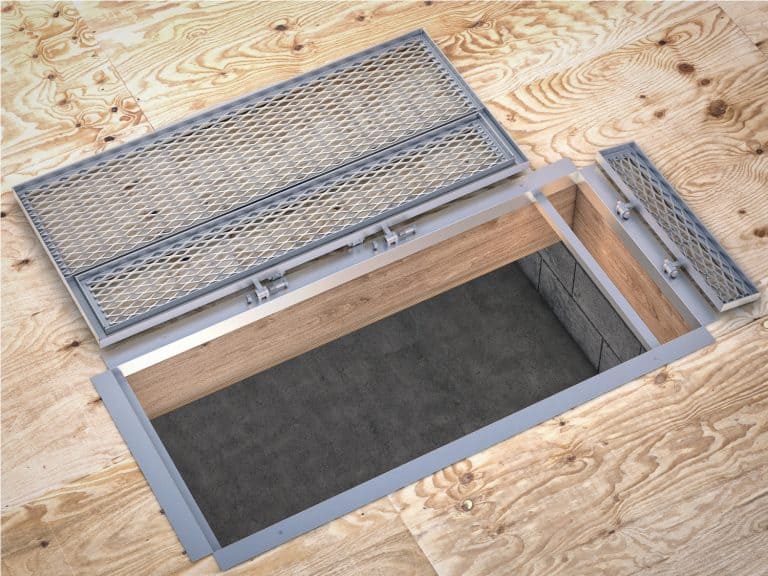
JMAC Safety Systems has launched a new safety product in a bid to protect workers between floors.
Teesside based JMAC Safety Systems announced this month that they have launched a new product to add to their market-leading range of health & safety products. Their latest offering, the MacHatch, has been introduced to the market to solve the issue that there is currently no suitable, tested and safe means of access and egress between floor levels during the construction phase of new dwellings. The firm says the MacHatch solves this problem and is available across the UK immediately. Stating that their product is ‘the future of safe access between floors’, the MacHatch is 3 years in the making and has been trialled, tested and further developed during this time to ensure quality is of the upmost importance and the best on the market. During this period, JMAC has worked alongside some of the UK’s largest housebuilders to ensure they have a product that meets all requirements from an operational, commercial and health and safety perspective on site.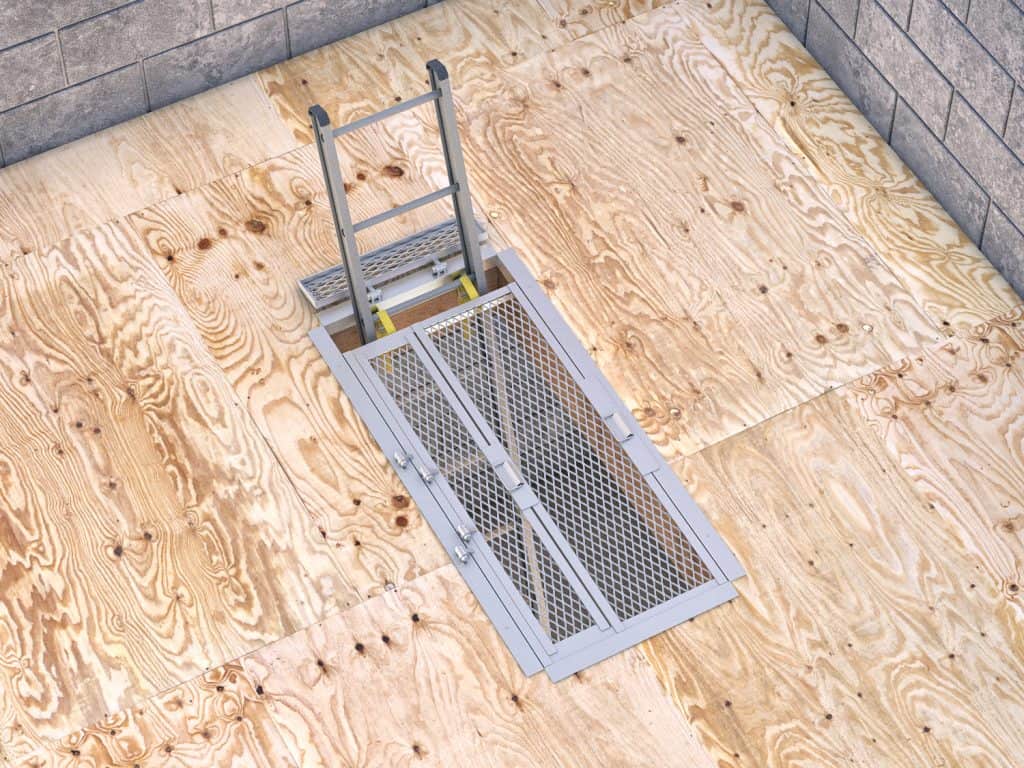 The multi-door loading hatch has been specifically designed to overcome any issues which may arise on site. For example, if a safety decking platform leg lands on one door, operatives are able to use another door to safely gain access to the upper floor levels. The hatch design has been carefully thought out, to ensure speed and productivity is maintained onsite with safety in mind.
Another great USP is the fact that one size fits all. The dimensions of the safety hatch allows the frame to sit within 550mm & 600mm width joist layouts and can be used anywhere within the floor joist layout, the hatch is screwed into position using the 4 holes situated in the frame. In addition to this, the non-slip multi-directional super grip profiled mesh is tested to BS7976 Part 2, a standard used by the Health & Safety executive, giving users added confidence in all weather conditions.
Made in the UK using locally sourced materials and a local supply chain, the MacHatch is available in 2 types: a cost-effective steel option & an ultra-light weight aluminium option too.
Speaking of his newly launched product JMAC Group MD, Luis McCarthy, said: “I know this product is going to be a fantastic addition to the construction industry, we’ve been working on it for over 3 years now and have worked closely with site teams, operatives and suppliers throughout the process to ensure we have it right. JMAC were the first to identify that access and egress between floors for safety decking installers was not suitable on most sites, and it would have been great to be the first one to solve the problem.
Our standards are so high, and we strive to achieve perfection, therefore we have taken our time to launch a product that we’re completely satisfied with. The great thing is that we already have a list of pre orders for this product as the house builders have watched and worked alongside us to develop it, they know the benefit it will bring and I’m delighted with the end result and looking forward to seeing the impact it makes within the industry.”
The multi-door loading hatch has been specifically designed to overcome any issues which may arise on site. For example, if a safety decking platform leg lands on one door, operatives are able to use another door to safely gain access to the upper floor levels. The hatch design has been carefully thought out, to ensure speed and productivity is maintained onsite with safety in mind.
Another great USP is the fact that one size fits all. The dimensions of the safety hatch allows the frame to sit within 550mm & 600mm width joist layouts and can be used anywhere within the floor joist layout, the hatch is screwed into position using the 4 holes situated in the frame. In addition to this, the non-slip multi-directional super grip profiled mesh is tested to BS7976 Part 2, a standard used by the Health & Safety executive, giving users added confidence in all weather conditions.
Made in the UK using locally sourced materials and a local supply chain, the MacHatch is available in 2 types: a cost-effective steel option & an ultra-light weight aluminium option too.
Speaking of his newly launched product JMAC Group MD, Luis McCarthy, said: “I know this product is going to be a fantastic addition to the construction industry, we’ve been working on it for over 3 years now and have worked closely with site teams, operatives and suppliers throughout the process to ensure we have it right. JMAC were the first to identify that access and egress between floors for safety decking installers was not suitable on most sites, and it would have been great to be the first one to solve the problem.
Our standards are so high, and we strive to achieve perfection, therefore we have taken our time to launch a product that we’re completely satisfied with. The great thing is that we already have a list of pre orders for this product as the house builders have watched and worked alongside us to develop it, they know the benefit it will bring and I’m delighted with the end result and looking forward to seeing the impact it makes within the industry.” Scaffolding supervisor saves life of Stanlow Refinery colleague

Altrad Scaffolding supervisor Paul Thomas has been praised by the company for saving the life of a colleague at the Stanlow Refinery.
Working on-site for Essar, he became concerned when a fellow worker seemed to be feeling unwell. He quickly suggested his colleague go to the medical facility to get checked out, though the operative explained he was fine and would be able to continue with his duties. It was clear to Paul something could be wrong and being genuinely worried about the employee, insisted they went to the centre together so his friend could get professional advice. There was certainly nothing wrong with Paul’s intuition as the moment they arrived at the centre, his colleague took a turn for the worse. In fact, it soon became obvious the man was suffering a major heart attack. Together with Chris Walsh, Paul was called on to perform CPR, eventually re-starting the man’s heart. Medical professionals were called to the scene to provide the necessary care and treatment. They later confirmed the actions of both Paul and Chris saved the life of their colleague. Paudie Somers, CEO of Altrad`s UK, Ireland & Nordics business told Scaffmag: “I`d like to take the opportunity to commend Paul on his proactive actions, which proved to be instrumental in saving the life of one of his colleagues. It`s our strong safety culture and our brilliant people that make Altrad the smartest choice, and we are proud have Paul as part of our team.”Construction contracts awarded increase by 81%

Industry analysts say UK contract award numbers in June have increased by 81.4%, signalling an improvement in conditions.
A market review by industry analysts Barbour ABI shows the total value of construction contract awards in June 2020 was £2.2 billion based on a three-month rolling average. Compared to May, this is a decrease of 9.2% and is also 57.3% lower than June 2019. However, contract award numbers in June increased by 81.4% to 477. The residential sector again dominated the share of contract awards with a total of 33.9%. Despite this, the largest project awarded for June was the in the Infrastructure sector with the Gatwick Airport railway station refurbishment, valuing in at £150M. The analysis shows that London has had the largest share of contracts awarded in June at 26.1%. This is followed by the South East at 16.4% and then the North West at 13.6%. Wales was the smallest region with only 1.4% of awards. Commenting on the figures, Tom Hall, Chief Economist at Barbour ABI and AMA Research said, “The UK economy plateaued in May as the easing of some lockdown restrictions mid-way through the month failed to significantly increase output. In-month GDP growth was 1.8% after the 20% contraction in April. With the outcome underwhelming compared to city economists’ expectations of 5.5% growth, output remains 25% down compared to February. June’s figures published next month will give a better understanding of how quickly lost output can be regained as larger parts of the economy resumed activity.” Download the full report here.Hydrajaws Launch New & Improved Digital Bluetooth System
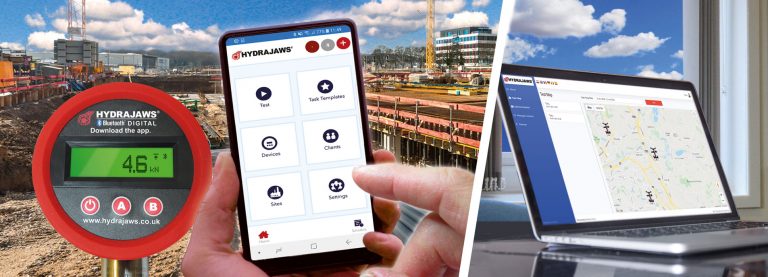
British pull-test manufactures Hydrajaws has launched a new and improved version of its Digital Bluetooth System.
Like the previous version, the Hydrajaws App connects by Bluetooth to a gauge and records pull-test results digitally and stores them in a report complete with result graphs. The new system now goes a step further by including an online customer cloud-based dashboard that can collect these results from a team of users, providing a comprehensive pull-test management system. Instead of purchasing a Bluetooth Digital Gauge, customers can now simply subscribe to an online licence. These licences provide access to the app and online dashboard. Used in conjunction with any Hydrajaws Digital Gauge, pull-tests can now be recorded and stored in a cloud-based database. This database provides a wealth of testing information including a test location map, service centre information, user licence details, gauge calibration dates and full reporting facilities, including the ability to add photos and notes.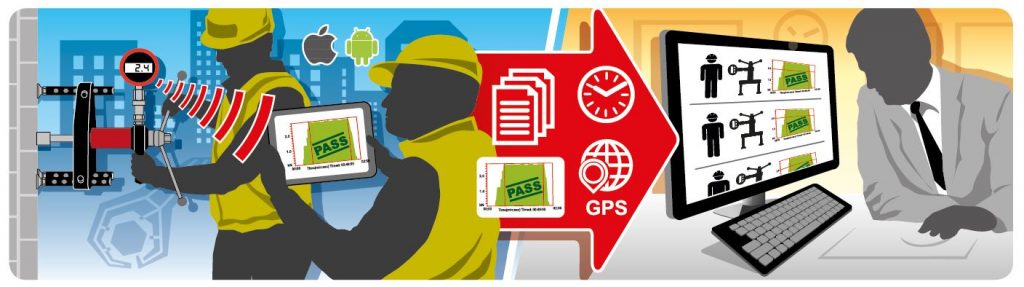 Data in the cloud database is connected to the ‘Evident Proof’ platform; its unique systems encrypts the data, timestamps it and stores it securely on Blockchain technology making it immune to tampering and indisputable proof of the pull test taking place.
Adrian Morgan, Managing Director at Hydrajaws, said: “We are extremely excited about our new app and the powerful pull test management system.”
“When life-threatening incidents occur the consequences and repercussions are very high. Unfortunately for the responsible parties there can be an overriding incentive to corrupt or tamper with the original data so that there is little or, no evidence to apportion blame.”
“Using the Evident Proof’ verification platform mitigates this risk by providing a fully auditable and transparent data provenance trail that is admissible in a court of law.”
Hydrajaws Ltd are a SME, based in Birmingham, who develop, manufacture and sell a range of portable testers for testing the crucial holding force of anchors, fixings in construction materials and engineered lifeline systems for personal fall protection.
For over thirty years their testers have been confirming the on-site safety of fixings in countries worldwide. With their extensive knowledge and expertise, they are regularly approached to provide solutions for a particular testing requirement.
Data in the cloud database is connected to the ‘Evident Proof’ platform; its unique systems encrypts the data, timestamps it and stores it securely on Blockchain technology making it immune to tampering and indisputable proof of the pull test taking place.
Adrian Morgan, Managing Director at Hydrajaws, said: “We are extremely excited about our new app and the powerful pull test management system.”
“When life-threatening incidents occur the consequences and repercussions are very high. Unfortunately for the responsible parties there can be an overriding incentive to corrupt or tamper with the original data so that there is little or, no evidence to apportion blame.”
“Using the Evident Proof’ verification platform mitigates this risk by providing a fully auditable and transparent data provenance trail that is admissible in a court of law.”
Hydrajaws Ltd are a SME, based in Birmingham, who develop, manufacture and sell a range of portable testers for testing the crucial holding force of anchors, fixings in construction materials and engineered lifeline systems for personal fall protection.
For over thirty years their testers have been confirming the on-site safety of fixings in countries worldwide. With their extensive knowledge and expertise, they are regularly approached to provide solutions for a particular testing requirement. Scaffolder seriously injured after falling at Scottish factory

A scaffolder has been rushed to hospital after falling at a factory in Scotland
The 39-year-old worker reportedly fell through the roof of Norbord’s MDF mill in Cowie, Scotland. Emergency services rushed to the scene shortly after 9.30 am yesterday (21 July). It is understood an air ambulance was also called to the chipboard factory. The worker was scrambled to Glasgow’s Queen Elizabeth University hospital to be treated for his injuries. One person who claimed to be onsite at the time told local media “A scaffolder fell through the roof and a girder landed on top of him.” The local police have launched an investigation into the incident and the Health and Safety Executive has been made aware. A spokesperson for Police Scotland said: “Around 9.35 am, officers were called to a report of a worker injured at premises on Station Road, Cowie. “Police and ambulance attended and the 39-year-old man has been taken to the Queen Elizabeth University Hospital in Glasgow. The Health and Safety Executive has been informed. “Officers are currently carrying out enquiries into this incident.” A spokesman for Norbord said: “A contractor erecting scaffolding fell from a platform. Our on-site medical team provided immediate assistance and emergency services were called. “The Health & Safety Executive is currently investigating and we are cooperating with their enquiries.”PERI’s scaffolding division set for growth following key appointment
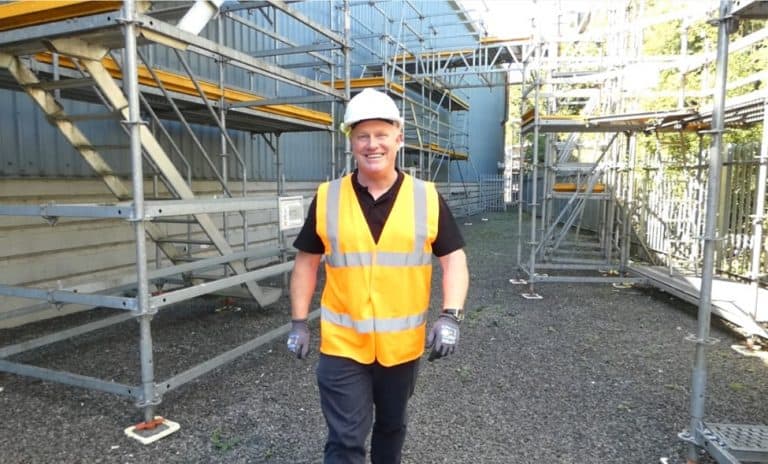
System scaffolding manufactures PERI has appointed Charles Stratford as its Business Development Manager for PERI UP.
The company says the appointment will enable it to develop its scaffolding proposition, so that it is more aligned to meet the growing demand for skilled workers, efficient solutions and digitalisation, now and in the future.
Charles joins PERI with over 20 years’ experience in the industry. The balance between his practical knowledge as a scaffolder early on in his career, coupled with his strategic acumen in recent senior roles made him the right candidate to navigate this new journey for PERI.
Charles will focus on how key challenges such as productivity and safety on site can be overcome by leveraging the benefits of system scaffolding.
Supported by a network of specialists across PERI and a new multimillion-euro production and galvanising plant in Germany, Charles is looking forward to growing PERI UK’s scaffolding division.
Commenting on his appointment, Charles Stratford said, “The features of system scaffold are inherently aligned to the productivity and safety measures that are expected on-site today. Something I am excited about is working with our designers on larger, more bespoke scaffolding solutions for our customers.
We have the right people, the right solutions and the right product for any scaffolding-related service our customers require, giving us the confidence to fulfil any requirement here at PERI.”
Small Business Confidence Bounces Back After Lockdown

Business finance study reveals predictive growth for UK small businesses has almost doubled in just three months.
Research carried out by Hitachi Capital Business Finance shows the proportion of UK small businesses predicting growth has almost doubled in just three months from 14% to 27%. It could be one of the first tangible indications that the Government’s easing of lockdown is having a positive impact on a key area of the UK economy. The quarterly tracking study goes beyond sentiment and confidence, says the business finance company. It examines the percentage of small businesses that actually predict growth in the next three months. Following last quarter’s report, which saw the percentage of small business owners predicting growth plummeting from 39% to just 14%, the new findings show the highest quarter-on-quarter rise in five years. With 27% predicting growth overall, there were significant rises in the percentage of small businesses predicting moderate expansion the next three months (up from 10% to 23%) or no change (26% to 43%). This meant there has been a huge reduction in the percentage of businesses that fear contraction (down from 31% to 19%) or collapse in the next three months (down by almost two thirds from 29% to 11%). By sector, the IT/telecoms sector had the highest proportion of small businesses that predicted growth for the three months to 30th September (44%). The biggest rises in confidence since lockdown were evidenced in and transport and distribution (up from 8% to 34%) and manufacturing (9% to 30%), where the resurgence of growth forecasts was striking. There were also significant rises in sectors hardest hit by lockdown: In retail, the percentage of small businesses predicting growth rose from 21% to 27% – and in hospitality growth forecasts rose from 11% to 16% in the three months since April. The research also suggests that smaller, more agile enterprises will be the fastest to adapt to the UK’s re-emergence from lockdown: Small businesses that had been trading for less than five years (35%) and those that employed 10-49 employees (37%) were most likely to predict business growth for the next three months (to 30th September). Gavin Wraith-Carter, Managing Director at Hitachi Capital Business Finance commented: “The latest Hitachi Capital research findings are remarkable for both the scale and the speed of the revival in small business confidence. We knew last quarter that small business confidence would fall as lockdown started and the scale of the fall was a concern, particularly the steep rise in the number of business owners fearing for their survival. Our new research – just in – shows what an immediate and positive impact the easing of lockdown has had on the small business community. Whilst bigger businesses are having to adjust and adapt at a slower pace, small business confidence across the UK has bounced back and as the engine room of the British economy, today’s figures can give us confidence that small businesses will lead the nation’s effort to rebuild the economy and secure growth.”System scaffolding can help with social distancing, says TRAD