Workmen are being driven up the wall by problems getting permission to park near sites they are working in the center of Oxford.Image courtesy of Oxford Mail
Anthony Burden who is a Plumber and gas heating engineer was told to use park-and-ride buses after being refused exemptins from parking restrictions by staff from NSL who are the contractor which control on-street parking for Oxford county council.
The Plumber who does a lot of work for Oxford University and shops in the center of oxford said:
“Before NSL took over, we had a system everyone understood.
“We could go to the old city council parking shop on a Monday and pay £15 for a permit for the week and they left us alone.
“When NSL first came in, they were very helpful. The dispensations became free and it seemed to be working well but recently we are finding it harder and harder to get them.
“We just do not know where we stand. It has become a lottery. Sometimes you get a dispensation, sometimes not.
“Small businesses need all the help they can get at the moment.
“The Government’s saying that we are vital to getting the economy going again but NSL are not helping us.”
Scaffolder Michael Palmer said: “It just seems to be getting worse and we’re losing money over it. An hour’s pay one day, a day’s pay other times. We don’t mind paying a fee, so long as we know where we stand.”
A council spokesman said: “A request for special dispensation to park in a restricted area can be made by calling 08453 371138.
“When determining whether permission can be given we have to look at the regulations in place, the presence of any other vehicles that may be working in the area, and whether there is any viable alternative for the vehicle to park legally. This involves looking at whether there is off-street parking available close by.
“These criteria have remained unchanged since the council took on responsibility for on-street parking enforcement in 1997.”
NSL said the rules for parking dipensations are a matter for the Oxford county council.
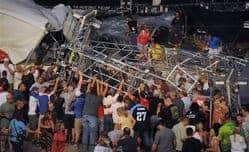
A stage collapsed during a powerful storm at the Indiana State Fair on Saturday, sending steel scaffolding into the terrified crowd and killing at least five people awaiting a performance by the country band Sugarland.The collapse came moments after an announcer warned of the advancing storm and gave instructions on what to do in event of an evacuation. Witnesses said a wall of dirt, dust and rain blew up quickly like a dust bowl and a burst of high wind toppled the rigging. People ran, screaming and shouting, desperate to get out of the way.
Afterward, hundreds of concert-goers rushed amid the chaos to tend to the injured, many trying to lift heavy beams, lights and other equipment that blew onto the crowd. Witnesses said many of the injured were in the VIP section closest to the stage, known as the “Sugar Pit.” Emergency crews set up a triage center in a tunnel below the grandstand at the Indianapolis fairgrounds.
Indiana State Police 1st Sgt David Bursten said Sunday that four people died when the collapse happened and a fifth person died overnight at a hospital. At least 45 people were injured and treated at hospitals. Bursten said the injuries ranged from cuts and scrapes to “very serious injuries.”
At least 18 people were taken to Wishard Memorial Hospital with problems ranging from head injuries and bone fractures to lacerations and other cuts and bruises, hospital spokesman Todd Harper said. He said those injuries were not life-threatening and conditions ranged from fair to critical. One person treated there was a 7-year-old child, he said, but didn’t elaborate further.
Indiana University Health said Sunday that 26 people were treated at its hospitals, including three at its children’s hospital. It said 16 were brought from the fair by ambulance, and all but one of those patients remained hospitalized.
Fair officials canceled all activities Sunday. The fair, which runs through Aug. 21, was expected to resume Monday with a service honoring the victims, Bursten said.
The Iowa State Fair announced Sugarland and opening act Sara Bareilles had canceled their Sunday show there.
Sugarland lead singer Jennifer Nettles issued a statement Sunday saying the band is “stunned and heartbroken for the fans and their families in Indiana. We hold those injured in our prayers at this very sad time. There are no words. It is tragic.”
Nettles and Kristian Bush have sold more than 8 million records performing as Sugarland.
Emergency personnel and fair officials had been monitoring the weather and preparations were being made to evacuate the facility because a severe storm was expected in the area around 9:15 p.m., Bursten said. But the storm hit just before 9 p.m., and a “significant gust of wind” struck the stage rigging that holds lights and other equipment before the evacuation plan was activated, he said.
“As we all know, weather can change in a very rapid period of time,” he said.
Concert-goers said Bareilles had finished performing and the crowd was waiting for Sugarland to take the stage. They said an announcer alerted them that severe weather was possible and gave instructions on what to do if an evacuation was necessary. But the same announcer said concert organizers hoped the show would go on, and many fans stayed put.
The wind that toppled the rigging came just minutes after that announcement, fans said.
“It was like it was in slow motion,” concert-goer Amy Weathers told the Indianapolis Star. “You couldn’t believe it was actually happening.”
Associated Press photographer Darron Cummings was in the audience shortly before the collapse. He said he and his companions sought shelter in a nearby barn after seeing dark clouds approaching.
“Then we heard screams. We heard people just come running,” Cummings told the AP. “When you see dark clouds like that, if there’s going to be bad weather, there’s going to be mass chaos on leaving.”
Witnesses told WTHR that dirt, dust, rain and wind came up the main thoroughfare of the fairgrounds just before the collapse.
“Panic kicked in when they seen the dust bowl coming in from the Midway,” concert-goer Darryl Cox told the television station.
Another person at the concert, Emily Davis, told the station there was lightning and the sky got dark but it wasn’t raining when the wind suddenly toppled the rigging.
“It was horrible, people were running and going crazy,” she said.
Jessica Alsman told the AP the towering, metal stage scaffolding “kind of wobbled at first.” Then pandemonium set in as it fell.
“As soon as we saw the wind gust, the wind was in our faces,” Alsman said. She and three friends grabbed each other and formed a chain.
“You can’t imagine _ we just thought it was going to rain or something,” Alsman said.
The Marion County Coroner’s office identified the five victims as 23-year-old Alina Bigjohny of Fort Wayne, 29-year-old Christina Santiago of Chicago, and three Indianapolis residents: 42-year-old Tammy Vandam, 49-year-old Glenn Goodrich and 51-year-old Nathan Byrd. It was Byrd who died overnight.
Indiana’s position in the Midwest has long made it prone to volatile changes in weather. In April 2006, tornado-force winds hit Indianapolis just after thousands of people left a free outdoor concert by John Mellencamp held as part of the NCAA men’s Final Four college basketball championship tournament.
And in May 2004, a tornado touched down south of the Indianapolis Motor Speedway, delaying the start of the Indianapolis 500 and forcing a nearly two-hour interruption in the race.
CADS are pleased to announce the latest software update of model IT, which now supports the Kwikstage system.Kwikstage System Scaffolding
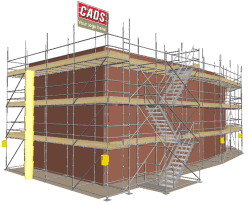
In model IT 3.1 Kwikstage scaffolding can be used to build independent or birdcage scaffolding. Options are available to build with continuous or single-bay façade bracing, with steel or timber battens, using guard rails or Kwikguard frames. Depending on the modules that you have licensed you can print a Kwikstage material list and drawings, or export drawings to PDF or AutoCAD DXF
Even more System Scaffolding Support!
New system staircases have been provided for Cuplok and Kwikstage scaffolding, enabling users to build a Cuplok staircase with 8 or 10 legs or a Kwikstage scaffold with 8 or 12 legs.
Other New Features
As with all of our releases many of our customers popular requests have also been added, including new staircases, ladder hatches, deck adaptors, steel toe boards, corner fillers and improvements to the drawings so this release has something for everyone, whether an existing user or not.
Find out more at www.smartscaffolder.com
The Scaffolder is among a string of suspected rioters and looters who were facing court today.805 arrests have been made in London so far after four nights of violence across the UK.
Christopher Heart, 23, Chingford, Essex, was caught red-handed in a JD sports shop in the same area wearing brand new trainers and a body warmer with the tags still attached.
the dad of two pleaded guilty to burglary with intent to steal he said he was “sorry for the inconvenience caused by the recent riots”
shouted he was “sorry for the inconvenience caused by the recent riots” after pleading guilty to burglary with intent to steal at Highbury Magistrates Court.
The case was committed to the Crown Court as magistrates ruled they had insufficient powers to sentence him.
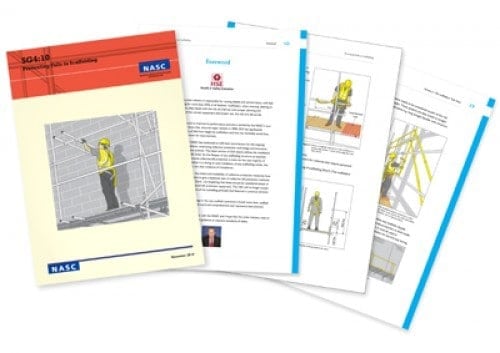
SG4:10 (Preventing Fall’s in Scaffolding) the Safety Guidance was released in December 2010 by the NASC (National Access and Scaffolding Confederation) which has become the the established minimum standard for fall prevention in the scaffolding industry.
The new revision of the guidance saw the removal of the ‘tunneling unprotected traversing element’ and saw the introduction of the ‘Scaffolders Safe Zone’.ScaffMag.com has gained an exclusive interview with Simon Hughes who is the Technical Author of the SG4 Working Party. We gave you our loyal readers and our 2,000 strong facebook fan page followers the chance to ask the questions.We read through your questions and picked the best 10 to be answered by the man in the know Simon Hughes CMIOSH, MIIRSMQ – Dave Asks: “SG4:10 is it Guidance or Law ?”A – “SG4 is not law, it is simply industry guidance. However HSE and the courts might make reference to it as an example of good practice. In your defence you would have to demonstrate that you did something as good as or better than, if choosing not to comply with SG4. In simple terms you would be better off working to the principles of SG4 rather than risking injury/enforcement action or trying to reinventing the wheel.Q – Steve Asks: “What powers have the HSE got if your found to be not working to SG4:10?”A – “The HSE will enforce the Work at Height Regs as the law and not SG4, however they may cite SG4 as an example of how you can comply. They can stop you working, and even prosecute you as an individual and your employer.Q – Andy Canning Asks : “What is the proposed weight which would be exerted on a scaff hook by a fall by average joe ?”A – “Scaffold hooks (connectors) are designed and tested to the British and European Standard (BS EN 362:2004) and must have a minimum static load rating of 20kN (approximately 2 tonnes of force). Also the shock absorber on your lanyard (BS EN 355: 2002) must reduce the load imposed to no more than 6kN (approximately 600kg) in a fall. The test mass used to test personal fall protection equipment and anchor points is 100kg (approximately 15 ½ stone) which is based on (believe it or not) a European ergonomic model for an average Joe. I appreciate that there are many scaffolders using this equipment that weigh considerably more than 15 ½ stone and some manufacturers offer supersized harnesses for example, but this should not affect the strength of the connectors. Your main concern as a scaffolder should be the suitability of anchor point, providing your connector is in good working order.”Q – Mark Wilkinson Asks: “I work offshore and do a lot of hop up and various scaffolds which are only 2 to 4ft off the ground also lots of pipes and things in the way you can hardly get up there yourself to put a handrail up in the first place. How can we get this advanced handrail up there for us to put handrail on ?”A –“I agree, trying to weave a scaffold through complex pipework and plant off-shore or on an industrial plant is difficult and that most proprietary advanced guardrail systems are indeed unsuitable for such applications due to the amount of obstructions.The collective guardrail options in SG4:10 were designed to provide a range of solutions available to the scaffolder to suit most scaffolding applications. As consultants and inspectors we are tending to see more industrial and off-shore scaffolders opting for the short-lift system of work to provide collective protection in advance and where this cannot be achieved resorting to double lanyard methods to ensure they are continually attached until the guardrails are installed.I do appreciate that most of these short ‘hop-up’ scaffolds would not provide a suitable anchor-point for a conventional scaffolders lanyard and I share scaffolders frustrations when clients insist on 100% clipping on even when the equipment would be ineffective.”Q – Martin Forsythe Asks: “What was wrong with SG4:05? Why did SG4:10 have to be such a radical change to SG4:05? Why cant scaffolders and scaffolding companies have some consultation where they can express their views in the hope that we can find easier solutions before these guidance notes get foisted upon us ?”A – “SG4 revisions in 2000 and subsequently in 2005 were effectively a compromise agreement between the HSE and NASC, permitting scaffolders to traverse out on a boarded lift without fall protection which didn’t comply with the law at that time.The HSE accepted our argument that scaffolders needed to transfer themselves and materials along a lift and that clipping on and off with double lanyards at every transom was impractical, in the absence of any other technology. However, the guide was viewed as a significant step forward by the industry on the basis that it is reviewed at least every 5 years, with changes in legislation or technology, or following any significant accident learning.”In the lead up to the 2010 revision, HSE made their views very clear to the industry that they were unhappy with certain elements of the old tunnelling principle and that by the time of the next revision (2010), the unprotected traversing would no longer be considered acceptable. This was communicated via the NASC in SG4:05 Appendix A in 2008, some 2 years before the latest revision.Prior to the 2010 revision, there was extensive consultation with in the NASC and at HSE scaffolding events (Safety and Health Awareness Days, Working Well Together campaigns etc.) and exhibitions (IOSH, H&S Expo, Access Industry Forum). I personally delivered two rounds of presentations at all of the NASC regional meetings in 2009 and 2010 to seek input from the membership. Ultimately Safety Guidance Number 4 is an NASC publication and the NASC is the only nationally recognised industry association and thereby viewed by many as the representative body for the scaffolding trade.”Q – Stewart Quinney Asks: “Why is scaffolding an easy target yet not many scaffolders have accidents ?”A – “I agree the scaffolding trade is an easy target, especially when you consider how few accidents occur compared with other high risk trades such as demolition or roofing. However, if you look at the NASC and HSE statistics it was not always the case and reputations and perceptions take a long time to change.The gap between the professional contractors wanting to do the right thing and everyone else is growing, which I personally support, as it will drive contractors to improve safety or compete further down the food chain. Client’s expectations for health and safety performance is also increasing, despite the difficult economic climate.Looking at the impact of SG4 and falls, which is perceived to be our biggest risk, there has been a significant reduction in the number of falls since 2000. However, we still see too many examples of unsafe practice by certain elements of our industry that will ensure our trade continues to receive a disproportionate amount of attention.Ultimately, we are an easy target and very visible, by the nature of the job.”
Q – Tony Warburton Asks: “Is advanced guard rails a legal requirement ?”A – “No Advanced Guardrail Systems are not specifically a legal requirement, but the use of collective protection over personal protection is. How you, as a scaffolder, maintain collective protection during erection, altering and dismantling scaffold was the challenge faced by the NASC when considering the legal changes brought about by the Work at Height Regulations 2005 and to a certain degree the previous Construction (Health, Safety and Welfare) Regulations 1996.SG4:10 focuses on creating a scaffolders’ safe zone and features a range of solutions for the majority of scaffolding applications.At some point, in most jobs, the scaffolder will be faced with a risk of a fall and will need to resort to his personal fall protection equipment (harness). However, if you were to choose harnesses and lanyards over the collective protection achieved by a guardrail, then you would have to justify why. Given the range of technology and low cost solutions available and featured in SG4:10 you would have to go a long way to satisfy the HSE and possibly the court that a guardrail collective protection method of working was not justifiable.”Q – Curt Willetts Asks: “When I did my scaff step course our instructor told us we should not top out over the handrail. so what we should do is top out stood on a 2ft square platform! in my eyes its safer to do it stood on the boarded lift before the handrails gone in.”A – “I agree fully that topping out from a scaffolders step should be avoided. I appreciate that it may be unavoidable with some system scaffolds and that hemping over a guardrail introduces additional hazards. Especially where you are topping out with long tube to a short hemp. Scaffolders and employers should consider this additional hazard and assess the length of tube and the height of the temp being negotiated. Although I do also appreciate that joint positions and staggers also need to be considered. In any case working from a fully boarded platform will allow better movement, good balance and posture for what is one of the most strenuous manual handling tasks a scaffolder performs.”Q – Shaun Barrett Asks: Sg4.10 “It isn’t just about advanced guard rails and using hop ups the way around it is to use a double landyard (crabbing) your clipped on at all times, is this correct ?”A – “Using collective protection to create a safe zone is the priority for typical scaffolds founded on the ground. In my opinion, the protected traverse using double guardrails is a last resort, as you would be relying upon personal fall protection as your primary means of protection, when other safer collective measures may be available. I have used the double lanyard system and it is easier, especially with karabiners that are designed to clip to the standards, but the law requires us to consider collective protection first.”Q – Shaun Farmer Asks: “How can we use an advanced guardrail on a hanger ?”A – “I’m not aware of an advanced guardrail method for a hanger. Typically you’d rig up retrievable inertia blocks for working from droppers. As a priority you should fix guardrails as soon as the lift is formed. Interestingly I did see a truss-out being erected where the scaffolders assembled a frame and pushed it out horizontally as an advanced guardrail prior to boarding out and fixing the puncheons. The best ideas and innovations come from the scaffolders themselves, so I’m sure it’s only a matter of time before some comes up with something for a hanger.”Q – Steve Asks: “What powers have the HSE got if your found to be not working to SG4:10?”A – “The HSE will enforce the Work at Height Regs as the law and not SG4, however they may cite SG4 as an example of how you can comply. They can stop you working, and even prosecute you as an individual and your employer.”
I would like to thank Simon Huges for his time in taking part in this Q&A.
If you require more information regarding SG4:10 please visits www.nasc.org.uk
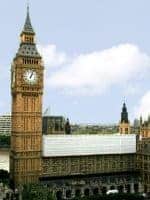
One of the largest scaffolding companies in the southeast Benchmark Scaffolding Ltd which employes over 350 scaffolders was placed in administration but is back in business with the SAME name.Benchmark Scaffolding Ltd work has been around some of London’s most famous buildings that include Selfridges in Oxford Street, Houses of Parliament and Allenbuilds’s roof refurbishment.
Benchmark Scaffolding Ltd was placed into administration but was recently purchased by a unknown company that is owned by investor RCapital, which then changed it’s name to BSL Realisations 2011 ltd that then ceased trading.
The purchasing company then changed its name to Benchmark Scaffolding Ltd which is who they are now.
The restructuring has helped save more than 350 jobs and ensured the continuation of building works at the Olympic site in Stratford
This move for Benchmark has now made the company considerably financially stronger and has once again the capacity to expand there customer base and business interests.
Written By Daniel Norton
*A previous news story about this has been removed as parts were untrue and misrepresented Benchmark Scaffolding Ltd which i apologize for.*
A Skipton couple were baffled when they returned from holiday to find scaffolding had been erected around their home and parts of the exterior were missing.Graham and Susan Tudgey, who had not asked for any work to be carried out, were shocked to discover relatively new guttering and downpipes had been removed, thrown in a skip and taken away.
“It turned out that Yorkshire Housing, who own two properties on the same row as me, sent contractors and erected scaffolding around the wrong houses,” said Mr Tudgey.
“It really annoyed me. Not only because they had no right to enter my property without permission, but because I had only recently replaced my guttering and downspouts when I had a new roof fitted last year.”
Mr Tudgey, who lives in one of a block of four terrace houses in Clifford Court, off Broughton Road, immediately tried to contact Yorkshire Housing, but to no avail.
“I have tried to speak to someone at Yorkshire Housing’s repair team and asked for someone to ring me back or make a home visit, but I think they are too embarrassed to talk to me,” he said.
“I may now seek legal advice to find out whether I could claim for illegal entry and trespass onto my property, damage to my guttering and rent for the scaffolding that is taking up space on my property.”
Yesterday, Chris Welch, head of investment at Yorkshire Housing, apologised to the Tudgeys for the error and promised their home would receive new guttering before the weekend.
“Yorkshire Housing has been working with a local contractor to carry out guttering repairs on some of our properties and due to an error, the wrong property was identified by workmen,” he said.
“We have spoken at length with the contractor who has expressed sincere apologies to the Tudgeys.
“We are now installing new and improved guttering on the property, with a 25 year guarantee, along with other painting and repair works, this will be done in the next two days.”
He added: “Yorkshire Housing sincerely apologies for the inconvenience caused. We will be working closely with our contractor to ensure future works are carried out without error and all works meet with the Tudgeys’ expectations.”
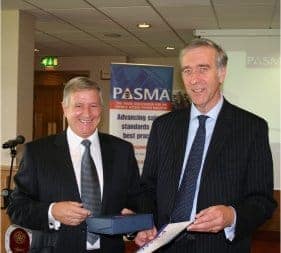
Harsco’s Product Marketing Manager has been presented with its prestigious Lifetime Achievement Award.
Peter Bond has been at Harsco Infastructure for 20 years, his decision to retire prompted the special achievement.
PASMA (Prefabricated Access Suppliers’ and Manufactures’ Association) presented Peter with the prestigious award at there annual meeting in Haydock last month which has only been given out to 3 other people in 30 years.
Peter said:
“It has been very rewarding working on the PASMA Council. The training certification scheme is now one of the largest of its kind, and it is the most powerful voice on mobile tower safety in this country.
“I feel I have learnt an enormous amount over the years, and hopefully have made a useful contribution along the way. I wish them all good luck in the future.”
Founded in 1974, PASMA is the recognised focus and authority for mobile access towers, promoting safety standards and best practice across a range of sectors and representing the interests of manufacturers, suppliers, specifiers and users.
The association’s training scheme is one of the most successful and largest schemes of its kind in the UK, with 50,000 users completing it each year.
One of New York’s biggest scaffolding companies must submit to a court-approved financial monitor, and its owners must pay $1.9 million, to resolve a massive felony tax-cheating scheme, a Manhattan judge ruled on Thursday.
Regional Scaffolding owners Paul Mazzucca, 43, and Lawrence Blinn, 51, each must also serve five years’ probation.
Both pleaded guilty in May.
Their Bronx-based scaffolding company has made tens of millions of dollars off city contracts, including at the now-demolished, 9/11-damaged Deutsche Bank building.
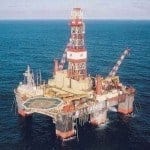
Cape has secured two new contracts that will provide specialist access services offshore around Australia.Cape will be providing a range of scaffolding services which include design and offshore supervision on the multi billion dollar ExxonMobil Kipper Tuna Turrum project, which is one of the largest domestic gas developments in the East Pacific Ocean.
The project has been estimated at 6-8 months work by McDermott Australia who has contracted Cape to supply there scaffolding services Cape also have the possibility of further maintenance or project work on the same multibillion dollar project.
Cape’s newly formed Marine & Offshore division has also been contracted by Sapura Acergy Australia to provide rope access services for removal of the old Montara Platform in the Timor Sea.
Chief Executive of Cape, Martin May, said:
“Securing these contracts is as major achievement for Cape’s newly formed Marine & Offshore division. In the offshore environment it is essential that the crews work together and share the common goal of flawlessness. Cape has demonstrated its ability to deliver to the highest standards offshore and is delighted to be securing further business in this area.”
We use cookies on our website to give you the most relevant experience by remembering your preferences and repeat visits. By clicking “Accept”, you consent to the use of ALL the cookies.
This website uses cookies to improve your experience while you navigate through the website. Out of these, the cookies that are categorized as necessary are stored on your browser as they are essential for the working of basic functionalities of the website. We also use third-party cookies that help us analyze and understand how you use this website. These cookies will be stored in your browser only with your consent. You also have the option to opt-out of these cookies. But opting out of some of these cookies may affect your browsing experience.
Necessary cookies are absolutely essential for the website to function properly. These cookies ensure basic functionalities and security features of the website, anonymously.
Cookie
Duration
Description
cookielawinfo-checbox-analytics
11 months
This cookie is set by GDPR Cookie Consent plugin. The cookie is used to store the user consent for the cookies in the category "Analytics".
cookielawinfo-checbox-functional
11 months
The cookie is set by GDPR cookie consent to record the user consent for the cookies in the category "Functional".
cookielawinfo-checbox-others
11 months
This cookie is set by GDPR Cookie Consent plugin. The cookie is used to store the user consent for the cookies in the category "Other.
cookielawinfo-checkbox-necessary
11 months
This cookie is set by GDPR Cookie Consent plugin. The cookies is used to store the user consent for the cookies in the category "Necessary".
cookielawinfo-checkbox-performance
11 months
This cookie is set by GDPR Cookie Consent plugin. The cookie is used to store the user consent for the cookies in the category "Performance".
viewed_cookie_policy
11 months
The cookie is set by the GDPR Cookie Consent plugin and is used to store whether or not user has consented to the use of cookies. It does not store any personal data.
Functional cookies help to perform certain functionalities like sharing the content of the website on social media platforms, collect feedbacks, and other third-party features.
Performance cookies are used to understand and analyze the key performance indexes of the website which helps in delivering a better user experience for the visitors.
Analytical cookies are used to understand how visitors interact with the website. These cookies help provide information on metrics the number of visitors, bounce rate, traffic source, etc.
Advertisement cookies are used to provide visitors with relevant ads and marketing campaigns. These cookies track visitors across websites and collect information to provide customized ads.


 The collapse came moments after an announcer warned of the advancing storm and gave instructions on what to do in event of an evacuation. Witnesses said a wall of dirt, dust and rain blew up quickly like a dust bowl and a burst of high wind toppled the rigging. People ran, screaming and shouting, desperate to get out of the way.
Afterward, hundreds of concert-goers rushed amid the chaos to tend to the injured, many trying to lift heavy beams, lights and other equipment that blew onto the crowd. Witnesses said many of the injured were in the VIP section closest to the stage, known as the “Sugar Pit.” Emergency crews set up a triage center in a tunnel below the grandstand at the Indianapolis fairgrounds.
Indiana State Police 1st Sgt David Bursten said Sunday that four people died when the collapse happened and a fifth person died overnight at a hospital. At least 45 people were injured and treated at hospitals. Bursten said the injuries ranged from cuts and scrapes to “very serious injuries.”
At least 18 people were taken to Wishard Memorial Hospital with problems ranging from head injuries and bone fractures to lacerations and other cuts and bruises, hospital spokesman Todd Harper said. He said those injuries were not life-threatening and conditions ranged from fair to critical. One person treated there was a 7-year-old child, he said, but didn’t elaborate further.
Indiana University Health said Sunday that 26 people were treated at its hospitals, including three at its children’s hospital. It said 16 were brought from the fair by ambulance, and all but one of those patients remained hospitalized.
Fair officials canceled all activities Sunday. The fair, which runs through Aug. 21, was expected to resume Monday with a service honoring the victims, Bursten said.
The Iowa State Fair announced Sugarland and opening act Sara Bareilles had canceled their Sunday show there.
Sugarland lead singer Jennifer Nettles issued a statement Sunday saying the band is “stunned and heartbroken for the fans and their families in Indiana. We hold those injured in our prayers at this very sad time. There are no words. It is tragic.”
Nettles and Kristian Bush have sold more than 8 million records performing as Sugarland.
Emergency personnel and fair officials had been monitoring the weather and preparations were being made to evacuate the facility because a severe storm was expected in the area around 9:15 p.m., Bursten said. But the storm hit just before 9 p.m., and a “significant gust of wind” struck the stage rigging that holds lights and other equipment before the evacuation plan was activated, he said.
“As we all know, weather can change in a very rapid period of time,” he said.
Concert-goers said Bareilles had finished performing and the crowd was waiting for Sugarland to take the stage. They said an announcer alerted them that severe weather was possible and gave instructions on what to do if an evacuation was necessary. But the same announcer said concert organizers hoped the show would go on, and many fans stayed put.
The wind that toppled the rigging came just minutes after that announcement, fans said.
“It was like it was in slow motion,” concert-goer Amy Weathers told the Indianapolis Star. “You couldn’t believe it was actually happening.”
Associated Press photographer Darron Cummings was in the audience shortly before the collapse. He said he and his companions sought shelter in a nearby barn after seeing dark clouds approaching.
“Then we heard screams. We heard people just come running,” Cummings told the AP. “When you see dark clouds like that, if there’s going to be bad weather, there’s going to be mass chaos on leaving.”
Witnesses told WTHR that dirt, dust, rain and wind came up the main thoroughfare of the fairgrounds just before the collapse.
“Panic kicked in when they seen the dust bowl coming in from the Midway,” concert-goer Darryl Cox told the television station.
Another person at the concert, Emily Davis, told the station there was lightning and the sky got dark but it wasn’t raining when the wind suddenly toppled the rigging.
“It was horrible, people were running and going crazy,” she said.
Jessica Alsman told the AP the towering, metal stage scaffolding “kind of wobbled at first.” Then pandemonium set in as it fell.
“As soon as we saw the wind gust, the wind was in our faces,” Alsman said. She and three friends grabbed each other and formed a chain.
“You can’t imagine _ we just thought it was going to rain or something,” Alsman said.
The Marion County Coroner’s office identified the five victims as 23-year-old Alina Bigjohny of Fort Wayne, 29-year-old Christina Santiago of Chicago, and three Indianapolis residents: 42-year-old Tammy Vandam, 49-year-old Glenn Goodrich and 51-year-old Nathan Byrd. It was Byrd who died overnight.
Indiana’s position in the Midwest has long made it prone to volatile changes in weather. In April 2006, tornado-force winds hit Indianapolis just after thousands of people left a free outdoor concert by John Mellencamp held as part of the NCAA men’s Final Four college basketball championship tournament.
And in May 2004, a tornado touched down south of the Indianapolis Motor Speedway, delaying the start of the Indianapolis 500 and forcing a nearly two-hour interruption in the race.
The collapse came moments after an announcer warned of the advancing storm and gave instructions on what to do in event of an evacuation. Witnesses said a wall of dirt, dust and rain blew up quickly like a dust bowl and a burst of high wind toppled the rigging. People ran, screaming and shouting, desperate to get out of the way.
Afterward, hundreds of concert-goers rushed amid the chaos to tend to the injured, many trying to lift heavy beams, lights and other equipment that blew onto the crowd. Witnesses said many of the injured were in the VIP section closest to the stage, known as the “Sugar Pit.” Emergency crews set up a triage center in a tunnel below the grandstand at the Indianapolis fairgrounds.
Indiana State Police 1st Sgt David Bursten said Sunday that four people died when the collapse happened and a fifth person died overnight at a hospital. At least 45 people were injured and treated at hospitals. Bursten said the injuries ranged from cuts and scrapes to “very serious injuries.”
At least 18 people were taken to Wishard Memorial Hospital with problems ranging from head injuries and bone fractures to lacerations and other cuts and bruises, hospital spokesman Todd Harper said. He said those injuries were not life-threatening and conditions ranged from fair to critical. One person treated there was a 7-year-old child, he said, but didn’t elaborate further.
Indiana University Health said Sunday that 26 people were treated at its hospitals, including three at its children’s hospital. It said 16 were brought from the fair by ambulance, and all but one of those patients remained hospitalized.
Fair officials canceled all activities Sunday. The fair, which runs through Aug. 21, was expected to resume Monday with a service honoring the victims, Bursten said.
The Iowa State Fair announced Sugarland and opening act Sara Bareilles had canceled their Sunday show there.
Sugarland lead singer Jennifer Nettles issued a statement Sunday saying the band is “stunned and heartbroken for the fans and their families in Indiana. We hold those injured in our prayers at this very sad time. There are no words. It is tragic.”
Nettles and Kristian Bush have sold more than 8 million records performing as Sugarland.
Emergency personnel and fair officials had been monitoring the weather and preparations were being made to evacuate the facility because a severe storm was expected in the area around 9:15 p.m., Bursten said. But the storm hit just before 9 p.m., and a “significant gust of wind” struck the stage rigging that holds lights and other equipment before the evacuation plan was activated, he said.
“As we all know, weather can change in a very rapid period of time,” he said.
Concert-goers said Bareilles had finished performing and the crowd was waiting for Sugarland to take the stage. They said an announcer alerted them that severe weather was possible and gave instructions on what to do if an evacuation was necessary. But the same announcer said concert organizers hoped the show would go on, and many fans stayed put.
The wind that toppled the rigging came just minutes after that announcement, fans said.
“It was like it was in slow motion,” concert-goer Amy Weathers told the Indianapolis Star. “You couldn’t believe it was actually happening.”
Associated Press photographer Darron Cummings was in the audience shortly before the collapse. He said he and his companions sought shelter in a nearby barn after seeing dark clouds approaching.
“Then we heard screams. We heard people just come running,” Cummings told the AP. “When you see dark clouds like that, if there’s going to be bad weather, there’s going to be mass chaos on leaving.”
Witnesses told WTHR that dirt, dust, rain and wind came up the main thoroughfare of the fairgrounds just before the collapse.
“Panic kicked in when they seen the dust bowl coming in from the Midway,” concert-goer Darryl Cox told the television station.
Another person at the concert, Emily Davis, told the station there was lightning and the sky got dark but it wasn’t raining when the wind suddenly toppled the rigging.
“It was horrible, people were running and going crazy,” she said.
Jessica Alsman told the AP the towering, metal stage scaffolding “kind of wobbled at first.” Then pandemonium set in as it fell.
“As soon as we saw the wind gust, the wind was in our faces,” Alsman said. She and three friends grabbed each other and formed a chain.
“You can’t imagine _ we just thought it was going to rain or something,” Alsman said.
The Marion County Coroner’s office identified the five victims as 23-year-old Alina Bigjohny of Fort Wayne, 29-year-old Christina Santiago of Chicago, and three Indianapolis residents: 42-year-old Tammy Vandam, 49-year-old Glenn Goodrich and 51-year-old Nathan Byrd. It was Byrd who died overnight.
Indiana’s position in the Midwest has long made it prone to volatile changes in weather. In April 2006, tornado-force winds hit Indianapolis just after thousands of people left a free outdoor concert by John Mellencamp held as part of the NCAA men’s Final Four college basketball championship tournament.
And in May 2004, a tornado touched down south of the Indianapolis Motor Speedway, delaying the start of the Indianapolis 500 and forcing a nearly two-hour interruption in the race.
 The collapse came moments after an announcer warned of the advancing storm and gave instructions on what to do in event of an evacuation. Witnesses said a wall of dirt, dust and rain blew up quickly like a dust bowl and a burst of high wind toppled the rigging. People ran, screaming and shouting, desperate to get out of the way.
Afterward, hundreds of concert-goers rushed amid the chaos to tend to the injured, many trying to lift heavy beams, lights and other equipment that blew onto the crowd. Witnesses said many of the injured were in the VIP section closest to the stage, known as the “Sugar Pit.” Emergency crews set up a triage center in a tunnel below the grandstand at the Indianapolis fairgrounds.
Indiana State Police 1st Sgt David Bursten said Sunday that four people died when the collapse happened and a fifth person died overnight at a hospital. At least 45 people were injured and treated at hospitals. Bursten said the injuries ranged from cuts and scrapes to “very serious injuries.”
At least 18 people were taken to Wishard Memorial Hospital with problems ranging from head injuries and bone fractures to lacerations and other cuts and bruises, hospital spokesman Todd Harper said. He said those injuries were not life-threatening and conditions ranged from fair to critical. One person treated there was a 7-year-old child, he said, but didn’t elaborate further.
Indiana University Health said Sunday that 26 people were treated at its hospitals, including three at its children’s hospital. It said 16 were brought from the fair by ambulance, and all but one of those patients remained hospitalized.
Fair officials canceled all activities Sunday. The fair, which runs through Aug. 21, was expected to resume Monday with a service honoring the victims, Bursten said.
The Iowa State Fair announced Sugarland and opening act Sara Bareilles had canceled their Sunday show there.
Sugarland lead singer Jennifer Nettles issued a statement Sunday saying the band is “stunned and heartbroken for the fans and their families in Indiana. We hold those injured in our prayers at this very sad time. There are no words. It is tragic.”
Nettles and Kristian Bush have sold more than 8 million records performing as Sugarland.
Emergency personnel and fair officials had been monitoring the weather and preparations were being made to evacuate the facility because a severe storm was expected in the area around 9:15 p.m., Bursten said. But the storm hit just before 9 p.m., and a “significant gust of wind” struck the stage rigging that holds lights and other equipment before the evacuation plan was activated, he said.
“As we all know, weather can change in a very rapid period of time,” he said.
Concert-goers said Bareilles had finished performing and the crowd was waiting for Sugarland to take the stage. They said an announcer alerted them that severe weather was possible and gave instructions on what to do if an evacuation was necessary. But the same announcer said concert organizers hoped the show would go on, and many fans stayed put.
The wind that toppled the rigging came just minutes after that announcement, fans said.
“It was like it was in slow motion,” concert-goer Amy Weathers told the Indianapolis Star. “You couldn’t believe it was actually happening.”
Associated Press photographer Darron Cummings was in the audience shortly before the collapse. He said he and his companions sought shelter in a nearby barn after seeing dark clouds approaching.
“Then we heard screams. We heard people just come running,” Cummings told the AP. “When you see dark clouds like that, if there’s going to be bad weather, there’s going to be mass chaos on leaving.”
Witnesses told WTHR that dirt, dust, rain and wind came up the main thoroughfare of the fairgrounds just before the collapse.
“Panic kicked in when they seen the dust bowl coming in from the Midway,” concert-goer Darryl Cox told the television station.
Another person at the concert, Emily Davis, told the station there was lightning and the sky got dark but it wasn’t raining when the wind suddenly toppled the rigging.
“It was horrible, people were running and going crazy,” she said.
Jessica Alsman told the AP the towering, metal stage scaffolding “kind of wobbled at first.” Then pandemonium set in as it fell.
“As soon as we saw the wind gust, the wind was in our faces,” Alsman said. She and three friends grabbed each other and formed a chain.
“You can’t imagine _ we just thought it was going to rain or something,” Alsman said.
The Marion County Coroner’s office identified the five victims as 23-year-old Alina Bigjohny of Fort Wayne, 29-year-old Christina Santiago of Chicago, and three Indianapolis residents: 42-year-old Tammy Vandam, 49-year-old Glenn Goodrich and 51-year-old Nathan Byrd. It was Byrd who died overnight.
Indiana’s position in the Midwest has long made it prone to volatile changes in weather. In April 2006, tornado-force winds hit Indianapolis just after thousands of people left a free outdoor concert by John Mellencamp held as part of the NCAA men’s Final Four college basketball championship tournament.
And in May 2004, a tornado touched down south of the Indianapolis Motor Speedway, delaying the start of the Indianapolis 500 and forcing a nearly two-hour interruption in the race.
The collapse came moments after an announcer warned of the advancing storm and gave instructions on what to do in event of an evacuation. Witnesses said a wall of dirt, dust and rain blew up quickly like a dust bowl and a burst of high wind toppled the rigging. People ran, screaming and shouting, desperate to get out of the way.
Afterward, hundreds of concert-goers rushed amid the chaos to tend to the injured, many trying to lift heavy beams, lights and other equipment that blew onto the crowd. Witnesses said many of the injured were in the VIP section closest to the stage, known as the “Sugar Pit.” Emergency crews set up a triage center in a tunnel below the grandstand at the Indianapolis fairgrounds.
Indiana State Police 1st Sgt David Bursten said Sunday that four people died when the collapse happened and a fifth person died overnight at a hospital. At least 45 people were injured and treated at hospitals. Bursten said the injuries ranged from cuts and scrapes to “very serious injuries.”
At least 18 people were taken to Wishard Memorial Hospital with problems ranging from head injuries and bone fractures to lacerations and other cuts and bruises, hospital spokesman Todd Harper said. He said those injuries were not life-threatening and conditions ranged from fair to critical. One person treated there was a 7-year-old child, he said, but didn’t elaborate further.
Indiana University Health said Sunday that 26 people were treated at its hospitals, including three at its children’s hospital. It said 16 were brought from the fair by ambulance, and all but one of those patients remained hospitalized.
Fair officials canceled all activities Sunday. The fair, which runs through Aug. 21, was expected to resume Monday with a service honoring the victims, Bursten said.
The Iowa State Fair announced Sugarland and opening act Sara Bareilles had canceled their Sunday show there.
Sugarland lead singer Jennifer Nettles issued a statement Sunday saying the band is “stunned and heartbroken for the fans and their families in Indiana. We hold those injured in our prayers at this very sad time. There are no words. It is tragic.”
Nettles and Kristian Bush have sold more than 8 million records performing as Sugarland.
Emergency personnel and fair officials had been monitoring the weather and preparations were being made to evacuate the facility because a severe storm was expected in the area around 9:15 p.m., Bursten said. But the storm hit just before 9 p.m., and a “significant gust of wind” struck the stage rigging that holds lights and other equipment before the evacuation plan was activated, he said.
“As we all know, weather can change in a very rapid period of time,” he said.
Concert-goers said Bareilles had finished performing and the crowd was waiting for Sugarland to take the stage. They said an announcer alerted them that severe weather was possible and gave instructions on what to do if an evacuation was necessary. But the same announcer said concert organizers hoped the show would go on, and many fans stayed put.
The wind that toppled the rigging came just minutes after that announcement, fans said.
“It was like it was in slow motion,” concert-goer Amy Weathers told the Indianapolis Star. “You couldn’t believe it was actually happening.”
Associated Press photographer Darron Cummings was in the audience shortly before the collapse. He said he and his companions sought shelter in a nearby barn after seeing dark clouds approaching.
“Then we heard screams. We heard people just come running,” Cummings told the AP. “When you see dark clouds like that, if there’s going to be bad weather, there’s going to be mass chaos on leaving.”
Witnesses told WTHR that dirt, dust, rain and wind came up the main thoroughfare of the fairgrounds just before the collapse.
“Panic kicked in when they seen the dust bowl coming in from the Midway,” concert-goer Darryl Cox told the television station.
Another person at the concert, Emily Davis, told the station there was lightning and the sky got dark but it wasn’t raining when the wind suddenly toppled the rigging.
“It was horrible, people were running and going crazy,” she said.
Jessica Alsman told the AP the towering, metal stage scaffolding “kind of wobbled at first.” Then pandemonium set in as it fell.
“As soon as we saw the wind gust, the wind was in our faces,” Alsman said. She and three friends grabbed each other and formed a chain.
“You can’t imagine _ we just thought it was going to rain or something,” Alsman said.
The Marion County Coroner’s office identified the five victims as 23-year-old Alina Bigjohny of Fort Wayne, 29-year-old Christina Santiago of Chicago, and three Indianapolis residents: 42-year-old Tammy Vandam, 49-year-old Glenn Goodrich and 51-year-old Nathan Byrd. It was Byrd who died overnight.
Indiana’s position in the Midwest has long made it prone to volatile changes in weather. In April 2006, tornado-force winds hit Indianapolis just after thousands of people left a free outdoor concert by John Mellencamp held as part of the NCAA men’s Final Four college basketball championship tournament.
And in May 2004, a tornado touched down south of the Indianapolis Motor Speedway, delaying the start of the Indianapolis 500 and forcing a nearly two-hour interruption in the race.
 Kwikstage System Scaffolding
In model IT 3.1 Kwikstage scaffolding can be used to build independent or birdcage scaffolding. Options are available to build with continuous or single-bay façade bracing, with steel or timber battens, using guard rails or Kwikguard frames. Depending on the modules that you have licensed you can print a Kwikstage material list and drawings, or export drawings to PDF or AutoCAD DXF
Even more System Scaffolding Support!
New system staircases have been provided for Cuplok and Kwikstage scaffolding, enabling users to build a Cuplok staircase with 8 or 10 legs or a Kwikstage scaffold with 8 or 12 legs.
Other New Features
As with all of our releases many of our customers popular requests have also been added, including new staircases, ladder hatches, deck adaptors, steel toe boards, corner fillers and improvements to the drawings so this release has something for everyone, whether an existing user or not.
Find out more at www.smartscaffolder.com
Kwikstage System Scaffolding
In model IT 3.1 Kwikstage scaffolding can be used to build independent or birdcage scaffolding. Options are available to build with continuous or single-bay façade bracing, with steel or timber battens, using guard rails or Kwikguard frames. Depending on the modules that you have licensed you can print a Kwikstage material list and drawings, or export drawings to PDF or AutoCAD DXF
Even more System Scaffolding Support!
New system staircases have been provided for Cuplok and Kwikstage scaffolding, enabling users to build a Cuplok staircase with 8 or 10 legs or a Kwikstage scaffold with 8 or 12 legs.
Other New Features
As with all of our releases many of our customers popular requests have also been added, including new staircases, ladder hatches, deck adaptors, steel toe boards, corner fillers and improvements to the drawings so this release has something for everyone, whether an existing user or not.
Find out more at www.smartscaffolder.com
 Kwikstage System Scaffolding
In model IT 3.1 Kwikstage scaffolding can be used to build independent or birdcage scaffolding. Options are available to build with continuous or single-bay façade bracing, with steel or timber battens, using guard rails or Kwikguard frames. Depending on the modules that you have licensed you can print a Kwikstage material list and drawings, or export drawings to PDF or AutoCAD DXF
Even more System Scaffolding Support!
New system staircases have been provided for Cuplok and Kwikstage scaffolding, enabling users to build a Cuplok staircase with 8 or 10 legs or a Kwikstage scaffold with 8 or 12 legs.
Other New Features
As with all of our releases many of our customers popular requests have also been added, including new staircases, ladder hatches, deck adaptors, steel toe boards, corner fillers and improvements to the drawings so this release has something for everyone, whether an existing user or not.
Find out more at www.smartscaffolder.com
Kwikstage System Scaffolding
In model IT 3.1 Kwikstage scaffolding can be used to build independent or birdcage scaffolding. Options are available to build with continuous or single-bay façade bracing, with steel or timber battens, using guard rails or Kwikguard frames. Depending on the modules that you have licensed you can print a Kwikstage material list and drawings, or export drawings to PDF or AutoCAD DXF
Even more System Scaffolding Support!
New system staircases have been provided for Cuplok and Kwikstage scaffolding, enabling users to build a Cuplok staircase with 8 or 10 legs or a Kwikstage scaffold with 8 or 12 legs.
Other New Features
As with all of our releases many of our customers popular requests have also been added, including new staircases, ladder hatches, deck adaptors, steel toe boards, corner fillers and improvements to the drawings so this release has something for everyone, whether an existing user or not.
Find out more at www.smartscaffolder.com
 805 arrests have been made in London so far after four nights of violence across the UK.
Christopher Heart, 23, Chingford, Essex, was caught red-handed in a JD sports shop in the same area wearing brand new trainers and a body warmer with the tags still attached.
the dad of two pleaded guilty to burglary with intent to steal he said he was “sorry for the inconvenience caused by the recent riots”
shouted he was “sorry for the inconvenience caused by the recent riots” after pleading guilty to burglary with intent to steal at Highbury Magistrates Court.
The case was committed to the Crown Court as magistrates ruled they had insufficient powers to sentence him.
805 arrests have been made in London so far after four nights of violence across the UK.
Christopher Heart, 23, Chingford, Essex, was caught red-handed in a JD sports shop in the same area wearing brand new trainers and a body warmer with the tags still attached.
the dad of two pleaded guilty to burglary with intent to steal he said he was “sorry for the inconvenience caused by the recent riots”
shouted he was “sorry for the inconvenience caused by the recent riots” after pleading guilty to burglary with intent to steal at Highbury Magistrates Court.
The case was committed to the Crown Court as magistrates ruled they had insufficient powers to sentence him.
 805 arrests have been made in London so far after four nights of violence across the UK.
Christopher Heart, 23, Chingford, Essex, was caught red-handed in a JD sports shop in the same area wearing brand new trainers and a body warmer with the tags still attached.
the dad of two pleaded guilty to burglary with intent to steal he said he was “sorry for the inconvenience caused by the recent riots”
shouted he was “sorry for the inconvenience caused by the recent riots” after pleading guilty to burglary with intent to steal at Highbury Magistrates Court.
The case was committed to the Crown Court as magistrates ruled they had insufficient powers to sentence him.
805 arrests have been made in London so far after four nights of violence across the UK.
Christopher Heart, 23, Chingford, Essex, was caught red-handed in a JD sports shop in the same area wearing brand new trainers and a body warmer with the tags still attached.
the dad of two pleaded guilty to burglary with intent to steal he said he was “sorry for the inconvenience caused by the recent riots”
shouted he was “sorry for the inconvenience caused by the recent riots” after pleading guilty to burglary with intent to steal at Highbury Magistrates Court.
The case was committed to the Crown Court as magistrates ruled they had insufficient powers to sentence him.
 Benchmark Scaffolding Ltd work has been around some of London’s most famous buildings that include Selfridges in Oxford Street, Houses of Parliament and Allenbuilds’s roof refurbishment.
Benchmark Scaffolding Ltd was placed into administration but was recently purchased by a unknown company that is owned by investor RCapital, which then changed it’s name to BSL Realisations 2011 ltd that then ceased trading.
The purchasing company then changed its name to Benchmark Scaffolding Ltd which is who they are now.
The restructuring has helped save more than 350 jobs and ensured the continuation of building works at the Olympic site in Stratford
This move for Benchmark has now made the company considerably financially stronger and has once again the capacity to expand there customer base and business interests.
Benchmark Scaffolding Ltd work has been around some of London’s most famous buildings that include Selfridges in Oxford Street, Houses of Parliament and Allenbuilds’s roof refurbishment.
Benchmark Scaffolding Ltd was placed into administration but was recently purchased by a unknown company that is owned by investor RCapital, which then changed it’s name to BSL Realisations 2011 ltd that then ceased trading.
The purchasing company then changed its name to Benchmark Scaffolding Ltd which is who they are now.
The restructuring has helped save more than 350 jobs and ensured the continuation of building works at the Olympic site in Stratford
This move for Benchmark has now made the company considerably financially stronger and has once again the capacity to expand there customer base and business interests.
 Peter Bond has been at Harsco Infastructure for 20 years, his decision to retire prompted the special achievement.
PASMA (Prefabricated Access Suppliers’ and Manufactures’ Association) presented Peter with the prestigious award at there annual meeting in Haydock last month which has only been given out to 3 other people in 30 years.
Peter said:
Peter Bond has been at Harsco Infastructure for 20 years, his decision to retire prompted the special achievement.
PASMA (Prefabricated Access Suppliers’ and Manufactures’ Association) presented Peter with the prestigious award at there annual meeting in Haydock last month which has only been given out to 3 other people in 30 years.
Peter said:
 Peter Bond has been at Harsco Infastructure for 20 years, his decision to retire prompted the special achievement.
PASMA (Prefabricated Access Suppliers’ and Manufactures’ Association) presented Peter with the prestigious award at there annual meeting in Haydock last month which has only been given out to 3 other people in 30 years.
Peter said:
Peter Bond has been at Harsco Infastructure for 20 years, his decision to retire prompted the special achievement.
PASMA (Prefabricated Access Suppliers’ and Manufactures’ Association) presented Peter with the prestigious award at there annual meeting in Haydock last month which has only been given out to 3 other people in 30 years.
Peter said:
 One of New York’s biggest scaffolding companies must submit to a court-approved financial monitor, and its owners must pay $1.9 million, to resolve a massive felony tax-cheating scheme, a Manhattan judge ruled on Thursday.
Regional Scaffolding owners Paul Mazzucca, 43, and Lawrence Blinn, 51, each must also serve five years’ probation.
Both pleaded guilty in May.
Their Bronx-based scaffolding company has made tens of millions of dollars off city contracts, including at the now-demolished, 9/11-damaged Deutsche Bank building.
One of New York’s biggest scaffolding companies must submit to a court-approved financial monitor, and its owners must pay $1.9 million, to resolve a massive felony tax-cheating scheme, a Manhattan judge ruled on Thursday.
Regional Scaffolding owners Paul Mazzucca, 43, and Lawrence Blinn, 51, each must also serve five years’ probation.
Both pleaded guilty in May.
Their Bronx-based scaffolding company has made tens of millions of dollars off city contracts, including at the now-demolished, 9/11-damaged Deutsche Bank building.
 Cape will be providing a range of scaffolding services which include design and offshore supervision on the multi billion dollar ExxonMobil Kipper Tuna Turrum project, which is one of the largest domestic gas developments in the East Pacific Ocean.
The project has been estimated at 6-8 months work by McDermott Australia who has contracted Cape to supply there scaffolding services Cape also have the possibility of further maintenance or project work on the same multibillion dollar project.
Cape’s newly formed Marine & Offshore division has also been contracted by Sapura Acergy Australia to provide rope access services for removal of the old Montara Platform in the Timor Sea.
Chief Executive of Cape, Martin May, said:
Cape will be providing a range of scaffolding services which include design and offshore supervision on the multi billion dollar ExxonMobil Kipper Tuna Turrum project, which is one of the largest domestic gas developments in the East Pacific Ocean.
The project has been estimated at 6-8 months work by McDermott Australia who has contracted Cape to supply there scaffolding services Cape also have the possibility of further maintenance or project work on the same multibillion dollar project.
Cape’s newly formed Marine & Offshore division has also been contracted by Sapura Acergy Australia to provide rope access services for removal of the old Montara Platform in the Timor Sea.
Chief Executive of Cape, Martin May, said:
 Cape will be providing a range of scaffolding services which include design and offshore supervision on the multi billion dollar ExxonMobil Kipper Tuna Turrum project, which is one of the largest domestic gas developments in the East Pacific Ocean.
The project has been estimated at 6-8 months work by McDermott Australia who has contracted Cape to supply there scaffolding services Cape also have the possibility of further maintenance or project work on the same multibillion dollar project.
Cape’s newly formed Marine & Offshore division has also been contracted by Sapura Acergy Australia to provide rope access services for removal of the old Montara Platform in the Timor Sea.
Chief Executive of Cape, Martin May, said:
Cape will be providing a range of scaffolding services which include design and offshore supervision on the multi billion dollar ExxonMobil Kipper Tuna Turrum project, which is one of the largest domestic gas developments in the East Pacific Ocean.
The project has been estimated at 6-8 months work by McDermott Australia who has contracted Cape to supply there scaffolding services Cape also have the possibility of further maintenance or project work on the same multibillion dollar project.
Cape’s newly formed Marine & Offshore division has also been contracted by Sapura Acergy Australia to provide rope access services for removal of the old Montara Platform in the Timor Sea.
Chief Executive of Cape, Martin May, said: