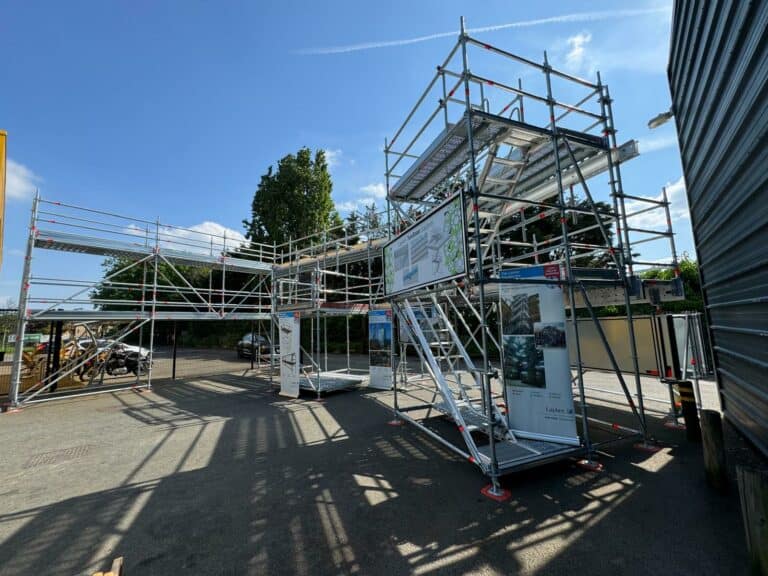
Layher UK, the esteemed provider of system scaffolding solutions, launched its first Open Morning of 2024 at Simian Risk’s training centre in Leytonstone on Tuesday, 21st May.
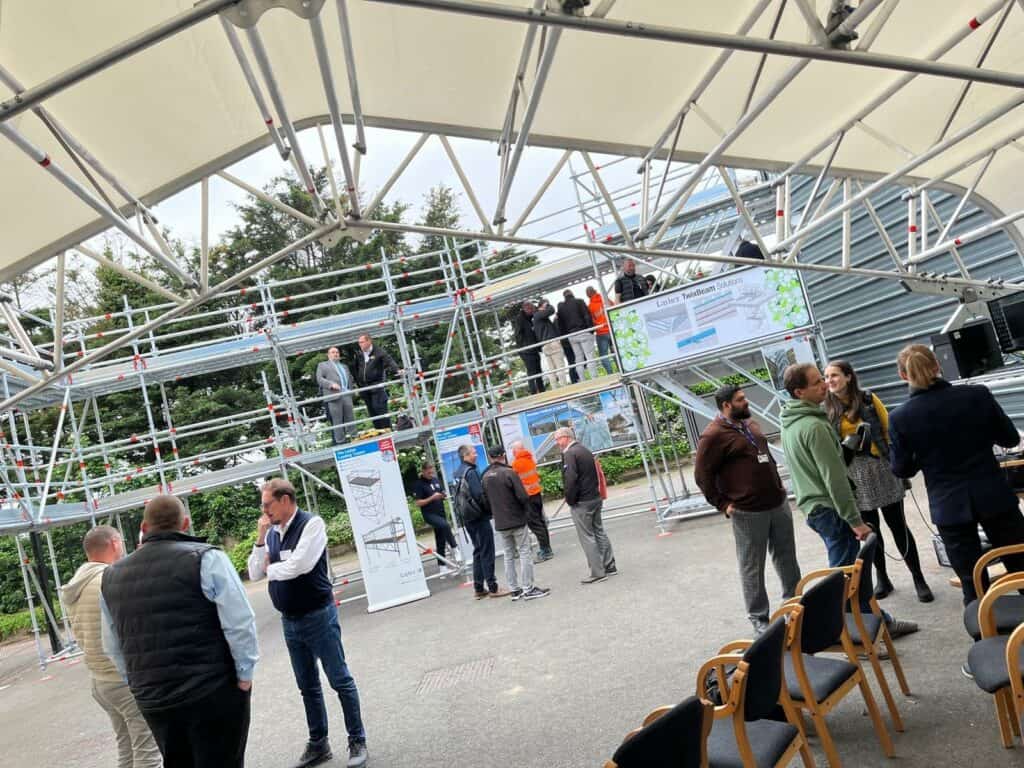
The event provided a hands-on experience for attendees to observe Layher’s innovative product demonstrations, engage with the team, and partake in informal discussions about enhancing business operations with Layher’s solutions.
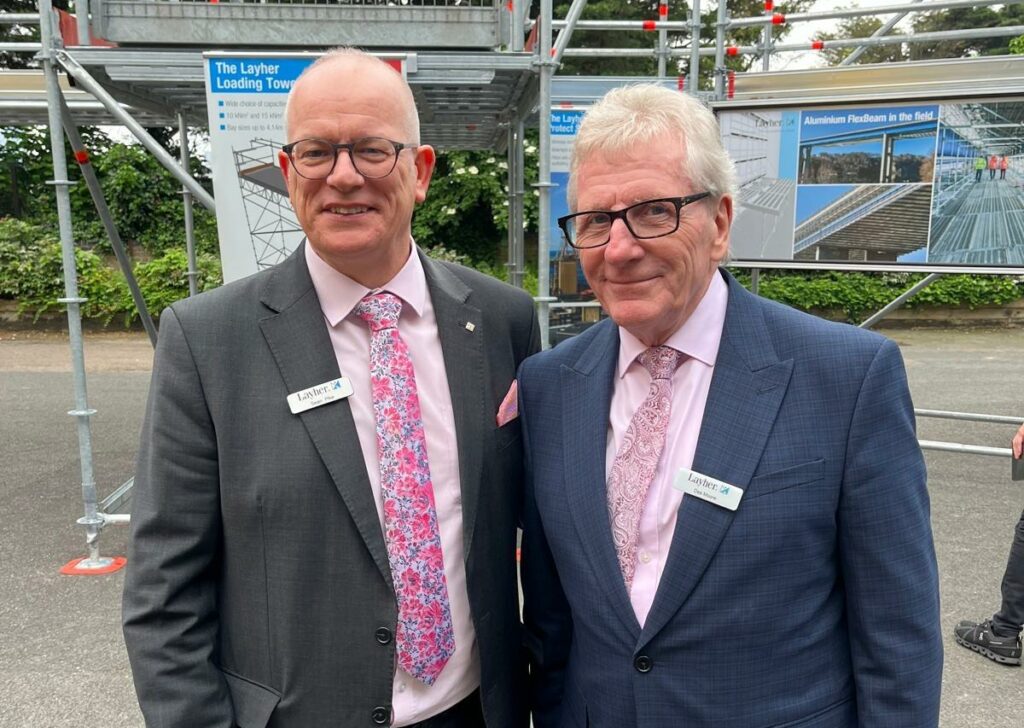
A key highlight of the morning was the joint presentations by Sean Pike, Layher UK MD and Des Moore, Layher’s Brand Ambassador. Both are well known in the industry – Des for his remarkable success in driving substantial revenue streams for TRAD Scaffolding through Layher’s Allround® Scaffolding. Both gentlemen shared their extensive knowledge and experience.
Sean Pike & Des Moore
Des gave unique insight from the system scaffold users’ perspective. His presentation aimed to shift the industry’s perspective from questioning the need for system scaffolding to recognising the optimal timing for investing in Layher’s advanced systems.
Reflecting on a recent LinkedIn poll about system scaffolding, Des noted, “Although 64% of respondents highlighted the time and cost-saving advantages of system scaffolding, 19% still perceive it as too expensive. With my experience, I beg to differ.” Des emphasised the long-term benefits and cost-efficiency of system scaffolding, noting its superior longevity and durability compared to traditional scaffolding methods.
The event, which ran from 9 a.m. to 12 p.m., had intimate regional attendance, which ensured meaningful interactions and product exploration. Attendees were treated to speeches by Sean Pike, Managing Director at Layher UK, and Des Moore. Sean elaborated on Layher’s core values of strategic partnership via their unique four ‘S’ promise of Service, Support, Solutions and Supply and the significant benefits of their original Allround® Modular Scaffolding System for projects of any size.
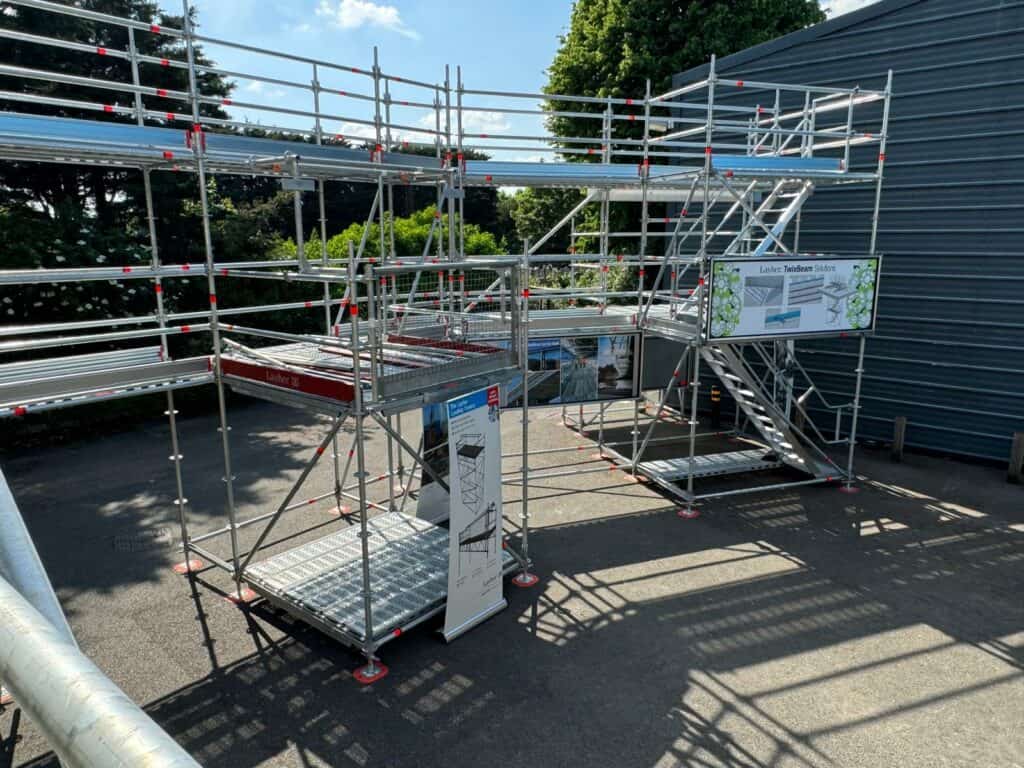
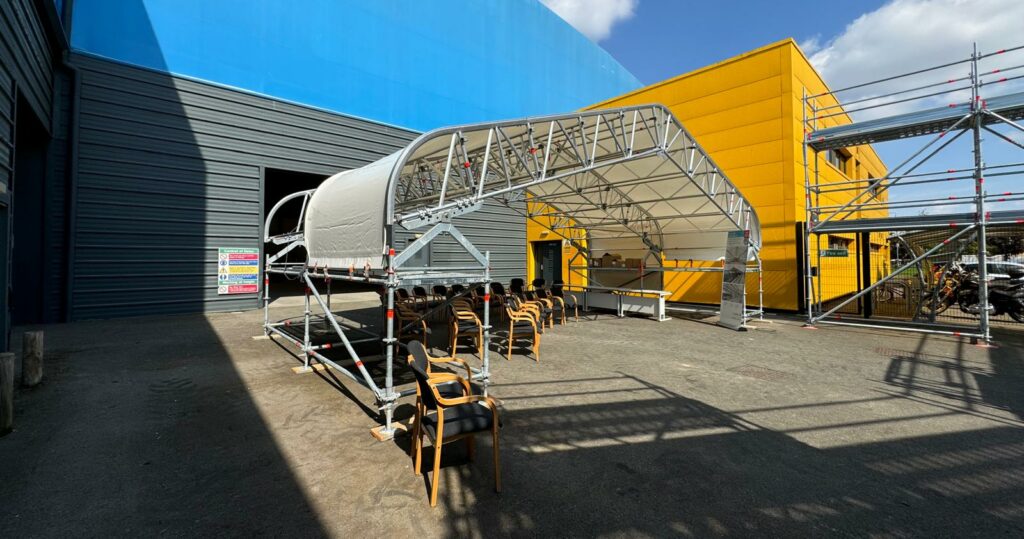
The event showcased new products, including Twix and Flex beam, as well as the more established universal products, loading bays, and site stairs. It also highlighted solutions, such as splays in Allround®. The Layher Keder XL Roof was also on display.
Sean Pike highlighted the importance of these events, stating, “We’re committed to providing attendees with a comprehensive understanding of our products and fostering quality conversations. That’s why we’re hosting multiple events throughout the year”.
Des Moore also addressed the financial benefits of Layher’s system scaffolding from a contractor’s standpoint. He illustrated how the initial investment is outweighed by the long-term savings in labour and the potential to enter new markets, leading to significant turnover and margin benefits.
Additionally, Layher showcased its cutting-edge technologies, including LayherSIM [Scaffold Information Modelling] and LayPLAN VR, which garnered considerable interest. The event also demonstrated the use of Flex Beam for quick and strong street gantry scaffolds and its latest innovation, the Twix Beam, for suspended scaffolds.
Layher’s Open Morning Series to Continue Across the UK
The Leytonstone event marks the beginning of Layher’s series of Open Mornings planned across the UK, with the next events scheduled at Eggborough Depot on 3rd September,Livingston Depot on 24th September, and West Brom on 8th October.
These events provide a unique opportunity for industry professionals to explore Layher’s innovative scaffolding solutions and their practical and financial benefits, paving the way for enhanced efficiency and profitability within the construction sector.
As the anticipation builds for SCP’s annual golf event next month, the organising team visited the Astbury Golf and Lodge Resort in Bridgnorth this week to finalise plans for the highly anticipated July event. They took to social media to share behind-the-scenes footage, offering a sneak peek into the preparations.The video showcases several highlights of the premier Astbury Golf Resort, teasing the renowned 18-hole championship golf course to their followers. This year’s tournament, scheduled for July 19, marks the fourth edition of the event, promising a day filled with camaraderie, competition, and high spirits. You can watch the video below.
SCP’s goal is to bring together dedicated scaffolders and leading industry professionals for a day of conversation, enjoyment, and, most importantly, a great game of golf. Participation is entirely free; the only requirement is that you are an experienced scaffolding industry professional with a passion for golf.The event will take place at The Astbury Golf and Lodge Resort in Bridgnorth, United Kingdom. With limited spaces remaining, those interested are encouraged to register now to avoid disappointment.Registration closes on June 21, so act quickly to secure your spot.For more information and to sign up, visit SCP Golf Registration.Don’t miss out on what promises to be an unforgettable day on the greens!
The National Access and Scaffolding Confederation (NASC) has announced a pioneering initiative designed to bridge the critical skills gap in the UK’s thriving scaffolding and access sector.
This innovative Talent Solution aims to connect young professionals with reputable employers, addressing the urgent need for skilled talent in this rapidly expanding industry.With the demand for top-tier scaffolding services on the rise, thousands of scaffolding contracting businesses are struggling to recruit young talent to meet industry needs. Recognising this pressing issue, NASC has developed a comprehensive platform to streamline the recruitment process and promote the diverse opportunities within the sector.The NASC Talent Solution provides a user-friendly interface for candidates to register and connect with quality employers actively seeking skilled and enthusiastic individuals. By leveraging strategic partnerships with leading job portals and utilising targeted social media and digital advertising campaigns, NASC ensures maximum visibility and reach for both candidates and employers.
Henry Annafi, NASC’s Training and Careers Manager, expressed his excitement about the initiative. “Our new Talent Solution represents a significant step forward in addressing the skills gap within the scaffolding and access sector. By providing a streamlined platform for talent acquisition and promotion, we aim to attract the brightest minds and nurture a new generation of skilled professionals,”Annafi said.A standout feature of the NASC Talent Solution is the exclusive access granted to NASC members. These members can benefit from a comprehensive Talent Pack, which includes display materials and interactive equipment designed to showcase the exciting and diverse opportunities within the scaffolding and access sector. The Talent Pack aims to inspire and educate aspiring candidates about the rewarding career prospects available.It’s worth noting that scaffolders and access operatives are highly trained professionals who often command salaries exceeding £50,000 per annum. With ample opportunities for career growth and advancement, the sector offers competitive remuneration packages and a supportive working environment, with many skilled individuals advancing into management and engineering design roles.NASC’s Talent Solution is set to revolutionise the recruitment landscape within the scaffolding and access industry. By bridging the gap between talent supply and industry demand, the initiative fosters a culture of excellence and innovation.For more information about the NASC Talent Solution and how to get involved, please visit www.scaffoldingcareers.com.
A scaffolder has been fined £750 and ordered to pay costs of £643 for not wearing a harness while working at height. His client, Giant Scaffolding Ltd, faced a more substantial penalty of £15,000 plus £5,000 in costs.
Gary Roser, a self-employed scaffolder from Hastings, was working for Giant Scaffolding Ltd on a four-storey scaffold at a building on East Parade, Hastings, last October.He was observed by a passing Health & Safety Executive (HSE) inspector balancing on scaffolding tubes approximately 8 meters above the ground without a harness.During the hearing at Hastings Magistrates’ Court, it was revealed that although harnesses were available in a van for the workers, they were not used. Industry guidelines mandate that scaffolders must wear a fall arrest harness when working more than 4 meters above the ground without a safe platform and edge protection in place.Furthermore, the court heard that Battle-based Giant Scaffolding had repeatedly failed to respond to written inquiries from the inspector, despite numerous warnings.HSE inspector Melvyn Stancliffe commented on the case, highlighting the importance of safety measures. “The simple measure of wearing a harness can save scaffolders from death or serious injury. A basic common-sense approach to work is all that’s needed to prevent a possible tragedy. In many cases, harnesses are available but some workmen just cannot be bothered to wear them. They should take a moment to think about the consequences.”He added, “It was reckless for Mr Roser to be working in this way. He was exposing himself and members of the public walking below to unnecessary risk. He was seen working in 2008 in similar circumstances and was warned about his future conduct. Giant Scaffolding Ltd has also been warned about the dangerous working practices of those working for it.”
Tata Chemicals Europe Limited has been fined £1.125 million following the tragic death of Michael Densmore, a 37-year-old Scaffolder and father of four, who succumbed to injuries sustained while working at the company’s Lostock Hall site in Northwich.
The incident occurred on 30 November 2016, when Mr. Densmore, a scaffolder employed by Altrad NSG, was erecting a scaffold tower in the chemical plant. While stepping over a trough containing calcium hydroxide, heated to approximately 90 degrees Celsius, his foot slipped on an unfastened lid, leading to severe chemical and thermal burns.Despite receiving specialist treatment and surgery at Whiston Hospital’s burns unit, Mr. Densmore tragically died at home on 3 January 2017, following a haemorrhage to his injured foot.The Health and Safety Executive (HSE) investigation revealed significant lapses in safety protocols at the Tata Chemicals site. There was no permit for hazardous work, inadequate risk assessment, and insufficient warning signs about the dangerous conditions. Crucially,Mr. Densmore had not been informed about the operational chemical troughs or the unfastened lids.Michael alongside his sons Billy and MikeyIn a heartfelt statement, Mr. Densmore’s family described him as “a loving and amazing role model” and expressed their profound grief: “Our lives fell apart and have not been the same since that terrible day. Nobody should have to lose someone they love due to a workplace accident. The trauma we have all suffered as a family cannot truly be put into words.”This incident is not the first safety breach for Tata Chemicals Europe, which has faced previous prosecutions related to health and safety failures. The company pleaded guilty to breaching Section 3(1) of the Health and Safety at Work etc. Act 1974 and was fined £1.125 million, along with an additional £60,603.54 in costs, at Chester Crown Court on 5 June 2024.HSE Inspector Matt Lea emphasised the preventable nature of Mr. Densmore’s death, stating, “This tragic death could have been preventable had Michael Densmore and his colleagues been managed under a robust permit to work system for working in a live chemical plant containing corrosive chemicals heated almost to boiling point. Companies should learn the lessons from this incident and ensure robust safety measures are in place.”The case was prosecuted by HSE enforcement lawyer Chloe Ward and supported by paralegal officer Sarah Thomas.
The Scaffolding Conference (ScaffCon24) has exclusively revealed to Scaffmag an impressive lineup of industry leaders for its upcoming event on October 11, 2024, at The Belfry Hotel and Resort.
This year’s keynote speaker is Tim Balcon, Chief Executive of the Construction Industry Training Board (CITB), who will address pressing industry issues and the post-election landscape.
Former NASC Chief to Lead Key Panel
Notably, Robin James, Operations Director at the Temporary Works Forum and former Managing Director of the National Access and Scaffolding Confederation (NASC) will lead a crucial panel discussion titled “Demystifying Temporary Works.” Joining Balcon and James are other distinguished speakers, including Lee Greatorex, HSE Inspector from the Regulatory Support Unit, Construction Sector of the Health and Safety Executive (HSE), and Robert Candy, CEO of the Scaffolding Association. These experts will provide valuable insights into the latest industry regulations, best practices, and training initiatives.
Cutting-Edge Panels to Elevate Industry Standards and Practice
The conference will feature two additional panels: “Working at Height Updates” and “Project Management.” These sessions will focus on current scaffolding industry regulations, best practices, skills, and training, offering attendees practical knowledge and strategies to enhance their operations.Organised by the Scaffolding Association as part of National Scaffolding Week, ScaffCon24 aims to advance industry standards and foster professional development. The event is open to all industry stakeholders and includes an evening dinner dance with a live band and DJ, providing ample networking opportunities in a relaxed setting.A limited number of early bird tickets are available at a discounted rate of £250 per person plus VAT, exclusively through the event website, scaffoldconference.co.uk. Industry professionals are encouraged to secure their spots promptly, as availability is limited.For further details, visit scaffoldconference.co.uk or contact Sally at [email protected].
JR Scaffold Services, a division of The JR Group and one of Scotland’s largest scaffolding providers has successfully completed a significant town centre roofing project at The Corn Exchange, a JD Wetherspoons pub and restaurant in Arbroath.The project was undertaken on behalf of Castlecourt Construction.The Paisley-based scaffolding company worked on the landmark building in Market Place, marking its second collaboration with JD Wetherspoons and Castlecourt Construction. JR Scaffold Services was responsible for installing a full perimeter access scaffold, facilitating the complete overcladding of the building’s outdated asbestos roof.Throughout the four-week installation project, a dedicated three-person team from JR Scaffold Services erected approximately 1,300 square meters of external scaffolding. Additionally,around 480 cubic meters of scaffolding was utilised within the internal roof space to create a large bird cage scaffold, allowing for necessary internal structural roofing work.The project’s complex location required the implementation of a narrow width scaffold built off a steel staircase at the rear of the building, as flat ground was unavailable. This intricate task was followed by an engineered beam section, which was bracketed off the structural wall of the building to bridge over neighbouring roofs.JR Scaffold Services was chosen for this specialised project due to their status as one of the few asbestos ancillary license holders in Scotland. The company’s 15 years of expertise and training in safely handling asbestos materials played a crucial role in their selection.John Jack, Contract Director at JR Scaffold Services, expressed his satisfaction with the project’s outcome: “We handed this project to our colleague Brian Keaney as his very first job as a Contract Manager, and we’re delighted with the job that he and his team have delivered. Even with some of the complexities involved, Brian and his team have taken his first project in stride and helped us continue to build our great relationship with the team at Castlecourt Construction. This job had unique complexities due to the tight workspace and asbestos exposure; however, our team is well equipped to handle such challenges with ease, and our experience in these areas served us well here.”
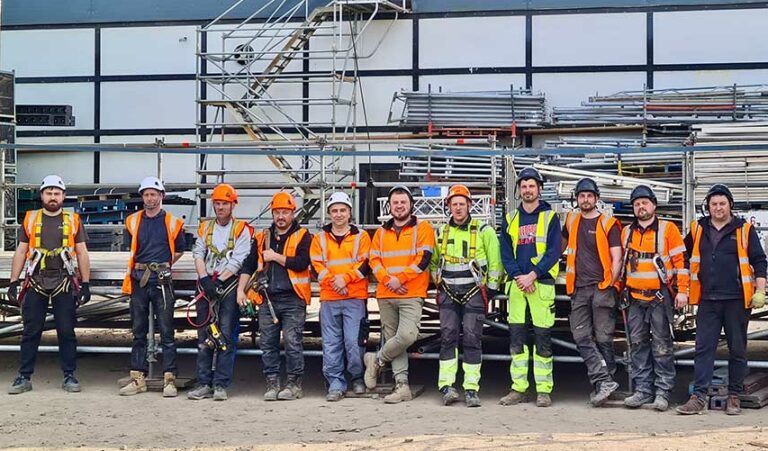
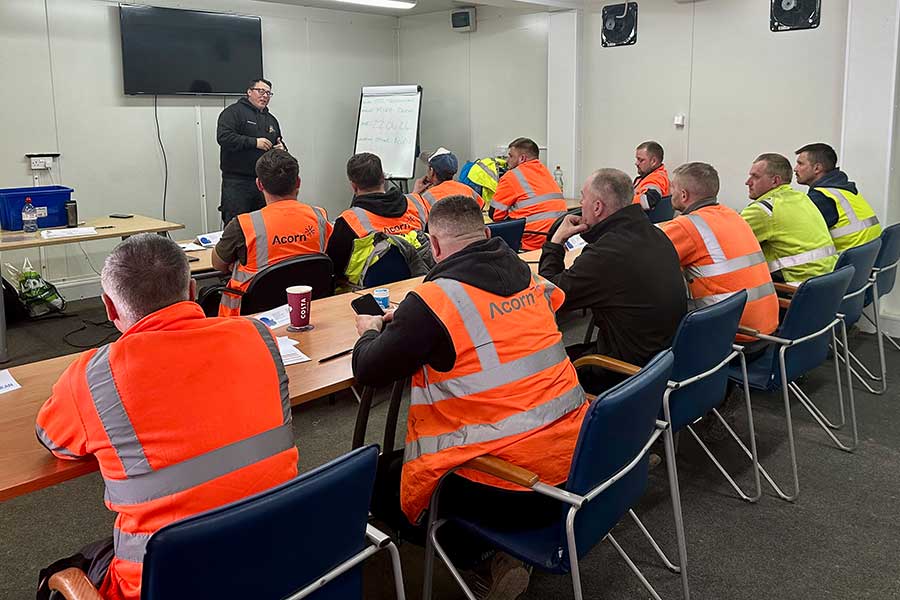
Acorn Structures is reaffirming its dedication to elevating event site safety standards by collaborating with the Event Structures Industry Training Scheme (ESITS) to provide extensive training and accreditation for its employees.
This initiative comes ahead of the 2024 festival, concert, summer sports, and outdoor event season, highlighting Acorn’s proactive approach to industry safety.
ESITS was established to address a significant gap in specialised training for professionals working within the event industry. Existing scaffolder qualification schemes fall short in covering the diverse skills required for Temporary Demountable Structures (TDS) used across various event sites. Acorn took the lead in committing to ESITS by enrolling its employees in comprehensive training and qualification programs.
In early 2023, Acorn conducted the inaugural one-day General Event Crew Operative (GECO) course, followed by the intensive 10-day Temporary Demountable Structures trainee course, and concluded with the TDS Technician (Staging) Assessed Route of Entry.
Recently, Acorn furthered its support by piloting the 10-day Temporary Demountable Structures Technician course, a key part of their 2024 training investment program.
Acorn’s commitment to improving site safety is driven by Co-founder and CEO Andy Nutter and Technical Director Igor Pacejs, who have collaborated closely with SIMIAN to develop the ESITS qualification.
Their efforts were supported by HR and Payroll Manager Becky Williamson and Construction and Event Manager Craig Morland, who played vital roles in coordinating training administration. The ESITS accreditation process is overseen by a Board of Governors, Training Committee, and Industry Interest Group, ensuring the scheme’s relevance and quality.
“We have been working with Simian for almost 20 years,” stated Andy Nutter from Acorn’s Head Office near Leeds, where the company’s training takes place. “We jointly developed System Scaffold training with CISRS, which was then adopted by the NASC and the construction industry. I hope the events industry will join Acorn and other early adopters like IPS and Actavo in supporting ESITS qualifications to ensure improved site safety in the temporary event structures sector,” he added.
Mike Dean, ESITS Scheme Director, expressed enthusiasm for the ongoing partnership with Acorn: “At ESITS, we are thrilled to work with Acorn Events on their mission to upskill their workforce and raise competency standards across the events industry. By providing comprehensive training programs and certifications, we can equip event professionals with the knowledge and skills necessary to deliver exceptional experiences. Together, we are committed to driving innovation, professionalism, and excellence in Temporary Demountable Structures.”
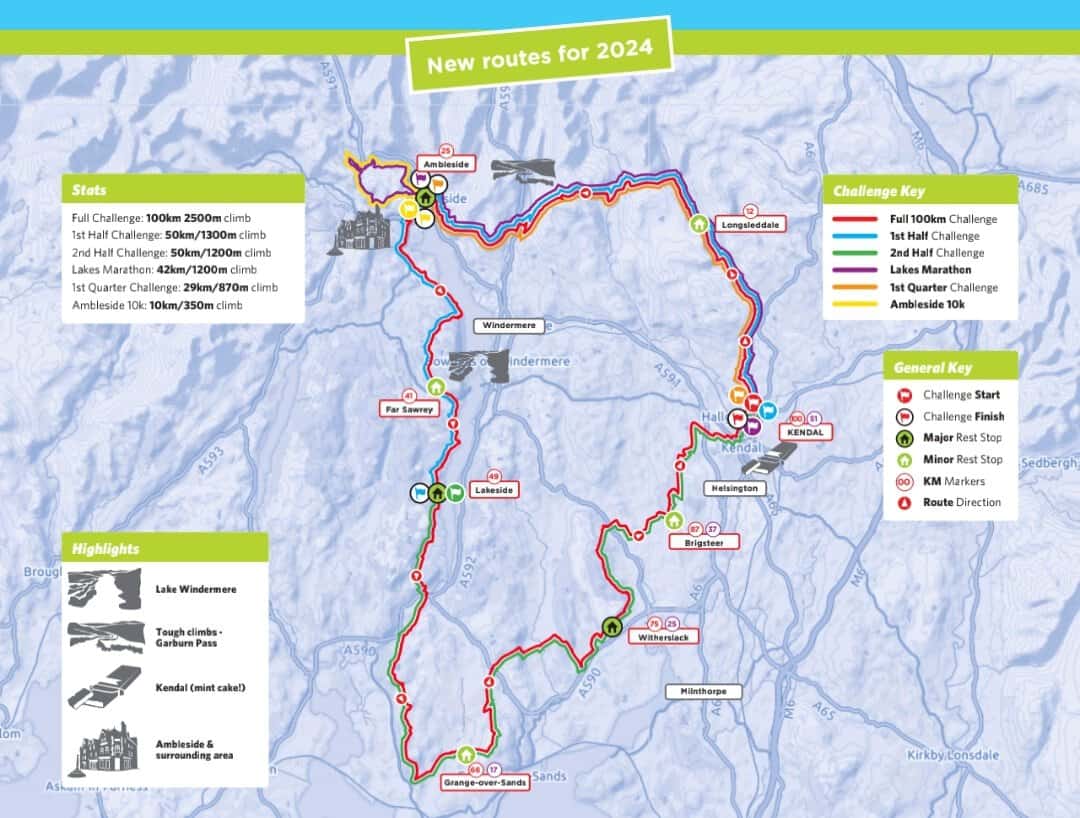
In an inspiring move to support two young girls battling hair loss due to cancer treatment and alopecia, senior staff members from AJS Scaffolding are participating in the gruelling Lakeside Ultra Challenge this weekend.
The initiative aims to raise funds to provide custom-made wigs for the girls, helping to restore their confidence and bring a bit of joy into their lives.The Lakeside Ultra Challenge is no small feat, demanding participants to complete a 100-kilometer course on foot with an overall climb of 2500 meters, all against the clock to secure a bonus. Despite the challenge, the participants have covered all their own fees and accommodation costs, amounting to hundreds of pounds each, highlighting their dedication to the cause.Several businesses have already shown their support by pledging funds to be released upon the completion of the challenge. Notable commitments have come from Reactive Scaffold and MSC Consultants. Additionally, other companies, including EMTECH Group, CNS, and Northern Scaffolding, have generously contributed in advance.The organisers are reaching out for further support from the community and businesses alike. They encourage donations, even as small as £5.00, to help them reach their goal. Donations can be made through their JustGiving page: Support the Lakeside Ultra Challenge.Little Lady Locks, the charity benefiting from this initiative, is dedicated to providing high-quality wigs for children experiencing hair loss. More information about their work can be found on their website: Little Lady Locks.This heartwarming effort by AJS Scaffolding not only highlights the compassion and community spirit within the company but also serves as a powerful reminder of the difference that collective efforts can make in the lives of those facing tough challenges.
The mother of an 18-year-old apprentice who was tragically killed in a scaffolding collapse in Sydney, Australia, has called on the New South Wales (NSW) government to implement industrial manslaughter laws, ensuring no other family endures the heartache of losing a child in a workplace accident.
In April 2019, Christopher Cassaniti lost his life when an overloaded perimeter facade scaffold, burdened with 18 tonnes over its capacity, collapsed at a Macquarie Park construction site. The collapse trapped Christopher and his colleague Khaled Wehbe. It was later revealed that essential ties connecting the scaffolding to the building had been removed, contributing to the fatal incident.Christopher’s mother, Patrizia Cassaniti, has been a vocal advocate for legislative change, urging NSW to align with other mainland states by introducing industrial manslaughter as a distinct offence. “I’ll never get justice for my son and it hurts. It’s something that you can’t accept but I’m hoping that families in the future won’t have to go through this anguish,” said Ms Cassaniti, describing her son as an “exceptional and kind kid”.
Legislative Push for Tougher Penalties
The NSW government is set to introduce the legislation into parliament this week. The proposed bill would make industrial manslaughter a criminal offence, with penalties including up to 25 years in jail and civil fines up to $20 million – the most severe in any Australian jurisdiction.Ms Cassaniti, who will speak alongside NSW Industrial Relations Minister Sophie Cotsis at a rally on Monday, believes the new law could save lives. “I would like to see this law not only put corporations and companies on alert, but also individuals,” she said. “Managers, officers, and workers should all be responsible for safety, and if they are found to have done something that caused the death of a person through their negligence and reckless behaviour, I want to see them prosecuted and go to jail.”
Broad Public Support
Recent polling by Pyxis Polling & Insights shows that NSW voters largely support the introduction of industrial manslaughter laws, with 68% of 2040 respondents in favour. Support is higher in regional areas (70%) compared to metropolitan Sydney (66%), and consistently above 60% across the political spectrum.Despite NSW being one of the few states, alongside Tasmania, without specific industrial manslaughter laws, 76% of respondents expressed surprise at this legislative gap. Unions NSW Secretary Mark Morey emphasised the community’s demand for accountability. “When a worker doesn’t return home it is a life-altering trauma for their loved ones,” he said. “The people of NSW want corporations and CEOs held accountable for workplace deaths. It is simply unacceptable that workers continue to lose their lives due to negligent and unsafe practices.”
Historical Context and Legal Repercussions
From 2013 to 2022, NSW averaged at least one workplace fatality per week, the highest rate among Australian states and territories. Following Christopher Cassaniti’s death, Synergy Scaffolding Services pleaded guilty to a Work Health and Safety Act offence and was fined $2 million in November 2022. GN Residential Construction also faced significant penalties, including a $900,000 fine and permanent disqualification of its contractor licence. The company’s director, Nicholas Kodomichalo, received a 10-year ban from holding any authority under the Home Building Act 1989.Ms Cassaniti’s advocacy underscores a broader call for stronger workplace safety measures and legal reforms. As NSW prepares to debate the proposed laws, there is hope that tougher penalties will deter negligent practices and ensure safer working environments, preventing further tragedies and delivering justice for affected families.
We use cookies on our website to give you the most relevant experience by remembering your preferences and repeat visits. By clicking “Accept”, you consent to the use of ALL the cookies.
This website uses cookies to improve your experience while you navigate through the website. Out of these, the cookies that are categorized as necessary are stored on your browser as they are essential for the working of basic functionalities of the website. We also use third-party cookies that help us analyze and understand how you use this website. These cookies will be stored in your browser only with your consent. You also have the option to opt-out of these cookies. But opting out of some of these cookies may affect your browsing experience.
Necessary cookies are absolutely essential for the website to function properly. These cookies ensure basic functionalities and security features of the website, anonymously.
Cookie
Duration
Description
cookielawinfo-checbox-analytics
11 months
This cookie is set by GDPR Cookie Consent plugin. The cookie is used to store the user consent for the cookies in the category "Analytics".
cookielawinfo-checbox-functional
11 months
The cookie is set by GDPR cookie consent to record the user consent for the cookies in the category "Functional".
cookielawinfo-checbox-others
11 months
This cookie is set by GDPR Cookie Consent plugin. The cookie is used to store the user consent for the cookies in the category "Other.
cookielawinfo-checkbox-necessary
11 months
This cookie is set by GDPR Cookie Consent plugin. The cookies is used to store the user consent for the cookies in the category "Necessary".
cookielawinfo-checkbox-performance
11 months
This cookie is set by GDPR Cookie Consent plugin. The cookie is used to store the user consent for the cookies in the category "Performance".
viewed_cookie_policy
11 months
The cookie is set by the GDPR Cookie Consent plugin and is used to store whether or not user has consented to the use of cookies. It does not store any personal data.
Functional cookies help to perform certain functionalities like sharing the content of the website on social media platforms, collect feedbacks, and other third-party features.
Performance cookies are used to understand and analyze the key performance indexes of the website which helps in delivering a better user experience for the visitors.
Analytical cookies are used to understand how visitors interact with the website. These cookies help provide information on metrics the number of visitors, bounce rate, traffic source, etc.
Advertisement cookies are used to provide visitors with relevant ads and marketing campaigns. These cookies track visitors across websites and collect information to provide customized ads.
 The event, which ran from 9 a.m. to 12 p.m., had intimate regional attendance, which ensured meaningful interactions and product exploration. Attendees were treated to speeches by Sean Pike, Managing Director at Layher UK, and Des Moore. Sean elaborated on Layher’s core values of strategic partnership via their unique four ‘S’ promise of Service, Support, Solutions and Supply and the significant benefits of their original Allround® Modular Scaffolding System for projects of any size.
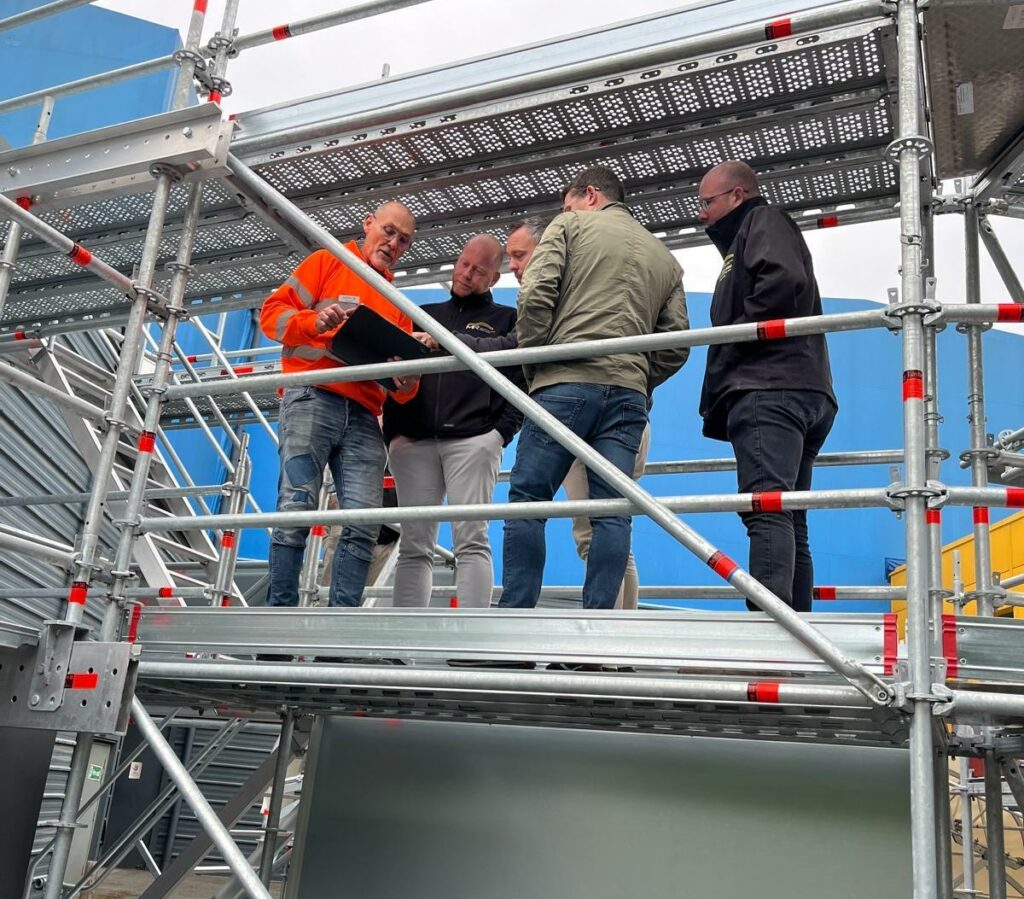 The event showcased new products, including Twix and Flex beam, as well as the more established universal products, loading bays, and site stairs. It also highlighted solutions, such as splays in Allround®. The Layher Keder XL Roof was also on display.
 Sean Pike highlighted the importance of these events, stating, “We’re committed to providing attendees with a comprehensive understanding of our products and fostering quality conversations. That’s why we’re hosting multiple events throughout the year”.
Des Moore also addressed the financial benefits of Layher’s system scaffolding from a contractor’s standpoint. He illustrated how the initial investment is outweighed by the long-term savings in labour and the potential to enter new markets, leading to significant turnover and margin benefits.
Sean Pike highlighted the importance of these events, stating, “We’re committed to providing attendees with a comprehensive understanding of our products and fostering quality conversations. That’s why we’re hosting multiple events throughout the year”.
Des Moore also addressed the financial benefits of Layher’s system scaffolding from a contractor’s standpoint. He illustrated how the initial investment is outweighed by the long-term savings in labour and the potential to enter new markets, leading to significant turnover and margin benefits.
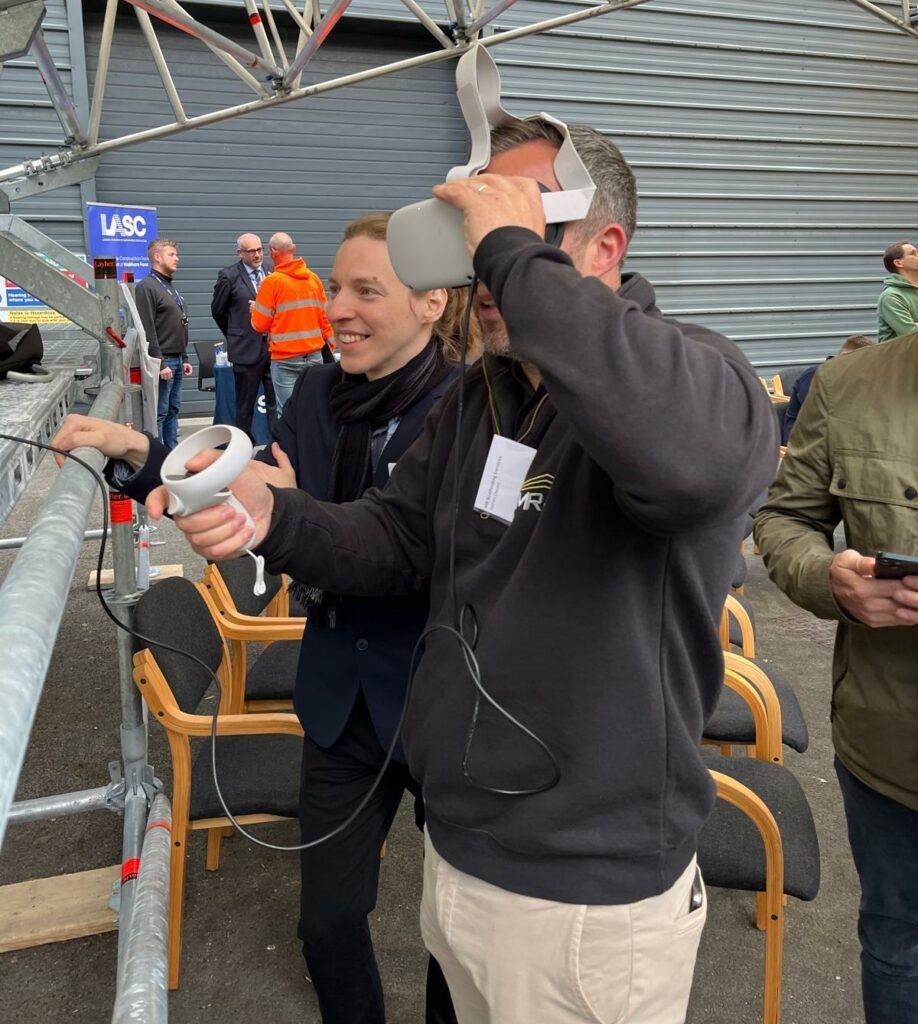 Additionally, Layher showcased its cutting-edge technologies, including LayherSIM [Scaffold Information Modelling] and LayPLAN VR, which garnered considerable interest. The event also demonstrated the use of Flex Beam for quick and strong street gantry scaffolds and its latest innovation, the Twix Beam, for suspended scaffolds.


 Henry Annafi, NASC’s Training and Careers Manager, expressed



 Notably, Robin James, Operations Director at the
 Recently, Acorn furthered its support by piloting the 10-day Temporary Demountable Structures Technician course, a key part of their 2024 training investment program.
Acorn’s commitment to improving site safety is driven by Co-founder and CEO Andy Nutter and Technical Director Igor Pacejs, who have collaborated closely with SIMIAN to develop the ESITS qualification.
Their efforts were supported by HR and Payroll Manager Becky Williamson and Construction and Event Manager Craig Morland, who played vital roles in coordinating training administration. The ESITS accreditation process is overseen by a Board of Governors, Training Committee, and Industry Interest Group, ensuring the scheme’s relevance and quality.
“We have been working with Simian for almost 20 years,” stated Andy Nutter from Acorn’s Head Office near Leeds, where the company’s training takes place. “We jointly developed System Scaffold training with CISRS, which was then adopted by the NASC and the construction industry. I hope the events industry will join Acorn and other early adopters like IPS and Actavo in supporting ESITS qualifications to ensure improved site safety in the temporary event structures sector,” he added.
Mike Dean, ESITS Scheme Director, expressed enthusiasm for the ongoing partnership with Acorn: “At ESITS, we are thrilled to work with Acorn Events on their mission to upskill their workforce and raise competency standards across the events industry. By providing comprehensive training programs and certifications, we can equip event professionals with the knowledge and skills necessary to deliver exceptional experiences.
Together, we are committed to driving innovation, professionalism, and excellence in Temporary Demountable Structures.”
Recently, Acorn furthered its support by piloting the 10-day Temporary Demountable Structures Technician course, a key part of their 2024 training investment program.
Acorn’s commitment to improving site safety is driven by Co-founder and CEO Andy Nutter and Technical Director Igor Pacejs, who have collaborated closely with SIMIAN to develop the ESITS qualification.
Their efforts were supported by HR and Payroll Manager Becky Williamson and Construction and Event Manager Craig Morland, who played vital roles in coordinating training administration. The ESITS accreditation process is overseen by a Board of Governors, Training Committee, and Industry Interest Group, ensuring the scheme’s relevance and quality.
“We have been working with Simian for almost 20 years,” stated Andy Nutter from Acorn’s Head Office near Leeds, where the company’s training takes place. “We jointly developed System Scaffold training with CISRS, which was then adopted by the NASC and the construction industry. I hope the events industry will join Acorn and other early adopters like IPS and Actavo in supporting ESITS qualifications to ensure improved site safety in the temporary event structures sector,” he added.
Mike Dean, ESITS Scheme Director, expressed enthusiasm for the ongoing partnership with Acorn: “At ESITS, we are thrilled to work with Acorn Events on their mission to upskill their workforce and raise competency standards across the events industry. By providing comprehensive training programs and certifications, we can equip event professionals with the knowledge and skills necessary to deliver exceptional experiences.
Together, we are committed to driving innovation, professionalism, and excellence in Temporary Demountable Structures.”