Northern Ireland’s Health & Safety Executive (HSENI) have issued a Safety Alert.
Broken scaffold boards have recently caused an increase in serious accidents on construction sites in Northern Ireland. The majority of injuries happen when boards used in ‘platform brackets’ break during normal work activities.
HSENI find during their site visits that there are boards in use which superficially look sound, but on closer inspection are found to have been weakened. It is vital that you have a system of work which ensures that all scaffold boards are checked regularly for damage, rot or any other feature which may reduce the strength of the board.
The misuse of boards can cause serious damage. Do not use scaffold boards to:
- assist vehicles over soft ground
- store heavy objects, for example, lifting pallets of blocks on to scaffolding at areas which are not specifically designed loading bays
- make a ramp for wheel barrow access
Accidental damage can occur from:
- driving vehicles over boards unintentionally
- throwing or dropping boards from heights
- impact loads, for example dropping heavy sills
Common examples of unacceptable damage include:
- fungal decay, for example wet rot
- broken or damaged end bands
- wood broken from the edge of the boards which significantly reduces the cross-section of the board, for example, notches
- loose or broken knots
- excessive cuts in the faces of boards caused by hand saws, circular saws or angle grinders (trades likely to use power tools on scaffold must use sacrificial timber and not cut directly onto scaffold boards)
- transverse cracks caused by overloading.
- infestation of the timber, for example, holes caused by insects
In normal use, a board’s top face on one job may become its bottom face on the next job. Mechanical damage may occur on the first job but the failure may not happen until the board is turned and loaded in the opposite direction. The user causing the damage may not witness the failure and is unlikely to be aware of the consequences of their actions. If the board is damaged to an extent that will reduce its strength, or is likely to cause unsafe footholding, or an injury whilst handling the board, it should be destroyed.
There is a British Standard specification for scaffold boards – BS 2482:2009. Failure of a new board graded to this standard is unlikely when it is first used. Failures are much more likely to be due to misuse during construction work.
There are a number of boards in use commonly referred to as Grade A boards which have not been graded to the requirements of BS2482:2009.
HSENI recommends that only boards manufactured to the British Standard are acceptable. This ensures a consistently high standard throughout the industry.
The end bands must be present at both ends of the scaffold board. They have an important role in protecting the vulnerable end grain of the boards. They should extend around the edges of the board by at least 150 millimetres for 38 millimetre boards and at least 100 millimetres for 63 millimetre boards.
Fungal decay, usually wet rot, is common in poorly stored scaffold boards. It can be detected by discolouration of the wood, which also becomes softer – you can easily push a screwdriver into attacked wood. Rot often starts at cracks or around knots in wood because water is retained in these areas. The boards will often smell musty and will feel lighter than an equivalent sound board.
In the early stages of decay there is a considerable loss in resistance to impact loads, for example, a worker jumping onto a board, or lifting a heavy sill.
Storage of scaffold boards
Decay in your boards can be reduced by storing planks properly when not in use. This is particularly relevant in these economic times when large quantities of scaffolding may be stored for longer periods of time.
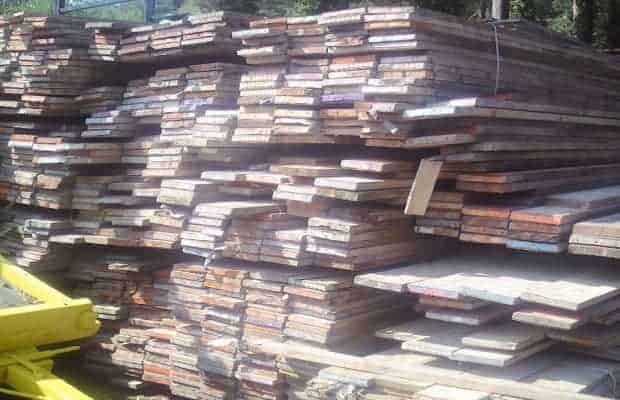
Boards should be stored preferably under cover and clear of the ground. Spacers must be used between each layer of stacked boards to allow an adequate flow of air around the boards to dry them out.
To prevent further accidents check to see if the scaffold boards you are using comply with the following:
- all scaffolding boards conform to BS 2482:2009
- they are cleaned prior to inspection – all surface contamination which obscures the surface of the board, for example, cement must be removed before inspection – this can usually be done using a paint scraper or a stiff hand brush
- boards are inspected prior to being put into use, at regular intervals whilst in use and before storage
- they are not damaged beyond the limits in the British Standard including cracks, cuts or notches cut out of them
- damaged / defective boards are immediately taken out of use and disposed of appropriately
- all boards in storage are stacked in a way which allows for ventilation
- where machine testing is carried out ensure that boards are tested in both directions