
Ad
Tuesday, March 24, 2026

We should think twice before using scaffolding, says demolition boss

ADVERTISEMENT
Getting your Trinity Audio player ready...

The Vice-President of the Insitute of Demolition Engineers has said his industry should think twice before using scaffolding to cover buildings under demolition.

VP, Richard Dolman, who is also the managing director of AR Demolition, said it was time for the demolition industry to consider new ways of dust suppression and protection from flying debris during the demolition of buildings.

His stark comments were captured in a ConstructionIndex article following a flurry of recent demolition incidents that involved the collapse of scaffolding in Reading, Liverpool and Nuneaton.

Speaking to Theconstructionindex Dolman said: “For many years, I’ve never understood why people think is a good idea to fasten scaffolding to a building, then demolish the structure behind the scaffold using a machine.

“Scaffolding is useful if it’s used to take a building apart in reverse of how it was constructed, but I’ve never thought that it goes well with big machinery. It’s not even great for stopping dust because the minute you dismantle it, the dust goes everywhere. If there’s a structural collapse, you’re in real trouble as the recent incidents show.”
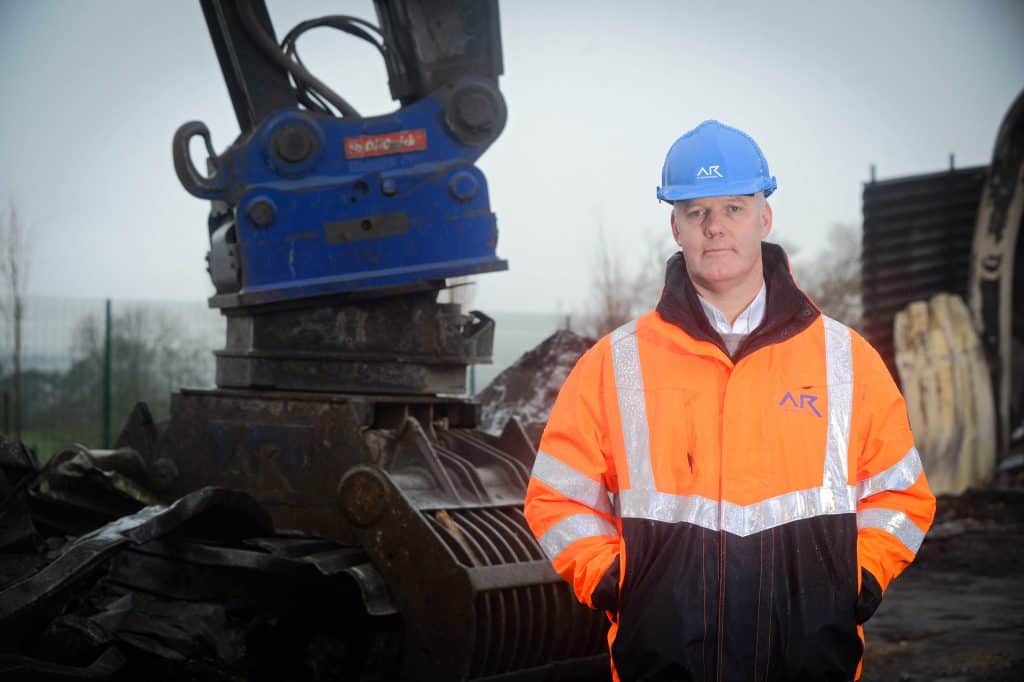
An Image of Richard Dolman of AR Demolition
Richard Dolman

However, his company AR Demolition has invented an alternative solution in the form of a modular debris protection frame and blast mats.

“Our modular frame system took six months to design and can be transported in sections and bolted together in a day. The mats hang off a crane or a demolition rig – they’re six metres wide, 15 metres high and act as shield to stop debris and dust,” he said.

“Only a few companies use it and as far as I know we’re the only one which uses an incorporated jet system to spray water back on to the work face.”

He concluded in saying: “Let me emphasise that I’m not saying there is no place for scaffolding in demolition. There are occasions – mainly during floor-by-floor, very controlled, small-scale demolition – when it is the most appropriate method of dust suppression and protection against debris. I just think that there are better methods which should be more commonplace.”

ADVERTISEMENT

Popular Categories

Latest posts

Government launches consultation on plan to merge CITB and ECITB

The UK government has launched a consultation on proposals to merge the Construction Industry Training Board (CITB) and the Engineering Construction Industry Training Board...

Robotics firm KEWAZO secures $35m backing to scale industrial lifting technology

KEWAZO, a robotics company focused on heavy industry, has raised $35m in funding to accelerate the rollout of its lifting robot across global industrial...

Pay gap pushing scaffolders from New Zealand to Australia

Construction firms in New Zealand are facing a growing shortage of scaffolders as experienced workers move to Australia in search of higher wages and...

Barking Riverside expansion approved to deliver up to 20,000 homes

Revised outline plans for the Barking Riverside development in east London have been approved by the London Borough of Barking & Dagenham, enabling a...

Beyond the Hype: Where AI Actually Delivers Value for a Scaffold Business

AI can draft a site report in seconds, but it cannot plumb a standard or assume legal accountability. Scaffold businesses operate in a world...

New data shows construction workforce becoming younger and more skilled

New data from the Construction Skills Certification Scheme (CSCS) suggests the profile of the UK construction workforce is changing, with more young people entering...

Teen in coma after scaffolding accident on Fife housing project

A teenager remains in a coma after being seriously injured by falling scaffolding material while working at a housing block in Kirkcaldy. Brodie Thomson, 16,...

NASC gains formal role in CITB levy consensus process

The National Access and Scaffolding Confederation (NASC) has been granted Prescribed Organisation status by the Construction Industry Training Board (CITB), giving the trade body...

New platform aims to bring instant scaffolding quotes to UK market

A London-based roofing contractor has launched a new digital platform designed to simplify how scaffolding is sourced and booked. The platform, called ScaffLink, allows homeowners...

Inflatable tent system installed at height during £38m Bolton hospital project

Robertson Construction has installed a series of inflatable roofing tents as part of a major redevelopment programme at the Royal Bolton Hospital. The air-filled structures...

Latest news

Magazine

Spring Issue #29 | Past issues >>

Trending now ⚡︎

Teen scaffolding labourer dies after fall through shaft on London site

A construction company has been fined after a teenage...

Teen in coma after scaffolding accident on Fife housing project

A teenager remains in a coma after being seriously...

Robotics firm KEWAZO secures $35m backing to scale industrial lifting technology

KEWAZO, a robotics company focused on heavy industry, has...

New data shows construction workforce becoming younger and more skilled

New data from the Construction Skills Certification Scheme (CSCS)...

New platform aims to bring instant scaffolding quotes to UK market

A London-based roofing contractor has launched a new digital...

Related articles

Latest topics

Teen scaffolding labourer dies after fall through shaft on London site

A construction company has been fined after a teenage...

Government launches consultation on plan to merge CITB and ECITB

The UK government has launched a consultation on proposals...

Robotics firm KEWAZO secures $35m backing to scale industrial lifting technology

KEWAZO, a robotics company focused on heavy industry, has...

Pay gap pushing scaffolders from New Zealand to Australia

Construction firms in New Zealand are facing a growing...
ADVERTISEMENTS