The best read news website & magazine in Scaffolding
Welcome to the UK’s most popular and informative Scaffolding & Access Magazine
Our website is a hugely popular digital scaffolding resource. Launched back in 2009, ScaffMag has grown in popularity to become the industry’s leading source for the latest independent trade news, current affairs, scaffolding jobs and profiling the very best from our sector.
ScaffMag gives businesses and brands an unrivalled opportunity to advertise their products or services 24 hours a day 7 days a week to a highly targeted audience.Our readership includes main and sub-contractors, manufacturers, consultants, scaffolders and many others. We offer print and digital advertising opportunities across desktop, mobile and tablet channels.
During 2023 we welcomed over 250,000 individual users to the site, generating over 760,000 pageviews. We remain amongst our industry the most followed and liked company on social media with more than 132,000 followers on Facebook alone.
– Daniel Norton, Editor of ScaffMag
Our Socal Readership
96,777
Followers
8,008
Followers
14,802
Followers
6,855
Followers
10,637
Followers
6,500+
Email Subscribers
2023 Annual Website Traffic*
769K
Page Views
1.61
Pages/Sessions
300K
Sessions
2:18
Avg. Session Duration
172K
Unique Users
68.46%
Bounce Rate
*Google Analytics for 2023/24
Digital Advertising
We provide businesses and brands an unrivalled opportunity to advertise their products or services 24 hours a day 7 days a week to a highly targeted audience.
For a full list of website advertising opportunities with ScaffMag please contact us and download our 2024 Media Pack.
Engaging The Industry Across Every Device
Daily/Weekly Newsletter
Our Daily Download and Weekly Rundown email newsletter is essential reading for thousands of scaffolding professionals. They are sent to more than 7,200 people providing a unique reach into companies across the country and the world.The newsletter enjoys an above-average open rate for the construction sector of 38% and our list is constantly updated to only include regular readers. Our subscriber database can be made available to selected clients for direct marketing in the form of an Email Blast.
EMAIL SPONSORSHIP ScaffMag offers email sponsorship in our daily and weekly round-up emails in the form of a banner advertisement contained within the newsletterEmail Banner: £300.00pcm
EMAIL BLAST ScaffMag give’s businesses and industry service providers the ability to send out their very own promotional email co-branded with ScaffMag to our database of subscribers. Email Blast: £400.00 per campaign
Interested in learning more about advertising with us? Drop us a line on 01472 476024 or email [email protected]
Magazine
As a natural progression for both our loyal readership and our scaffold sector advertising customers, we have launched the ScaffMag magazine – a fresh, slick, modern, vibrant and engaging product to enjoy and to back up our ScaffMag.com community and social media following, which advertisers in the magazine can tap their brand into.Created with both the scaffolder and contractor in mind, The ScaffMag Magazine gives businesses and brands an unrivalled opportunity to advertise their products or services 24:7:365 to a large, rapidly expanding and highly-targeted audience. It’s a unique proposition in digital and print.
Testimonials
“The new issue of Scaffmag is packed with great articles and opinions. We’re very lucky in our industry to have such a great support and loudspeaker for everything we do! Thanks as always to Daniel Norton for putting such great content together.” – Des Moore
Digital Readership*
286,329
Impressions
147,098
Reads
1,261
Ad Clicks
*Stats from Issuu.com
To find out more about advertising in our quarterly magazine please view and download our 2021 Media Pack.
ScaffMag continues to dominate the social media networks within our industry with the most liked/followed Facebook page in the sector. At the time of writing this, ScaffMag’s official page has 135,000+ followers and 81,000+ likes.
For an up to date view of our social media stats see the boxes below.
Two men have been seriously injured after steelwork collapsed onto scaffolding erected on a town hall at a construction site in West London.
Dozens of police, fire and ambulance vehicles attended Hammersmith town hall in King Street after the incident at around 5.30pm on Wednesday.
According to reports, both men had suffered ‘life-threatening injuries and were rushed to a major trauma centre “as a priority”.
The Metropolitan police have said the men were taken to a central London hospital, and the Health and Safety Executive had been informed.
A source told Scaffmag: “The steelwork collapsed and took the scaffolding down with it, when the steelwork failed it knocked over the cherry picker the steelworkers were working on.”
It is believed that one of the steel erectors was thrown 30m from the cherry picker and the other was still attached by his harness.
The London ambulance service said: “An investigation has been launched after two men were injured after scaffolding attached to Hammersmith town hall collapsed late on Wednesday afternoon.
“Officers from the Metropolitan police attended along with firefighters.”
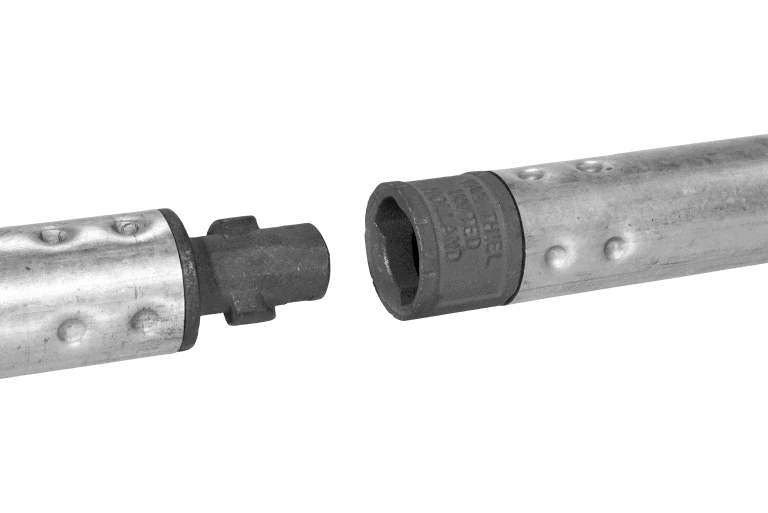
Tube-Lock® can revolutionize the way you are designing and erecting scaffolds. By combining simplicity and strength, Tube-Lock holds many benefits over traditional tube and fitting scaffolding.
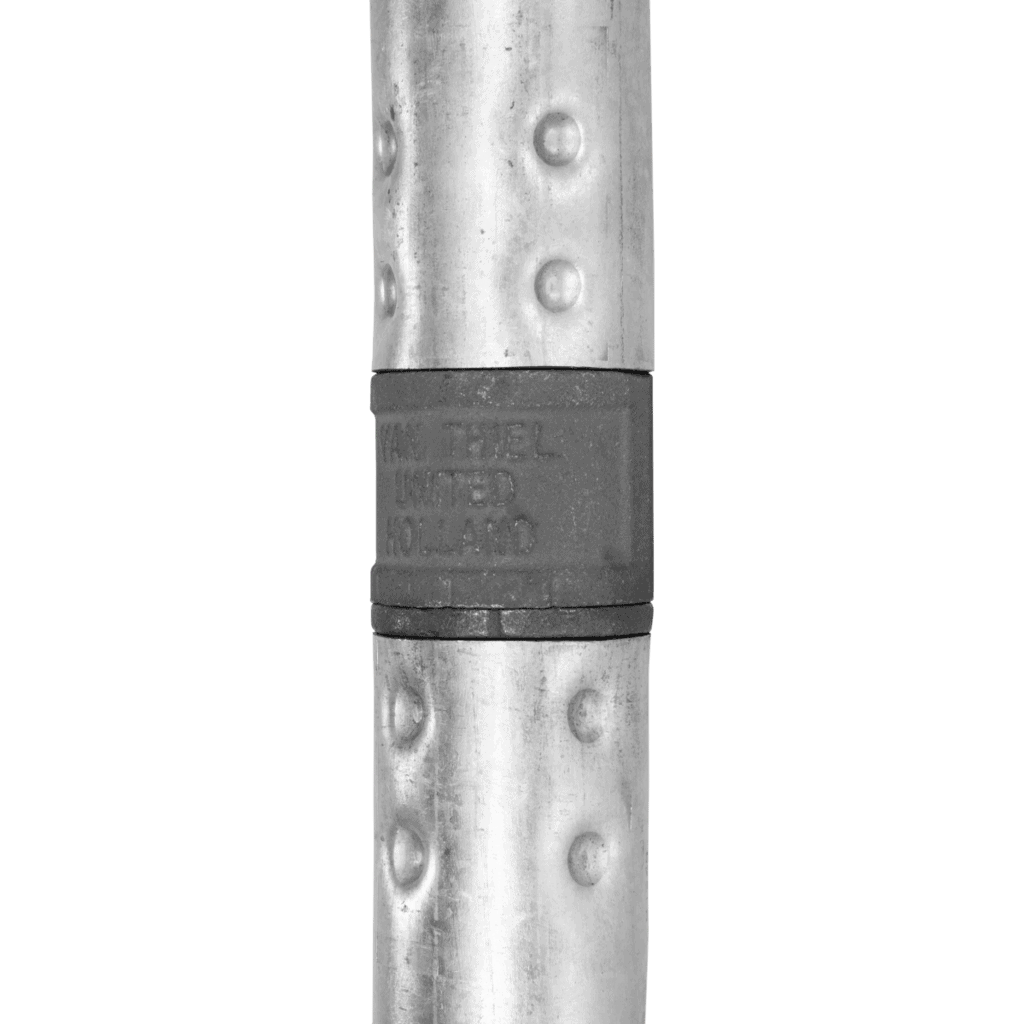
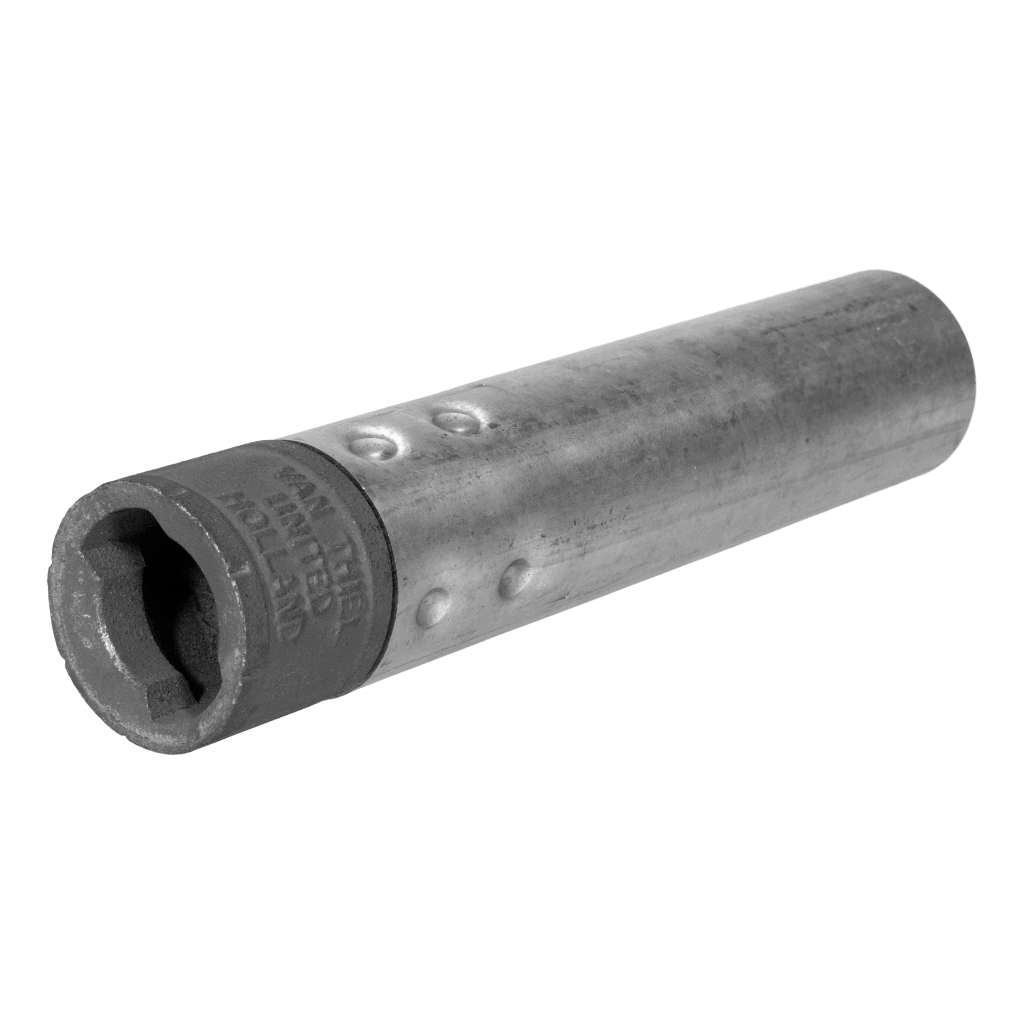
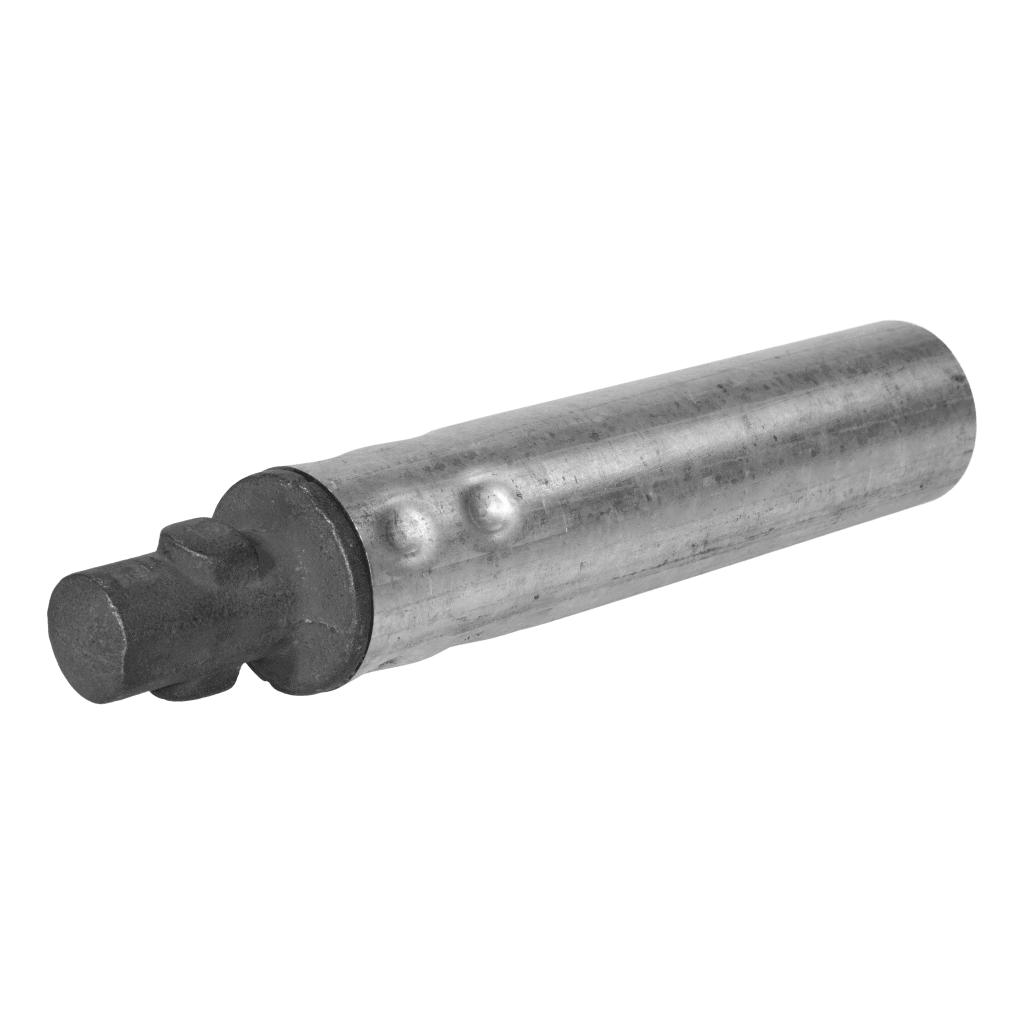
Tube-Lock® tubes are regular 48,3mm scaffolding tubes, fitted with two cast iron Tube-Lock pieces. Because of the Tube-Lock ends, tubes can be connected with each other by a twisting motion, visibly locking them in place. No tools nor additional parts are required to make or secure the connection.
This provides many advantages.
Because the two tubes can be joined by a twisting motion, it is a fast and easy way to connect tubes together. This leads to faster erection and dismantling times for the entire scaffold.
Furthermore, no additional parts nor tools are needed. No longer needing sleeve couplers and joint pins means that there are no spare parts that need to be transported. Additionally, you don’t have to invest in sleeve couplers and joint pins as you no longer need them.
This also eliminates the risk of sleeve couplers breaking, getting lost or getting stolen. And you don’t have to service the sleeve couplers anymore. Tube-Lock connections are completely maintenance-free.
Another logistical advantage is that Tube-Lock comes in standard lengths from 1 meter or 4ft up to 4 meters or 13ft. Because of this flexibility, it prevents the necessity of cutting the tubes to length.
The maximum length of 4 meters means the maximum weight of a Tube-Lock tube is 16 kg. This leads to less strain on scaffolders, which is essential because of the strict Occupational Health and Safety regulations.
Additionally, there is no need to stagger joints, Tube-Lock is as strong as a continuous tube. The connection may even be submitted to pull force. Using Tube-Lock tubes leads to a smooth tube connection over the full length of the tube. This makes it possible to use couplers anywhere on the tube. Even on the Tube-Lock connection.
Van Thiel United Ltd. can make Tube-Lock tubes out of your (used) scaffolding tube!
In their innovative production facility, they can turn your (used) scaffolding tube to Tube-Lock tubes! This means you can update your own material without enormous investments. Even the repair of existing Tube-Lock stock is possible. And they now offer a special discount on the conversion of your scaffolding tube!
Three men have been sentenced for their role in a construction test fraud scheme that allowed more than 70 candidates to cheat health and safety exams.
The investigation, led by the Metropolitan Police, uncovered a year-long operation involving the use of Bluetooth earpieces to feed answers to test candidates at centres across London.
The case came to light after concerns were raised by the Construction Industry Training Board (CITB), which flagged unusual activity linked to its testing system. Officers then carried out surveillance at multiple test centres, working alongside Pearson Professional Assessments to identify those involved.
At Snaresbrook Crown Court on 31 March, three men were sentenced after pleading guilty to fraud by false representation.
Sushil Kumar, 37, was jailed for two years and eight months. Pradeep Sheragar, 35, received a two-year suspended sentence. Jaspal Sani, 43, was given a one year and three month suspended sentence.
Police said candidates paid up to £850 to receive answers during exams. The group is believed to have made more than £60,000.
Detective Sergeant Neil Stanley said the scheme exploited individuals seeking work while putting others at risk.
“Falsifying results is extremely dangerous and poses a risk to site workers,” he said. “This showed a clear disregard for safety.”
The fraud directly undermined the integrity of the Construction Skills Certification Scheme (CSCS), which requires workers to pass health and safety tests before accessing sites.
CITB said it would work with CSCS to revoke any qualifications obtained fraudulently.
Christopher Simpson, Head of CITB Standards Setting Body, said: “Cheats and fraudsters who circumvent these safety critical exams are putting lives at risk.”
The organisation has urged the industry to report suspected fraud and warned that further action will be taken against those attempting to bypass safety requirements.
Scaffolding companies and industry figures have taken to social media to mark April Fools’ Day, with a wide range of posts blending humour with familiar industry themes.
Among the more widely shared posts, Connolly Scaffolding Ltd claimed it had been appointed to carry out works at both of Manchester’s major football clubs.
While works at Old Trafford were described as routine upgrades, the post joked that Manchester City F.C.’s Etihad Stadium was to be demolished immediately due to “planning irregularities”, leaving uncertainty over future fixtures.
Sustainability and innovation were also common targets. Optimum Scaffolding Ltd announced it had invested in five “Euro7 horse-drawn carriages”, claiming the move would reduce emissions while running on “recycled grass”.
Technology themes featured heavily. Total Access Solutions Pty Ltd shared a mock announcement claiming it would introduce “scaffbots” capable of replacing human scaffolders.
In the post, Managing Director Stuart White outlined a future with no wages, no breaks, and no downtime, reflecting ongoing discussions around automation and labour shortages.
Others focused on regulation and policy. ScaffSAFE’s Steve Gregory joked that the UK Government was preparing to ban impact wrenches, proposing a return to manual tools under a fictional “Traditional Methods Act”.
Politics also featured. Ultra Access’s Jason Gibbs claimed he was standing as an MP in Clacton-on-Sea, directly challenging Nigel Farage, with supposed backing from the National Access and Scaffolding Confederation.
Other posts leaned into culture and everyday site life. Coles Scaffolding’s Martyn Coles announced a fictional takeover by “Disney Construction Group”, while James McMillan shared a mock film concept starring Jason Statham in a scaffolding-themed action film.
Meanwhile, Carl Sharley promoted a fake “Inspect7® Mug” system for rating tea, and Dr. Alan Osborn announced a fictional Tube and Fitting Scaffolding World Championships.
AI helps with April Fools
This year, many of the posts were made more convincing by the growing use of AI-generated imagery, with realistic visuals helping blur the line between genuine announcements and satire.
Across the posts, common themes emerged, including automation, sustainability, regulation, and industry culture. Many of the jokes worked by exaggerating real issues, making them believable enough to prompt initial reactions before the punchline became clear.
The volume and variety of posts underline how social media is now embedded in the scaffolding sector, giving companies and individuals a platform to engage audiences beyond standard project updates and safety messaging.
For one day, at least, the industry steps back from its usual focus and shows a more informal side, even if the announcements remain firmly fictional.
City Access Scaffolding has completed a management buyout, with its existing leadership team taking full ownership of the business.
Original co-founder Mark Skinner, alongside directors Ryan Scott and Ross Archibald, has acquired the company. The move marks a transition in ownership following more than 11 years of trading.
Kirsty Allan and Jonathan Allan, who co-founded the business in 2014, have stepped away from the company after gradually reducing their involvement in day-to-day operations.
The new ownership structure formalises the leadership team, with Mark Skinner appointed managing director, Ryan Scott as operations director, and Ross Archibald as commercial director.
The company said the change represents continuity in how the business has been operating in recent years, with the existing leadership team already responsible for its day-to-day running.
In a statement, Kirsty Allan said the business had grown from a start-up with limited capital into an established contractor delivering projects across Scotland.
She added on LinkedIn that the company is “in a strong position, with a capable leadership team and clear direction for the future”.
Jonathan Allan said the original aim of the business was to deliver quality work and create long-term opportunities within the workforce.
Mark Skinner said the focus would remain on developing the company’s workforce and supporting progression from within the business.
Ryan Scott said he was “proud to now be part of leading it into its next chapter”, while Ross Archibald added that the company would continue to focus on client relationships alongside commercial discipline.
City Access Scaffolding has also confirmed it will continue investing in apprentices and workforce development as part of its next phase.
The business was founded in 2014 and operates across Scotland.
JMAC Industrial and Access Group Ltd has acquired a majority shareholding in Tees Site Support Ltd, marking the company’s first acquisition as it looks to grow its industrial services capability.
The deal, completed on 11 March 2026, brings additional expertise in rope access, confined space entry, rescue, cleaning and specialist industrial support into the group.
JMAC said the move is part of a longer-term plan to strengthen its position as a provider of industrial access solutions, alongside its existing scaffolding and access operations.
Tees Site Support operates across high-risk and complex environments, with services typically used in sectors such as energy, infrastructure and heavy industry. The addition is expected to broaden the range of services JMAC can offer to both existing and new clients.
Speaking about the acquisition on LinkedIn, Luis McCarthy said the business was progressing towards its long-term vision, building on its history and recent growth.
Ryan Payne described the deal as an important step in the company’s development, noting that it represents JMAC’s first acquisition and forms part of a wider pipeline of projects and growth plans.
The move reflects a wider shift in the access sector, where contractors are expanding beyond traditional scaffolding into rope access and specialist industrial services to meet demand for multi-discipline solutions.
JMAC indicated that further growth will be driven through a mix of organic development and future acquisitions.
The final 20 teams competing at ScaffChamp powered by Layher 2026 have been confirmed, with the last place secured after a qualification event in Hungary.
Stabil Epito claimed the final spot on 28 March, completing the line-up for this year’s competition. The Hungarian team is already familiar with the event, having finished third in 2025.
The competition is set to take place in June with organisers expected to host the event in front of an international audience of contractors, suppliers and industry stakeholders.
The 2026 edition will again bring together teams from across Europe, Asia, North America and South America, underlining the competition’s international reach.
European teams make up the majority of the field, with entries from countries including the UK, Germany, Poland and Italy. Among them is AK Scaffolding, representing the United Kingdom, alongside A-TEAM, a group of apprentices representing Scotland and Northern Ireland.
Teams from outside Europe include Mongolia’s Team NBIK, Canada’s Échafaudage Vermeren, and TALIM from Peru.
ScaffChamp has grown in recent years into one of the most recognised competitive events in the scaffolding sector, testing teams on speed, accuracy and safety in scaffold assembly and dismantling.
A full list of participating teams, including profiles and contact details, has been published on the official ScaffChamp 2026 team page.
The government has confirmed Roads Investment Strategy 3 (RIS3), a £27 billion programme covering England’s motorway and A-road network through to 2031.
A record £8.4 billion has been directed at renewals. That includes the resurfacing of more than 9,000 kilometres of motorway and A-road lanes, close to a quarter of the entire strategic road network.
The most significant opportunity for the sector lies in structural and reconstruction contracts. Confirmed projects include concrete road rebuilds on the M180 and A180, and bridge renewals on the M6 Lune Gorge and the M32 Eastville Viaduct.
These schemes typically require falsework, propping and specialist access, work that falls within the civil engineering offer of most established contractors.
Five major enhancement projects are due to start within the RIS3 period. They include the A66 Northern Trans-Pennine dualling and the Lower Thames Crossing.
A further 16 local authority-led road schemes have also been confirmed, covering bypasses, junction upgrades and new links across England.
National Highways Executive Director Elliot Shaw said the renewals focus “will keep people connected to their loved ones, support the delivery of new homes and jobs, and give industry the confidence to plan and invest in the UK.”
What this means for contractors
Unlike previous strategies, RIS3 shifts emphasis away from large new builds and towards maintenance and targeted upgrades. For contractors with civil engineering experience, the procurement window is opening now.
National Highways procurement channels and Tier 1 supply chain frameworks are the routes to watch as schemes progress to tender stage.
The National Access and Scaffolding Confederation (NASC) has announced a series of new regional chair and vice chair appointments as part of a wider expansion of its regional network.
The move follows significant growth in membership, with the organisation reporting a 40% increase in its core membership since 2023.
NASC said the expansion is aimed at strengthening local representation and ensuring members have a stronger voice at regional level. Regional meetings are now attracting more than 100 delegates, reflecting increased engagement across the industry.
The trade body said its regional structure plays a central role in shaping guidance, policy and best practice, alongside the Construction Industry Scaffolders Record Scheme (CISRS).
New appointments
The latest appointments include:
London and South-East Chair: David Evans (MR Scaffolding) Vice Chair: Martin George (CCS Scaffolding)
West Midlands Chair: Steve Fellows (Malvern Scaffolding) Vice Chair: Sam McSpadden (Phoenix Group)
East Midlands Vice Chair: Jay Love (Access 2)
North-East Vice Chair: Luis McCarthy (JMAC Industrial and Access Group)
Wales Chair: David Anderson (Allen and Foxworthy) Vice Chair: Kate Thomson (Thomson Scaffolding)
Ireland Chair: Robert Andrews (Advanced NI Scaffolding)
They join existing regional leaders, including East Midlands Chair Lisa Rooney, North-East Chair Darren Maratty, South-West Chair Dave Battison, and Scotland Chair Ronnie Charters.
NASC also confirmed that Michael Lloyd of LTC Scaffolding has stepped down as South-East regional chair after eight years in the role.
Industry voice
Clive Dickin, chief executive of NASC and CISRS, said regional representatives remain central to how the organisation supports its members.
He said: “Our regions are at the heart of NASC and what it does and the regional chairs and vice chairs are fundamental to how we serve members on the ground.
“They are the connection between NASC and the businesses and people that make up our membership, and I am delighted to welcome this new group into their roles.”
NASC said members can attend regional meetings through its events calendar, with sessions continuing to focus on knowledge sharing, industry input and collaboration.
Layher UK has announced a series of open morning events aimed at giving customers and partners direct access to its latest systems, product developments and digital tools.
Branded as “Sizzle & Learn” sessions, the events will run from 10:00 to 13:00 and combine live demonstrations with informal networking, alongside refreshments including tea, coffee and breakfast rolls
The first session will take place on 31 March in Letchworth, focusing on event structures. The day will include demonstrations of Layher’s SIM2Field digital tool, alongside a promotional offer on event decks and transoms for orders placed on the day.
A second event is scheduled for 24 June in Livingston, with a focus on formwork solutions. Attendees will be able to see the FW system in action, with a related on-the-day offer available.
The final open morning will be held on 21 July at Eggborough. This session will centre on the launch of Layher’s Flex Beam, alongside demonstrations of Twix Beam solutions. Both product lines will be included in event-specific offers.
Layher said the sessions are designed to give attendees a practical understanding of how its systems can be applied on site, while also offering early access to new products and technical support.
The programme reflects a wider push by the company to engage directly with contractors through hands-on learning and live demonstrations, rather than traditional presentations.
Two people have been taken to hospital after a building partially collapsed in Oldham town centre.
Emergency services were called to King Street at about 12:40 GMT on Tuesday after the front of a terraced property gave way. The building had been surrounded by scaffolding at the time of the incident.
Greater Manchester Fire and Rescue Service said five people were inside the property but all managed to escape.
North West Ambulance Service confirmed that two casualties were taken to hospital. Their injuries are not believed to be serious.
A large emergency response was deployed, including three ambulances, an air ambulance and a hazardous area response team. Police and fire crews established a cordon, with several roads closed.
Engineers from Cadent Gas were called to the scene after a gas main was damaged during the collapse.
Chris Campbell, operations manager at Cadent, said engineers were working to secure the supply.
“Our engineers are currently on site securing a damaged gas main, caused by the collapse of a nearby building earlier today,” he said.
“We are working closely with the emergency services and are awaiting confirmation that the site is safe for our teams to access the gas pipe and isolate the supply to the affected property.”
Witnesses described a significant emergency presence in the area. Local businessman Kwok Wong said the scene was already attended by emergency services when he arrived.
“The building was a mess,” he said. “Air ambulances landed on top of the Mecca Bingo roof.”
The property, previously home to a Euro King Mini Market, is owned by Oldham councillor Kamran Ghafoor, who declined to comment.
Authorities have urged the public to avoid the area while investigations continue.
In the heart of Manchester’s financial district, a major high-rise development is setting new benchmarks for construction scaffolding in the UK. For this complex inner-city project, Prime Scaffold Design engineered the hoist tower, while Scafom-rux supplied the RINGSCAFF modular scaffolding system to build the 140-metre-high structure – the tallest ground-based scaffold ever erected in Manchester.
20,000 modular scaffolding components in action
Construction on the site began in September 2023 with demolition and enabling works. Since then, the project has steadily gathered momentum. Within 26 months, work progressed to level 14 of the above-ground structure, while a three-storey basement and extensive internal fit-outs up to level 12 took shape below.
With the concrete frame advancing floor by floor, the 140-metre hoist tower is already playing a central role by providing vital access for both personnel and materials as the building rises.
“The hoist tower is a critical element of the project,” explains Mark Gaffney of Kinlan Scaffolding. “It will service all floors and has been designed to safely carry loads of up to 10?kN per square metre. With over 20,000 RINGSCAFF components totalling around 100 tonnes, the structure demonstrates the versatility and strength of modular scaffolding systems.”
Perfecting the scaffold design off-site
The scaffold design had to meet demanding technical requirements, from its self-weight and live loads to anchoring in tight urban spaces with challenging ground conditions. Early-stage collaboration between Scafom-rux and Kinlan Scaffolding allowed a trial section of the tower to be built off-site to refine the design and ensuring seamless integration with the trades on-site.
“Material delivery and logistics posed significant challenges due to the restricted city-centre site,” adds Andrew Gee from Scafom-rux. “By staging deliveries via Kinlan’s yard on the outskirts of Manchester and lifting materials with tower cranes, we ensured efficiency while meeting all project deadlines.”
Project partners on site: Andrew Gee of Scafom-rux and Mark Gaffney of Kinlan Scaffolding in front of the 140-metre-high RINGSCAFF hoist tower in Manchester’s financial district.
How to anchor a 140 meter high hoist tower
The scaffold assembly required a small dedicated team on-site, typically two to four scaffolders, supported by engineers and site personnel. The hoist tower reaches an impressive 140?metres, making it the tallest ground-based scaffold ever erected in Manchester. Achieving this height posed particular challenges, as the scaffold had to be carefully anchored with pre-installed ties to ensure stability while safely carrying materials and personnel throughout the building.
David Rogerson from Prime Scaffold Design, responsible for the scaffold engineering, explains: “The ties were a little bit out of the ordinary, so we worked with the concrete contractor to look at casting anchors. The solution was to install the ties ahead of the scaffold, so when Kinlan and the team progressed with the scaffold, the anchor point is right where we need it.“
Despite the complexity, early milestones, such as completing the basement deck and installing the hoist, were achieved on schedule. Project Manager John Holden of Domis Construction highlights the building’s distinctive design: “The building will be one of the most striking glass façades in Manchester. Incorporating the historic Sir Ralph Abercromby Pub into the scheme added complexity, but we managed to progress without delays.”
“The monster of Manchester”: Tackling one of the UK’s most challenging urban construction sites
Looking ahead, the project aims for completion of the concrete frame by December 2026, with overall delivery scheduled for September 2027. “Manchester’s tallest ground-based scaffold shows what careful planning and close collaboration can achieve,” concludes Andrew Gee.
“It’s a high-profile, technically challenging project, and we are proud to be part of it. The monster of Manchester, as we call it.”
As the building continues to rise, it stands not only as a record-breaking structure but also as a showcase of technical expertise and teamwork in one of the UK’s most challenging urban construction sites.
Project Key Facts
Hoist tower height: 140?metres
Total scaffold components: 20,000 parts of RINGSCAFF modular scaffolding
Total scaffold weight: ca. 100?tonnes
Safety design load: 10?kN/m² on scaffold platforms
Anchoring system: Pre-installed ties integrated with concrete frame
Project timeline: Concrete frame completion by Dec 2026, overall delivery Sep 2027
We use cookies on our website to give you the most relevant experience by remembering your preferences and repeat visits. By clicking “Accept”, you consent to the use of ALL the cookies.
This website uses cookies to improve your experience while you navigate through the website. Out of these, the cookies that are categorized as necessary are stored on your browser as they are essential for the working of basic functionalities of the website. We also use third-party cookies that help us analyze and understand how you use this website. These cookies will be stored in your browser only with your consent. You also have the option to opt-out of these cookies. But opting out of some of these cookies may affect your browsing experience.
Necessary cookies are absolutely essential for the website to function properly. These cookies ensure basic functionalities and security features of the website, anonymously.
Cookie
Duration
Description
cookielawinfo-checbox-analytics
11 months
This cookie is set by GDPR Cookie Consent plugin. The cookie is used to store the user consent for the cookies in the category "Analytics".
cookielawinfo-checbox-functional
11 months
The cookie is set by GDPR cookie consent to record the user consent for the cookies in the category "Functional".
cookielawinfo-checbox-others
11 months
This cookie is set by GDPR Cookie Consent plugin. The cookie is used to store the user consent for the cookies in the category "Other.
cookielawinfo-checkbox-necessary
11 months
This cookie is set by GDPR Cookie Consent plugin. The cookies is used to store the user consent for the cookies in the category "Necessary".
cookielawinfo-checkbox-performance
11 months
This cookie is set by GDPR Cookie Consent plugin. The cookie is used to store the user consent for the cookies in the category "Performance".
viewed_cookie_policy
11 months
The cookie is set by the GDPR Cookie Consent plugin and is used to store whether or not user has consented to the use of cookies. It does not store any personal data.
Functional cookies help to perform certain functionalities like sharing the content of the website on social media platforms, collect feedbacks, and other third-party features.
Performance cookies are used to understand and analyze the key performance indexes of the website which helps in delivering a better user experience for the visitors.
Analytical cookies are used to understand how visitors interact with the website. These cookies help provide information on metrics the number of visitors, bounce rate, traffic source, etc.
Advertisement cookies are used to provide visitors with relevant ads and marketing campaigns. These cookies track visitors across websites and collect information to provide customized ads.