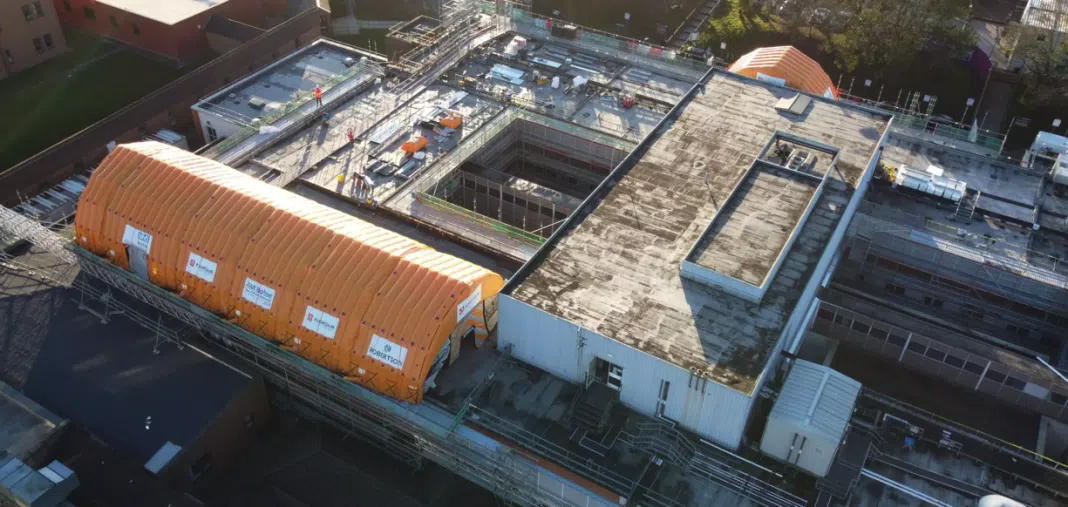
Robertson Construction has installed a series of inflatable roofing tents as part of a major redevelopment programme at the Royal Bolton Hospital.
The air-filled structures are being used during the replacement of the maternity unit roof, which contains reinforced autoclaved aerated concrete (RAAC) panels that have reached the end of their service life. The works form part of a wider programme to address RAAC across the Bolton NHS Foundation Trust estate.
The modular tents, supplied by Njordair, are designed to create a weather-protected working environment at height. Each structure can be deployed in around seven minutes and deflated in three minutes using a constant-flow air system powered by the hospital’s mains electricity.
In total, 13 tents will be used during the 40-week project.
The structures have been adapted through a temporary works design process to allow them to be installed on the hospital roof. Robertson said the system allows teams to maintain programme continuity while minimising disruption to hospital operations.
The roof works are being carried out on a complex site made up of interconnected buildings where critical services, including the hospital’s oxygen store, must remain accessible at all times.
According to the contractor, using a traditional scaffold solution for large temporary roof structures would have created logistical challenges and greater disruption to the hospital’s 24-hour operations.
Instead, the project combines lightweight scaffolding with the inflatable tents to create enclosed work areas that can be quickly moved as the programme progresses.
Njordair director and co-founder Aubrey Kingsbury said the application of the system on the Bolton project was unusual in the UK.
“Out of almost a decade of experience, we have never seen our product used in this way in the UK,” he said.
“Fast Tent is made from heavy-duty, flame-retardant PVC and can withstand high winds and the toughest weather conditions, making it well suited for this project.”
Robertson Group chief executive Elliot Robertson said the approach was developed to maintain hospital operations while enabling essential roof replacement works to proceed safely.
“We are always looking for innovations that help us deliver high-quality projects and services for our customers,” he said.
“As the partner of choice for the trust to deliver essential RAAC replacement and create modern, safe healthcare environments, we needed to find a solution that didn’t impact day-to-day operations at the hospital.”
He added that the system could encourage wider exploration of alternative temporary protection solutions on complex refurbishment projects.