The UK’s largest scaffolding trade association has spoken out about the government’s cash boost to create a new flexible approach to apprenticeships.
The government has recently announced a £7m funding pot to support flexible apprenticeship opportunities.
Sectors including the construction industry can now bid for a share of the fund to support the creation of new flexible apprenticeships, intended to unlock opportunities for people to develop the skills they need to get good jobs.
Current rules insist that apprenticeships must be at least 12 months long, so some sectors have found it challenging to benefit.
It is hoped the fund will help to establish a small number of agencies that will set up new flexi-job apprenticeships so an apprentice can work across a range of projects and with different employers to gain the knowledge, skills and behaviours they need to be occupationally competent.
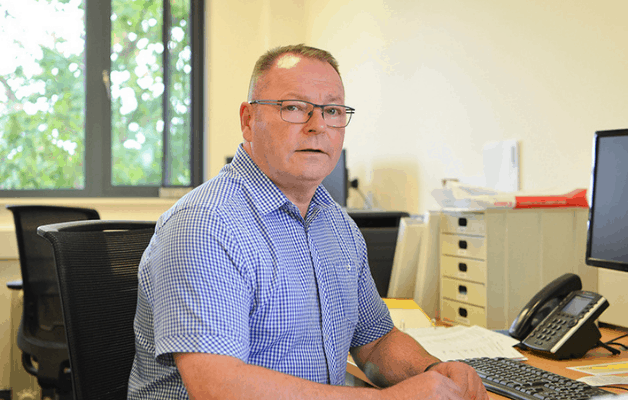
Robert Candy, Chief Executive of the Scaffolding Association said “The construction industry suffers from significant skills shortages and desperately needs training solutions that work for each of the many diverse sectors that contribute to its overall success.This cash boost from Government is welcome but the money must benefit the companies and individuals that need it the most and not line the pockets of training companies and agencies.”
From small and compact to intricate and large, there’s a certain family company in the UK able to focus on their amazing scaffolding and rigging experience together, so millions can watch some of our biggest events on stage and television. Grahame Anderson has been zooming in to find out more.
Mention scaffolding to anyone and it’s more than likely they’ll think of those structures placed around buildings during a construction project. There is in fact much more to the craft than meets the eye for the layman especially. Just picture some big sporting events, special outside broadcasts, concerts or outside meetings, and the chances are you’ll spot some kind of support rigging. And of course, all put together by highly skilled scaffolders with safety at the forefront.
As a family business, Focus Rigging has been doing just that for more than 13 years slowly diversifying along the way.
Managing Director Gary McMahon told me: “At Focus our team are highly experienced within the Media and Events industry with a combined knowledge of more than 200 years which allows us to have a refreshing and unique perspective on management, production and provisioning of temporary structure solutions to a highly demanding industry where safety, stringent time constraint and budget awareness are a priority.“We will deliver any project on time and within budget, utilising our strategically placed depots in London, Manchester and Bristol enabling us to successfully service the U.K, Ireland and mainland Europe with ease.”The Open Golf
Focus Rigging are an impressive business with some major clients added to an already first-class CV. These include both ITV and the BBC, Sky Sports, The Jockey Club, BT, Amazon, Matchroom, Arsenal and Chelsea football clubs, Wimbledon, The Royal Albert Hall and both The Premier League and Football Association. All of this achieved through seven family members.
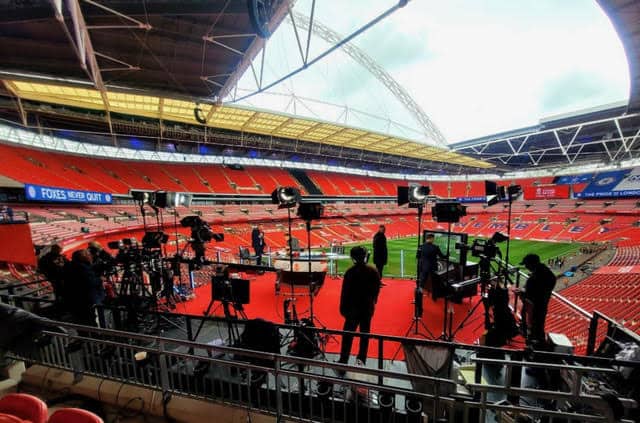
Aintree Grand National: Entrance BridgeWembley Stadium FA Cup Final 2021: Studio Platforms For BBC & BT
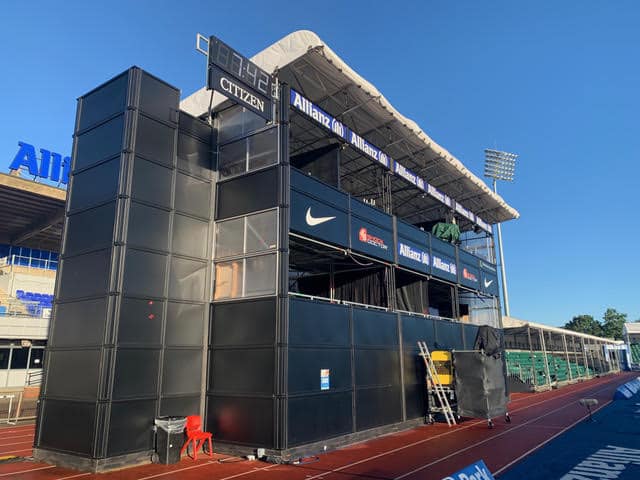
Owned by Gary and Andrew McMahon they began life primarily as a TV Scaffolding company – and yes, the industry plays a huge role in bringing all manner of outside broadcasts to the masses. Something we perhaps take for granted as Gary explained: “It’s an important market and something we’re immensely proud to be involved in. In fact, we now cover staging, trussing, bespoke carpentry and various fabrications. The projects we’ve been involved with have taken us all over Europe, working in France, Italy, Holland, Germany, Lithuania, Estonia, Slovenia, Sweden, Slovakia, Malta, The Czech Republic and Spain. We’ve a head Office in Hemel Hemstead and two smaller teams working from yards in both Bristol and Manchester.“The wonderful thing is there’s never a dull moment with plenty of variety to keep everyone fully animated. It really is a labour of love for us all. We love every moment of this job.”Saracens RFC: Temporary Media Gantry
Focus provides a personal service to all clients from the initial phone call to the handover of the project. It helps of course to always deal with the same person who oversees every element of the job. It all means customers can rest assured they always have someone close at hand to rely on.
Each job is different so it’s difficult to choose a stand-out event in the sense they are all of the highest quality. OR put it another way, Six Nations rugby matches to the FA Cup Final, long running tv dramas carrying amazing backdrops to major concerts, The Derby, international test cricket and much more. We think you’ll get the picture. Just take a look at some of these social media comments to get a real flavour of the very essence of Focus Rigging:
“Top class job by the team at ‘The Oval’ today……Some amazing views of London as well as the cricket for @skysportscricket & @ctvob to capture.”“After 8 days of blood sweat & tears we have now left Windsor.Immensely honoured to be part of another huge Royal event albeit a very sad & emotional occasion for the nation.So very, very proud of the team who went above & beyond in challenging circumstances??#teamfocus.”“6m x 6m ‘Presentation Platform’ with bespoke glass balustrade installed today at @aintreeracecourse for the @thejockeyclub“Looking forward to seeing all the presentations take place on this structure next week.”“Day 2 completed at Twickenham Stadium Studio Platform and Beauty Shot rig now all in place and handed over to the @itvsport & @telegenicob teams to work their magic @sixnationsrugby @englandrugby.”
So the next time you see those pundits doing their stuff in what looks like a well-designed studio, put a little focus on what it took to set everything up for your enjoyment. Chances are Focus Rigging will have played a part.
This article was first published in the ScaffMag Magazine Issue 13
July saw the official opening of The London Academy of Sustainable Construction in the heart of Waltham Forest. Cllr Simon Miller from the London borough of Waltham Forest was charged with carrying out the ceremony as a host of proud guests looked on. It’s the newest centre in their portfolio.
This superb centre will continue to deliver the full CISRS scaffolding Curriculum to the highest standards for a range of clients. But it will also maintain a sharp focus on benefiting the residents of Waltham Forest, in the form of Pre-employment Training Schemes (PETS), Green Energy Skills Training, Modern Methods of Construction, Construction Engineering, Digital Construction and Apprenticeships.
SIMIAN MD Simon Hughes explained: “After what has been an incredibly challenging 18 months or so, it’s hugely rewarding to officially launch our newly branded London Academy of Sustainable Construction.Big thanks to the Simian team, our partners and Waltham Forest Council for their efforts in getting us to where we are today. Our intention is for LASC to become a benefit to the whole Waltham Forest community, and we have already seen some fantastic employment results for residents, but we aim to build on this and get more and more local people skilled and ready for work in the construction and green energy sectors”.
In fact, the day was cause for a double celebration as Cllr Clyde Loakes also took time to launch the new Green Skills Hub, set to benefit the whole community. The green energy skills hub courses are being developed at LASC as part of the Green Energy Skills Training Alliance (GESTA), a joint initiative between London Borough of Waltham Forest Council, Waltham Forest College, and SIMIAN. The training is planned to meet the skills need for the installation and maintenance of energy efficiency technology for new build construction and the retrofit of existing properties.
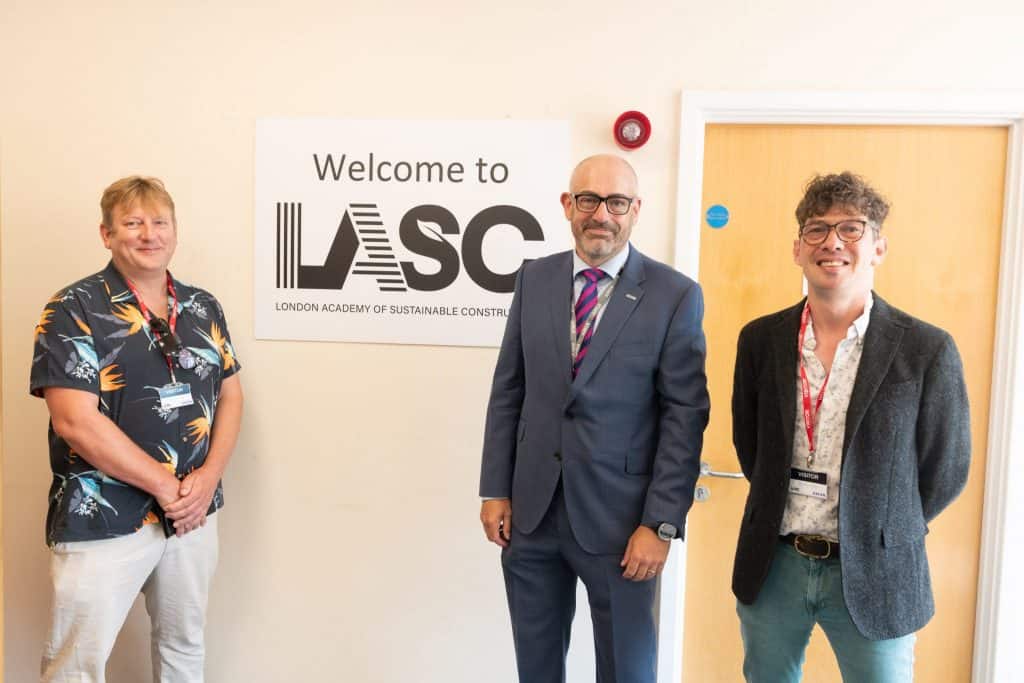
(L to R) Cllr Clyde Loakes (Deputy Chair of the LGA’s Environment Board), Simon Hughes (SIMIAN MD), Cllr Simon Miller.
Neil Bewick, Centre Manager at LASC said: “This delivery marks a significant step forward for the development of our Green Energy Skills Training at the London Academy of Sustainable Construction here in Waltham Forest. Air source heat pump technology is a low carbon heating option for both new build construction and retrofit of existing social housing and private properties. We are keen to support the emergence of this energy efficient technology by providing skills training for installers not only in the borough of Waltham Forest but the wider pan-London and southeast region.”
As a company SIMIAN was established in 2005 by a team of scaffolding industry experts with unsurpassed knowledge, expertise and experience. SIMIAN has rapidly grown to become one of the UK’s leading training and consultancy organisations.
They deliver training courses designed for all levels of personnel from apprenticeships for those just starting out in their career through to courses for advanced level scaffolders, inspectors and supervisors.
It’s worth noting their highly skilled team of scaffolding consultants are dedicated to instilling a safe operating culture throughout global construction, infrastructure and industrial environments.
Construction output fell by 1.3% in June 2021, following a decline in repairs and maintenance work.
Materials price rises and shortages have also been blamed for the fall.
The Office for National Statistics reported that June output was 0.3% below the February 2020 pre-coronavirus pandemic level. New work was 2.1% below the pre-pandemic level, while repair and maintenance was 3.1% above.
Despite three monthly falls in growth for the months within quarter 2 (Apr to June) 2021, quarterly growth increased by 3.3% which, apart from quarter 3 (July to Sept) 2020, was the strongest quarterly growth since quarter 3 2013 (3.6%).
Fraser Johns, finance director at Beard, said: “For output to drop for the third consecutive month to below pre-pandemic levels, should start to ring some alarm bells. As an industry we’ve been saying for months now that the pandemic bounce-back could potentially be scuppered by a combination of the serious materials shortage, rising prices, labour shortages and now not enough HGVs on the roads to supply building sites. It’s not the kind of prediction anybody wants to be right about, but today’s stats demonstrate that these issues are really beginning to bite.“At the same time, it is encouraging to see quarterly levels of growth up 3.3% in Q2 compared to Q1, driven in part by new orders, but it is some way below the growth in the economy overall at 4.8%. And of course, that first quarter was spent still under lockdown.“Right now, we have to work together with suppliers, surveyors, customers and consultants to be proactive about the issues we face and take a multi-step approach to things like procurement to manage our way out of this current decline.”
Scaffolding erected over a railway bridge in Warrington collapsed overnight causing travel chaos for weekend commuters.
All trains between Warrington and Liverpool were cancelled on Sunday morning (8th Aug) after the scaffolding collapsed near Warrington Central Station.
Due to ongoing repair works a large span scaffolding bridge erected on Bewsey Street seems to have buckled and collapsed onto the railway line.
Local media report that the scaffold “fell in on itself early Sunday morning amid stormy conditions.”
Northern Rail laid on replacement buses throughout the day. A spokesman said: “Due to an obstruction near to the track, trains were unable to call at stations between Mossley Hill and Warrington Central.”
Several cranes were rushed to the site to help remove the scaffold. Disruption on the line continued until 7 pm on Sunday.
French giants the Altrad Group has agreed on a deal to acquire and take over the scaffolding and construction product suppliers Actavo Hire & Sales.
The Altrad Group has announced that on the 5th August 2021 it struck a deal to acquire Actavo Hire and Sales from the Actavo Group for an undisclosed sum.
Actavo Hire and Sales, which is based in Wakefield, West Yorkshire, has twenty-six Hire & Sales branches in the UK and four branches in Ireland. They offer a wide range of specialised scaffolding and building equipment for hire and sales.
Ran Oren Altrad Group Co-CEO said: “This acquisition sees our first venture into Ireland as well as extending our product offering and service in the UK. I am pleased to welcome Actavo Hire & Sales into the Altrad Group and we look forward to the next chapter building on the previous success of the company as part of the Altrad Group.”
Founded in 1985, France headquartered Altrad Group has over the years rapidly expanded through a series of strategic acquisitions to provide industrial services and scaffolding solutions.
The Group employs around 42,000 people worldwide and owns established international brands including Cape, Hertel and Prezioso Linjebygg.
In recent years the Altrad Group has acquired a number of well-established industry firms including Generation, Beaver 84, and TRAD.
Italian scaffolding rental and services specialist Euroedile has acquired formwork and scaffolding manufacturer Pilosio Group.
The deal worth €8 million will bring together Eurodile’s 53 years‘ of scaffolding erection experience with Pilosio’s production capacity to provide a full service globally.
Pilosio’s 45,000 square metre headquarters in the northeast of Italy has manufactured scaffolding, formwork, shoring structures, temporary coverings and mobile towers for 60 years.
The Pilosio Group, is a long-standing Italian player in the construction and maintenance equipment manufacturing sector that is currently in liquidation.
Euroedile said they came forward with a business plan that would not only provide continuity of employment for all employees, but would also revolutionise the production of the Pilosio brand in order to create scaffolding 4.0 and become competitive at a global level.
Founded in 1986, near Venice, Euroedile has 110 employees and reported a turnover of €15 million in 2020 and specialises in the sale, rental, assembly of scaffolding and formwork in Italy and abroad.
“We will bring a breath of “new air” not only by reinforcing Pilosio’s historical production but also by implementing the range with innovative materials and new products, says Nereo Parisotto, CEO of Euroedile.
Nereo Parisotto, CEO of Euroedile“All this will allow companies that rely on the Pilosio brand to work better, faster and safer. We have 35 years of experience in the field and, above all, engineering studies carried out by Euroedile’s technicians that have allowed us to carry out works that others would sometimes not even think of.”
Euroedile/Pilosio Group now aims to provide a unique full range of scaffolding and formwork services and products to the market, including consultancy and site assistance in the construction and renovation of bridges and viaducts, industrial and residential constructions, power plants and dams, as well as churches.
Embrace Building Wraps has now completed the world’s largest scaffold wrap installation at the Bullring in Birmingham
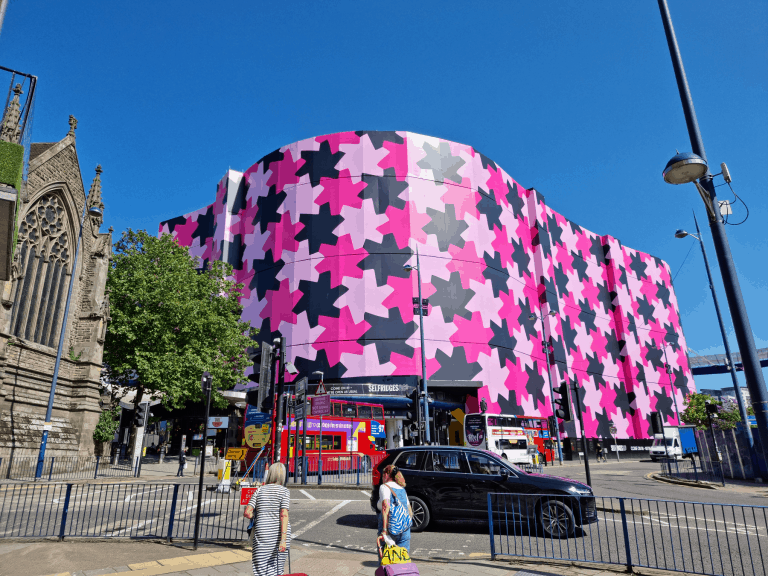
The final section of a colourful printed scaffold banner covering the temporary scaffolding installed by Midland Scaffolding Services at the iconic Selfridges & Co department store in Birmingham has now been installed.
The striking dogtooth flower design wrap measures almost 9,000 m2. This is 58% bigger than the currently recognised Guinness World Record holder for the largest scaffold banner which was installed in Madrid back in 2018 at a mere 5,672 m2.
At the extremes, the wrap is 246 metres long & 37 metres high equivalent to a giant wall of nineteen double-decker buses stacked eight high.
Installation of the frames and digitally printed wrap which will disguise the works during renovations commenced on-site at the end of December 2020. The banner features an artwork design produced by Birmingham-born designer Osman Yousefzada comprising of interlocking six-metre diameter dog tooth flower designs in three contrasting colours.
In total the Embrace Building Wraps team installed 5,888 linear metres of scaffold tubes for the banner frames, vertical curved shaping, and buffer rails. To put that into perspective, if laid end to end the scaffold tubes would extend around four miles (six kilometres).
The weight of the printed wraps alone is just under five tonnes, more than three Mini Coopers. Embrace seamlessly joined 24 individual banners of various shapes & sizes of which 85% had three or more adjoining perimeter edges that had to line up perfectly with the adjacent banners.
Landmark new research from CITB has outlined the scale of the mental health challenge facing construction.
A consistent approach to supporting construction workers’ mental health is the goal of a new initiative led by the Construction Leadership Council (CLC) and CITB.
CITB’s Mental Health And Construction: A Consistent Approach research, published today (Wednesday 4 August), is the most comprehensive study conducted on mental health and self-harm within construction. The report identifies opportunities for industry to address shortcomings and improve wellbeing for workers.
The risk of suicide among some site-based workers is three times the national average and a May 2020 Chartered Institute of Building report found that 26% of construction workers who responded to their survey had experienced suicidal thoughts; 97% had experienced stress over the past year.
CITB’s new research highlights a growing number of good initiatives but finds that their impact is currently held back by the lack of a coherent aim and message. Given the growing need to tackle mental health, developing a joined-up approach has become more urgent.
The CLC has backed the research having already prioritised mental health in its recovery plan, and is now pulling industry together to agree a plan to address it. This will seek to tackle the underlying causes of poor mental health, generate better evidence of what impact the initiatives are achieving and develop a more joined up approach.
Industry culture still perpetuates poor mental wellbeing. Factors include working away from home, heavy workloads, long working hours, and job insecurity. Poor management practices and understanding can exacerbate the problem, but some exemplars do a great job of looking after their workers – this inconsistency needs to be tackled.
The level and quality of evidence must also improve. There is a range of different mental health and wellbeing support available from industry professional bodies, charities and employers. However, evidence of the effectiveness of the support available is limited.
There needs to be more consistent and accessible support for workers in the smaller firms that supply larger ones. Many employers provide mental health and wellbeing support programmes to workers in their supply chains. However, these workers are often not aware that they can access mental health and wellbeing resources from their principal contractor.
CITB has invested in programmes aimed at helping industry develop skills, behaviours and ways of working that will make it a safer, healthier place to work. Since June 2018 it has funded over 29.000 mental health courses.
CITB provided funding for a Build UK and Timewise project where BAM Construct, BAM Nuttall, Skanska and Willmott Dixon joined forces to identify what measures best enhanced flexible working for some 11,000 employees.
Funding by CITB, through the Building Mental Health initiative, the Lighthouse Construction Industry Charity and Mental Health First Aid England, has helped train over 260 Mental Health First Aid Instructors.
CITB Policy Director Steve Radley said: “The pandemic has shone an even brighter light on the need to tackle mental health across society. Construction faces greater challenges than most other industries but employers are demonstrating their awareness of the need to tackle it. The Building Mental Health programme beat its targets to train mental health first aiders by more than 40%.“As well as supporting construction workers, tackling mental health will help employers to retain more of them and get the best from them at a time when more firms are reporting skill shortages. We need strong industry leadership on this and it’s great to see CLC picking up the baton.”The CLC, with support from CITB, has already taken the lead in engaging with organisations to agree the best way to deliver an integrated support service of shared goals and strategies.
CECA Chief Executive Alasdair Reisner, who leads the CLC workplace culture workstream, said: “The CLC is acutely aware of the mental health and wellbeing challenges faced by industry. Progress towards improving the situation has been frustratingly slow in recent years and there is no doubt that some of the statistics relating to mental health and construction are not good enough.“Encouragingly, this report from CITB includes good examples of best practice from which the whole sector can be inspired. The CLC will provide the shared vision and goals that industry has called for. We will do our utmost to accelerate improvements across the sector, particularly for SMEs, and look forward to collaborating with stakeholders on this crucial construction priority.”
Building Mental Health, supported by the Lighthouse Construction Industry Charity, provides free support and resources, from industry experts, to increase mental health awareness.
Bill Hill, CEO of the Lighthouse Construction Industry Charity, said: “Doing things right is important. Doing right things can save lives. Implementing and measuring a comprehensive programme to improve workforce wellbeing in construction needs no thought, it is the right thing to do. It will improve the workplace culture, support and retain the existing workforce, make the industry more attractive to the next generation and will undoubtably save lives.”
Read Mental Health And Construction: A Consistent Approach.
As part of the Houses of Parliament ongoing restoration works, Alltask was contracted to carry out an extensive scaffold access package to the inside of Westminster Hall, incorporating the external roof lantern.
Westminster Hall is the oldest building on the parliamentary estate carrying more than 900 years of fascinating history. Set to play a prominent part in future events, Westminster Hall has been transformed to befit its 21st century standing in the world. As part of the Palace of Westminster situated on the north bank of the River Thames in the City of Westminster, this special place has been the site of crucial episodes in the UK’s history, such as the trial of Charles I, coronation banquets, the lying-in-state of monarchs and prime ministers and addresses by world leaders.
The oak hammer-beam roof in Westminster Hall, commissioned by Richard II in 1393, is the largest in Northern Europe, spanning more than 20 metres. A steel frame structure, installed by Sir Frank Baines between 1913 and 1922 to reinforce the roof, made the access system to undertake the project works possible.
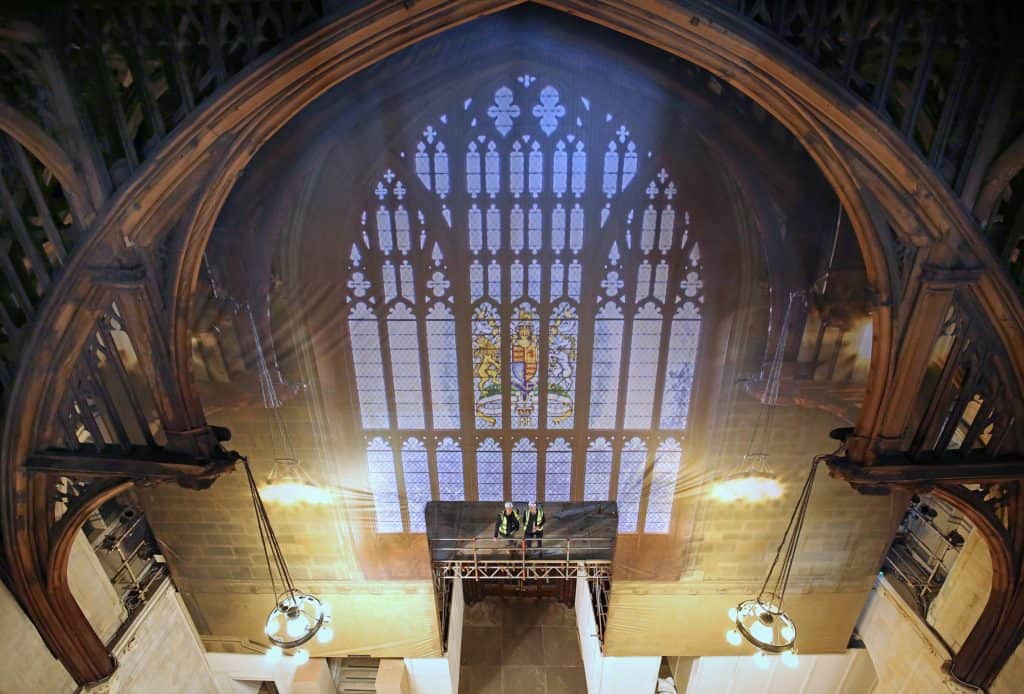
The main works in Westminster Hall comprised two parts. The first element involved the meticulous conservation of the internal roof trusses sited 28m above ground level. The second involved the deconstruction & restoration of the external roof lantern.
From the outset, Alltask was under no illusions about the significance and historical importance of this project. Westminster Hall’s interior is steeped in history, and just about everything contained within it is irreplaceable. During the planning stage, no stone was left unturned to the extent that Alltask created a full-scale, proof of concept mock-up at their Rochester head office. This fully functioning scaffolding structure for one of the Westminster Hall roof space’s internal bays was lifted and lowered with the client and relevant stakeholders in attendance.
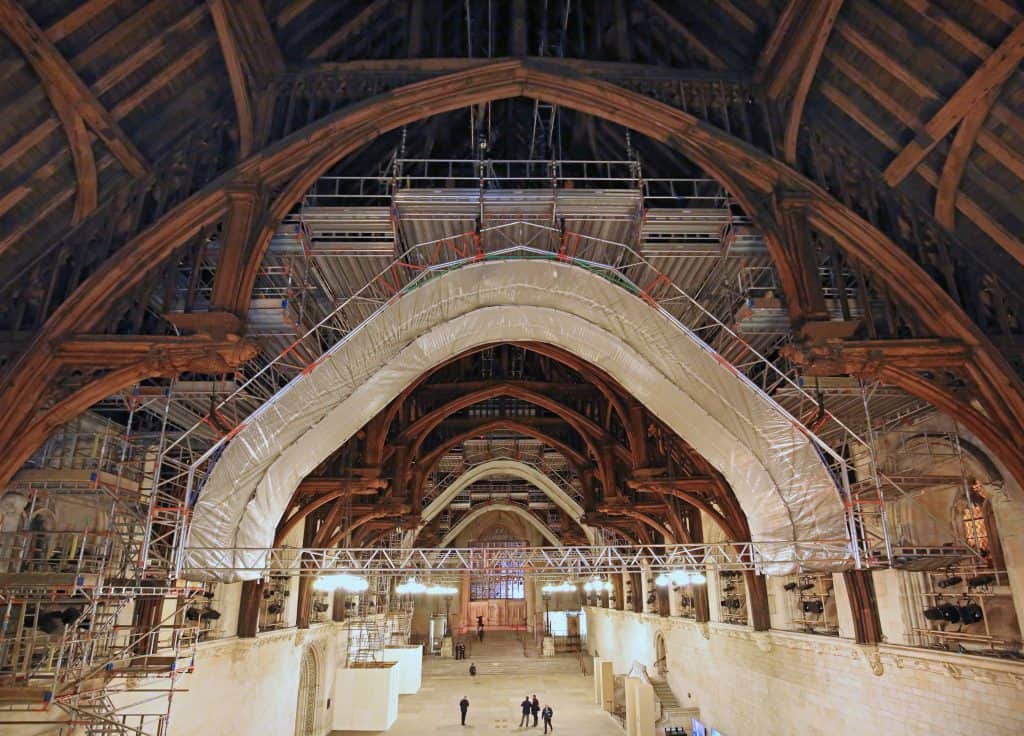
Once appointed, Alltask immediately consulted with their system scaffold partners, HAKI UK, and co-developed a lightweight access solution built at ground level and lifted into position via purpose-built hoists made in Germany specifically for the contract. Unbelievably, Alltask managed to get this process down to a fine art by constructing & installing a single roof truss bay in one single weekend. Once lifted, the scaffolding rig remained suspended on the hoists but as a secondary precautionary measure, was also held in position by a series of purpose-made chains connected to a series of node points within the roof structure itself.
Hanging a scaffold by hoists & chains 28m in the air turned into a real labour of love for Rochester based Alltask, and they certainly rose to the challenge given what in real terms was such a complicated design brief. Liam Duffy, Contracts Director for Alltask Scaffolding, explained, “The scaffolding was in preparation for large-scale conservation and refurbishment work & quite rightly, great care had to be taken given the historical importance of such an iconic building. Liam also says, “Being involved in this project has been a privilege from start to finish for my entire team”.
The roof structure within Westminster Hall is comprised of 14 individual bays, 12 of these bays were suspended via Alltask purpose-built HAKI access rigs. However, the smaller bays at either end of the Hall had to be constructed from ground level, which presented another challenge as one of the criteria was to ensure that the scaffolds were as ‘invisible’ as possible. Achieving this with the suspended rigs wasn’t such a challenge, as when lifted into their highest position were barely visible from the hall floor. But, how do you hide a scaffold at ground level? Not a problem for Alltask, who created a printed screen fixed to the scaffold that mirrored the hall’s existing walls and features.
Alltask operatives involved in this major project were trained and competent in rigging, slinging, scaffolding, HAKI system trained & MEWP trained.
Key Project Facts:
£750k worth of bespoke HAKI components.
Bespoke hoists made in Germany.
Bespoke secondary support chains.
Security vetted & cleared operatives.
Bay 0 & 14 scaffolds clad in fabric to match building surrounds.
Fire-rated materials.
Out of hours working for installation & removal.
All operatives trained specifically for the task.
Westminster Hall dates back to 1099 & is part of the Westminster UNESCO World Heritage Site
This article was first published in the ScaffMag Magazine Issue 13
We use cookies on our website to give you the most relevant experience by remembering your preferences and repeat visits. By clicking “Accept”, you consent to the use of ALL the cookies.
This website uses cookies to improve your experience while you navigate through the website. Out of these, the cookies that are categorized as necessary are stored on your browser as they are essential for the working of basic functionalities of the website. We also use third-party cookies that help us analyze and understand how you use this website. These cookies will be stored in your browser only with your consent. You also have the option to opt-out of these cookies. But opting out of some of these cookies may affect your browsing experience.
Necessary cookies are absolutely essential for the website to function properly. These cookies ensure basic functionalities and security features of the website, anonymously.
Cookie
Duration
Description
cookielawinfo-checbox-analytics
11 months
This cookie is set by GDPR Cookie Consent plugin. The cookie is used to store the user consent for the cookies in the category "Analytics".
cookielawinfo-checbox-functional
11 months
The cookie is set by GDPR cookie consent to record the user consent for the cookies in the category "Functional".
cookielawinfo-checbox-others
11 months
This cookie is set by GDPR Cookie Consent plugin. The cookie is used to store the user consent for the cookies in the category "Other.
cookielawinfo-checkbox-necessary
11 months
This cookie is set by GDPR Cookie Consent plugin. The cookies is used to store the user consent for the cookies in the category "Necessary".
cookielawinfo-checkbox-performance
11 months
This cookie is set by GDPR Cookie Consent plugin. The cookie is used to store the user consent for the cookies in the category "Performance".
viewed_cookie_policy
11 months
The cookie is set by the GDPR Cookie Consent plugin and is used to store whether or not user has consented to the use of cookies. It does not store any personal data.
Functional cookies help to perform certain functionalities like sharing the content of the website on social media platforms, collect feedbacks, and other third-party features.
Performance cookies are used to understand and analyze the key performance indexes of the website which helps in delivering a better user experience for the visitors.
Analytical cookies are used to understand how visitors interact with the website. These cookies help provide information on metrics the number of visitors, bounce rate, traffic source, etc.
Advertisement cookies are used to provide visitors with relevant ads and marketing campaigns. These cookies track visitors across websites and collect information to provide customized ads.










 Hanging a scaffold by hoists & chains 28m in the air turned into a real labour of love for Rochester based Alltask, and they certainly rose to the challenge given what in real terms was such a complicated design brief. Liam Duffy, Contracts Director for Alltask Scaffolding, explained, “The scaffolding was in preparation for large-scale conservation and refurbishment work & quite rightly, great care had to be taken given the historical importance of such an iconic building. Liam also says, “Being involved in this project has been a privilege from start to finish for my entire team”.
The roof structure within Westminster Hall is comprised of 14 individual bays, 12 of these bays were suspended via Alltask purpose-built HAKI access rigs. However, the smaller bays at either end of the Hall had to be constructed from ground level, which presented another challenge as one of the criteria was to ensure that the scaffolds were as ‘invisible’ as possible. Achieving this with the suspended rigs wasn’t such a challenge, as when lifted into their highest position were barely visible from the hall floor. But, how do you hide a scaffold at ground level? Not a problem for Alltask, who created a printed screen fixed to the scaffold that mirrored the hall’s existing walls and features.
Hanging a scaffold by hoists & chains 28m in the air turned into a real labour of love for Rochester based Alltask, and they certainly rose to the challenge given what in real terms was such a complicated design brief. Liam Duffy, Contracts Director for Alltask Scaffolding, explained, “The scaffolding was in preparation for large-scale conservation and refurbishment work & quite rightly, great care had to be taken given the historical importance of such an iconic building. Liam also says, “Being involved in this project has been a privilege from start to finish for my entire team”.
The roof structure within Westminster Hall is comprised of 14 individual bays, 12 of these bays were suspended via Alltask purpose-built HAKI access rigs. However, the smaller bays at either end of the Hall had to be constructed from ground level, which presented another challenge as one of the criteria was to ensure that the scaffolds were as ‘invisible’ as possible. Achieving this with the suspended rigs wasn’t such a challenge, as when lifted into their highest position were barely visible from the hall floor. But, how do you hide a scaffold at ground level? Not a problem for Alltask, who created a printed screen fixed to the scaffold that mirrored the hall’s existing walls and features.
 Alltask operatives involved in this major project were trained and competent in rigging, slinging, scaffolding, HAKI system trained & MEWP trained.